
 100% FREE ACCESS
12th Standard CBSE Syllabus & Materials
12th Standard CBSE
CBSE 12th Economics Government Budget and the Economy Previous year Question Papers Study Material - QB365 Set A
NEW12th Standard CBSE
CBSE 12th Computer Science Interface Python with MySQL - New Previous year Question Papers Study Material - QB365 Set A
NEW12th Standard CBSE
CBSE 12th Computer Science Database Concept - New Previous year Question Papers Study Material - QB365 Set A
NEW12th Standard CBSE
CBSE 12th Computer Science Data Communication - New Previous year Question Papers Study Material - QB365 Set A
NEW12th Standard CBSE
CBSE 12th Computer Science Data Structures - New Previous year Question Papers Study Material - QB365 Set A
NEW12th Standard CBSE
CBSE 12th Computer Science Functions - New Previous year Question Papers Study Material - QB365 Set A

Published on: 25/10/2025
Download CBSE Class 12th Standard CBSE Biology question papers, sample papers, important questions, and previous year solved papers in PDF format. Get free study materials, NCERT solutions, and exam preparation resources for Class 12th Standard CBSE Biology
Questions + Answers key
Take MCQ Biology Test
1.
Give one example where population estimation of an organism is done indirectly without actually counting the organisms.
2.
How do herbs and shrubs survive under the shadow of big canopied trees in forests?
3.
Why do predators avoid eating monarch butterfly? How does the butterfly develop this protective features?
4.
Name the interspecific interaction in which one is detrimental while the other is neutral.
5.
How is diapause different from hibernation?
6.
Egrets are often seen along with grazing cattle. How do you refer to this interaction? Give a reason for this association.
7.
How do seals adapt to their natural habitat? Explain.
8.
Why are small animals rarely found in the polar regions? Explain.
9.
How do snails, seeds, bears, zooplanktons, fungi and bacteria adapt to conditions unfavourable for their survival?
10.
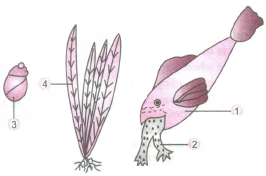
In the given picture what is the relationship between (1) and (2) with respect to population interaction and between (3) and (4) with respect to trophic levels?
11.
Why is the thermoregulation more effective achieved in larger animals than in smaller ones?
12.
A population of paramoecium caudatum was grown in a culture medium. After 5 days, the culture medium became over-crowed wth paramoecium and had depleted nutrients. What will happen to the population and what type of growth curve will the population attain? Draw the growth curve.
13.
How do organisms like fungi, zooplanktons and bears overcome the temporary, short-lived climatic stressful conditions? Explain.
14.
Comment on the following figure: I, II and III, A, B, C, D, G, P, Q, R, S are species.
15.
What is mutualism? Describe any four examples.
16.
Study the table given below in regard to population interactions and answer the questions that follow:
| Species A | Species B | Name of Interaction |
|---|---|---|
| (-) | (0) | (a) |
| (+) | (-) | (b) |
| (-) | (-) | (c) |
| (+) | (+) | (d) |
| (+) | (0) | (e) |
[Note : (+) plus = Beneficial interaction
(-) minus = Detrimental interaction
(0) zero = Neutral interaction ]
(a) Identify the interactions (a) to (e)
(b) Explain each one of them.
17.
Annual migration does not occur in case of
arctic tern
salmon
Siberian crane
salamander
18.
Small fish get struck near the bottom of a shark and derives its nutrition from it? This kind of association is called as
symbiosis
commensalism
predation
parasitism
19.
The term ecology was coined by
Odum
E. Munch
Tansley
Reiter
20.
Photosynthetically active radiation (PAR) represents the following range of wavelength
450-950 nm
340-450 nm
400-700 nm
500-600 nm
21.
Lichens are well known combination of an alga and a fungus where fungus has
an epiphytic relationship with the alga
a parasitic relationship with the alga
a symbiotic relationship with the alga
a saprophytic relationship with alga
1.
()
Tiger census in national parks and tiger reserves is carried out by counting the pug marks or faecal pellets.
2.
()
The herbs and shrubs growing in the forests are adapted to photosynthesise optimally under very low light conditions.
3.
()
Fish migrate and snails go into aestivation to avoid summer-related problems.
4.
()
Amensalism.
5.
| Diapause | Hibernation |
| It is a stage of suspended development shown by zooplanktons under unfavourable conditions in their habitat. | Hibernation is the phenomenon of escaping in time the stressful condition of the winter |
6.
The interaction is called commensalism.
The egrets always, forage close to where the cattle are grazing.
As they move, thJ cattle stir up and flush out from the vegetation the insects which otherwise might be difficult for the egrets to find and catch.
Thus, the egrets are benefitted while the cattle are neither benefitted nor harmed.
7.
Seals have thich layer of fat, called blubber below their skin.
The blubber acts as an insulator and reduces loss of body heat.
8.
Heat loss or heat gain is a function of surface area.
Since small animals (like humming birds) have a larger surface area relative to their volume, they tend to lose body heat very fast, when it is cold outside.
They spend more energy to generate body heat through metabolism; considering the cost and benefit of maintaining a constant internal temperature, small animals (humming birds) are not found in polar regions.
9.
Ways to adapt unfavourable conditions are:
(i) Snails undergo aestivation (summer sleep) to avoid summer related problems.
(ii) Bears undergo hibernation (winter sleep) during winter.
(iii) Zooplanktons enter a stage of suspended development called diapause.
(iv) Bacteria and fungi slow down their metabolic rate and from thick-walled spores germinate when the conditions become suitable.
10.
(i) Relationship between (1) and (2) is of predator-prey relationship.
(ii) Relationship between (3) and (4) is producer and (3) is primary consumer.
11.
Larger animals such as birds and mammals are able to maintain body temperature by physiological means.These have more volume and smaller surface area as compared to smaller animals.
12.
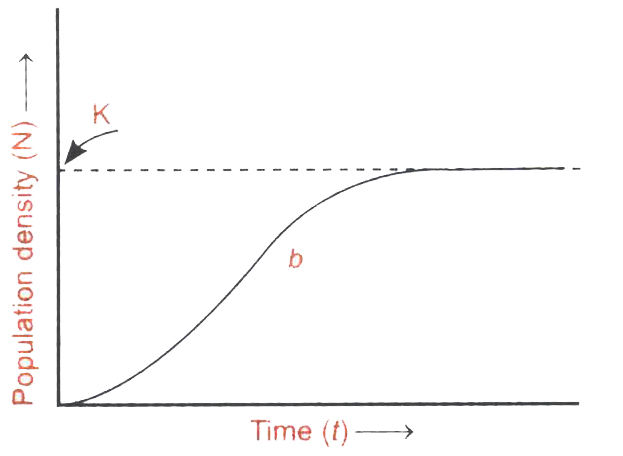
13.
Fungi produce various kinds of thick-walled spores to survive under unfavorable conditions; they germinate when conditions become favorable.
Zooplanktons enter diapause, a stage of suspended development, under unfavourable conditions.
Bears go into hibernation during winter to escape in time of unfavourable conditions.
14.
.png)
Figure I It is a single population and all individuals are of the same species, i.e., a individuals interact among themselves and their environment intraspecific interaction.
Figure II It is a community and it contains three populations of species A, Band C. They interact with each other and their environment and is called interspecific interaction.
Figure III It is a biome. It contains three communities of which one is in climax and other two are in' different stages of development. All three communities are in the same environment and they interact with each other and their environment.
15.
Mutualism:
Mutualism is defined as the interspecific interaction in which both the interacting species are benefitted, e.g.
(i) Lichens show an intimate mutualistic relationship between a fungus and an alga, where the fungus provides protection and helps the alga to absorb nutrients.
The alga prepares the food for the fungus too.
(ii) Mycorrhizae are mutualistic association between certain fungi and the roots of higher plants.
The fungus helps the plant by making the nutrients available in the vicinity of roots, and stores certain minerals like phosphorus in the mantle of hyphae
The fungus gets food and shelter from the plant.
(iii) Plants depend on insects for pollination; the insects are rewarded in the form of nectar or edible pollen or sometimes place for oviposition.
(iv) Rhizobium in the root nodules of legumes helps in nitrogen fixation and nitrogen nutrition to the plants and in turn gets shelter and food from the plant.
16.
(a) (+) and (+): Mutualism
It is defined as the interspecific interaction in which both the partners are benefitted, e.g. the fungus and algae in a lichen.
(b) (-) and (-): Competition
It is a type of interaction either among the individuals of the same species (intra-specific competition) or between the individuals of two different species (inter-specific competition).
(c) (+) and (-): Predation
It is an interspecific interaction, where one animal, called predator, consumes the other animal, called prey; one is benefitted and the other is harmed, e.g. the lion eating deer.
(d) (+) and (0): Commensalism
It is an interspecific interaction in which one of the species is benefitted and other is neither benefitted nor harmed, e.g. an orchid growing on a mango tree.
OR
(d) (-) and (0): Amensalism
It is an interspecific interaction in which one is harmed and the other is neither benefitted nor harmed, e.g. antibiotic secreted by a fungus kills many bacteria in the vicinity.
(b) (c) (+) and (-): Predation
It is an interspecific interaction, where one animal, called predator, consumes the other animal, called prey; one is benefitted and the other is harmed, e.g. the lion eating deer.
(c) (c) (+) and (-): Predation
It is an interspecific interaction, where one animal, called predator, consumes the other animal, called prey; one is benefitted and the other is harmed, e.g. the lion eating deer.
(d) (+) and (0): Commensalism
It is an interspecific interaction in which one of the species is benefitted and other is neither benefitted nor harmed, e.g. an orchid growing on a mango tree.
(e)(d) (+) and (0): Commensalism
It is an interspecific interaction in which one of the species is benefitted and other is neither benefitted nor harmed, e.g. an orchid growing on a mango tree.
17.
(d)
salamander
18.
(b)
commensalism
19.
(d)
Reiter
20.
(c)
400-700 nm
21.
(c)
a symbiotic relationship with the alga

12th Standard CBSE Syllabus & Materials
12th Standard CBSE
CBSE 12th Computer Science Python Revision Tour I - New Previous year Question Papers Study Material - QB365 Set A
NEW12th Standard CBSE
CBSE 12th Business Studies Planning Important Questions And Answers Study Material - QB365 Set A
NEW12th Standard CBSE
CBSE 12th Business Studies Business Environment Important Questions And Answers Study Material - QB365 Set A
NEW12th Standard CBSE
CBSE 12th Business Studies Principles of Management Important Questions And Answers Study Material - QB365 Set A



NCERT Books

Syllabus

Exam Pattern

Sample Question Papers

Previous year Question Papers

Important Notes

MCQ Practice test

NCERT Exemplers

Case study Questions

Image Based Questions

Passage based Questions

HOT Questions

Value Based Questions

Model Questions Papers
NCERT ( Book Back ) Questions

Assertion and Reason
Important Questions And Answers

CBSE 12th Standard CBSE Subjects
CBSE Standards