
 100% FREE ACCESS
12th Standard CBSE Syllabus & Materials
12th Standard CBSE
CBSE 12th Economics Government Budget and the Economy Previous year Question Papers Study Material - QB365 Set A
NEW12th Standard CBSE
CBSE 12th Computer Science Interface Python with MySQL - New Previous year Question Papers Study Material - QB365 Set A
NEW12th Standard CBSE
CBSE 12th Computer Science Database Concept - New Previous year Question Papers Study Material - QB365 Set A
NEW12th Standard CBSE
CBSE 12th Computer Science Data Communication - New Previous year Question Papers Study Material - QB365 Set A
NEW12th Standard CBSE
CBSE 12th Computer Science Data Structures - New Previous year Question Papers Study Material - QB365 Set A
NEW12th Standard CBSE
CBSE 12th Computer Science Functions - New Previous year Question Papers Study Material - QB365 Set A

Published on: 17/10/2025
Download CBSE Class 12th Standard CBSE Biology question papers, sample papers, important questions, and previous year solved papers in PDF format. Get free study materials, NCERT solutions, and exam preparation resources for Class 12th Standard CBSE Biology
Questions + Answers key
Take MCQ Biology Test
1.
Explain giving two reasons, how immune response by 'vaccine' is different from that by 'antitoxin' in humans.
2.
Some human diseases are transmitted only when the blood of a patient comes in contact with the blood of a healthy person. In one of such disease, there is a progressive decrease in the number of lymphocytes of the patient.
i) Name the disease & its causative agent
ii) Name the type of lymphocytes affected due to this infection.
3.
Explain structure of Insulin. How insulin is synthesised in human (or mammals)? Why is proinsulin so called? How is insulin different from it?
4.
How do organisms which cannot migrate tend to overcome adverse environmental conditions? Explain taking one example each from vertebrates and angiosperms, respectively.
5.
When and where did Australopithecus live? Mention their characteristics.
6.
Explain the effects of alcohol on the
(i) kidney
(ii) brain
(iii) heart
(iv) liver
(v)immunity
7.
Fitness is the end result of the ability to adapt and get selected by Nature. Explain with suitable example.
8.
After consuming sugarcane juice from a roadside vendor, Monu suffered from cough. His mother advised him to cover his nose while coughting and sneezing.
Read the above passage and answer the following questions:
(i) Why did Monu fall ill?
(ii) Why did his mother advise him to cover his nose while coughting and snazing?
9.
What is natural selection in modern terms? Elucidate the three different effects of natural selection on variation.
10.
(a) Why is Bacillus thuringiensis considered suitable for developing GM plant?
(b) Explain how it has been used to develop Gm crops.
11.
(a) Name the nematode that infects and damages tobacco roots.
(b) How are transgenic tobacco plants produced to solve this problem?
12.
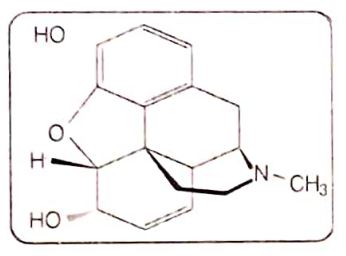
ldentify the compound chemical structure as shown below. State any three of its physical properties.
13.
(i) Write the complete name of the diagnostic test for AIDS. Explain the principle it works on.
(ii) Name the type of genetic material present in AIDS causing pathogen.
14.
Mention the cause of ADA deficiency in humans. How has genetic engineering helped patients suffering from it?
15.
The scientists believe that evolution is geadual.But extinction part of evolutionary story are sudden,abrupt and group specific comment whether a natural disaster can be the cause for extinction of species.
16.
Plasmodium falciparum is the causative agent of the most severe form of malaria. It is distributed throughout the tropics. Explain why malaria is restricted to the tropics.
17.
Match the items given in column I with those given (one or more ) in column II.
| Column I | Column II |
| (i) Crustose lichen | (a) Commensalim |
| (ii) Interspecific interaction | (b) Mutualism |
| (iii) Rhizobium and Leguminous plants | (c) Pioneer community |
| (iv) Bombykol | (d) Parental care |
| (v) Intraspecific intreaction | (e) Sex attractant |
| (f) Amensalism | |
| (g) lithosere |
18.
If you discover a fossil of a bird with scales on the body and teeth in the beak, what would you conclude about its position in the animal kingdom?
19.
20.
21.
22.
The Ti plasmid used for producing transgenic plants is found in
Azotobacter
Rhizobium
Azospirillum
Agrobacterium
23.
This is not Darwinian concept
variations
struggle for existence
natural selection
survival of the fittest
24.
Which of the following is a living fossil?
Moss
Saccharomyces
Spirogyra
Cyas
25.
Which one of the following organisms reproduces sexually only once in its life time?
Banana plant
Mango
Tomato
Eucalyptus
26.
Antibodies are produced by
Leucocytes
Lymphocytes
Erythrocytes
None of these
27.
The bacterium bacillus thuringiensis is widely used in contemporary biology as
Insecticide
Agent for production of dairy products
Source of industrial enzyme
Indicator of water pollution
28.
Choose the wrong statement.
HIV virus has RNA as it genetic material
HIV virus replicates in TH lymphocytes
Antiretroviral drugs are only partially effective for AIDS treatment
HIV spreads be sexual contact or sharing needle with the infected person and not by mere touch or physical contact
The time-lag between the infection and appearance of AIDS symptoms may vary from few hours to a week.
29.
Which one of the following is the infective stage of Ascaris lumbricoides?
Unsegmented egg
Egg with first stage larva
Egg with second stage larva
Free third stage larva
30.
Which bacteria is used as biopesticide first on the commercial scale in the world?
Bacillus thuringiensis
E.coli
Pseudomonas aeruginosa
Agrobacterium tumefaciens
31.
Which of the following is not a component of innate immunity?
Antibodies
Interferons
Complement proteins
Phagocytes
32.
Read the following and answer any four questions from (i) to (v) given below :
Plants having foreign genes in their genome through genetic engineering are called transgenic plants. Genes can be incorporated either through a vector or through direct introduction of DNA. Bt cotton is a genetically modified organism which is pest resistant. It contain gene cry I Ac and cry II Ab of Bacillus thuringiensis. It is used to controllepidopterans, coleopterans and dipterans. Bt cotton can resist cotton bollworm and produce higher yields. Cry gene produces cry protein or Bt toxin. It is an endotoxin which remains as protoxin in plants and converted to active toxin after getting ingested by the insects. Alkaline pH of the insect gut solubilises the protein crystals, the activated toxin creates pores to the mid guts wall of the insects which cause them to death.
(i) Bt cotton crops are
| (a) fungal resistant | (b) insect resistant | (c) drought resistant | (d) all of these |
(ii) Cotton bollworms are killed by the protein encoded by the gene
| (a) cry I Ac | (b) cry I Ab | (c) cry II Ab | (d) both (a) and (c). |
(iii) Which of the following is not an advantage of GM crops?
| (a) GM plants enhance nutritional value of food. |
| (b) GM plants are more tolerant to abiotic stresses. |
| (c) GM plants have helped to reduce post harvest losses. |
| (d) GM plants can cause gene transfer to non-target plant species. |
(iv) Bacillus thuringiensis is a
| (a) air borne bacteria | (b) soil borne bacteria | (c) soil borne fungus | (d) food borne bacteria. |
(v) Assertion : Cotton bollworms are killed by ingesting the leaves of the transgenic plant.
Reason : Bt toxin binds with the midgut wall of the insect and make pores in them.
| (a) Both assertion and reason are true and reason is the correct explanation of assertion |
| (b) Both assertion and reason are true but reason is not the correct explanation of assertion. |
| (c) Assertion is true but reason is false |
| (d) Both assertion and reason are false. |
33.
Read the following and answer any four questions from (i) to (v) given below:
In a study to test a new vaccine against a viral disease, mouse model testing is done. In this process, mice are vaccinated and their blood samples were tested. Mice developed mild disease symptom. After few days those mice were again infected with the virus. This time they do not show any disease symptoms. Their blood samples were tested. Two graphs show antibody concentration for the first and second infection in mice blood.
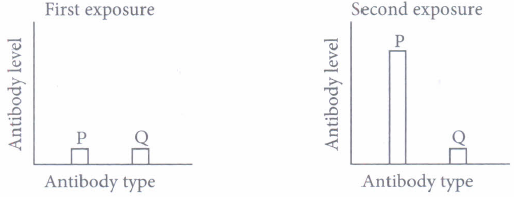
Based on the above information, answer the following questions.
(i) P and-Q in the given graphs indicate
| (a) IgM and IgG respectively | (b) IgG and IgM respectively | (c) IgG and IgE respectively | (d) IgM and IgA respectively |
(ii) Which form of pathogen is used in vaccination?
| (a) Activated and strong pathogenic antigens | (b) Inactivated and weakened pathogenic antigens | (c) Hyperactive and strong pathogen | (d) Preformed antibodies |
(iii) Which of the following is incorrect for P?
| (a) It is the most abundant class of Ig. | (b) It is found in blood, lymph and intestine. | (c) It is unable to cross the placental barrier | (d) It is a monomer. |
(iv) How does vaccination work?
| (a) The immune system produces antibodies which stay in the blood. |
| (b) Memory lymphocytes remain in the body to fight off any future infection with the same pathogen. |
| (c) The dead pathogen stays in the body and constantly stimulates the immune system |
| (d) All of these. |
(v) Assertion: Mice do not show any disease symptoms during second exposure to the pathogenic virus.
Reason: The antibody production is accelerated and more intense during secondary immune response.
| (a) Both assertion and reason are true and reason is the correct explanation of assertion. |
| (b) Both assertion and reason are true but reason is not the correct explanation of assertion. |
| (c) Assertion is true but reason is false. |
| (d) Both assertion and reason are false. |
34.
35.
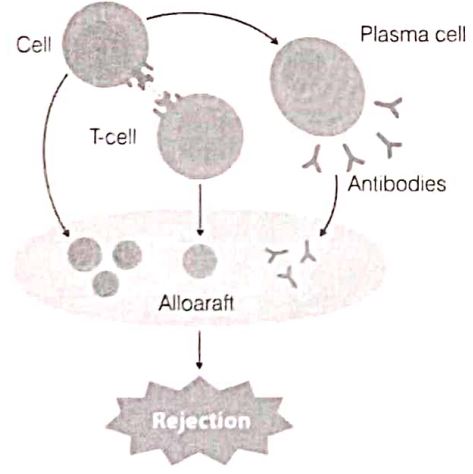
Given below is the schematic representation of transplant rejection. When a person receives an organ from someone else, his body may recognise this foreign organ and attacks them. Study the figure given below and comment upon the appropriateness of the Assertion and Reason.
Assertion (A) In organ transplantation, donor and recipient should be genetically as close as possible.
Reason (R) Cell-mediated immune response is responsible for such graft rejection.
(a) If both A and R are true and R is the correct explanation of A
(b) If both A and R are true, but R is not the correct explanation of A
(c) If A is true, but R is false
(d) If A is false, but R is true
36.
Assertion: Predation and parasitism are considered to be negative interactions.
Reason: Predators and parasites limit the population of their host species.
Codes:
(a) Both assertion and reason are true and reason is the correct explanation of assertion.
(b) Both assertion and reason are true but reason is not the correct explanation of assertion.
(c) Assertion is true but reason is false.
(d) Both assertion and reason are false.
1.
Immune response by vaccine is different frorn that by antitoxin in humans in two ways
(i) Vaccines give long term protection unlike antitoxins.
(ii) Vaccines can either destroy, kill or render a pathogen inactive, whereas antitoxins render a toxic substance harmless.
2.
i) AIDS caused by HIV
ii) T - lymphocytes
3.
(1) Insulin is made up of two short polypeptide chains; A and chain B which are linked together bydisulphide bridges. (2) It is synthesised in inactive form called proinsulin.
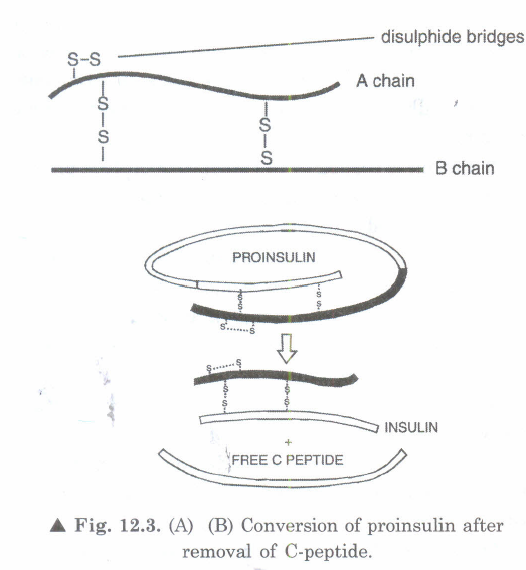
(2) Insulin is synthesised as pro-hormone called proinsulin (i.e. which is to be processed before becoming functional) contains an extra stretch called C-peptide which is usually removed during maturation of insulin.
4.
Vertebrates like bear undergo hibernation, to escape in time.
Angiosperms produce seeds and certain other vegetative structures to tide over unfavourable conditions in the habitat.
5.
Australopithecus lived in the East-African grassland.
1. They were probably not taller than four feet.
2. They walked upright.
3. They hunted with stone weapons and essentially ate fruits.
6.
(i) Effect on kidney It reduces ADH secretion, which results in rapid dehydration.
(ii) Effect on brain Reduced self control, judgement, loss of muscle coordination, in coherent speech, etc.
(iii) Effect on heart Increased blood pressure which affects the activity of heart.
(iv) Effect on liver Alcohol consumption cause liver, cirrhosis.
(v) Effect on immunity Alcoholism decreases the resistance to infection.
7.
1. Industrial Melanism : Before industrialisation started in England it was observed, there were more white -winged peppered moth, on trees than dark winged moth, but after industrialisation, there were more dark - winged moths in the same area,
2. predators spot a moth against a contrasting background, post industrialisation the tree trunks became dark due to industrial smoke and soot, Under this condition the white- winged moth did not survive, due to predators, but the dark-winged moth managed to survive. II or any other example explained under the following heads in the text book - fitness, selection and adaptation.
8.
(i) He consumed uncovered food products and drinks which got contaminated by pathogenic microbes.
(ii) This practice helps in preventing spread of infectious diseases.
9.
Natural Selection: In modern term natural selection is differential reproduction. Natural selection is main evolutionary process which causes the change of allele frequencies or in other words selection is the consistent differences in contribution of various genotypes to the next generation.
In in a population both small and largest individuals contribute relatively fewer offspring to the next generation then those closer to the averages do, stabilizing selection is operating.
If centre of population contributes more then equilibrium is maintained while if extremes of population work then two peaks in the distribution of a trait produced, while former is disruptive selection.
10.
Bacillus thuringiens· :
(a) This bacterium produces a protein, which is toxic to he larvae of insects like bollworm, budworm, flies, bettles,etc.
Bt-toxin gene has been cloned from the bacteria and been expressed in plants to provide resistance to insects without the need for chemical insecticides.
(b) The gene (cry) coding for the protein has been isolated using restriction enzymes.
They are cloned in the vectors and then introduced into a number of crop plants like cotton, tomato, corn, rice, etc.
There are a number of different forms of the gene, that code for insect-specific Cry proteins, e.g., crylAc and cryllAb control cotton bollworm.
crylAb controls corn borer.
The transgenic plants (called as Bt corn, Bt rice, Bt cotton, etc.) produce the protein in their cells and express the insect/pest resistance.
11.
Nematode-resistant tobacco plants are produced through RNA interference. The process RNA interference (RNAi) involves silencing of a specific mRNA.
A complementary double-stranded RNA binds to the mRNA and prevents its translation.
The complementary! RNA for making the double stranded RNA comes either from an infection by RNA viruses or mobile genetic elements, called transposons, which replicate through an RNA-intermediate.
The nematode-specific genes were introduced into the host plant by the use. of Agrobacterium vectors.
The introduction of DNA is such that it produced both sense and anti-sense RNA in the host cells.
These two RNAs are complementary to each other and hence form a double-strandedd RNA, which initiates the RNA interference and silencing of mRNA.
The parasite could not live in such a transgenic host that expresses the specific interfering double-stranded RNA; so, the transgenic plant is protected from the nematode.
12.
The chemical compound given is morphine. It is an effective sedative, analgesic and painkiller.
Morphine is obtained from latex of poppy plant. It is crystalline white in appearance and is odourless.
13.
(i) There are several methods for the diagnosis of HIV infection like Enzyme Linked Immuno Sorbent Assay (ELISA), PCR test, Western blotting, etc. Out of these, ELISA and Western blotting are widely used. ELISA is based on the principle of antigen-antibody interaction Infection by pathogen can be detected by the presence of antigens like proteins and glycoproteins or by detecting the antibodies produced against the pathogen
(ii) Genetic material present in AIDS causing pathogen is RNA.
14.
Deletion/mutation of the gene which forms the enzyme - adenosine deaminase.
1.Lymphocytes from the blood of the patient, can be grown in a culture outside the body, ADA cDNA gene can be inserted into the lymphocyte using retroviral vector, then lymphocytes can be returned to the patient. (They can start producing ADA).
15.
Yes,a natural disaster can be cause for extinction of species.As new species evolved to fit ever changing ecological niches,older species fade away.
But,the rate of extinction is far constant.In last 500 million years,50-90% or more of all species on earth have disappeared in a geological blinks.the most studied mass extinction between the cretaceous and palaeocene peroid about 65 million years the cause is suspected to be volcanic eruptions and impacts of large asteroids or comets striking the earth.
16.
Malaria is transmitted by anopheles mosquito, which is insect vector for the Plasmodium falciparum parasite.
This parasite needs warm conditions with temperatures above to 20°C complete its life cycle in the mosquito. Therefore, mosquitoes breed in warm conditions of tropics and in area of stagnant water.
17.
(i) c, h
(ii) a, f
(iii) b
(vi) e
(v) d
18.
The animal is a connecting link between reptiles and birds. The presence of scales and teeth in the beak are reptilian characters, whereas the beak itself is an avian character.
19.
(d)
20.
(d)
21.
(c)
22.
(d)
Agrobacterium
23.
(d)
survival of the fittest
24.
(d)
Cyas
25.
(d)
Eucalyptus
26.
(b)
Lymphocytes
27.
(a)
Insecticide
28.
(e)
The time-lag between the infection and appearance of AIDS symptoms may vary from few hours to a week.
29.
(c)
Egg with second stage larva
30.
(a)
Bacillus thuringiensis
31.
(a)
Antibodies
32.
(i) (b) : The genetically modified crop called Btcotton contains Bt toxin genes. The gene cry 1 Ac and cry II Ab control cotton bollworms. Similarly, cry I Ab has been introduced in Bt corn to protect the same from corn borer.
(ii) (d) : cry I Ab has been introduced to Bt corn to protect them from corn borer. cry I Ac and cry II Ab control cotton bollworms.
(iii) (d) : Gene transfer to non-target plant species is a major disadvantageous concern of GM plants. It can even cause to produce 'superweeds'
(iv) (b)
(v) (a): The Bt toxin proteins exist as inactive protoxins but once an insect ingests the inactive toxin it is converted into an active form of toxin due to the alkaline pH of the alimentary canal that solublises the crystals. The activated toxin binds to the surface of midgut epithelial cells and create pores which cause cell swelling and lysis and finally cause death of the insect.
33.
(i) (b): Initial contact with an antigen causes primary immune response. In primary immune response, no antibodies are present initially. Then, a slow rise in the antibody titer occurs, first IgM and then IgG, followed by a gradual decline in antibody titer. In secondary immune response, the antibody formation is accelerated and more intense. This is also called booster response. It mainly consists of IgG antibodies.
(ii) (b) : Vaccine is a preparation or extract of an inactivated/attenuated (weakened) pathogen of a disease which on inoculation into a healthy person provides immunity by inducing antibodies production.
(iii) (c) : IgG is the only class of antibody to cross the placenta from mother to foetus.
(iv) (d)
(v) (a)
34.
35.
(b) If both A and R are true, but R is not the correct explanation of A
36.
(a): Predation and parasitism are considered to be negative interactions, because in both of these interactions one species gains and the other suffers. Predation is the interaction between species involving killing and consumption of prey. The species which eats the other is called the predator, and the one consumed by other is termed as prey. Predation is commonly illustrated by the herbivore-carnivore interaction.
Parasitism is the interaction in which the species smaller in size (the parasite) lives in or on the larger species (the host) from which it obtains food and shelter. Parasites like leeches, tick, lice, mites feed on the body fluids of the hosts. Parasites, like the predators limit the population of the host species. Parasites are generally host- specific, and do not have choice or alternatives like predators. Parasites are smaller in size and have higher biotic/reproductive potential compared to the predators. Parasites have poor means of dispersal and require specialised structures to reach or invade the host. Predators, on the other hand, are quite mobile and capable of capturing the prey.

12th Standard CBSE Syllabus & Materials
12th Standard CBSE
CBSE 12th Computer Science Python Revision Tour I - New Previous year Question Papers Study Material - QB365 Set A
NEW12th Standard CBSE
CBSE 12th Business Studies Planning Important Questions And Answers Study Material - QB365 Set A
NEW12th Standard CBSE
CBSE 12th Business Studies Business Environment Important Questions And Answers Study Material - QB365 Set A
NEW12th Standard CBSE
CBSE 12th Business Studies Principles of Management Important Questions And Answers Study Material - QB365 Set A



NCERT Books

Syllabus

Exam Pattern

Sample Question Papers

Previous year Question Papers

Important Notes

MCQ Practice test

NCERT Exemplers

Case study Questions

Image Based Questions

Passage based Questions

HOT Questions

Value Based Questions

Model Questions Papers
NCERT ( Book Back ) Questions

Assertion and Reason
Important Questions And Answers

CBSE 12th Standard CBSE Subjects
CBSE Standards