 100% FREE ACCESS
12th Standard CBSE Syllabus & Materials
12th Standard CBSE
CBSE 12th Economics Government Budget and the Economy Previous year Question Papers Study Material - QB365 Set A
NEW12th Standard CBSE
CBSE 12th Computer Science Interface Python with MySQL - New Previous year Question Papers Study Material - QB365 Set A
NEW12th Standard CBSE
CBSE 12th Computer Science Database Concept - New Previous year Question Papers Study Material - QB365 Set A
NEW12th Standard CBSE
CBSE 12th Computer Science Data Communication - New Previous year Question Papers Study Material - QB365 Set A
NEW12th Standard CBSE
CBSE 12th Computer Science Data Structures - New Previous year Question Papers Study Material - QB365 Set A
NEW12th Standard CBSE
CBSE 12th Computer Science Functions - New Previous year Question Papers Study Material - QB365 Set A

Published on: 17/10/2025
Download CBSE Class 12th Standard CBSE Biology question papers, sample papers, important questions, and previous year solved papers in PDF format. Get free study materials, NCERT solutions, and exam preparation resources for Class 12th Standard CBSE Biology
Questions + Answers key
Take MCQ Biology Test
1.
(i) List any four major goals of human genome project
(ii) Write any four ways the knowledge from HGP is of significance for humans.
(iii) Expand BAC and mention its importance.
2.
(i) 'EcoRI' has played very significant role in rDNA technology.
(a) Explain the convention for naming EcoRI.
(b) Write the recognition site and the cleavage sites of this restriction endonuclease. (ii) What are the protruding and hanging stretches of DNA produced by these restriction enzymes called ? Describe their role on formation of rDNA.
3.
Observe the representation of genes involved in the lac operon given below.
| p | i | p | Ⓞ | z | y | a |
(i) Identify the region where the repressor protein will attach normally.
(ii) Under certain conditions repressor is unable to attach at this site. Explain.
(iii) If repressor fails to attach to the said site what products will be formed by z, y and a?
(iv) Analyse why this kind of regulation is called negative regulation.
4.
(a) Name the hormone that initiates spermatogenesis in humans. Describe the process of spermatogenesis in sequence mentioning the ploidy of the cells at each step.
(b) Draw the diagram of a mature human sperm and label the parts that
(i) helps it reaching to the ovum.
(ii) providing energy for it to reach the ovum.
(iii) helping it to gain entry into the ovum.
5.
(a) Explain the menstrual phase in a human female. State the levels of ovarian and pituitary hormones during this phase.
(b) Why is follicular phase in the menstrual cycle also referred as proliferative phase? Explain.
(c) Explain the events that occur in a graafian follicle at the time of ovulation and thereafter.
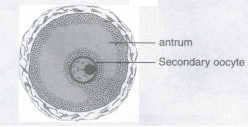
(d) Draw a graafian follicle and label antrum and secondary oocyte.
6.
Arun visited his grandfather's farm and noticed that one of the workers was introducing earthworms in the soil. He quickly rushed to his grandfather and asked him the reason. His grandfather explained him the advantages of earthworm in soil improvement.
(i) Why are earthworms also known as detritivores?
(ii) Explain fragmentation.
(iii) Name the steps in the process ofdecomposition.
(iv) What values are shown by Arun?
7.
(a)Mention the role of vectors in recombinant DNA technology. Give any two examples.
(b)With the help of diagrammatic representation only, Show the steps of recombinant DNA technology.
8.
(a) Explain primary productivity and the factors that influence it.
(b) Describe how do oxygen and chemical composition of detritus control decomposition.
9.
How is detritus decomposed step-by-step by different agents and made available as nutrients to the plants?Explain.
10.
(i)What are the three types of RNA?
(ii)Which one of these has the shape of a clover leaf in two-dimentional structure?
(iii)How is each RNA related in the information during protein synthesis?Explain.
11.
(a) Draw a diagrammatic sectional view of a mature anatropous ovule and label the following parts in it.
(i) that develops into seed coat.
(ii) that develops into embryo after fertilisation.
(iii) that develop into endosperm in an albuminous seed.
(iv) through which the pollen tube gains entry into the embryo sac.
(v) that attaches the ovule to placenta.
(b) Describe the characteristic features of wind-pollinated flowers.
12.
(a) Differentiate between: Autogamy, geitonogamy and xenogamy.
(b) Explain the events that occur during pollen-pistil interaction.
1.
a) Some of the important purposes of the Human Genome Project were as follows:
Identify all the approximately 20000-25000 genes In human DNA,
Determine the sequences of the 3 billion chemical base pairs that make up human DNA,
Stole this Information in databases,
Improve tools for data analysis,
Address the ethical legal and social issues (ELSI) that may arise from the project
b) Four ways the knowledge from HGP is of significance for humans are:
agricultural production
environmental remediation
prevents disorders
diagnosed disorder
c) BAC- bacterial artificial chromosomes
It is used for the cloning of DNA fragments.
2.
(a) EcoRI comes from Escherichia coli RYB strain. In EcoRI, 'E' comes from the genus 'Escherichia' and 'co' comes from the species name 'coli'. The genus and species names should be in italics. The letter 'R' is derived from the name of the strain RYB. Roman numbers following the names indicate the order in which the enzymes were isolated from that strain of bacteria.
(b) EcoRI a type II restriction enzyme that cuts only at the restriction site with the 5'-GAATTC-3' sequence. It chops the DNA at a specified location, resulting in sticky ends.
EcoRI has a palindrome recognition site that cuts DNA following G, creating sticky ends with GAATTC. It is a six-nucleotide sequence with GAATTC in the 5' to 3' direction and CTTAAG in the 3' lo 5' direction on the complementary strand.
(ii) The protruding and hanging stretches of DNA produced by these restriction enzymes are called sticky ends. They are important in the formation of rDNA because they form hydrogen bonds with their complimentary cut counter parts. This stickiness of the ends facilitates the action of the enzyme DNA ligase.
3.
(i) Repressor will attach at the operator (o) region.
(ii) If an inducer (like lactose) binds to the repressor and inactivates it, it cannot bind to the operator.
(iii) If repressor is not bound to the operator, the operon is 'on' and transcription occurs.
(iv) It is called negative regulation as it involves constitutive (all the time) repressor. The operon is always in off position due to presence of repressor and is switched on only in presence of an inducer. Inducer Lactose or allolactose interacts with repressor making it inactive.
4.
(a) Gonadotropin releasing hormone / GnRH.
Process of spermatogenesis :
Correct diagram:
(i) Tail
(ii) Middle piece/mitochondria
(iii) Acrosome
5.
(a) Menstrual phase occurs when released ovum not fertilised, break down of endometrial lining (of the uterus) and its blood vessel form the liquid that comes out through the vagina, lasts for 3 to 5 days.
(b) Primary follicle grows into graafian follicle under the influence of LH & FSH , regeneration of endometrium (under the influence of estrogen).
(c) Graafian follicle ruptures to release the ovum (secondary oocyte) r remaining parts of the Graafian follicle transform into corpus luteum.
(d)
6.
(i) Earthworms are known as detritivores as they breakdown detritus(dead remains of plants and animals) into smaller particles. Earthworms are often called farmer's friend.
(ii) Fragmentation is the first step in the process of decomposition. It is the process by which detritivores (e.g. earthworm) breakdown detritus in smaller particles.
(iii) The steps involved in decomposition are fragmentation, leaching, catabolism, humification and mineralisation.
(iv) Arun is very alert, curious and had scientific attitude.
7.
(a) Role of Vectors
Ethidium bromide
The vectors have the ability to replicate within the bacterial cells independent of the control of chromosomal DNA.
If an alien piece of DNA is linked to the vector, it can be made to multiply its number equal to the copy number of the vector.
Vectors are also used in the selection of recombinants from non-recombinants.
e.g., plasmids and bacteriophages are the most commonly used vectors.
8.
(a) Primary productivity refers to the amount of biomass or organic matter produced per unit area over a time period by plants by photosynthesis.
1. It is expressed in terms of weight (g-2) or energy (kcal m-2).
2. It can be considered in terms of gross primary productivity (GPP) or net primary productivity (NPP).
3. Gross primary productivity is the rate of production of biomass/organic matter by producers during photosynthesis.
4. Net primary productivity refers to the biomass/organic matter available at the producer level to the primary consumers,i.e. GPP -Respiratory losses.
Factors affecting primary productivity include:
(i) The availability of nutrients.
(ii) Water availability.
(iii) Temperature of the given place.
(iv) The type of plant species.
(v) The photosynthetic capacity of plants.
(b) (i) Chemical composition of detritus:
(ii) Decomposition is faster when detritus is rich in nitrogen and water-soluble substance like sugars.
(iii) Decomposition is an oxygen-consuming process.
(ii) Oxygen
1. Decomposition is an oxygen-consuming process.
2. Anaerobic conditions inhibit decomposition.
9.
Process of decomposition
(i) Fragmentation:
It is the process of breaking of the detritus into smaller particles by detritivores like earthworm.
(ii)Leaching:
It is the process in which water-soluble inorganic substances run down into soil horizon and get precipitated as unavailable salts.
(iii) Catabolism:
The enzymatic conversion of the detritus into simple organic compounds and then into inorganic compounds, is called catabolism.
The enzymes are secreted by the decomposers like bacteria and fungi.
(iv) Humification:
Humification during decomposition leads to the accumulation of a dark coloured, amorphous substance, called humus.
(v) Mineralisation:
It is the process in which the humus is degraded by certain microbes and the inorganic nutrients are released.
10.
(i) The three types of RNA are
(a) Messenger RNA (mRNA)
(b) Transfer RNA (tRNA)
(c) Ribosomal RNA (rRNA)
(ii) Transfer RNA has the shape of clover leaf in two dimensional structure.
(iii) Functions of RNAs
(a) Messenger RNA (mRNA)
It brings the genetic information of DNA transcribed on it, to ribosomes for protein synthesis.
It decides the sequence of amino acids in a polypeptide chain.
(b) Transfer RNA (tRNA)
It acts as an adapter molecule, that reads the code on mRNA on one hand and binds to a specific amino acid on the other hand.
By its anticodon, it recognises the codon and, leaves the amino acid coded by the mRNA at the site of protein synthesis.
(c) Ribosomal RNA (rRNA)
It forms the structure of ribosomes.
It also plays a catalytic role in the formation of peptide bond; 23S rRNA is ribozyme.
11.
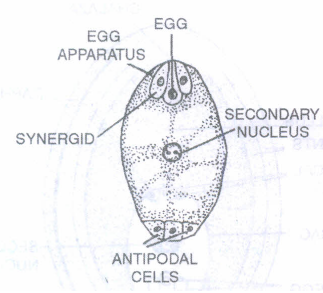
(i) part that develops into seed coat integuments
(ii) part that develops into an embryo after fertilization-egg
(iii) that develops into endosperm in a albuminous seed-polar nuclei
(iv) through which pollen tube enters into embryo sac-micropyle
(v) that attaches the ovule to the placenta funiculus.
12.
(a) Differences:
| Autogamy | Getonogamy | Xenogamy |
| It refers to the transfer of pollen grains from the anther of a flower to the stigma of the same flower | It refers to the transfer of pollen grains from the anther of a flower to the stigma of same plant. | It refers to the transfer of pollen grains from the anther of a flower to the stigma of another flower on a different plant of the same species. |
| It does not lead to genetic variation in the progency | It does not lead to genetic variation in the progeny. | It leads to genetic variation in the progeny |
| No pollinating agent is needed. | A pollinating agent is needed. | A pollinating agent is needed. |
(b) Pollen-Pistil Interaction.
The stigma/pistil has the ability to recognise the right type of pollen, i.e. the compatible pollen of the same species and rejects the wrong type of pollen grains.
It is the result of interaction between the chemical components of the pollen and those of stigma. - A compatible pollen grain starts its germination on the stigma.
The intine grows out through one of the germ pores as a protuberance.
The contents of the pollen move into this tube, i.e. the tube nucleus (nucleus of the vegetative cell) and the generative cell (or the two male gametes in those species where pollen is liberated in the three-celled stage).
The pollen tube grows through the tissues of stigma and style and enters the ovule through micropyle.
It enters the embryo sac through the filiform apparatus of one of the synergids to liberate the male gametes.
The events from the deposition of pollen on the stigma till the pollen tube enters the ovule, are collectively referred to as pollen-pistil interaction.

12th Standard CBSE Syllabus & Materials
12th Standard CBSE
CBSE 12th Computer Science Python Revision Tour I - New Previous year Question Papers Study Material - QB365 Set A
NEW12th Standard CBSE
CBSE 12th Business Studies Planning Important Questions And Answers Study Material - QB365 Set A
NEW12th Standard CBSE
CBSE 12th Business Studies Business Environment Important Questions And Answers Study Material - QB365 Set A
NEW12th Standard CBSE
CBSE 12th Business Studies Principles of Management Important Questions And Answers Study Material - QB365 Set A



NCERT Books

Syllabus

Exam Pattern

Sample Question Papers

Previous year Question Papers

Important Notes

MCQ Practice test

NCERT Exemplers

Case study Questions

Image Based Questions

Passage based Questions

HOT Questions

Value Based Questions

Model Questions Papers
NCERT ( Book Back ) Questions

Assertion and Reason
Important Questions And Answers

CBSE 12th Standard CBSE Subjects
CBSE Standards