
 100% FREE ACCESS
12th Standard CBSE Syllabus & Materials
12th Standard CBSE
CBSE 12th Economics Government Budget and the Economy Previous year Question Papers Study Material - QB365 Set A
NEW12th Standard CBSE
CBSE 12th Computer Science Interface Python with MySQL - New Previous year Question Papers Study Material - QB365 Set A
NEW12th Standard CBSE
CBSE 12th Computer Science Database Concept - New Previous year Question Papers Study Material - QB365 Set A
NEW12th Standard CBSE
CBSE 12th Computer Science Data Communication - New Previous year Question Papers Study Material - QB365 Set A
NEW12th Standard CBSE
CBSE 12th Computer Science Data Structures - New Previous year Question Papers Study Material - QB365 Set A
NEW12th Standard CBSE
CBSE 12th Computer Science Functions - New Previous year Question Papers Study Material - QB365 Set A
Published on: 25/10/2025
Download CBSE Class 12th Standard CBSE Chemistry question papers, sample papers, important questions, and previous year solved papers in PDF format. Get free study materials, NCERT solutions, and exam preparation resources for Class 12th Standard CBSE Chemistry
Questions + Answers key
Take MCQ Chemistry Test
1.
Arrange the following compounds in increasing order of their boiling points.
CH3CHO, CH3CH2OH, CH3OCH3, CH3CH2CH3
2.
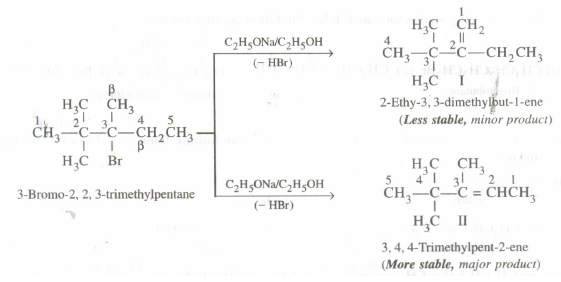
Predict all the alkenes that would be formed by dehydrohalogenation of the following halides with sodium ethoxide in ethanol and identify the major alkene.
(i) 1-Bromo-1-methylcyclohexane
(ii) 2-chloro-2-methylbutane
(iii) 3-Bromo-2, 2,3-trimethylpentane.
3.
While separating a mixture of ortho-and para-nitrophenols by steam distillation, name the isomer which will be steam volatile? Give reasons.
4.
The molar conductivity of 1.5 M solution of an electrolyte is found to be 138.9 S cm2 mol-1 . Calculete the conductivity of this solution.
5.
A solution of glucose (C6 H12 O6) in water is labelled as 10% by weight. What would be the molality of the solution? [Molar mass of glucose = 180 g mol-1]
6.
An organic compound (A) on treatment with ethyl alcohol gives a carboxylic acid (B) and compound (C). Hydrolysis of (C) under acidified conditions gives (B) and (D). Oxidation of (D) with KMnO4 also gives (B). (B) on heating with Ca(OH)2 gives (E) having moleuclar formula C3H6O. (E) does not give TOllens'test and does not reduce Fehiling's solution but forms 2, 4-dinitrophenyhydrazone. Identify (A),(B),(C),(D) and (E).
7.
What happens when
(i) n-butyl chloride is treated with alcoholic KOH.
(ii) bromobenzene is treated with Mg in the presence o dry ether.
(iii) Chlorobenzene is subjected to hydrolysis.
(iv) methyl bromide is treated with sodium in presence of dry ether.
(v) methyl chloride is treated with KCN?
8.
How much electricity in terms of Faraday is required to produce
(i) 20.0 g of Ca from molten CaCl2?
(ii) 50.0 g of Al from molten Al2O3?
9.
100 g of liquid A (molar mass 140 g mol -1) was dissolved in 1000 g of liquid B (molar mass 180 g mol-1). The vapour pressure of pure liquid B was found to be 500 torr. Calculate the vapour pressure of pure liquid A and its vapour pressure in the solution if the total vapour pressure of the solution is 475 torr.
10.
Why is sulphuric acid not used during the reaction of alcohols with KI?
11.
Explain the following with an example.
(i) Kolbes reaction.
(ii) Reimer-Tiemann reaction.
(iii) Williamson ether synthesis.
(iv) Unsymmetrical ether.
12.
18 g of glucose, C6H12O6, is dissolved in 1 kg of water in a saucepan. At what temperature will water boil at 1.013 bar? Kb for water is 0.52 K kg mol-1.
13.
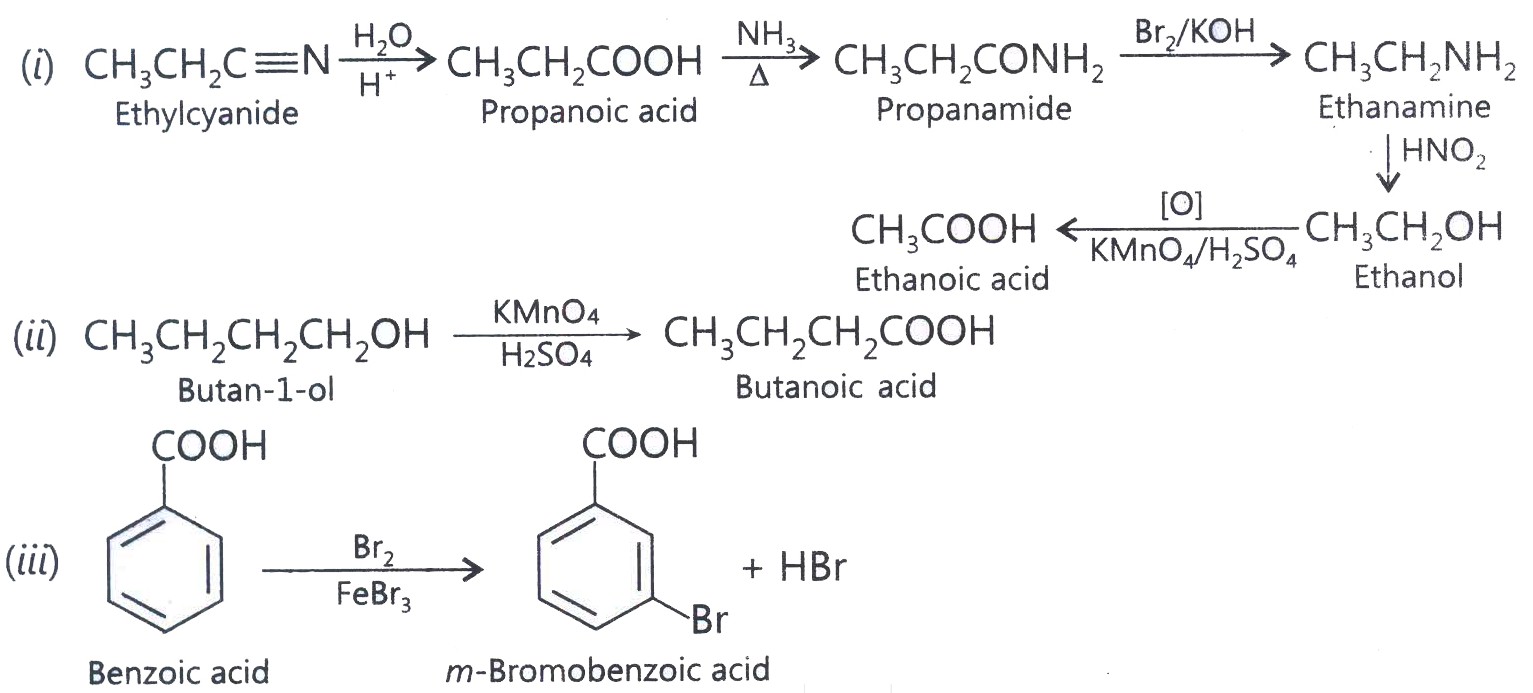
How are the following conversions carried out?
(i) Ethylcyanide to ethanoic acid
(ii) Butan-1-ol to butanoic acid
(iii) Benzoic acid to m-bromobenzoic acid.
14.
The molar conductivity of 0.025 mol L-1 methanoic acid is 46.1 S cm2 mol-1. Calculate its degree of dissociation and dissociation constant. Given \({ \lambda }^{ o }{ (H }^{ + })=349.6 \ S{ cm }^{ 2 }{ mol }^{ -1 }\) and \({ \lambda }^{ o }{ (H }COO^{ - })=54.6 \ S{ cm }^{ 2 }{ mol }^{ -1 }\).
15.
Phenol on being heated witlh concentrated H2SO4 and then with concentrated HNO3 gives
o -nitrophenol
2, 4, 6-trinitrophenol
p-nitrophenol
m-nitrophenol
16.
What would be the reactant and reagent used to obtain 2, 4-dimethyl pentan-3-ol?
Propanal and propyl magneslum bromide
3-methylbutanal and 2-methyl magnesium iodide
2-dimethylpropanone and methyl magnesium iodide
2-methylpropanal and iso-propyl magnesium iodide
17.
3-methyl pent-2-ene on reaction with HBr in presence of peroxide forms an addition product. The number of possible stereoisomers for the product are
6
0
2
4
18.
What will be the weight of silver deposited, if 96.5 A of current is passed into aqueous solution of AgNO3 for 100 s?
1.08g
10.8g
108g
1080g
19.
How many stereoisomers does this molecule have ? CH3CH = CHCH2CHB2CHBrCH3
8
2
4
6
20.
In a reaction, RCHO is reduced to RCH3 using amalgamated zinc and concentrated HCl and warming the solution. The reaction is known as
Meerwein-Ponndorf reaction
Clemmensen reduction
Wolff-Kishner reduction
Schiff's reaction
21.
The increasing order of the rate of HCN addition to compounds, A ----------- D is
A. HCHO B. CH3COCH3 C. PhCOCH3 D. PhCOPh
A < B < C < D
D < B < C < A
D < C < B < A
C < D < B < A
22.
Which of the following compounds can be classified as aryl halides?
p-ClC6H4CH2CH(CH3)2
p-CH3CHCl(C6H4)CH2CH3
o-BrH2C-C6H4CH(CH3)CH2CH3
C6H5-Cl
23.
A solution containing 1.8 g of a compound (empirical formula CH2O) in 40 g of water is observed to freeze at -0.465oC. The molecular formula of the compound is (Kf of water = 1.86 kg K mol-1)
C2H4O2
C3H6
C4H8O4
C5H10O5
C6H12O6
24.
Using the data given below find out the strongest reducing agent.
\({ E }_{ { Cr }_{ 2 }{ O }_{ 7 }^{ 2- }/{ Cr }^{ 3+ } }^{ \circleddash }=1.33V\ ,\ { E }_{ { Cl }_{ 2 }/{ Cl }^{ - } }^{ \circleddash }=1.36V\)
\({ E }_{ { MnO }_{ 4 }^{ - }/{ Mn }^{ 2+ } }^{ \circleddash }=1.51V\ ,\ { E }_{ { Cr }^{ 3+ }/{ Cr } }^{ \circleddash }=-0.74V\)
Cl-
Cr
Cr3+
Mn2+
25.
The main factor (s) which affect corrosion is /are
position of metal in electrochemical series
presence of CO2 in water
presence of impurities in metal
presence of protective coating
26.
In comparison to a 0.01 M solution of glucose, the depression in freezing point of a 0.01 M MgCI2 solution is _____________________.
the same
about twice
about three times
about six times
27.
Assertion (A) : Aquatic species are more comfortable in cold water rather than in warm water.
Reason (R) : Different gases have different KH values at the same temperature.
(a) Both (A) and (R) are correct, (R) is the correct explanation of (A).
(b) Both (A) and (R) are correct, (R) is not the correct explanation of (A).
(c) (A) is correct; (R) is incorrect.
(d) (A) is incorrect; (R) is correct
28.
Assertion: Presence of acids and bases activates carbonyl compounds for reaction.
Reason: Carbonyl compounds possess positive and negative centres and provide a seat for electrophilic and nucleophilic attack.
Codes:
(a) Assertion and reason both are correct statements and reason is correct explanation for assertion.
(b) Assertion and reason both are correct statements but reason is not correct explanation for assertion.
(c) Assertion is correct statement but reason is wrong statement.
(d) Assertion is wrong statement but reason is correct statement.
29.
Assertion: The ease of dehydration of alcohols follows the order: Primary> Secondary> Tertiary.
Reason: Dehydration proceeds through the formation of carbocations.
Codes:
(a) Assertion and reason both are correct statements and reason is correct explanation for assertion.
(b) Assertion and reason both are correct statements but reason is not correct explanation for assertion.
(c) Assertion is correct statement but reason is wrong statement.
(d) Assertion is wrong statement but reason is correct statement.
30.
Assertion: p- Dichlorobenzene has higher melting point than o-dichlorobenzene.
Reason: Stronger the van der Waals forces of attraction, higher is the melting point.
Codes:
(a) Assertion and reason both are correct statements and reason is correct explanation for assertion.
(b) Assertion and reason both are correct statements but reason is not correct explanation for assertion.
(c) Assertion is correct statement but reason is wrong statement.
(d) Assertion is wrong statement but reason is correct statement.
31.
Assertion : The electrical resistance of any object decreases with increase in its length.
Reason : The electrical resistance of any object decreases with increase in its area of cross-section.
Codes :
(a) Assertion and reason both are correct statements and reason is correct explanation for assertion.
(b) Assertion and reason both are correct statements but reason is not correct explanation for assertion.
(c) Assertion is correct statement but reason is wrong statement.
(d) Assertion is wrong statement but reason is correct statement.
32.
Read the passage given below and answer the following questions:
The addition reaction of enol or enolate to the carbonyl functional group of aldehyde or ketone is known as aldol addition. The \(\beta\)-hydroxyaldehyde or \(\beta\)-hydroxyketone so obtained undergo dehydration in second step to produce a conjugated enone. The first part of reaction is an addition reaction and the second part is an elimination reaction. Carbonyl compound having \(\alpha\)-hydrogen undergoes aldol condensation reaction.
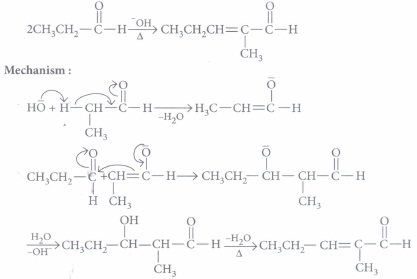
The following questions are multiple choice questions. Choose the most appropriate answer:
(i) Condensation reaction is the reverse of which of the following reaction?
| (a) Lock and key hypothesis | (b) Oxidation |
| (c) Hydrolysis | (d) Glycogen formation |
(ii) Which of the following compounds would be the main product of an aldol condensation of acetaldehyde and acetone?
| (a) CH3CH=CHCHO | (b) CH3CH=CHCOCH3 |
| (c) (CH3)2C=CHCHO | (d) (CH3)2C=CHCOCH3 |
(ii) Which combination of carbonyl compounds gives phenyl vinyl ketone by an aldol condensation?
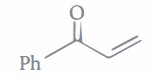
| (a) Acetophenone and Formaldehyde | (b) Acetophenone and acetaldehyde |
| (c) Benzaldehyde and acetaldehyde | (d) Benzaldehyde and acetone |
(iv) Which of the following will undergo aldol condensation?
| (a) HCHO | (b) CH3CH2OH |
| (c) C6H5CHO | (d) CH3CH2CHO |
33.
Read the passage given below and answer the following questions:
At 298 K, the vapour pressure of pure benzene, C6H6 is 0.256 bar and the vapour pressure of pure toluene
C6H5CH3 is 0.0925 bar. Two mixtures were prepared as follows:
(i) 7.8 g of C6H6 + 9.2 g of toluene
(ii) 3.9 g of C6H6 + 13.8 g of toluene
The following questions are multiple choice questions. Choose the most appropriate answer:
(i) The total vapour pressure (bar) of solution 1 is
| (a) 0.128 | (b) 0.174 | (c) 0.198 | (d) 0.258 |
(ii) Which of the given solutions have higher vapour pressure?
| (a) I | (b) II |
| (c) Both have equal vapour pressure | (d) Cannot be predicted |
(iii) Mole fraction of benzene in vapour phase in solution 1 is
| (a) 0.128 | (b) 0.174 | (c) 0.734 | (d) 0.266 |
(iv) Solution I is an example of a/an
| (a) ideal solution | (b) non-ideal solution with positive deviation |
| (c) non-ideal solution with negative deviation | (d) can't be predicted |
1.
\(\mathrm{CH}_3 \mathrm{CH}_2 \mathrm{CH}_3<\mathrm{CH}_3 \mathrm{OCH}_3<\mathrm{CH}_3 \mathrm{CHO}<\mathrm{CH}_3 \mathrm{CH}_2 \mathrm{OH}\) Stronger the attractive forces, higher is the boiling point. Hydrocarbons are non-polar having weakest attractive forces, ethers are polar and aldehydes have strong dipolar interaction. Alcohols have maximum intermolecular forces due to the presence of H-bonding.
2.
(i) In l-bromo-l-methylcyclohexane, the \(\beta \)-hydrogens on either side of the Br atom are equivalent, therefore, only 1- alkene is formed.
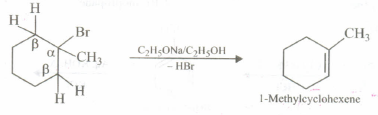
ii) 2-Boro-2-methylbutane has two different sets of equivalent \(\beta \)-hydrogens and hence, in principle, can give two alkenes (I and II). But according to SaytzetT rule, more highly substituted alkene (II), being mor~ stable, is the major product.

(iii) 3-Bromo-2, 2, 3-trimethylpentane has two different sets of \(\beta \)-hydrogens and hence, in principle, can give two alkenes (I and II). But according to SaytzetT rule, more highly substituted alkene (II), being more stable, is the major product.
3.
o-Nitrophenol is steam-volatile due to chelation (intramolecular H-bonding) and hence can be separated by steam distillation from p-nitrophenol which is not steam volatile because of intermolecular H-bonding.
4.
\(A_m={1000\times k\over M}\)
138.9 S cm2 mol-1=\(1000\times k\over 1.5\)
\(k={138.9\times 1.5\over 1000}={208.05\over 1000}={2.0805}\times 10^{-1}\ S\ cm^{-1}\)
5.
Molar mass of solute,
\({ M }_{ B }=\frac { { K }_{ f }\times{ W }_{ B }\times1000 }{ { W }_{ A }\times \triangle { T }_{ f } } \)
\( { W }_{ B }=1.0g\)
\( { W }_{ A }=50.0g\)
\( \triangle { T }_{ f }=0.40K\)
\( { K }_{ f }=5.12 \ K \ kg \ { mol }^{ -1 }\)
\(\\ { M }_{ B }=\frac { 5.12\times1.0\times1000 }{ 50\times0.40 } \)
\(=256 \ g/mol\)
6.
(i) Since compound (E) with molecular formula, C3H60 does not reduce Tollens' reagent and Fehling's solution but forms 2, 4-dinitrophenylhydrazone, it must be a ketone. But the only possible ketone having the molecular formula, C3H6O is acetone or propanone. Thus, compound (E) is acetone or (propanone) CH3COCH3·
(ii) Since acetone (E) is obtained by heating compound (8) with Ca(OH)2 therefore, (B) must be acetic acid (ethanoic acid), CH3COOH.
(iii) Since (D) on oxidation with KMn04 gives acetic acid (8), therefore, (D) must be ethyl alcohol (ethanol), CH3CH2OH.
(iv) Since acetic acid (8) and ethyl alcohol (D) are obtained by hydrolysis of (C) under acidic conditions, therefore, (C) must be ethyl acetate (ethyl ethanoate), CH3COOC2H5
(v) Since ethyl acetate (C) and acetic acid (8) are obtained by treatment of compound (A) with ethyl alcohol, therefore, compound (A) must be acetic anhydride (ethanoic anhydride), (CH3COO)2O.
(vi) All the reactions involved in this problem can now be explained as follows
7.
\(\underset { n-Butylchloride }{ { CH }_{ 3 }{ CH }_{ 2 }{ CH }_{ 2 }{ CH }_{ 2 }CI } +KOH(alc.)\overset { \triangle }{ \longrightarrow } \underset { But-l-ene }{ { CH }_{ 3 }{ CH }_{ 2 }CH={ CH }_{ 2 }+KCI+{ H }_{ 2 }O } \)
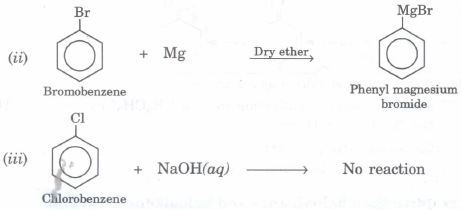
\((iv)\quad { 2CH }_{ 3 }Br+2Na\overset { Dry\quad ether }{ \underset { \quad Wurt\\ reaction }{ \longrightarrow } } \underset { Ethane }{ { CH }_{ 3 }{ CH }_{ 3 } } +2NaBr\)
\(\\ (vi)\quad \underset { Methyl\\ chloride }{ { CH }_{ 3 }CI } +KCN\longrightarrow \underset { Methyl\\ chloride }{ { CH }_{ 3 }CN } +KCI\)
8.
(i) \({ Ca }^{ 2+ }(aq)+2{ e }^{ - }\longrightarrow Ca(s)\)
2 F is required for 40 g of Ca
1 F is required for 20g of Ca
(ii) \({ Al }^{ 3+ }(aq)+3{ e }^{ - }\longrightarrow Al(s)\)
\(Eq.wt.=\frac { 27 }{ 3 } =9,Z=\frac { Eq.wt. }{ 96500 } =\frac { 9 }{ 96500 }\)
\(m=Z\times Q\)
\(50=\frac { 9 }{ 96500 } \times Q\)
\(Q=\frac { 50\times 96500 }{ 9 } =5.3611\times { 10 }^{ 5 }C=\frac { 5.3611\times { 10 }^{ 5 }F }{ 96500 } =5.56F\)
9.
\(\text { No. of moles of solute, } n_{2}=\frac{100}{140}=\frac{5}{7} \text { mole }\)
\(\text { No. of moles of solvent, } n_{1}=\frac{1000}{180}=\frac{50}{9} \text { mole }\)
Mole fraction of solute
\(x_{2}=\frac{n_{2}}{n_{1}+n_{2}}=\frac{5 / 7}{5 / 7+50 / 9}=0.114\)
\(\text {Mole fraction of solvent, } x_{1}=\left(1-x_{2}\right)=(1-0 \cdot 114)\)
= 0.886
According to Raoult's law
\( P_{A}=x_{A} P_{A}^{0}=0.114 \times P_{A}^{0} \)
\(P_{B}=x_{B} P_{B}^{\circ}=0.886 \times 500=443 \text { torr } \)
\(P_{\text {Total }}=P_{A}+P_{B}\)
\(475=0.114 P_{A}^{\circ}+443\)
\( P_{A}^{\circ}=\frac{475-443}{0 \cdot 114}=280 \cdot 7 \text { torr } \)
\(\therefore P_{A}=0 \cdot 114 \times 280 \cdot 7=32 \text { torr. }\)
10.
In the presence of sulphuric acid (H2SO4), KI produces HI
\(2 \mathrm{KI}+\mathrm{H}_{2} \mathrm{SO}_{4} \rightarrow 2 \mathrm{KHSO}_{4}+2 \mathrm{HI}\)
Since H2SO4 is an oxidizing agent, it oxidizes HI (produced in the reaction to I2).
\(2 \mathrm{HI}+\mathrm{H}_{2} \mathrm{SO}_{4} \rightarrow \mathrm{I}_{2}+\mathrm{SO}_{2}+\mathrm{H}_{2} \mathrm{O}\)
As a result, the reaction between alcohol and HI to produce alkyl iodide cannot occur. Therefore, sulphuric acid is not used during the reaction of alcohols with KI. Instead, a non-oxidizing acid such as H3PO4 is used.
11.
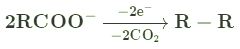
(i) Kolbes reaction.
It is a decarboxylative dimerisation of two carboxylic acids (or carboxylate ions) to form carbon carbon bond of alkane.
(ii) Reimer-Tiemann reaction.
It involves the ortho-formylation of phenols. Phenol is converted to salicylaldehyde.

(iii) Williamson ether synthesis.
Sodium alkoxide reacts with alkyl halide to form an ether.
\(\mathbf{C}_{2} \mathrm{H}_{5} \mathrm{ONa}+\mathrm{C}_{2} \mathrm{H}_{5} \mathrm{Cl} \rightarrow \mathrm{C}_{2} \mathrm{H}_{5}-\mathrm{O}-\mathrm{C}_{2} \mathrm{H}_{5}+\mathrm{NaCl}\)
(iv) Unsymmetrical ether.
Two different alkyl groups are attached to O atom. The general formula is R−O−R′. An example is ethyl methyl ether
\(\mathrm{CH}_{3}-\mathrm{CH}_{2}-\mathrm{O}-\mathrm{CH}_{3}\)
12.
Moles of glucose = 18 g/ 180 g mol–1 = 0.1 mol
Number of kilograms of solvent = 1 kg
Thus molality of glucose solution = 0.1 mol kg-1
For water, change in boiling point
\(\triangle\)Tb = Kb × m = 0.52 K kg mol–1 x 0.1 mol kg–1 = 0.052 K
Since water boils at 373.15 K at 1.013 bar pressure, therefore, the
boiling point of solution will be 373.15 + 0.052 = 373.202 K.
13.
14.
\({ { \wedge }^{ ° } }_{ \left( HCOOH \right) }={ { \lambda }^{ ° } }_{ \left( { H }^{ + } \right) }+{ { \lambda }^{ ° } }_{ \left( { HCOO }^{ - } \right) }\)
\(=349.6+54.6\\=404.2S{ cm }^{ 2 }{ mol }^{ -1 }\)
\(\alpha =\frac { { { { \wedge } }^{ m } }_{ c } }{ { { { \wedge } }^{ m } }_{ 0 } } =\frac { 46.1 }{ 404.2 } =0.114\)
\({ K }_{ c }=\frac { c{ \alpha }^{ 2 } }{ 1-\alpha } =\frac { 0.025\times { \left( 0.114 \right) }^{ 2 } }{ 1-0.114 } =3.67\times { 10 }^{ -4 }\)
15.
(b)
2, 4, 6-trinitrophenol
16.
(d)
2-methylpropanal and iso-propyl magnesium iodide
17.
(d)
4
18.
(b)
10.8g
19.
(c)
4
20.
(b)
Clemmensen reduction
21.
22.
(a)
p-ClC6H4CH2CH(CH3)2
23.
(e)
C6H12O6
24.
(b)
Cr
25.
(a)
position of metal in electrochemical series
26.
0.01 M MgCI2 = 0.03 M particle concentration which is three times in comparison to 0.01 M glucose. Hence, depression will be about three times.
27.
(b) Aquatic species are more comfortable in cold water rather than in warm water because the solubility of gases decreases with increase of temperature.
28.
(b): Presence of acid intensifies the partial positive charge on carbonyl carbon and hence, activates the group.

Presence of base activates a-methylene component of the carbonyl compounds by converting them in carbanions.
\(\mathrm{RCH}_{2} \mathrm{CHO}+: B^{-} \rightarrow \mathrm{R} \overline{\mathrm{C}} \mathrm{HCHO}+B \mathrm{H}\)
29.
(d): The ease of dehydration of alcohols can be explained on the basis of stability of the intermediate carbocation. Greater the stability of the carbonation formed, greater will be the rate of reaction. The order of stability of carbocation formed is:
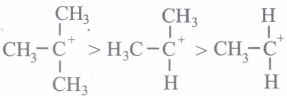
This is due to the electron releasing (+I) effect of the alkyl groups. Therefore, the ease of dehydration of alcohols follows the order: Tertiary> Secondary> Primary Dehydration of alcohols proceed through carbocation formation.
30.
(b): Among dichlorobenzenes, the p-isomer being symmetrical, packs closely in the crystal lattice and hence has much higher melting point than o- and m- isomers.
31.
(d) : The electrical resistance of any object is directly proportional to its length I, and inversely proportional to its area of cross-section, A. So, it increases with increase in length of object and decreases with increase in area of cross-section of object.
32.
(i) (c) : Condensation reaction is the reverse of hydrolysis, which splits a chemical entity into two parts through the action of the polar water molecule
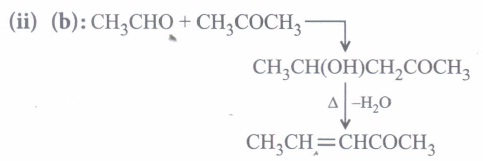
(iii) (a)
(iv) (d)
33.
(i) (b) : Moles of C6H6 = \(\frac{7.8}{78}=0.1\)
Mole C6H5CH3 = \(\frac{9.2}{92}=0.1\)
Mole fraction of C6H6 = \(\frac{0.1}{0.1+0.1}=0.5\)
=> Mole fraction of C6H5CH3 = 0.5
Vapour pressure of toluene = Vapour pressure of pure toluene x mole fraction of toluene
= 0.0925 x 0.5 = 0.04625
Vapour pressure of benzene = 0.256 x 0.5 = 0.128
Total vapour pressure of solution = 0.17425
(ii) (a) : Moles of benzene in solution-II = \(\frac{3.9}{78}=0.05\)
Moles of toluene in solution-II = \(\frac{13.8}{92}=0.15\)
Vapour pressure of solution
= 0.256 x 0.05 + 0.0925 x 0.15
= 0.0128 + 0.013875 = 0.026675
(iii) (c) : Mole fraction of benzene in vapour phase
\(y_{\text {benzene }}=\frac{p_{\text {benzene }}}{P_{\text {total }}}=\frac{0.128}{0.17425}=0.734\)
(iv) (a) : Benzene and toluene form an ideal solution.

12th Standard CBSE Syllabus & Materials
12th Standard CBSE
CBSE 12th Computer Science Python Revision Tour I - New Previous year Question Papers Study Material - QB365 Set A
NEW12th Standard CBSE
CBSE 12th Business Studies Planning Important Questions And Answers Study Material - QB365 Set A
NEW12th Standard CBSE
CBSE 12th Business Studies Business Environment Important Questions And Answers Study Material - QB365 Set A
NEW12th Standard CBSE
CBSE 12th Business Studies Principles of Management Important Questions And Answers Study Material - QB365 Set A



NCERT Books

Syllabus

Exam Pattern

Sample Question Papers

Previous year Question Papers

Important Notes

MCQ Practice test

NCERT Exemplers

Case study Questions

Image Based Questions

Passage based Questions

HOT Questions

Value Based Questions

Model Questions Papers
NCERT ( Book Back ) Questions

Assertion and Reason
Important Questions And Answers

CBSE 12th Standard CBSE Subjects
CBSE Standards