 100% FREE ACCESS
12th Standard CBSE Syllabus & Materials
12th Standard CBSE
CBSE 12th Economics Government Budget and the Economy Previous year Question Papers Study Material - QB365 Set A
NEW12th Standard CBSE
CBSE 12th Computer Science Interface Python with MySQL - New Previous year Question Papers Study Material - QB365 Set A
NEW12th Standard CBSE
CBSE 12th Computer Science Database Concept - New Previous year Question Papers Study Material - QB365 Set A
NEW12th Standard CBSE
CBSE 12th Computer Science Data Communication - New Previous year Question Papers Study Material - QB365 Set A
NEW12th Standard CBSE
CBSE 12th Computer Science Data Structures - New Previous year Question Papers Study Material - QB365 Set A
NEW12th Standard CBSE
CBSE 12th Computer Science Functions - New Previous year Question Papers Study Material - QB365 Set A
Published on: 25/10/2025
Download CBSE Class 12th Standard CBSE Chemistry question papers, sample papers, important questions, and previous year solved papers in PDF format. Get free study materials, NCERT solutions, and exam preparation resources for Class 12th Standard CBSE Chemistry
Questions + Answers key
Take MCQ Chemistry Test
1.
(a) Write a chemical test to distinguish between dimethyl amine and ethanamine.
(b) Write the product formed when benzene diazonium chloride is treated with KI.
2.
What happens when
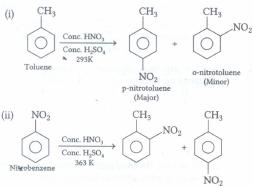
(i) toluene is treated with conc. HNO3 and conc. H2SO4 at 293 K?
(ii) nitrobenzene is treated with conc. HNO3 and conc. H2SO4 at 363 K?
3.
Give chemical tests to distinguish between the following pairs of compounds:
(i) Aniline and Ethylamine
(ii) Ethylamine and Dimethylamine
4.
What is Baker Mulliken's test? Discuss its chemistry.
5.
Name reagents required for preparation of methyl orange indicator (no reaction).
6.
Why is benzenediazonium chloride not stored and is used immediately after its preparation?
7.
What is Hinsberg reagent?
8.
What is the rol of HNO3 in the nitrating mixture used for nitration of benzene?
9.
How will you convert:
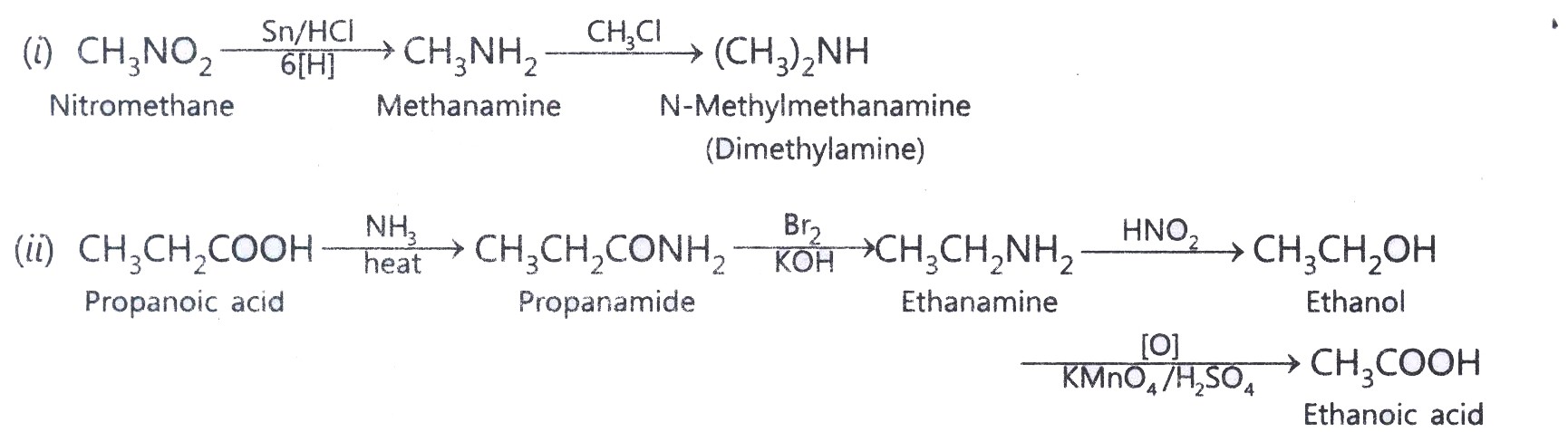
(i) Nitromethane into dimethylamine,
(ii) Propanoic acid into ethanoic acid?
10.
Write IUPAC names of the following compounds and classify them into primary, secondary and teetiary amines.
(i) (CH3)2CHNH2
(ii) CH3(CH2)2NH2
(iii) CH3NHCH(CH3)2
(iv)(CH3)3CNH2
11.
Out of ethylamine and ethyl alcohol which has higher boiling boiling point and why?
12.
Why cannot aromatic primary amines be prepared by Gabriel phythalimid synthesis?
13.
Complete the following reaction equations:
\((i)\ C_6H_5NH_2+CHCl_3+KOH(alc)\rightarrow\)
(ii) \(C_6H_5N_2Cl+H_3PO_2+H_2O\rightarrow\)
14.
How will you bring about the following conversions?
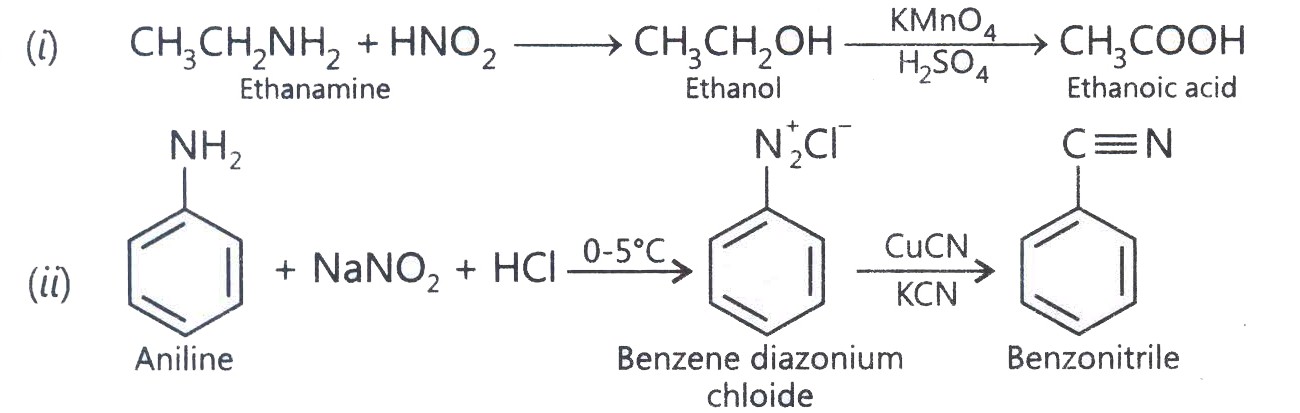
(i) Ethanamine to Ethanoic acid
(ii) Aniline to Benzonitrile
15.
How will you bring about the following conversions?
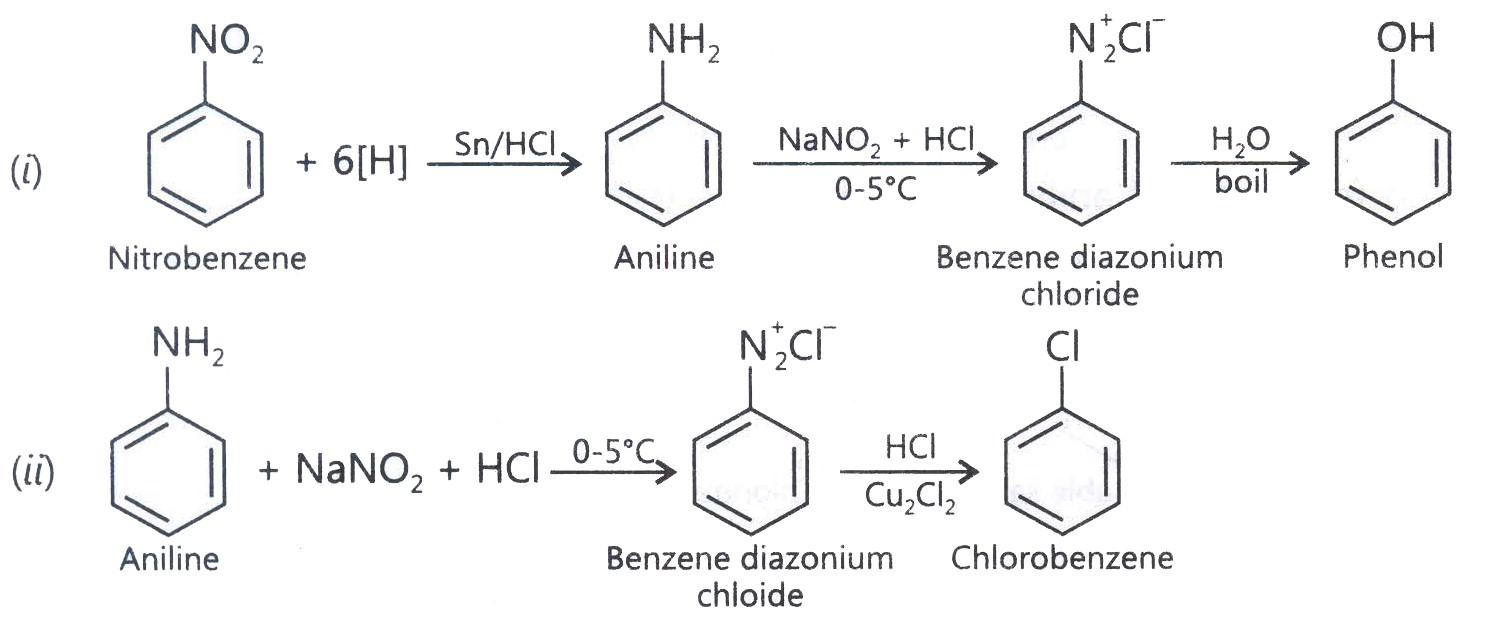
(i) Nitrobenzene to Phenol.
(ii) Aniline to Chlorobenzene.
16.
Write the structures of A, Band C in the following:
(i) C6H5-CONH2
(i) \({ CH }_{ 3 }-CI\overset { KCN }{ \longrightarrow } A\overset { { LiAIH }_{ 4 } }{ \longrightarrow } b\overset { { CHCI }_{ 3 }+alc.KOH }{ \longrightarrow } C.\)
17.
Why does bromination of aniline, even under very mild conditions, gives 2, 4, 6-tribromoaniline instantaneously?
18.
Write IUPAC names of the following compounds and classify them into primary, secondary and tertiary amines.
(i) (CH3)2CHNH2
(ii) CH3(CH2)2NH2
(iii) CH3NHCH(CH3)2
(iv) (CH3)3CNH2
(v) C6H5NHCH3
(vi) (CH2CH2)2NCH3
(vii) m-BrC6H4 NH2.
19.
Accomplish the following conversions:
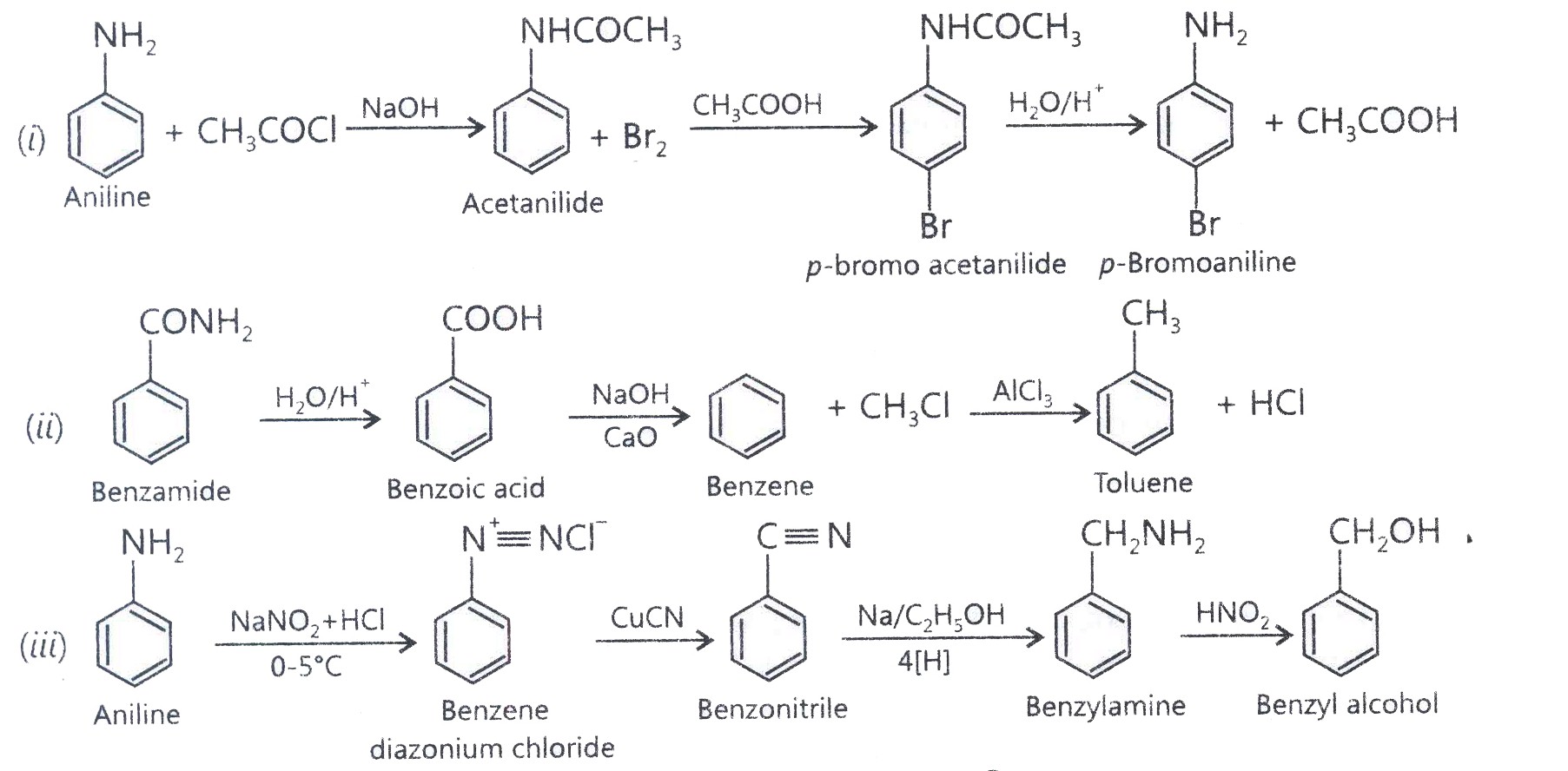
(i) Aniline to p-bromoaniline
(ii) Benzamide to toluene
(iii) Aniline to benzyle alcohol
20.
Accmplish the following conversions:
(i) Aniline to 2,4,6-tribromofluorobenzene
(ii) Benzyl chloride to 2-phenylethanamine
(iii) Chlorobenzene to p-chloroaniline.
21.
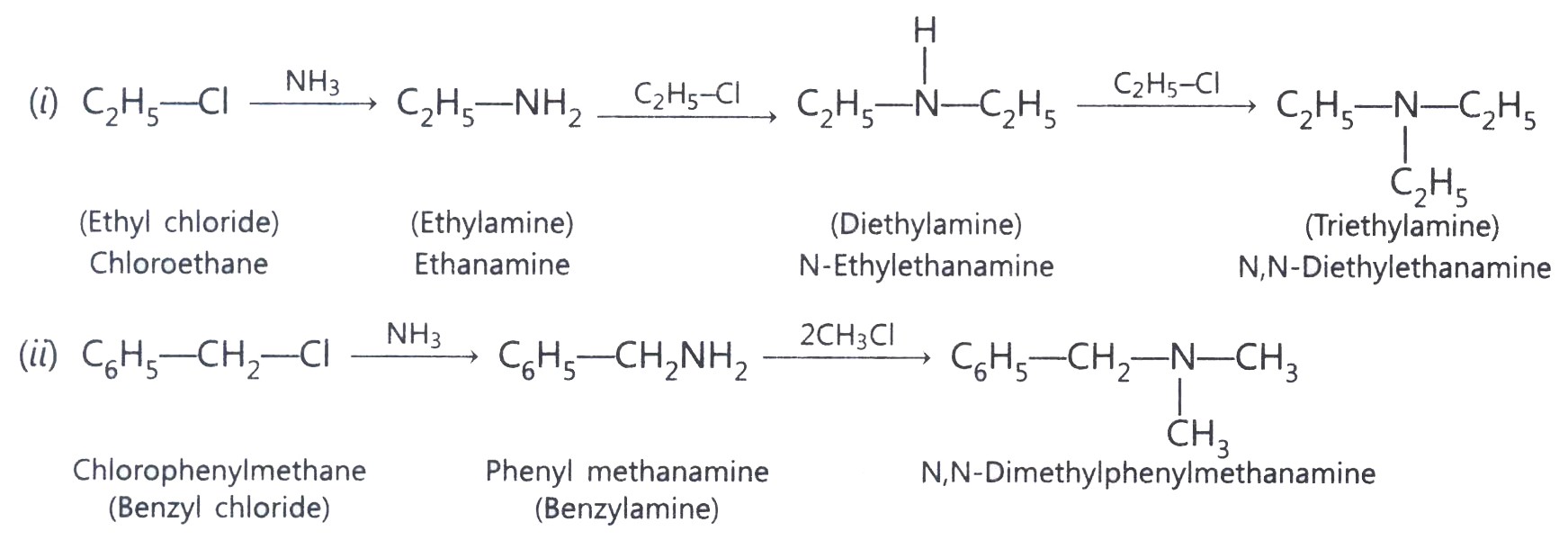
Write chemical equations for the following reactions:
(i) Reaction of ethanolic NH3 with C2H5Cl
(ii) Ammonolysis of Benzyl chloride and reaction of amine so formed with two moles of CH3Cl.
22.
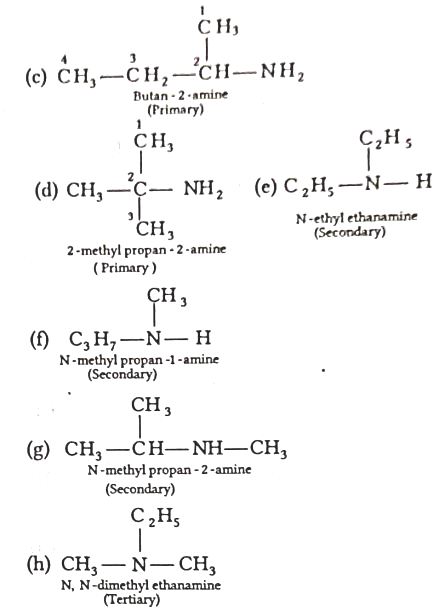
(i) Give the structures of different isomeric amines corresponding to the molecular formula, C4H11N.
(ii) Write the IUPAC names of all the isomers.
(iii) What type of isomerism is exhibited by different pairs of amines?
23.
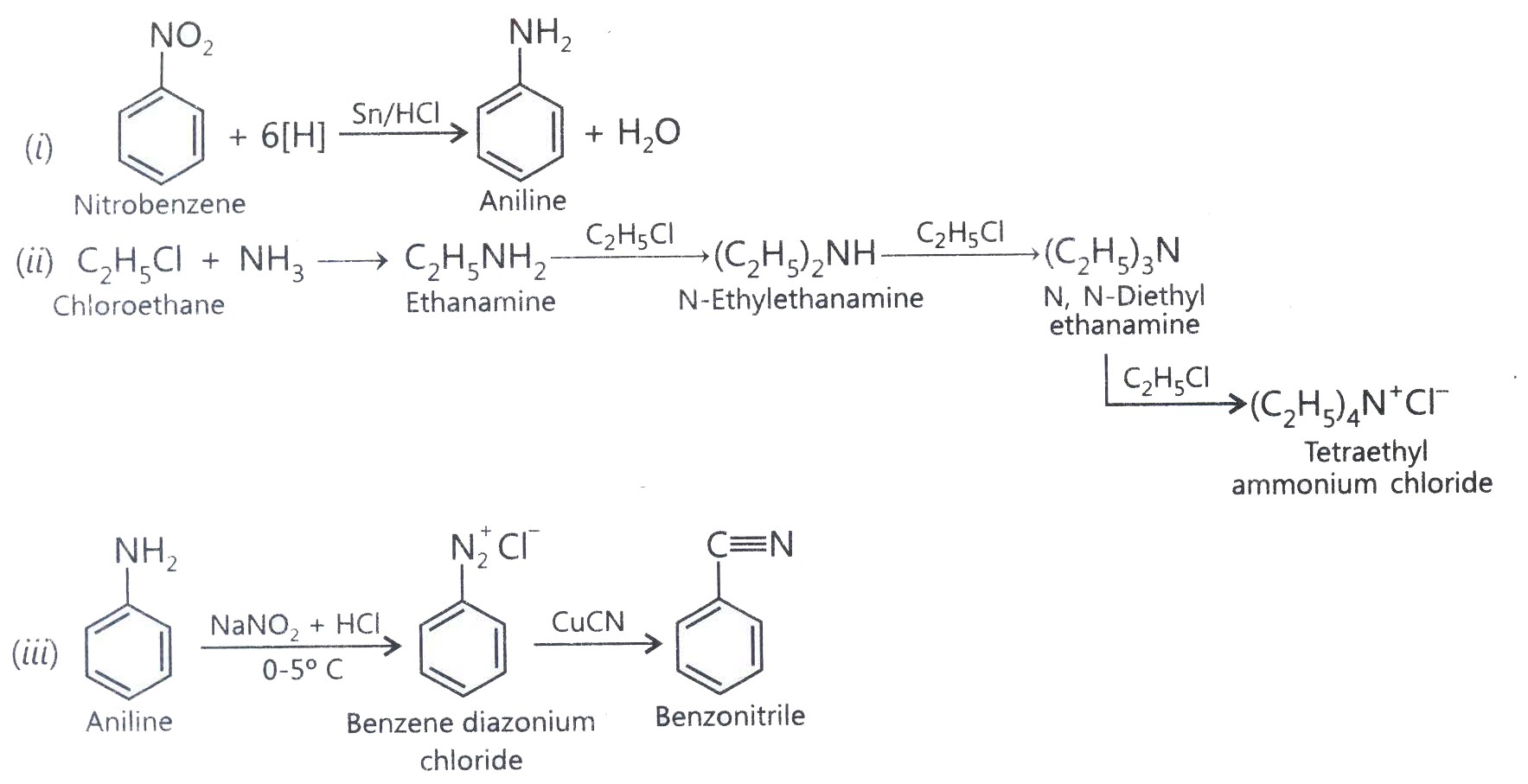
How would you achieve the following conversions?
(i) Nitrobenzene to aniline
(ii) An alkyl halide to a quaternary ammonium salt.
(iii) Aniline to benzonitrile.
Write the chemical equation with reaction conditions in each case.
24.
Give one chemical test each to distinguish between the compounds in the following pairs:
(i) Methyleamine and dimethylamine
(ii) Aniline and benzylamine
(iii) Ethylamine and aniline
25.
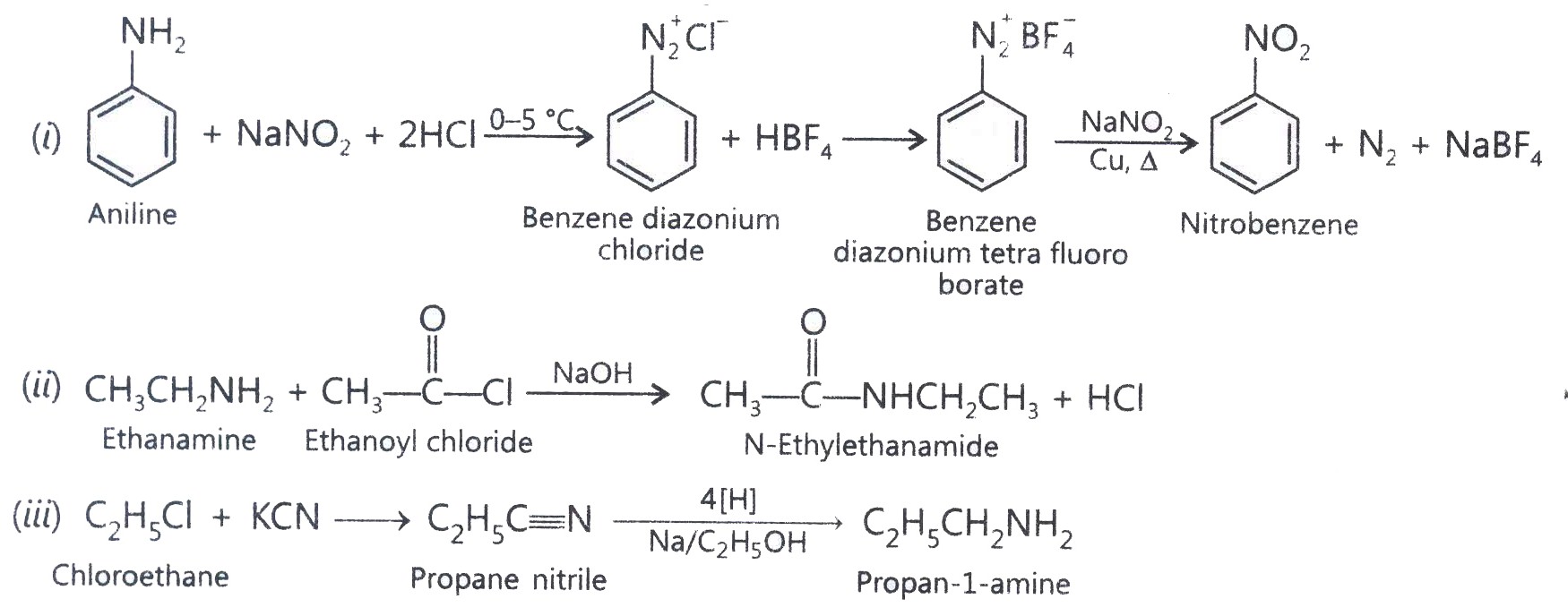
How are the following conversions carried out?
(i) Aniline to nitrobenzene
(ii) Ethanamine to N-ethylethanamid
(iii) Chloroethane to propan-1-amine
1.
(a) Test for dimethyl amine and ethanamine Ethanamine, being primary amine, on heating with chloroform and ethanolic potassium hydroxide form isocyanide which have foul smell whereas dimethyl does not give this kind of foul smell.
| \(\mathrm{CH}_3 \mathrm{CH}_2 \mathrm{NH}_2+\mathrm{CHCl}_3+3 \mathrm{KOH} \xrightarrow{\Delta}\) | \(\mathrm{CH}_3 \mathrm{CH}_2 \mathrm{NC}+3 \mathrm{KCl}+3 \mathrm{H}_2 \mathrm{O}\) | \(\left(\mathrm{CH}_3\right)_2 \mathrm{NH}+\mathrm{CHCl}_3+3 \mathrm{KOH} \xrightarrow{\Delta} \text { No foul smell }\) |
| Ethanamine | Ethyl isocyanide | Dimethylamine |
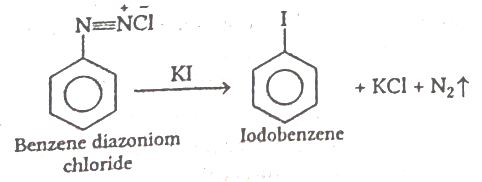
(b) Benzene diazonium chloride when treated with KI form iodobenzene. The reaction involved is as follows
2.
3.
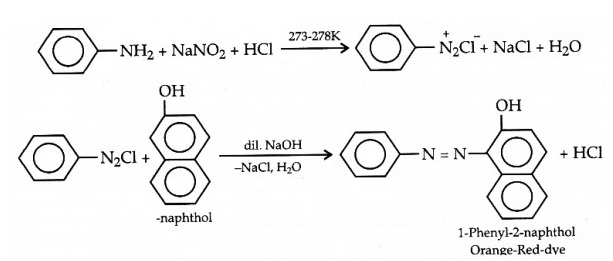
(i) Aniline forms diazonium salt with NaNO2/HCl which gives orange red dye with \(\beta\) -napththol. Ethyl amine does not give this test
(b) Ethyl amine gives foul smelling ethyl isocyanide on heating with chloroform and potassium hydroxide solution. Dimethyl amine does not give this test.
C2H5NH2+CHCI3+3KOH⟶C2H5NC+3KCI+3H2O
4.
Both aliphatic and aromatic nitro compounds on reduction in neutral medium, i.e., Zn dust and NH4Cl solution, give the corresponding hydroxylamines.
\({ C }_{ 6 }{ H }_{ 5 }{ NO }_{ 2 }\quad \quad \overset { Zn/{ NH }_{ 4 }Cl,{ H }_{ 2 }O }{ \underset { \Delta }{ \longrightarrow } } \quad \quad { C }_{ 6 }{ H }_{ 5 }NHOH\\ Nitrobenzene\quad \quad \quad \quad \quad phenylhydroxylamine\\ \)
These hydroxylamines, when warmed with Tollens' reagent, are easily oxidized to the corresponding nitroso compounds and thus reduce Tollens' reagent to metallic silver
\({ C }_{ 6 }{ H }_{ 5 }NHOH+2{ \left[ Ag{ \left( { NH }_{ 3 } \right) }_{ 2 } \right] }^{ + }+2{ OH }^{ - }\longrightarrow { C }_{ 6 }{ H }_{ 5 }N=O+2Ag\downarrow +4{ NH }_{ 3 }+2{ H }_{ 2 }O\)
This reaction is called Baker Mulliken's test and is used as a test for detection of nitro group in organic compounds.
5.
Reagents required are:
(i) sulphanilic acid
(ii) N, N-dimethylaniline
(iii) NaNO2 HCI and
(iv) a base.
6.
Benzenediazonium chloride is unstable. Therefore, it cannot be stored. Instead it is used immediately after its preparation.
7.
Benzenesulphonyl chloride (C6H5SO2CI) is called Hinsberg's reagent.
8.
HNO acts as a base in the nitrating mixture (conc.HNO3+conc.H2SO4). H2SO4 acts on HNO3 to generate the electrophile, \({ NO }_{ 2 }^{ + }\) (nitronium ion)
9.
10.
(i) 2-Propanamine \(\left( { 1 }^{ \circ } \right) \)
(ii) 1-Propanamine \(\left( { 1 }^{ \circ } \right) \)
(iii) N-Methyl-2-propanamine \(\left( { 2 }^{ \circ } \right) \)
(iv) 2-Methyl-2-propanamine \(\left( { 1 }^{ \circ } \right) \)
11.
Ethyl alcohol has higher boiling point than ethlamine because there is stronger intermolecular H- bonding in ethanol than ethylamine due to more electronegativity of oxygen than nitrogen.
12.
It is because there is double bond character between C\(\rightarrow\)X bond due to which it cannot be broken easily that is why aromatic amines cannot be prepared by Gabriel phthalimide synthesis.
13.
(i) \(\underset { Aniline }{ C_{ 6 }H_{ 5 }NH_{ 2 } } +CHCl_{ 3 }+\underset { (alc) }{ 3KOH } \quad { \longrightarrow }\underset { Phenyl\quad carbylamine }{ C_{ 6 }H_{ { 5 } }N_{ \rightarrow }^{ = }C } +3KCl+3H_{ 2 }O\)
(ii) \(\underset { Benzene\\ diazonium\\ Chloride }{ C_{ 6 }H_{ 5 }N_{ 2 }Cl } +\underset { Hypo\\ phosphorus\quad \\ acid }{ H_{ 3 }PO_{ 2 } } +H_{ 2 }O\quad { \longrightarrow }\underset { Benzene }{ C_{ 6 }H_{ 6 } } +\underset { Phosphoric\\ acid }{ H_{ 3 }PO_{ 3 } } +N_{ 2 }+HCl\)
14.
15.
16.
(i) \({ C }_{ 6 }{ H }_{ 5 }-{ CONH }_{ 2 }\overset { { Br }_{ 2 }/KOH }{ \longrightarrow } { C }_{ 6 }{ H }_{ 5 }{ NH }_{ 2 }\)
\([A]\overset { { NaNO }_{ 2 }+HCI }{ \longrightarrow } { C }_{ 6 }{ H }_{ 5 }{ N }_{ 2 }^{ + }{ CI }^{ - }[B]\overset { KI }{ \longrightarrow } { C }_{ 6 }{ H }_{ 5 }I[C]\)
(ii) \({ CH }_{ 3 }CI\overset { KCN }{ \longrightarrow } { CH }_{ 3 }CN[A]\overset { { LiAIH }_{ 4 } }{ \longrightarrow } { CH }_{ 3 }{ CH }_{ 2 }{ NH }_{ 2 }[B]\overset { { CHCI }_{ 3 }+KOH }{ \longrightarrow } { CH }_{ 3 }{ CH }_{ 2 }NC[C]\)
17.
Due to strong electron-donating effect of the -NH2 group, the electron density increases at the 0-, positions. Further, when aniline is treated with Br2 the Br+ attacks the benzene ring at o- and p-positions to form carbocation intermediates which are stabilized not only by the usual resonance of the Henzene ring. but also by the -NH2 group as shown below: In case of o-bromination, the carbocation intermediate is stabilized not only by usual resonating structure (I, III and IV) but is also stabilized by resonance structure (II) in which the lone pair of electrons on the N. atom interacts with the positively charged carbon of the ring. Similarly, in case of p-bromination, the carbocation is stabilized not only by the usual resonating structures (V, VI, and VIII) but is also stabilized by the resonance structure (VII) in which the lone pair of electrons on the N-atom interacts with the positively charged carbon of the ring. These additional resonating structures (II and VII) increase the stability of the carbocation to such an extent that bromination occurs instantaneously at the p- and two. o- positions giving 2, 4, 6-tribromoaniline.
18.
(i) Propan-2-amine \(\left( { 1 }^{ \circ } \right) \),
(ii) Propan-1-amine \(\left( { 1 }^{ \circ } \right) \),
(iii) N-Methylpropan-2-amine \(\left( { 2 }^{ \circ } \right) \),
(iv) 2-Methylpropan-2-amine \(\left( { 3 }^{ \circ } \right) \),
(v) N-Methylbenzenamine or N-Methylaniline \(\left( { 2 }^{ \circ } \right) \),
(vi) N-Ethyl N-methylethanamine \(\left( { 3 }^{ \circ } \right) \),
(vii) 3-Bromobenzenamine or 3-Bromoaniline \(\left( { 1 }^{ \circ } \right) \).
19.
20.
s.jpg)
s.jpg)
21.
22.
(i) and (ii)
Eight isomers of C4H11N are
(a) \(\stackrel{4}{\mathrm{C}} \mathrm{H}_3-\stackrel{3}{\mathrm{C}} \mathrm{H}_2-\stackrel{2}{\mathrm{C}} \mathrm{H}_2-\stackrel{1}{\mathrm{C}} \mathrm{H}_2-\mathrm{NH}_2\)
Butan -1 -amine
(Primary)
(b) CH3
|
\(\stackrel{3}{CH}_3-{ }^2 \mathrm{CH}-\stackrel{1}{C} \mathrm{H}_2-\mathrm{NH}_2\)
2-methyl propan -1-amine
(Primary)
(iii) Isomerism exhibited by different amines are:
(a) Chain isomers, i.e. have different carbon chains, (a) and (b), (c) and (d) (as discussed in part (i) and (ii)]
(b) Position isomers, i.e. functional group occupy different positions, (a) and (c), (b) and (d).
(c) Metamers, i.e. different alkyl groups are attached to the same functional group, (e) and (f), (e) and (g).
(d) Functional isomers, i.e. they have different functional groups. All the three categories (1°, 2° and 3°) of amines are the functional isomers of each other.
23.
24.
(i) Methylamine and dimethylamine can be distinguished by the carbylamine test. Carbylamine test: Aliphatic and aromatic primary amines on heating with chloroform and ethanolic potassium hydroxide form foul-smelling isocyanides or carbylamines. Methylamine (being aliphatic primary amine) gives a positive carbylamine test, but dimethylamine does not.
(ii) Secondary and tertiary amines can be distinguished by allowing them to react with Hinsbergs reagent (benzenesulphonyl chloride, C6H5SO2Cl). Secondary amines react with Hinsberg’s reagent to form a product that is insoluble in an alkali. For example, N, N−diethylamine reacts with Hinsberg’s reagent to form N, N−diethylbenzenesulphonamide, which is insoluble in an alkali. Tertiary amines, however, do not react with Hinsberg’s reagent amines, however, do not react with Hinsberg’s reagent.
(iii) Aniline and benzylamine can be distinguished by their reactions with the help of nitrous acid, which is prepared in situ from a mineral acid and sodium nitrite. Benzylamine reacts with nitrous acid to form unstable diazonium salt, which in turn gives alcohol with the evolution of nitrogen gas.
25.

12th Standard CBSE Syllabus & Materials
12th Standard CBSE
CBSE 12th Computer Science Python Revision Tour I - New Previous year Question Papers Study Material - QB365 Set A
NEW12th Standard CBSE
CBSE 12th Business Studies Planning Important Questions And Answers Study Material - QB365 Set A
NEW12th Standard CBSE
CBSE 12th Business Studies Business Environment Important Questions And Answers Study Material - QB365 Set A
NEW12th Standard CBSE
CBSE 12th Business Studies Principles of Management Important Questions And Answers Study Material - QB365 Set A



NCERT Books

Syllabus

Exam Pattern

Sample Question Papers

Previous year Question Papers

Important Notes

MCQ Practice test

NCERT Exemplers

Case study Questions

Image Based Questions

Passage based Questions

HOT Questions

Value Based Questions

Model Questions Papers
NCERT ( Book Back ) Questions

Assertion and Reason
Important Questions And Answers

CBSE 12th Standard CBSE Subjects
CBSE Standards