
 100% FREE ACCESS
12th Standard CBSE Syllabus & Materials
12th Standard CBSE
CBSE 12th Economics Government Budget and the Economy Previous year Question Papers Study Material - QB365 Set A
NEW12th Standard CBSE
CBSE 12th Computer Science Interface Python with MySQL - New Previous year Question Papers Study Material - QB365 Set A
NEW12th Standard CBSE
CBSE 12th Computer Science Database Concept - New Previous year Question Papers Study Material - QB365 Set A
NEW12th Standard CBSE
CBSE 12th Computer Science Data Communication - New Previous year Question Papers Study Material - QB365 Set A
NEW12th Standard CBSE
CBSE 12th Computer Science Data Structures - New Previous year Question Papers Study Material - QB365 Set A
NEW12th Standard CBSE
CBSE 12th Computer Science Functions - New Previous year Question Papers Study Material - QB365 Set A

Published on: 25/10/2025
Download CBSE Class 12th Standard CBSE Chemistry question papers, sample papers, important questions, and previous year solved papers in PDF format. Get free study materials, NCERT solutions, and exam preparation resources for Class 12th Standard CBSE Chemistry
Questions + Answers key
Take MCQ Chemistry Test
1.
Give plausible explanation for each of the following:
(i) Why are amines less acidic than alcohols of comparable molecular masses?
(ii) Why do primary amines have higher boiling points than tertiary amines?
(iii) Why are aliphatic amines stronger bases than aromatic amines?
2.
Write the reactions of
(i) aromatic and
(ii) aliphatic primary amines with nitrous acid.
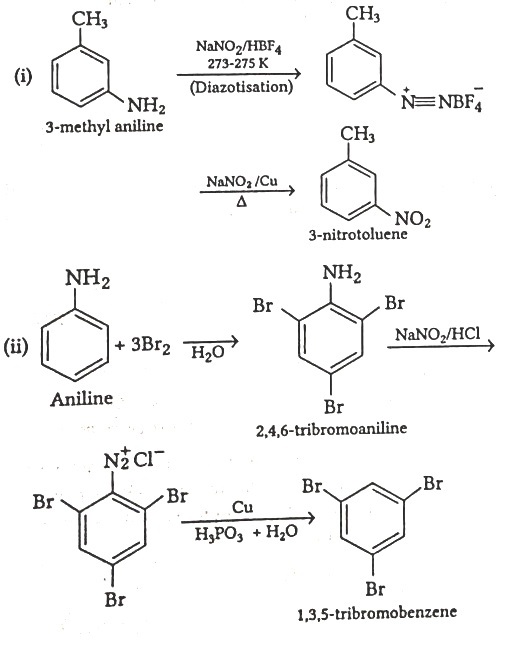
3.
Convert
(i) 3-Methylaniline into 3-nitrotoluence
(ii) Aniline into 1, 3, 5-tribromobenzene.
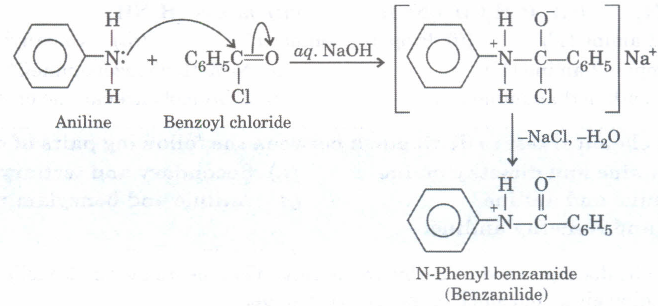
4.
Write chemical reaction of aniline with benzoyl chloride and write the name of the product abtained.
5.
Write structures and IUPAC names of
(i) the amide which gives propanamide by Hoffmann bromamide reaction.
(ii) the amine produced by the Hofmann degradation of benzamide.
6.
How will you carry out the following conversions?
q.jpg)
q.jpg)
7.
How will you bring out the following conversion?
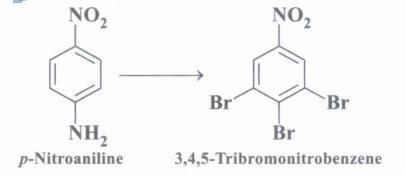
8.
Write following conversions:
(i) nitrobenzene\(\longrightarrow \)acetanilide
(ii) acetanilide\(\longrightarrow \)p-nitroaniline
9.
How will you carry out the following conversions?
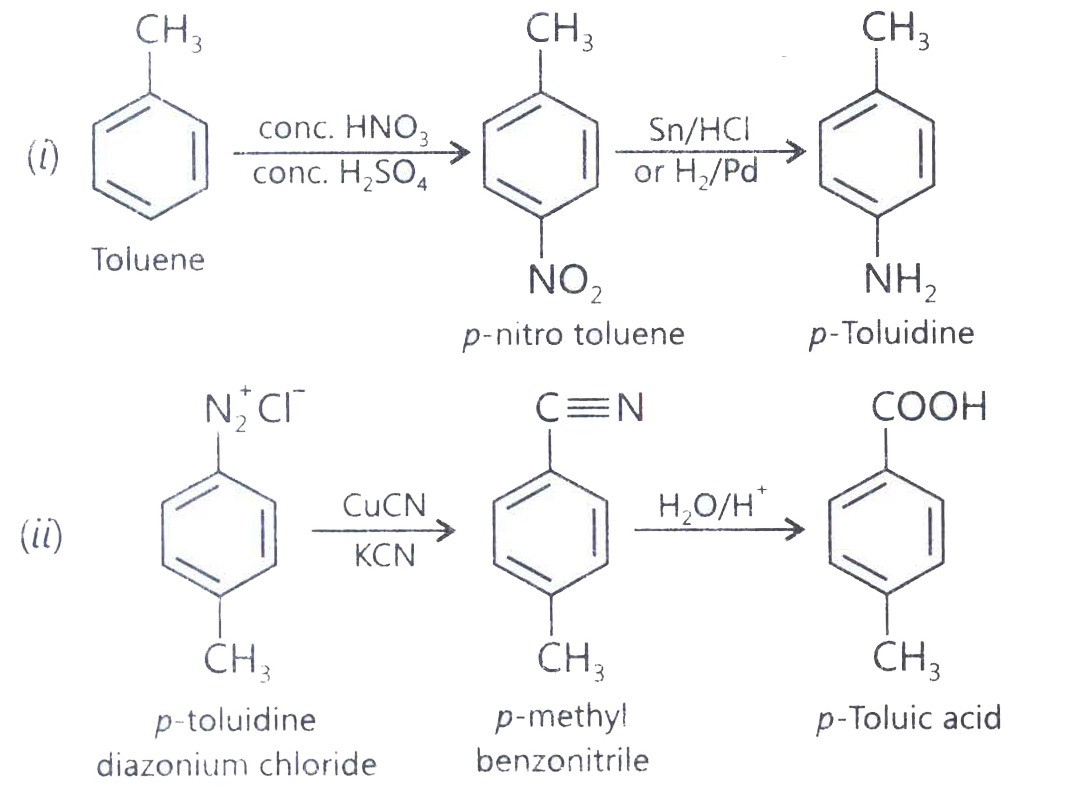
(i) toluene \(\longrightarrow \) p-toluidine
(ii) p-toluidine diazonium chloride \(\longrightarrow \) p-toluic acid
10.
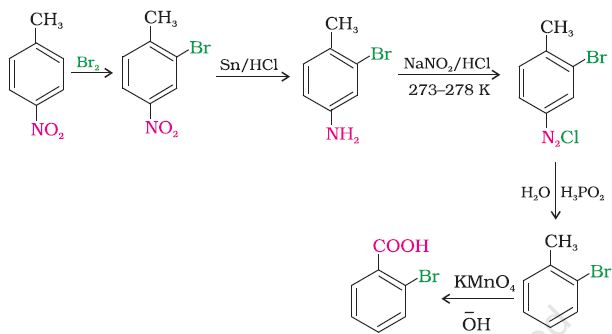
How will you convert 4-nitrotoluene to 2-bromobenzoic acid?
11.
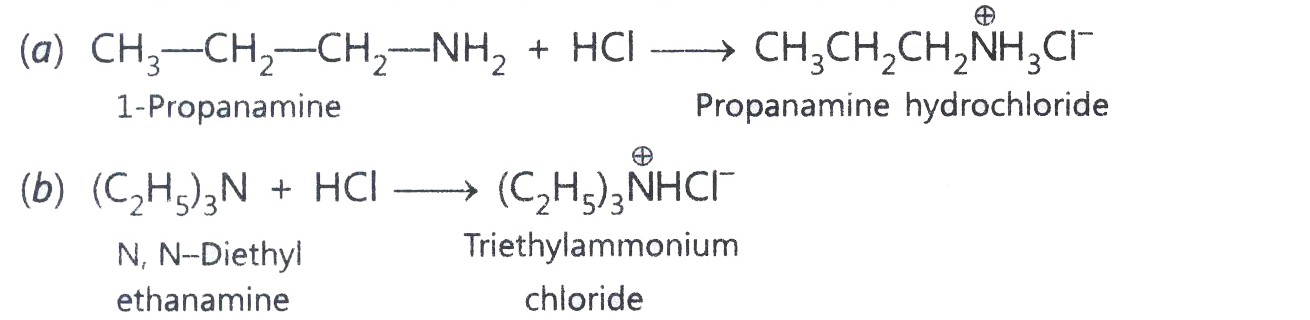
Complete the following acid-base reactions and name the products:
(a) CH3-CH2-CH2-NH2 + HCI \(\rightarrow \)
(b) (C2H5)3N+HCI \(\rightarrow \)
12.
Arrange the following in decreasing order of their basic strength:
C6H5NH2, C2H5NH2, (C2H5)2 NH, NH3
13.
Write chemical equations for the following conversions:
(i) CH3-CH2-Cl into CH3-CH2-CH2-NH2
(ii) C6H5-CH2-Cl into C6H5-CH2-CH2-NH2
14.
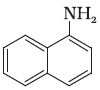
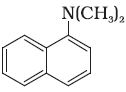
Classify the following amines as primary, secondary or tertiary:
(i)
(ii)
(iii) \(\left(\mathrm{C}_{2} \mathrm{H}_{5}\right)_{2} \mathrm{CHNH}_{2}\)
(iv) \(\left[\mathrm{C}_{2} \mathrm{H}_{5}\right)_{2} \mathrm{NH}\)
15.
Amino group is o, p-directing for aromatic electrophilic substitution. Why does aniline on nitroaniline?
16.
Out of ethylamine and ethyl alcohol which has higher boiling boiling point and why?
17.
How will you distinguish between C6H5CH2NH2 and C6H5NH2? Write the chemical equations for the reactions involved.
18.
Arrange the following substances:
C6H5NH2, (C2H5)2NH, (C2H5)3N, C2H5NH2
(i) In an increasing order of basic strength in water
(ii) In a decreasing order of basic strength in gas phase.
19.
Why cannot aromatic primary amines be prepared by Gabriel phythalimid synthesis?
20.
Complete the following reaction equations:
\((i)\ C_6H_5NH_2+CHCl_3+KOH(alc)\rightarrow\)
(ii) \(C_6H_5N_2Cl+H_3PO_2+H_2O\rightarrow\)
21.
Identify A and B in each of the following process:
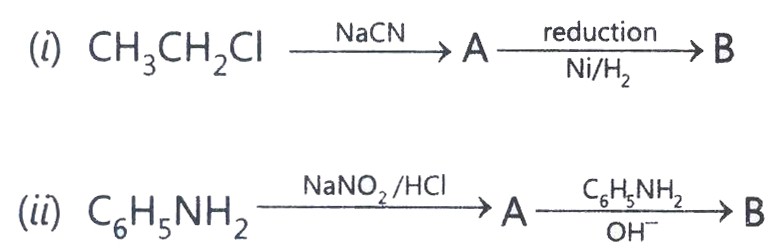
22.
How will you bring the following conversions?
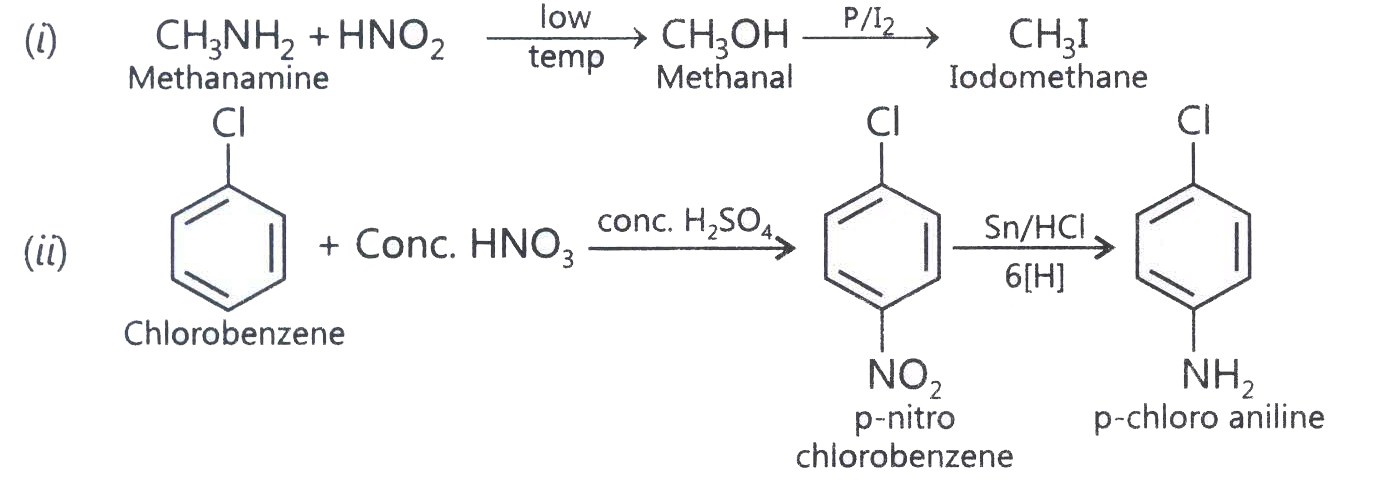
(i) Methanamine into Iodomethane
(ii) Chlorobenzene into p-chloroaniline.
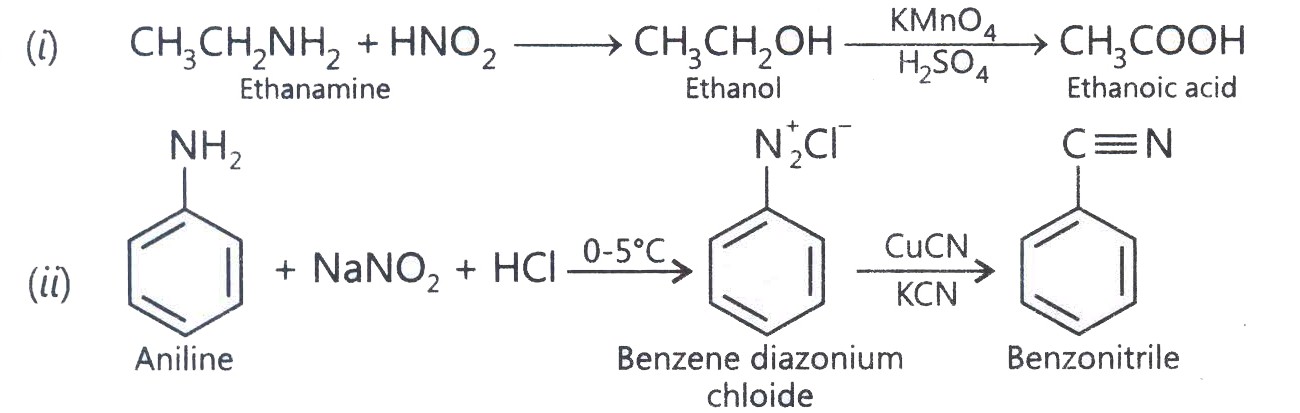
23.
How will you bring about the following conversions?
(i) Ethanamine to Ethanoic acid
(ii) Aniline to Benzonitrile
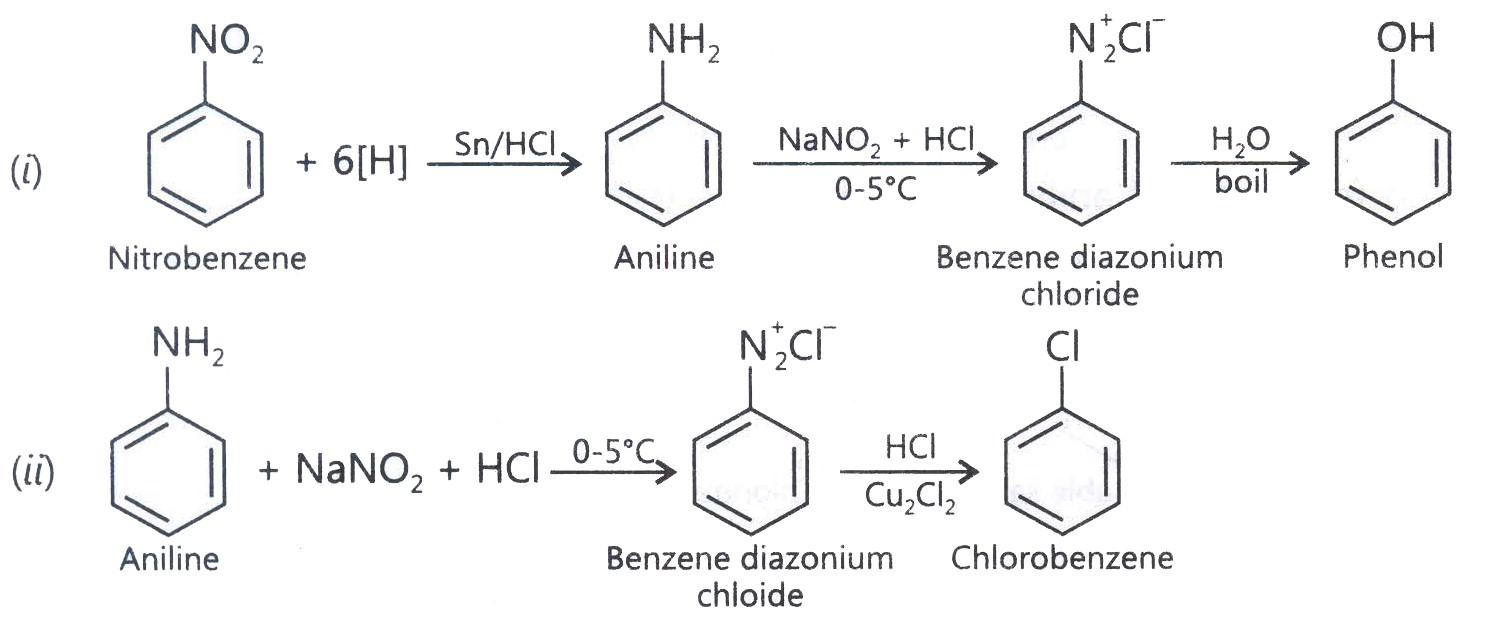
24.
How will you bring about the following conversions?
(i) Nitrobenzene to Phenol.
(ii) Aniline to Chlorobenzene.
25.
Account for the following:
(i) Diazonium salts of aromatic amines are more stable than those of aliphatic amines.
(ii) Amines are more basic than alcoholes of comparable molecular masses.
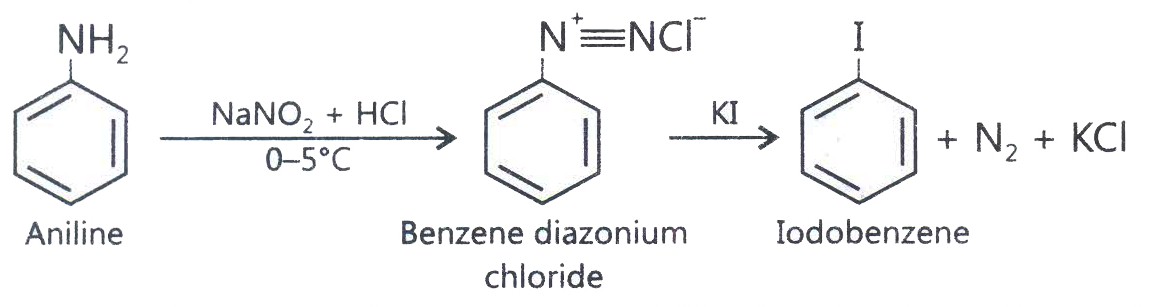
26.
How can you convert aniline to iodobenzene?
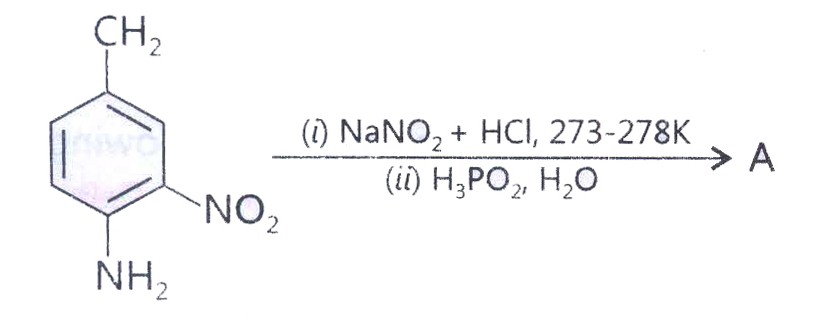
27.
Give the structure of 'A' in the following reaction.
28.
Why are aqueous solutions of amines basic in nature?
29.
Why do amines react as nucleophiles?
30.
Why is an alkylamine more basic than ammonia?
1.
(i) It is because C2H5O- is more stable than C2H5NH- because oxygen is more electronegative than nitrogen.
(ii) It is because primary amines are associated with intermolecular H-bonding, whereas tertiary arnines are not.
(iii) It is because there is electron withdrawing C6H5- group in aromatic amines which makes them less basic than aliphatic amines in which alkyl group is electron releasing.
2.
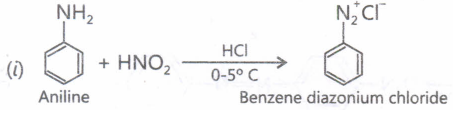
(ii) \( { C }_{ 2 }{ H }_{ 5 }{ NH }_{ 2 }+{ \ HNO }_{ 2 } \longrightarrow { C }_{ 2 }{ H }_{ 5 }OH+{ N }_{ 2 }+{ H }_{ 2 }O\\ Ethanamine\quad \quad\quad\quad\quad Nitrus\quad acid\quad \quad \quad \quad Ethanol\)
3.
4.
5.
(i) Propanamine contains three carbons. Hence, the amide molecule must contain four carbon atoms. Structure and IUPAC name of the starting amide with four carbon atoms are given below:
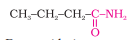
(ii) Benzamide is an aromatic amide containing seven carbon atoms. Hence, the amine formed from benzamide is aromatic primary amine containing six carbon atoms.

6.
s.jpg)
(ii) Follow procedures as in (i) till second last step
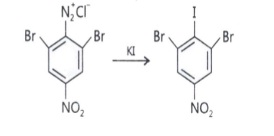
7.
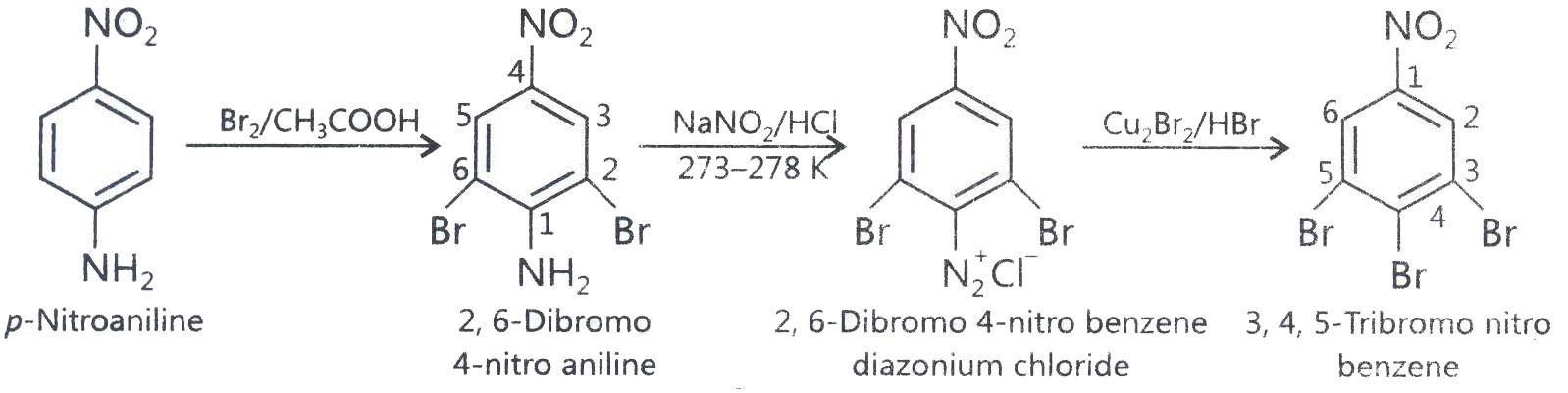
8.
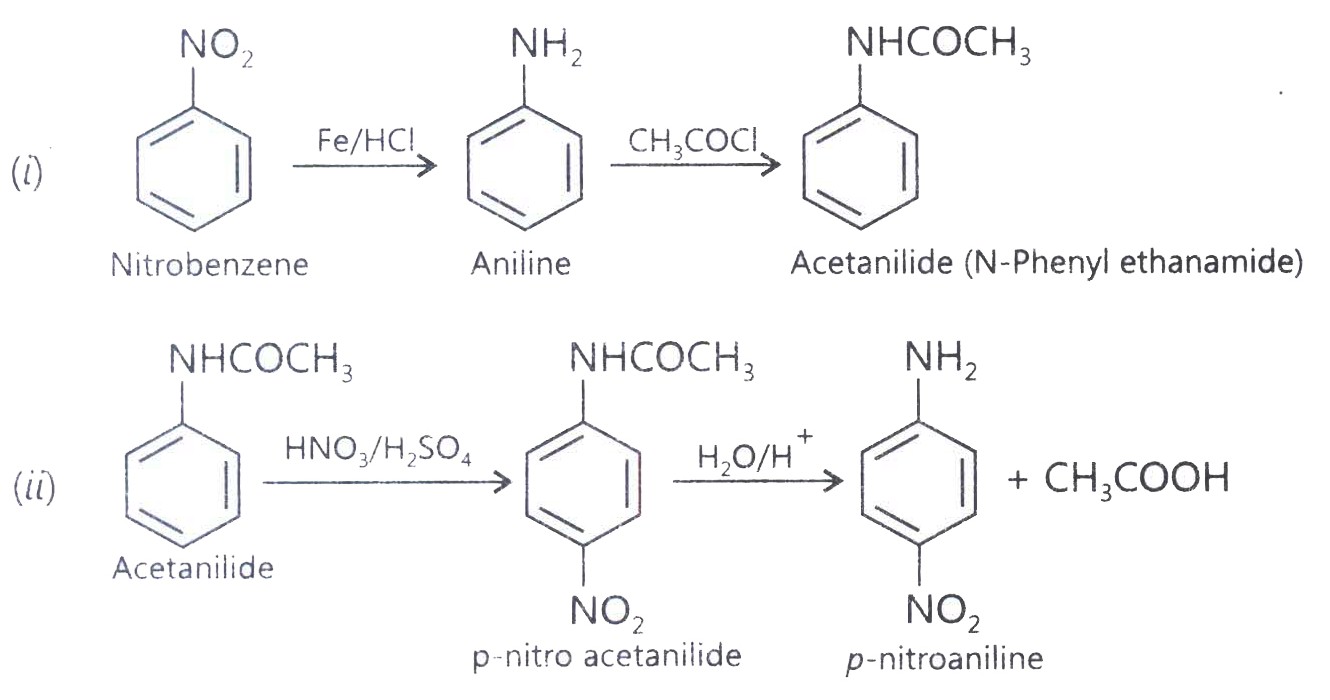
9.
10.
11.
12.
The decreasing order of basic strength of the given amines and ammonia follows the following order:
(C2H5)NH > C2H5NH2 > NH3 > C6H5NH2
13.

14.
(i) Primary
(ii) Tertiary
(iii) Primary
(iv) Secondary
15.
It is due to protonation of aniline to form C6H5NH3 which is electron with drawing, hence m-directing.
16.
Ethyl alcohol has higher boiling point than ethlamine because there is stronger intermolecular H- bonding in ethanol than ethylamine due to more electronegativity of oxygen than nitrogen.
17.
Add CHCI3 and alc. KOH,C6H5 - NH2 gives foul smell of isocyanide whereas C6H5 - NH - CH3 does not.
18.

19.
It is because there is double bond character between C\(\rightarrow\)X bond due to which it cannot be broken easily that is why aromatic amines cannot be prepared by Gabriel phthalimide synthesis.
20.
(i) \(\underset { Aniline }{ C_{ 6 }H_{ 5 }NH_{ 2 } } +CHCl_{ 3 }+\underset { (alc) }{ 3KOH } \quad { \longrightarrow }\underset { Phenyl\quad carbylamine }{ C_{ 6 }H_{ { 5 } }N_{ \rightarrow }^{ = }C } +3KCl+3H_{ 2 }O\)
(ii) \(\underset { Benzene\\ diazonium\\ Chloride }{ C_{ 6 }H_{ 5 }N_{ 2 }Cl } +\underset { Hypo\\ phosphorus\quad \\ acid }{ H_{ 3 }PO_{ 2 } } +H_{ 2 }O\quad { \longrightarrow }\underset { Benzene }{ C_{ 6 }H_{ 6 } } +\underset { Phosphoric\\ acid }{ H_{ 3 }PO_{ 3 } } +N_{ 2 }+HCl\)
21.
s.jpg)
s.jpg)
22.
23.
24.
25.
(i) It is because if resonance stabilization in diazonium salts of aromatic amines which is not possible in diazonium salts of aliphatic amines.
(ii) It is because 'N' is less electronegative than O, therefore, lone pair are easily avaiable.
26.
27.

28.
\(\mathrm{RNH}_2+\mathrm{H}_2 \mathrm{O} \longrightarrow \stackrel{\oplus}{\mathrm{N}} \mathrm{H}_3+\mathrm{OH}^{-}\). It is due to formation of OH-.
29.
It is due tp presence of lone pair of electronson nitrogen which they can donate and act as nucleophiles.
30.
It is because alkyl groups are electron releasing in alkyl amines, they will increase electron density on 'N', therefore, they are more basic than NH3.

12th Standard CBSE Syllabus & Materials
12th Standard CBSE
CBSE 12th Computer Science Python Revision Tour I - New Previous year Question Papers Study Material - QB365 Set A
NEW12th Standard CBSE
CBSE 12th Business Studies Planning Important Questions And Answers Study Material - QB365 Set A
NEW12th Standard CBSE
CBSE 12th Business Studies Business Environment Important Questions And Answers Study Material - QB365 Set A
NEW12th Standard CBSE
CBSE 12th Business Studies Principles of Management Important Questions And Answers Study Material - QB365 Set A



NCERT Books

Syllabus

Exam Pattern

Sample Question Papers

Previous year Question Papers

Important Notes

MCQ Practice test

NCERT Exemplers

Case study Questions

Image Based Questions

Passage based Questions

HOT Questions

Value Based Questions

Model Questions Papers
NCERT ( Book Back ) Questions

Assertion and Reason
Important Questions And Answers

CBSE 12th Standard CBSE Subjects
CBSE Standards