
 100% FREE ACCESS
12th Standard CBSE Syllabus & Materials
12th Standard CBSE
CBSE 12th Economics Government Budget and the Economy Previous year Question Papers Study Material - QB365 Set A
NEW12th Standard CBSE
CBSE 12th Computer Science Interface Python with MySQL - New Previous year Question Papers Study Material - QB365 Set A
NEW12th Standard CBSE
CBSE 12th Computer Science Database Concept - New Previous year Question Papers Study Material - QB365 Set A
NEW12th Standard CBSE
CBSE 12th Computer Science Data Communication - New Previous year Question Papers Study Material - QB365 Set A
NEW12th Standard CBSE
CBSE 12th Computer Science Data Structures - New Previous year Question Papers Study Material - QB365 Set A
NEW12th Standard CBSE
CBSE 12th Computer Science Functions - New Previous year Question Papers Study Material - QB365 Set A

Published on: 25/10/2025
Download CBSE Class 12th Standard CBSE Maths question papers, sample papers, important questions, and previous year solved papers in PDF format. Get free study materials, NCERT solutions, and exam preparation resources for Class 12th Standard CBSE Maths
Questions + Answers key
Take MCQ Maths Test
1.
Does there exist a function which is continuous everywhere but not differentiable at exactly two points? Justify your answer.
2.
Differentiate the functions with respect to cos x3 . sin2 (x5)
3.
Find all points of discontinuity of f, where f is defined by
\(f(x)=\left\{\begin{array}{ll} x+1, & \text { if } x \geq 1 \\ x^{2}+1, & \text { if } x<1 \end{array}\right.\)
4.
Find all points of discontinuity of f, where f is defined by
\(f(x)=\left\{\begin{array}{ll} \frac{x}{|x|}, & \text { if } x<0 \\ -1, & \text { if } x \geq 0 \end{array}\right.\)
5.
Let \(f(x)=\begin{cases} \frac { 1-sin^{ 3 }x }{ 3cos^{ 2 }x }\ \quad \quad \quad ,if\quad x<\frac { \pi }{ 2 }\\ a\qquad \qquad \ \ \ \quad,if\quad x=\frac {\pi }{ 2 } \\ \frac { b(1-sin\quad x) }{ (\pi -2x)^{ 2 } } \ \ \ \ \ \ \ \ ,if\quad x>\frac { \pi }{ 2 } \end{cases}\) If f(x) be a continuous function at x = \(\pi\over{2}\), find a and b.
6.
Differentiate w.r.t. x: \({ \left( 5x \right) }^{ 3\ cos\ 2x }\)
7.
For a positive constant a, find \( \frac { dy }{ dx } ,\ where: y={ a }^{ t+\frac { 1 }{ t } }and\ x={ \left( t+\frac { 1 }{ t } \right) }^{ a }\)
8.
\(If\quad y={ e }^{ y }(x+1)=1,\quad show\quad that: \frac { { d }^{ 2 }y }{ { dx }^{ 2 } } ={ \left( \frac { dy }{ dx } \right) }^{ 2 }.\)
9.
\(If=5\quad cosx-3sinx,\quad prove\quad that\quad \frac { { d }^{ 2 }y }{ { dx }^{ 2 } } +y=0\)
10.
Find the second order derivative of the functions: \({ x }^{ 2 }+3x+2\)
11.
Differentiate the following with respect to x: cos x.cos 2x. cos 3x
12.
Is the function defined by
\(f(x)={ x }^{ 2 }-sinx+5\) continuous at x=π?
13.
Show that the function f given by: \(f(x)=\begin{cases} { x }^{ 3 }+3,\quad if\quad x\neq 0 \\ 1,\quad \quad \quad if\quad x=0 \end{cases}\) is not continuous at x = 0.
14.
Differentiate w.r.t. x, the following function:
\((i) \sqrt{3 x+2}+\frac{1}{\sqrt{2 x^2+4}}\\ (ii) \log _7(\log x) \)
15.
Differentiate w.r.t. x the function in Exercises \(x^{x^2-3}+(x-3)^{x^2}, \text { for } x>3\)
16.
If \(y=\cos ^{-1} x\) , Find \(\frac{d^{2} y}{d x^{2}}\) in terms of y alone.
17.
Differentiate aX w.r.t. x, where a is a positive constant.
18.
If y = tan-1\(\sqrt { \frac { sinx }{ 1+cosx } , } find\frac { dy }{ dx } \)
19.
Differentiate sin {log (x3-1)}, with respect to x.
20.
State the points of discountinuity for the function \(f(x)= [x]\) in \(-3 < x < 3.\)
1.
consider the function f(x) = |x - 1| + |x - 2|
Differentiability of f(x)
Since modulus function is everywhere continuous and sum of two continuous function is also continuous.Graph of f(x) shows, that f(x) is every where derivable except possible at x = 0 and x = 1
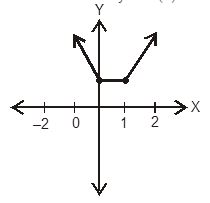
It can be seen from the above graph that, the given function is continuos everywhere but not differentiable at exactly two points which are 0 and 1.
2.
The given function is cos x3 . sin2 (x5)
\(\frac{d}{d x}\left[\cos x^{3} \cdot \sin ^{2}\left(x^{5}\right)\right]=\sin ^{2}\left(x^{5}\right) \times \frac{d}{d x}\left(\cos x^{3}\right)+\cos x^{3} \times \frac{d}{d x}\left[\sin ^{2}\left(x^{5}\right)\right] \)
\(=\sin ^{2}\left(x^{5}\right) \times\left(-\sin x^{3}\right) \times \frac{d}{d x}\left(x^{3}\right)+\cos x^{3} \times 2 \sin \left(x^{3}\right) \cdot \frac{d}{d x}\left[\sin x^{5}\right] \)
\(=-\sin x^{3} \sin ^{2}\left(x^{5}\right) \times 3 x^{2}+2 \sin x^{5} \cos x^{3} \cdot \cos x^{5} \times \frac{d}{d x}\left(x^{5}\right) \)
\(=-3 x^{2} \sin x^{3} \cdot \sin ^{2}\left(x^{5}\right)+2 \sin x^{5} \cos x^{5} \cos x^{3} \cdot \times 5 x^{4} \)
\(=10 x^{4} \sin x^{5} \cos x^{5} \cos x^{3}-3 x^{2} \sin x^{3} \sin ^{2}\left(x^{5}\right) \)
3.
\(f(x)=\left\{\begin{array}{ll} x+1, & \text { if } x \geq 1 \\ x^{2}+1, & \text { if } x<1 \end{array}\right.\)
The given function f is defined at all the points of the real line.
Let c be a point on the real line.
Case I:\(\text { If } c<1, \text { then } f(c)=c^{2}+1 \text { and } \lim _{x \rightarrow c} f(x)=\lim _{x \rightarrow c}\left(x^{2}+1\right)=c^{2}+1\)
\(\therefore \lim _{x \rightarrow c} f(x)=f(c) \)
Therefore, f is continuous at all points x, such that x < 1
Case II: \(\text { If } c=1, \text { then } f(c)=f(1)=1+1=2\)
The left hand limit of f at x = 1 is,
\(\lim _{x \rightarrow 1^{-}} f(x)=\lim _{x \rightarrow 1^{-}}\left(x^{2}+1\right)=1^{2}+1=2\)
The right hand limit of f at x = 1 is,
\(\lim _{x \rightarrow 1^{+}} f(x)=\lim _{x \rightarrow 1^{+}}(x+1)=1+1=2 \)
\(\therefore \lim _{x \rightarrow 1} f(x)=f(1) \)
Therefore, f is continuous at x = 1
Case III: \(\text { If } c>1, \text { then } f(c)=c+1 \)
\(\lim _{x \rightarrow c} f(x)=\lim _{x \rightarrow c}(x+1)=c+1 \)
\(\therefore \lim _{x \rightarrow c} f(x)=f(c) \)
Therefore, f is continuous at all points x, such that x > 1
Hence, the given function f has no point of discontinuity
4.
\(f(x)=\left\{\begin{array}{ll} \frac{x}{|x|}, & \text { if } x<0 \\ -1, & \text { if } x \geq 0 \end{array}\right.\)
It is known that \(x<0 \Rightarrow|x|=-x\)
Therefore, the given function can be rewritten as
\(f(x)=\left\{\begin{array}{l} \frac{x}{|x|}=\frac{x}{-x}=-1, \text { if } x<0 \\ -1, \text { if } x \geq 0 \end{array}\right.\)
\(\Rightarrow f(x)=-1 \text { for all } x \in \mathbf{R} \)
Let c be any real number. Then, \(\lim _{x \rightarrow c} f(x)=\lim _{x \rightarrow c}(-1)=-1\)
Also \(f(c)=-1=\lim _{x \rightarrow c} f(x)\)
Therefore, the given function is a continuous function.
Hence, the given function has no point of discontinuity.
5.
If function is continuous at \(x=\frac{\pi}{2}, \text { then }\)
\(\mathrm{LHL}_{x=\frac{\pi}{2}}=\mathrm{RHL}=f\left(\frac{\pi}{2}\right)\)
\(\mathrm{LHL}_{x=\frac{\pi}{2}}=\lim _{h \rightarrow 0} f\left(\frac{\pi}{2}-h\right) \)
\(=\lim _{h \rightarrow 0} \frac{1-\sin ^{3}\left(\frac{\pi}{2}-h\right)}{3 \cos ^{2}\left(\frac{\pi}{2}-h\right)}=\lim _{h-0} \frac{1-\cos ^{3} h}{3 \sin ^{2} h} \)
\(=\lim _{h \rightarrow 0} \frac{(1-\cos h)\left(1+\cos ^{2} h+\cos h\right)}{3(1-\cos h)(1+\cos h)} \)
\(=\lim _{h \rightarrow 0} \frac{1+\cos ^{2} h+\cos h}{3(1+\cos h)}=\frac{1+1+1}{3(1+1)}=\frac{1}{2} \ldots .(i i) \)
\(\operatorname{RHL} =\lim _{h=\frac{\pi}{2}} f\left(\frac{\pi}{2}+h\right)=\lim _{h \rightarrow 0} \frac{b\left\{1-\sin \left(\frac{\pi}{2}+h\right)\right\}}{\left\{\pi-2\left(\frac{\pi}{2}+h\right)\right\}^{2}} \)
\(=\lim _{h \rightarrow 0} \frac{b(1-\cos h)}{(\pi-\pi-2 h)^{2}}=\lim _{h \rightarrow 0} \frac{b(1-\cos h)}{4 h^{2}} \)
\(=\lim _{h \rightarrow 0} \frac{b \cdot 2 \sin ^{2} \frac{h}{2}}{4 h^{2}}=\lim _{h \rightarrow 0} \frac{b}{8}\left(\frac{\sin \frac{h}{2}}{\frac{h}{2}}\right)^{2} \)
\(=\frac{b}{8} \times 1=\frac{b}{8} \)
Substituting from (ii) and (iii) in (i), we get
\(\frac{1}{2}=\frac{b}{8}=a \Rightarrow a=\frac{1}{2}, b=4\)
Hence, for \(a=\frac { 1 }{ 2 } ,\quad b=4 \text { function is continuous at} x=\frac { \pi }{ 2 } .\)
6.
\(Let\ y={ \left( 5x \right) }^{ 3\ cos\ 2x }\)
\(Taking\ logs.,\ log\ y=log\ { \left( 5x \right) }^{ 3\ cos\ 2x }\)
\(Diff.w.r.t.x,\quad \frac { 1 }{ y } .\frac { dy }{ dx } \)
\(=3\left[ cos\quad 2x.\frac { 1 }{ 5x } (5)+log(5x).(-sin\quad 2x)2 \right] \)
\(\Rightarrow \frac { dy }{ dx } \)
\(=3y\left[ \frac { cos\quad 2x }{ x } -2sin\quad 2x\quad log\quad 5x \right]\)
\( Hence\quad \frac { dy }{ dx } ={ \left( 5x \right) }^{ 3\quad cos\quad 2x }\left[ 3\frac { cos\quad 2x }{ x } -6sin\quad 2x\quad log\quad 5x \right] \)
7.
Observe that both y and x are defined for all real t ≠ 0. Clearly
\( \frac{d y}{d t}=\frac{d}{d t}\left(a^{t+\frac{1}{t}}\right) =a^{t+\frac{1}{t}} \frac{d}{d t}\left(t+\frac{1}{t}\right) \cdot \log a \\ =a^{t+\frac{1}{t}}\left(1-\frac{1}{t^2}\right) \log a \)
Similarly \(\frac{d x}{d t} =a\left[t+\frac{1}{t}\right]^{a-1} \cdot \frac{d}{d t}\left(t+\frac{1}{t}\right) \)
\( =a\left[t+\frac{1}{t}\right]^{a-1} \cdot\left(1-\frac{1}{t^2}\right) \)
\(\frac{d x}{d t} \neq 0 \text { only if } t \neq \pm 1 \text {. Thus for } t \neq \pm 1\)
\(\frac{d y}{d x}=\frac{\frac{d y}{d t}}{\frac{d x}{d t}}=\frac{a^{t+\frac{1}{t}}\left(1-\frac{1}{t^2}\right) \log a}{a\left[t+\frac{1}{t}\right]^{a-1} \cdot\left(1-\frac{1}{t^2}\right)}\)
\(=\frac{a^{t+\frac{1}{t}} \log a}{a\left(t+\frac{1}{t}\right)^{a-1}}\)
8.
\(We\quad have:\quad { e }^{ y }(x+1)=1\)
\({ e }^{ y }=\frac { 1 }{ x+1 } \)
\(y=log\left( \frac { 1 }{ x+1 } \right) \)
\(y=-log(x+1)......(1)\)
\(\frac { dy }{ dx } =-\frac { 1 }{ x+1 } ....(2)\)
\( and\quad \frac { { d }^{ 2 }y }{ { dx }^{ 2 } } =\frac { 1 }{ { \left( x+1 \right) }^{ 2 } } ={ \left( \frac { dy }{ dx } \right) }^{ 2 }\)
\(Hence,\quad \frac { { d }^{ 2 }y }{ { dx }^{ 2 } } ={ \left( \frac { dy }{ dx } \right) }^{ 2 }\)
9.
\(We\quad have\quad y=5\quad cosx-3sinx\)
\( \frac { dy }{ dx } =-5\quad sin\quad x-3\quad cos\quad x\)
\(and\quad \frac { { d }^{ 2 }y }{ { dx }^{ 2 } } =-5\quad cos\quad x+3\quad sinx\)
\(=-(5\quad cos\quad x-3\quad sin\quad x)\)
\(=-y\)
\(Hence,\quad \frac { { d }^{ 2 }y }{ { dx }^{ 2 } } +y=0\)
10.
\(Let\quad y={ x }^{ 2 }+3x+2\)
\(\frac { dy }{ dx } =2x+3\quad and\quad \frac { { d }^{ 2 }y }{ { dx }^{ 2 } } =2\)
11.
\(Let\ y=cosx.\ cos\ 2x.\ cos\ 3x\)
\(Taking\ logs,\)
\(log\ y=log(os\ x.os\ 2x.\ cos\ 3x)\)
\(=log\ cosx+log\ cos2x+\ log\ cos3x\)
\(Diff.\quad w.r.t.\quad \frac { 1 }{ y } \frac { dy }{ dx } \)
\(=\frac { 1 }{ cos\quad x } (-sin\quad x)+\frac { 1 }{ cos\quad 2x } (-2sin\quad 2x)+\frac { 1 }{ cos\quad 3x } (-sin\quad 3x)\)
\(\frac { dy }{ dx } =y\left[ -tan\quad x-2\quad tan\quad 2x-3\quad tan\quad 3x \right] \)
\(=cos\quad x.os\quad 2x.\quad cos\quad 3x\)
\(\left[ -tan\ x-2\ tan\ 2x-3\ tan3x \right] \)
\(=-cos\ x\ cos\ 2x\ cos\ 3x\)
12.
\(We\ have:\ f(x)={ x }^{ 2 }-sin\ \pi +5={ \pi }^{ 2 }-0+5\)
\(={ \pi }^{ 2 }+5.\)
\(Now\ \lim _{ x\rightarrow \pi }{ f(x) } =\lim _{ x\rightarrow \pi }{ f({ x }^{ 2 }-sinx+5) } \)
\(={ \pi }^{ 2 }-sin\pi +5.\)
\(={ \pi }^{ 2 }-0+5={ \pi }^{ 2 }+5=f(\pi )\)
\(Hence,\ 'f'\ is\ continuous\ at\ x=\pi \)
13.
The function is defined at x = 0 and its value at x = 0 is 1. When x \(\ne\) 0, the function is given by a polynomial. Hence
\(\lim _{ x\rightarrow 0 }{ f(x) } =\lim _{ x\rightarrow 0 }{ { x }^{ 3 }+3 } =0+3=3\)
Since the limit of f at x = 0 does not coincide with f(0), the function is not continuous at x = 0. It may be noted that x = 0 is the only point of discontinuity for this function.
14.
\(\text {(i) Let } y=\sqrt{3 x+2}+\frac{1}{\sqrt{2 x^2+4}}=(3 x+2)^{\frac{1}{2}}+\left(2 x^2+4\right)^{-\frac{1}{2}}\)
Note that this function is defined at all real numbers \(x>-\frac{2}{3}\)Therefore
\( \frac{d y}{d x} =\frac{1}{2}(3 x+2)^{\frac{1}{2}-1} \cdot \frac{d}{d x}(3 x+2)+\left(-\frac{1}{2}\right)\left(2 x^2+4\right)^{-\frac{1}{2}-1} \cdot \frac{d}{d x}\left(2 x^2+4\right) \\ \)
\(=\frac{1}{2}(3 x+2)^{-\frac{1}{2}} \cdot(3)-\left(\frac{1}{2}\right)\left(2 x^2+4\right)^{-\frac{3}{2}} \cdot 4 x \\ \)
\( =\frac{3}{2 \sqrt{3 x+2}}-\frac{2 x}{\left(2 x^2+4\right)^{\frac{3}{2}}}\)
This is defined for all real numbers \(x>-\frac{2}{3}\)
\(\text {(ii) Let } y=\log _7(\log x)=\frac{\log (\log x)}{\log 7}\) (by change of base formula).
The function is defined for all real numbers x > 1. Therefore
\( \frac{d y}{d x} =\frac{1}{\log 7} \frac{d}{d x}(\log (\log x)) \)
\( =\frac{1}{\log 7} \frac{1}{\log x} \cdot \frac{d}{d x}(\log x) \)
\( =\frac{1}{x \log 7 \log x}\)
15.
\(x^{x^2-3}+(x-3)^{x^2}, \text { for } x>3\)
Let \(y=x^{x^2-3}+(x-3)^{x^2}\)
And let \(u=x^{x^2-3}, v=(x-3)^{x^2}\)
\(\boldsymbol{y}=\boldsymbol{u}+\boldsymbol{v}\)
Differentiating both sides w.r.t. x
\(\frac{d y}{d x}=\frac{d(u+v)}{d x} \)
\( \frac{d y}{d x}=\frac{d u}{d x}+\frac{d v}{d x}\)
Differentiating both sides with respect to x, we obtain
\( \frac{1}{u} \frac{d u}{d x}=\log x \cdot \frac{d}{d x}\left(x^2-3\right)+\left(x^2-3\right) \cdot \frac{d}{d x}(\log x) \)
\( \Rightarrow \frac{1}{u} \frac{d u}{d x}=\log x \cdot 2 x+\left(x^2-3\right) \cdot \frac{1}{x} \)
\( \Rightarrow \frac{d u}{d x}=x^{x^2-1}\left[\frac{x^2-3}{x}+2 x \log x\right]\)
Now, v=(x-3)x
Taking logarithm on both the sides, we obtain
\(\log v =\log (x-3)^{x^2} =x^2 \log (x-3)\)
Differentiating both sides with respect to x, we obtain
\(\frac{1}{v} \frac{d v}{d x}=\log (x-3) \cdot \frac{d}{d x}\left(x^2\right)+\left(x^2\right) \cdot \frac{d}{d x}[\log (x-3)] \)
\(\Rightarrow \frac{1}{v} \frac{d v}{d x}=\log (x-3) \cdot 2 x+x^2 \cdot \frac{1}{x-3} \cdot \frac{d}{d x}(x-3) \)
\( \Rightarrow \frac{d v}{d x}=v\left[2 x \log (x-3)+\frac{x^2}{x-3} \cdot 1\right] \)
\( \Rightarrow \frac{d v}{d x}=(x-3)^{x^2}\left[\frac{x^2}{x-3}+2 x \log (x-3)\right]\)
From (1), (2), and (3), we obtain
16.
We have,
\(f(x)=x^{2}+2 x-8, x \in[-4,2]\)
Rolle'stheoremis satisfied
\( \therefore f^{\prime}(c)=0 \)
\(\Rightarrow f^{\prime}(c)=2 c+2=0 \)
\(c+1=0 \Rightarrow c=-1 \)
17.
Let y = ax.
Taking log on both sides, we get log y = x log a
On differentiating both sides w.r.t. x, we get
\(\frac{1}{y} \frac{d y}{d x}=\log a \Rightarrow \frac{d y}{d x}=y \log a\)
Thus,\(\frac{d}{d x}\left(a^{x}\right)=a^{x} \log a\)
18.
Given, y = tan-1\(\sqrt { \frac { sinx }{ 1+cosx } } \)
y = tan-1\(\sqrt { \frac { 2sin\frac { x }{ 2 } cos\frac { x }{ 2 } }{ 2{ cos }^{ 2 }\frac { x }{ 2 } } } \)
y = tan-1\(\left( \sqrt { tan\frac { x }{ 2 } } \right) \)
y = tan-1
19.
\(\frac { d }{ dx } \left[ sin\left\{ log\left( { x }^{ 2 }-1 \right) \right\} \right] \)
\(=cos\left[ log\left( { x }^{ 2 }-1 \right) \right] .\frac { 1 }{ { x }^{ 3 }-1 } .3{ x }^{ 2 }\)
\(=\frac { 3{ x }^{ 2 }cos\left[ log\left( { x }^{ 3 }-1 \right) \right] }{ { x }^{ 3 }-1 } \)
20.
f(x) = [x] is not continuous for integers.Hence not continuous at x = ±2, ±1, 0

12th Standard CBSE Syllabus & Materials
12th Standard CBSE
CBSE 12th Computer Science Python Revision Tour I - New Previous year Question Papers Study Material - QB365 Set A
NEW12th Standard CBSE
CBSE 12th Business Studies Planning Important Questions And Answers Study Material - QB365 Set A
NEW12th Standard CBSE
CBSE 12th Business Studies Business Environment Important Questions And Answers Study Material - QB365 Set A
NEW12th Standard CBSE
CBSE 12th Business Studies Principles of Management Important Questions And Answers Study Material - QB365 Set A



NCERT Books

Syllabus

Exam Pattern

Sample Question Papers

Previous year Question Papers

Important Notes

MCQ Practice test

NCERT Exemplers

Case study Questions

Image Based Questions

Passage based Questions

HOT Questions

Value Based Questions

Model Questions Papers
NCERT ( Book Back ) Questions

Assertion and Reason
Important Questions And Answers

CBSE 12th Standard CBSE Subjects
CBSE Standards