
 100% FREE ACCESS
12th Standard CBSE Syllabus & Materials
12th Standard CBSE
CBSE 12th Economics Government Budget and the Economy Previous year Question Papers Study Material - QB365 Set A
NEW12th Standard CBSE
CBSE 12th Computer Science Interface Python with MySQL - New Previous year Question Papers Study Material - QB365 Set A
NEW12th Standard CBSE
CBSE 12th Computer Science Database Concept - New Previous year Question Papers Study Material - QB365 Set A
NEW12th Standard CBSE
CBSE 12th Computer Science Data Communication - New Previous year Question Papers Study Material - QB365 Set A
NEW12th Standard CBSE
CBSE 12th Computer Science Data Structures - New Previous year Question Papers Study Material - QB365 Set A
NEW12th Standard CBSE
CBSE 12th Computer Science Functions - New Previous year Question Papers Study Material - QB365 Set A

Published on: 25/10/2025
Download CBSE Class 12th Standard CBSE Maths question papers, sample papers, important questions, and previous year solved papers in PDF format. Get free study materials, NCERT solutions, and exam preparation resources for Class 12th Standard CBSE Maths
Questions + Answers key
Take MCQ Maths Test
1.
If A and B are two events such that P(A) =0.2, P(B) =0.4 and P(A U B) = 0.5, then value of P(A /B) is?
0.1
0.25
0.5
0.08
2.
A problem in Mathematics is given to three students whose chances of solving it are \(\frac{1}{2}, \frac{1}{3}, \frac{1}{4},\) respectively. If the events of their solving the problem are independent,then the probability that the problem will be solved, is
\(\frac{1}{4}\)
\(\frac{1}{3}\)
\(\frac{1}{2}\)
\(\frac{3}{4}\)
3.
For any two events A and B, if \(P(\bar{A})=\frac{1}{2}, P(\bar{B})=\frac{2}{3}\) and \(P(A \cap B)=\frac{1}{4}\), then \(P\left(\frac{\bar{A}}{\bar{B}}\right)\)equals to
\(\frac{3}{8}\)
\(\frac{5}{8}\)
\(\frac{1}{8}\)
\(\frac{1}{4}\)
4.
The corner points of the feasible region in the graphical representation of a linear programming problem are (2, 72), (15, 20) and (40,15). If Z = 18x + 9y be the objective function, then
Z is maximum at (2, 72), minimum at (15, 20).
Z is maximum at (15, 20), minimum at (40, 15).
Z is maximum at (40, 15), minimum at (15, 20).
Z is maximum at (40,15), minimum at (2, 72).
5.
A bag A contains 3 white, 2 red balls and a bag B contains 4 white and 5 red balls. One ball is drawn at random from one of the bags and is found to be red, then the probability that it was drawn from bag B is
\(\frac{27}{43}\)
\(\frac{20}{43}\)
\(\frac{25}{43}\)
none of these
6.
Solution of LPP
To maximise Z = 4x + 8y
subject to constraints: \(2 x+y \leq 30, x+2 y \leq 24, x \geq 3,\)\(y \leq 9, y \geq 0 \text { is }\)
x = 12, y = 6
x = 6, y = 12
x = 9, y = 6
none of these
7.
The maximum value of z= 4x + 3y, if the feasible region for an LPP is as shown below, is
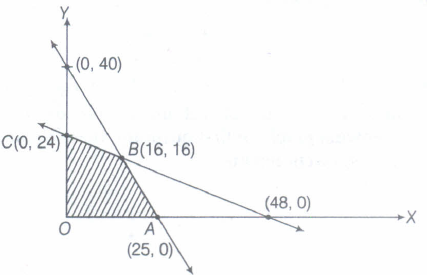
112
100
72
110
8.
If \(y=x \cos x, \text { then } \frac{d^{2} y}{d x^{2}}\) is
\(-x \cos x-2 \sin x\)
xcosx + 2sinx
xsinx + cosx
None of these
9.
If \(y=(\cos x)^{(\cos x)^{(\cos x) \ldots \infty}}\),then \(\frac{d y}{d x}\) is equal to
\(\frac{y \tan x}{y \log \cos x-1}\)
\(\frac{y^{2} \tan x}{y \log \cos x-1}\)
\(\frac{y \tan x}{1+y \log \cos x}\)
None ofthese
10.
If \(x^{y}=y^{x}, \text { then } x(x-y \log x) \frac{d y}{d x}\) is equal to
y(y-xlogy)
y(y + xlogy)
x(x + ylogx)
x(y -xlogy)
11.
How many of the following points satisfy the inequality 2x – 3y > -5?
(1, 1), (-1, 1), (1, -1), (-1, -1), (-2, 1), (2, -1), (-1, 2) and (-2, -1)
2
4
6
5
12.
Let Z = ax + by is a linear objective function. Variables x and y are called ……… variables.
Independent
Continuous
Decision
Dependent
13.
The linear inequalities or equations or restrictions on the variables of a linear programming problem are called …… The conditions x ≥ 0 , y ≥ 0 are called …….
Objective functions, optimal value
Constraints, non-negative restrictions
Objective functions, non-negative restrictions
Constraints, negative restrictions
14.
What is the point of discontinuity for signum function?
x = 1
x = -1
x = 0
function is continuous on R
15.
Let \(\begin{cases} 4x \ >2 \\ ax \ 0\le x\le 2 \\ b \ x<0 \end{cases}\) For what values of a and b, f is a continuous function.
a = 2, b = 0
a = 1, b = 0
a = 0, b = 2
a = 0, b = 0
16.
Which of the following functions are not continuous.
[x]
|x|
ex
\(\frac1x\), x ≠ 0
17.
In a box containing 100 bulbs, 10 are defective. The probability that out of a sample of 5 bulbs, none is defective is
10–1
\({ \left( \frac { 1 }{ 2 } \right) }^{ 5 }\)
\({ \left( \frac { 9 }{ 2 } \right) }^{ 5 }\)
\(\frac { 9 }{ 10 } \)
18.
If y = Ae5x,+ Be-5x x then \(\frac { { d }^{ 2 }y }{ dx^{ 2 } } \) is equal to
25y
5y
-25y
10y
19.
If y = sin-1 \(\left( \frac { 3x }{ 2 } -\frac { { x }^{ 3 } }{ 2 } \right) \), then \(\frac { dy }{ dx } \) is
\(\frac { 3 }{ \sqrt { 4-{ x }^{ 2 } } } \)
\(\frac { -3 }{ \sqrt { 4-{ x }^{ 2 } } } \)
\(\frac { 1 }{ \sqrt { 4-{ x }^{ 2 } } } \)
\(\frac {- 1 }{ \sqrt { 4-{ x }^{ 2 } } } \)
20.
Derivative of cot x° with respect to x is
cosec x°
cosec x° cot x°
-1° cosec2 x°
-1° cosec x° cot x°
21.
A card is lost from a pack of 52 cards. From the remaining cards two cards are drawn at random.
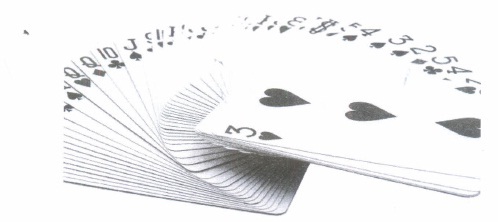
Based on the above information, answer the following questions.
(i) The probability of drawing two diamonds, given that a card of diamond is missing, is
| a) \(\frac{21}{425}\) | (b) \(\frac{22}{425}\) | (c) \(\frac{23}{425}\) | (d) None of these |
(ii) The probability of drawing two diamonds, given that a card of heart is missing, is
| a) \(\frac{26}{425}\) | (b) \(\frac{22}{425}\) | (c) \(\frac{19}{425}\) | (d) \(\frac{23}{425}\) |
(iii) Let A be the event of drawing two diamonds from remaining 51 cards and E1, E2, E3 and E4 be the events that lost card is of diamond, club, spade and heart respectively, then the approximate value of \(\sum_{i=1}^{4} P\left(A \mid E_{i}\right) \text { is }\)
| a) 0.17 | (b) 0.24 | (c) 0.25 | (d) 0.18 |
(iv) All of a sudden, missing card is found and, then two cards are drawn simultaneously without replacement. Probability that both drawn cards are king is
| a) \(\frac{1}{52}\) | (b) \(\frac{1}{221}\) | (c) \(\frac{1}{121}\) | (d) \(\frac{2}{221}\) |
(v) If two cards are drawn from a well shuffled pack of 52 cards, one by one with replacement, then probability of getting not a king in 1st and 2nd draw is
| a) \(\frac{144}{169}\) | (b) \(\frac{12}{169}\) | (c) \(\frac{64}{169}\) | (d) None of these |
22.
In a play zone, Aastha is playing crane game. It has 12 blue balls, 8 red balls, 10 yellow balls and 5 green balls. If Aastha draws two balls one after the other without replacement, then answer the following questions.
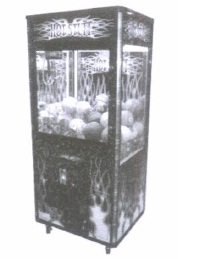
(i) What is the probability that the first ball is blue and the second ball is green?
| \((a) \ \frac{5}{119}\) | \((b) \ \frac{12}{119}\) | \((c) \ \frac{6}{119}\) | \((d) \ \frac{5}{119}\) |
(ii) What is the probability that the first ball is yellow and the second ball is red?
| \((a) \ \frac{6}{119}\) | \((b) \ \frac{8}{119}\) | \((c) \ \frac{24}{119}\) | (d) None of these |
(iii) What is the probability that both the balls are red?
| \((a) \ \frac{4}{85}\) | \((b) \ \frac{24}{595}\) | \((c) \ \frac{12}{119}\) | \((c) \ \frac{64}{119}\) |
(iv) What is the probability that the first ball is green and the second ball is not yellow?
| \((a) \ \frac{10}{119}\) | \((b) \ \frac{6}{85}\) | \((c) \ \frac{12}{119}\) | (d) None of these |
(v) What is the probability that both the balls are not blue?
| \((a) \ \frac{6}{595}\) | \((b) \ \frac{12}{85}\) | \((c) \ \frac{15}{17}\) | \((d) \ \frac{253}{595}\) |
23.
Deepa rides her car at 25 km/hr, She has to spend Rs. 2 per km on diesel and if she rides it at a faster speed of 40 km/hr, the diesel cost increases to Rs. 5 per km. She has Rs. 100 to spend on diesel. Let she travels x kms with speed 25 km/hr and y kms with speed 40 km/hr. The feasible region for the LPP is shown below:
Based on the above information, answer the following questions
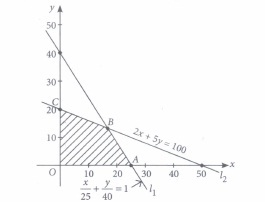
Based on the above information, answer the following questions.
(i) What is the point of intersection of line l1 and l2,
| \(\text { (a) }\left(\frac{40}{3}, \frac{50}{3}\right)\) | \(\text { (b) }\left(\frac{50}{3}, \frac{40}{3}\right)\) | \(\text { (c) }\left(\frac{-50}{3}, \frac{40}{3}\right)\) | \(\text { (d) }\left(\frac{-50}{3}, \frac{-40}{3}\right)\) |
(ii) The corner points of the feasible region shown in above graph are
| \(\text { (a) }(0,25),(20,0),\left(\frac{40}{3}, \frac{50}{3}\right)\) | \(\text { (b) }(0,0),(25,0),(0,20)\) | \(\text { (c) }(0,0),\left(\frac{40}{3}, \frac{50}{3}\right),(0,20)\) | \(\text { (d) }(0,0),(25,0),\left(\frac{50}{3}, \frac{40}{3}\right),(0,20)\) |
(iii) If Z = x + y be the objective function and max Z = 30. The maximum value occurs at point
| \(\text { (a) }\left(\frac{50}{3}, \frac{40}{3}\right)\) | (b) (0, 0) | (c) (25, 0) | (d) (0, 20) |
(iv) If Z = 6x - 9y be the objective function, then maximum value of Z is
| (a) -20 | (b) 150 | (c) 180 | (d) 20 |
(v) If Z = 6x + 3y be the objective function, then what is the minimum value of Z?
| (a) 120 | (b) 130 | (c) 0 | (d) 150 |
24.
(a) A function f(x) is said to be continuous in an open interval (a, b), if it is continuous at every point in this interval.
(b) A function f(x) is said to be continuous in the closed interval [a, b], if f(x) is continuous in (a, b) and \(\begin{equation} \lim _{h \rightarrow 0} f(a+h)=f(a) \text { and } \lim _{h \rightarrow 0} f(b-h)=f(b) \end{equation}\)
If function \(\begin{equation} f(x)=\left\{\begin{array}{ll} \frac{\sin (a+1) x+\sin x}{x} & , x<0 \\ c & , x=0 \\ \frac{\sqrt{x+b x^{2}}-\sqrt{x}}{b x^{3 / 2}} & , x>0 \end{array}\right. \end{equation}\) is continuous at x = 0, then answer the following questions.
(i) The value of a is
| (a) -3/2 | (b) 0 | (c) 1/2 | (d) -1/2 |
(ii) The value of b is
| (a) 1 | (b) -1 | (c) 0 | (d) any real number |
(iii) The value of c is
| (a) 1 | (b) 1/2 | (c) -1 | (d) -1/2 |
(iv) The value of a + c is
| (a) 1 | (b) 0 | (c) -1 | (d) -2 |
(v) The value oi c - a is
| (a) 1 | (b) 0 | (c) -1 | (d) 2 |
1.
(b)
0.25
2.
(d)
\(\frac{3}{4}\)
3.
(b)
\(\frac{5}{8}\)
4.
(c)
Z is maximum at (40, 15), minimum at (15, 20).
5.
(c)
\(\frac{25}{43}\)
6.
(a)
x = 12, y = 6
7.
(a)
112
8.
(a)
\(-x \cos x-2 \sin x\)
9.
Given that,\(y=(\cos x)^{(\cos x)^{(\cos x)} \cdots^{\infty}}\)
\(\Rightarrow \quad y=(\cos x)^{y}\)
Taking log on both sides, we get
log y = y log(cos x)
Now, differentiating w.r.t. x, we get
\(\frac{1}{y} \cdot \frac{d y}{d x}=y \cdot \frac{1}{\cos x}(-\sin x)+\log (\cos x) \cdot \frac{d y}{d x}\)
\(\Rightarrow \frac{d y}{d x}=y\left\{-y \tan x+\log \cos x \cdot \frac{d y}{d x}\right\} \)
\(\Rightarrow(1-y \log \cos x) \frac{d y}{d x}=-y^{2} \tan x \)
\(\Rightarrow \frac{d y}{d x}=\frac{y^{2} \tan x}{(y \log \cos x-1)} \)
10.
Since \(x^{y}=y^{x} \Rightarrow y \log x=x \log y\)
On differentiating w.r.t. x, we get
\( \Rightarrow y \cdot \frac{1}{x}+\log x \frac{d y}{d x}=\frac{x}{y} \frac{d y}{d x}+\log y \)
\(\Rightarrow \frac{d y}{d x}\left(\frac{x}{y}-\log x\right)=\frac{y}{x}-\log y \)
\(\Rightarrow x(x-y \log x) \frac{d y}{d x}=y(-x \log y+y) \)
11.
(d)
5
12.
(c)
Decision
13.
(b)
Constraints, non-negative restrictions
14.
(c)
x = 0
15.
(a)
a = 2, b = 0
16.
(a)
[x]
17.
(c)
\({ \left( \frac { 9 }{ 2 } \right) }^{ 5 }\)
18.
As y' = 5Ae5x - 5Be-5x
and y'' = 25Ae5x + 25Be-5x
= 25y
19.
As y = sin-1 \(y={ sin }^{ 2 }\left\{ 3.\frac { x }{ 2 } -4.{ \left( \frac { x }{ 2 } \right) }^{ 3 } \right\} \)
= 3 sin-1 \(\frac { x }{ 2 } \)
\(\therefore \ \frac { dy }{ dx } =3.\frac { 1 }{ \sqrt { 1-\frac { { x }^{ 2 } }{ 4 } } } .\frac { 1 }{ 2 } \)
\(=\frac { 3 }{ \sqrt { 4-{ x }^{ 2 } } } \)
20.
As xo = \(\frac { \pi }{ 180 } { x }^{ c }\)
\(\therefore \frac { d }{ dx } (cot{ x }^{ o })=\)\(\frac { d }{ dx } \left( cot\frac { \pi }{ 180 } x \right) \)
\(=-\frac { \pi }{ 180 } { cosec }^{ 2 }\frac { \pi }{ 180 } x\)
\(=-{ 1 }^{ o }{ cosec }^{ 2 }\frac { \pi }{ 180 } x\)
\(=-{ 1 }^{ o }{ cosec }^{ 2 }{ x }^{ 0 }\)
21.
(i) (b): Required probability = \(\frac{{ }^{12} C_{2}}{{ }^{51} C_{2}}\)
\(=\frac{12 \times 11}{51 \times 50}=\frac{22}{425}\)
(ii) (a): Required probability = \(\frac{{ }^{13} C_{2}}{{ }^{51} C_{2}}=\frac{13 \times 12}{51 \times 50}=\frac{26}{425}\)
(iii) (b): Clearly, P(A l E1) = \(\frac{{ }^{12} C_{2}}{{ }^{51} C_{2}}=\frac{22}{425}\)
\(P\left(A \mid E_{2}\right)=\frac{{ }^{13} C_{2}}{{ }^{51} C_{2}}=\frac{26}{425} \)
\(P\left(A \mid E_{3}\right)=P\left(A \mid E_{4}\right)=\frac{26}{425}\)
\(\therefore \sum_{i=1}^{4} P\left(A \mid E_{i}\right)=\frac{22}{425}+\frac{26}{425}+\frac{26}{425}+\frac{26}{425}=\frac{100}{425}=0.24\)
(iv) (b): P(getting both king) = \(\frac{{ }^{4} C_{2}}{{ }^{52} C_{2}}=\frac{4 \times 3}{52 \times 51}=\frac{1}{221}\)
(v) (a): P(drawing a king) = \(\frac{4}{52}=\frac{1}{13}\)
\(
\therefore \quad P(\text { not drawing a king })=1-\frac{1}{13}=\frac{12}{13} \)
\(\therefore \quad \text { Required probability }=\frac{12}{13} \times \frac{12}{13}=\frac{144}{169}\)
22.
Let B, R, Y and G denote the events that ball drawn is blue, red, yellow and green respectively.
\(\therefore P(B)=\frac{12}{35}, P(R)=\frac{8}{35}, P(Y)=\frac{10}{35} \text { and } P(G)=\frac{5}{35}\)
\((i) \ (c): P(G \cap B)=P(B) \cdot P(G \mid B)=\frac{12}{35} \cdot \frac{5}{34}=\frac{6}{119}\)
\((ii) \ (\mathbf{b}): P(R \cap Y)=P(Y) \cdot P(R \mid Y)=\frac{10}{35} \cdot \frac{8}{34}=\frac{8}{119}\)
(iii) (a): Let E = event of drawing a first red ball and
F = event of drawing a second red ball
Here, \(P(E)=\frac{8}{35} \text { and } P(E)=\frac{7}{34}\)
\(\therefore \P(F \cap E)=P(E) \cdot P(F \mid E)=\frac{8}{35} \cdot \frac{7}{34}=\frac{4}{85}\)
\(\text {(iv) }(c): P\left(Y^{\prime} \cap G\right)=P(G) \cdot\left(Y^{\prime} \mid G\right)=\frac{5}{35} \cdot \frac{24}{34}=\frac{12}{119}\)
(v) (d): Let E = event of drawing a first non-blue ball and F = event of drawing a second non-blue ball
Here, \(P(E)=\frac{23}{35} \text { and } P(F)=\frac{22}{34}\)
\(\therefore \ P(F \cap E)=P(E) \cdot P(F \mid E)=\frac{23}{35} \cdot \frac{22}{34}=\frac{253}{595}\)
23.
(i) (b): Let B(x, y) be the point of intersection of the given lines
2x + 5y = 100 ....(i)
and \(\frac{x}{25}+\frac{y}{40}=1 \Rightarrow 8 x+5 y=20\)...(ii)
Solving (i) and (ii), we get
\(x=\frac{50}{3}, y=\frac{40}{3}\)
ஃ The point of intersection \(B(x, y)=\left(\frac{50}{3}, \frac{40}{3}\right)\)
(ii) (d): The corner points of the feasible region shown in the given graph are
\((0,0), A(25,0), B\left(\frac{50}{3}, \frac{40}{3}\right), C(0,20)\)
(iii) (a): Here Z = x + y
| Corner Points | Value of Z = x + y |
| (0,0) | 0 |
| (25,0) | 25 |
| \(\left(\frac{50}{3}, \frac{40}{3}\right)\) | 30 ⇠ Maximum |
| (0,20) | 20 |
Thus, max Z = 30 occurs at point \(\left(\frac{50}{3}, \frac{40}{3}\right)\)
(iv) (b):
| Corner Points | Value of Z = 6x - 9y |
| (0,0) | 0 |
| (25,0) | 150 ⇠ Maximum |
| \(\left(\frac{50}{3}, \frac{40}{3}\right)\) | -20 |
| (0,20) | -180 |
(v) (c):
| Corner Points | Value of Z = 6x + 3y |
| (0,0) | 0 ⇠ Maximum |
| (25,0) | 150 |
| \(\left(\frac{50}{3}, \frac{40}{3}\right)\) | 140 |
| (0,20) | 60 |
24.
L.H.L (at x = 0) = \(\begin{equation} \lim _{x \rightarrow 0} \frac{\sin (a+1) x+\sin x}{x}\left(\frac{0}{0} \text { form }\right) \end{equation}\)
Using L' Hospital rule, we get
L.H.L.(at x = 0)
\(\begin{equation} =\lim _{x \rightarrow 0}(a+1) \cos (a+1) x+\cos x=a+2 \end{equation}\)
R.H.L \(\begin{equation} \text { (at } x=0)=\lim _{x \rightarrow 0} \frac{\sqrt{x+b x^{2}}-\sqrt{x}}{b x^{3 / 2}}=\lim _{x \rightarrow 0} \frac{\sqrt{1+b x}-1}{b x} \end{equation}\)
\(\begin{equation} =\lim _{x \rightarrow 0} \frac{1}{\sqrt{1+b x}+1}=\frac{1}{2} \end{equation}\)
Since,f(x) is continuous at x = 0.
\(\therefore\) From (i) and (ii), we get
\(\begin{equation} a+2=c=\frac{1}{2} \Rightarrow a=-\frac{3}{2}, c=\frac{1}{2} \end{equation}\)
Also, value of b does not affect the continuity of f(x), so b can be any real number.
(i) (a)
(ii) (d)
(iii) (b)
(iv) (c) : \(\begin{equation} a+c=-\frac{3}{2}+\frac{1}{2}=-1 \end{equation}\)
(v) (d) : \(\begin{equation} c-a=\frac{1}{2}+\frac{3}{2}=2 \end{equation}\)

12th Standard CBSE Syllabus & Materials
12th Standard CBSE
CBSE 12th Computer Science Python Revision Tour I - New Previous year Question Papers Study Material - QB365 Set A
NEW12th Standard CBSE
CBSE 12th Business Studies Planning Important Questions And Answers Study Material - QB365 Set A
NEW12th Standard CBSE
CBSE 12th Business Studies Business Environment Important Questions And Answers Study Material - QB365 Set A
NEW12th Standard CBSE
CBSE 12th Business Studies Principles of Management Important Questions And Answers Study Material - QB365 Set A



NCERT Books

Syllabus

Exam Pattern

Sample Question Papers

Previous year Question Papers

Important Notes

MCQ Practice test

NCERT Exemplers

Case study Questions

Image Based Questions

Passage based Questions

HOT Questions

Value Based Questions

Model Questions Papers
NCERT ( Book Back ) Questions

Assertion and Reason
Important Questions And Answers

CBSE 12th Standard CBSE Subjects
CBSE Standards