
 100% FREE ACCESS
6th Standard CBSE Syllabus & Materials
6th Standard CBSE
CBSE 6th Social Science The Value of Work - New Sample Question Papers Study Material - QB365 Set A
NEW6th Standard CBSE
CBSE 6th Social Science Family and Community - New Sample Question Papers Study Material - QB365 Set A
NEW6th Standard CBSE
CBSE 6th Social Science India's Cultural Roots - New Sample Question Papers Study Material - QB365 Set A
NEW6th Standard CBSE
CBSE 6th Social Science India,That is Bharat - New Sample Question Papers Study Material - QB365 Set A
NEW6th Standard CBSE
CBSE 6th Social Science Timeline and sources of history - New Sample Question Papers Study Material - QB365 Set A
NEW6th Standard CBSE
CBSE 6th Social Science Oceans and Continents - New Sample Question Papers Study Material - QB365 Set A

Published on: 24/10/2025
Download CBSE Class 6th Standard CBSE Mathematics question papers, sample papers, important questions, and previous year solved papers in PDF format. Get free study materials, NCERT solutions, and exam preparation resources for Class 6th Standard CBSE Mathematics
Questions + Answers key
Take MCQ Mathematics Test
1.
Estimate the sum(274 + 143) to the nearest hundred
2.
A car travel 1040 km in 16 h. At what speed per hour does the car move?
3.
Write the smallest five-digit number by using digits 0 and 9. (repeatation is allowed)
4.
Write the number 114 in roman numeral.
5.
Estimate the number 96726 nearest hundred.
6.
Write the place value of 6 in 769450.
7.
Write the smallest 8-digit number having four different digits.
8.
Write the following in Hindu-Arabic numeral XLVI
9.
Write the following in Hindu-Arabic numeral XXIV
10.
Write the numbers 137 and 198 into roman numerals.
11.
Estimate product of 39 \(\times\) 42.
12.
Estimate the following rounding off nearest 100.
945 - 560.
13.
Estimate the following rounding off nearest 100.
945 + 623.
14.
Round off each of the following numbers to nearest ten 4942
15.
Round off each of the following numbers to nearest ten 3945
16.
How many millimetres are there in 1m?
17.
How many centimetres makes a km?
18.
Convert the 5 kg 290 g into g.
19.
Write the place value of 6 in 762540.
20.
Write the numeral for the following:
Twenty millions five hundreds two thousands and six hundreds thirty two.
21.
Insert the commas at appropriate places according to International system of numeration 7869420
22.
Insert the commas at appropriate places according to International system of numeration 2546726
23.
Write the expanded form of the following 986256
24.
Write the expanded form of the following 76496
25.
Insert the commas appropriate places according to Indian system of numeration 6896462
26.
Insert the commas appropriate places according to Indian system of numeration 2464056
27.
Make the greatest five-digit number by using the digits 1, 2, 7, 9, 4, without repetition.
28.
Arrange the following numbers in ascending order, 1462,2605,3164,1562.
29.
Using the digits 3, 5, 4, 6 without repetition, write the smallest four-digit number.
30.
Write the greatest and smallest of the following numbers.29706,28706,39406,87604
31.
Which one is the greatest number?
15896,26760
32.
Which one is the greatest number?
47645,48740
33.
Write in the Hindu-Arabic numerals for the following LXXVI
34.
Write in the Hindu-Arabic numerals for the following CXCIX
35.
Express the following numbers as a roman numeral 961
36.
Express the following numbers as a roman numeral 868
37.
Estimate the product of 283 \(\times\) 253 by rounding off the first number upwards and the second number downwards.
38.
Estimate each difference to the nearest thousand (47005 - 39488)
39.
Estimate each difference to the nearest thousand (35863 - 27677)
40.
Write these numbers in roman numerals 389
41.
Write these numbers in roman numerals 341
42.
Solve the following with the help of bracket 200 \(\times\) 5850
43.
Solve the following with the help of bracket 27 \(\times\) 109
44.
Estimate 367 \(\times\) 231
45.
Estimate (673 - 528)
46.
Estimate (21397 + 27807 + 42505)
47.
Write the expressions for the following using brackets:
Forty five divided by three times the sum of three and two.
48.
Write the expressions for the following using brackets:
Divide the difference of eighteen and six by four.
49.
Write the expressions for the following using brackets:
Four multiplied by the sum of nine and two
50.
Estimate the following products using general rule 9250 \(\times\) 29
51.
Estimate the following products using general rule 1291\(\times\) 592
52.
Estimate the following products using general rule 5281\(\times\) 3491
53.
Estimate the following products using general rule 578 \(\times\) 161
54.
Estimate the following using general rule 28,292 - 21,496
55.
Estimate the following using general rule 12,904 + 2888
56.
Estimate the following using general rule 796 - 314
57.
Estimate the following using general rule 730+ 998.
58.
Estimate the following product 958 \(\times\) 387
59.
Estimate the following product 898 \(\times\) 785
60.
Estimate the following product 9 \(\times\) 795
61.
Estimate the following product 87 \(\times\) 313
62.
Express the following number as a roman numerals 479
63.
Express the following number as a roman numerals 596
64.
Write in roman numerals. 92
65.
Write in roman numerals. 73
66.
Solve the following with the help of expanding bracket: 27 \(\times\) 99
67.
Solve the following with the help of expanding bracket: 27 \(\times\) 105
68.
Round off these numbers to the nearest thousands 4235
69.
Round off these numbers to the nearest thousands 2936
70.
A merchant had Rs.24642. He placed an order for purchasing 20 radio sets at Rs. 1150. How much money will remain with him after purchase?
71.
A car covers 1002 km in 16 h. At what speed per hour does the car move?
72.
The mass of each gas cylinder is 16 kg 250 g. What is the total mass of 18 such cylinders?
73.
The cost of a steel almirah is Rs.22875. What is the cost of 465 such almirah?
74.
How many milligrams make one kilogram?
75.
How many centimeters make a kilometre?
76.
A milk dairy produced 75,678 L of milk in a day. It supplied 67,689 L of milk to milk depot. Find the milk left in the dairy.
77.
Write the number of expanded form 3\(\times\)10000 + 6 \(\times\)1000 + 4 \(\times\)100 + 3\(\times\)10 + 6 \(\times\)1.
78.
Write the smallest number of 5-digit by using 3, 2, 1,6, 5.
79.
Write the greatest number of 4-digit by using 6, 8, 2, 1.
80.
Write the expanded form of 96242.
81.
Find the sum of place and face values of 8 in 43836.
82.
Find the face value of 7 in 942756.
83.
What is the place value of 6 in 65489203?
84.
Using the digits 2, 3, 9, 6, write the smallest four-digit number.
85.
Arrange the following numbers in ascending order and write the smallest number
3763214,18340217,984671,3790423,18431056
86.
Place commas correctly and write the numerals:
Twenty three lakhs thirty thousands ten
87.
Place commas correctly and write the numerals:
Fifty eight millions four hundreds twenty three thousands two hundreds two
88.
Place commas correctly and write the numerals:
Seven crores fifty two lakhs twenty one thousands three hundreds two
89.
Place commas correctly and write the numerals:
Nine crores five lakhs forty one
90.
Place commas correctly and write the numerals:
Seventy three lakhs seventy five thousands three hundreds seven.
91.
What is 10000000 - 1=?
92.
What is 100000 - 1=?
93.
What is 10000- 1=?
94.
Whatis 100- 1=?
95.
What is 10- 1=?
96.
Use the given digits without repetition and make the greatest and smallest 4-digit numbers. 5, 4, 0, 3.
97.
Use the given digits without repetition and make the greatest and smallest 4-digit numbers. 1, 7, 6, 2.
98.
Use the given digits without repetition and make the greatest and smallest 4-digit numbers. 4, 7, 5, 0.
99.
Use the given digits without repetition and make the greatest and smallest 4-digit numbers. 9, 7,4, 1.
100.
Use the given digits without repetition and make the greatest and smallest 4-digit numbers. 2, 8, 7, 4.
101.
Can you instantly find the greatest and the smallest numbers in the row? 2853, 7691, 9999, 12002, 124.
102.
Can you instantly find the greatest and the smallest numbers in the row? 1834, 75284, 111, 2333, 450.
103.
Can you instantly find the greatest and the smallest numbers in the row?
1473,89423, 100,5000,310
104.
Can you instantly find the greatest and the smallest numbers in the row? 382, 4972, 18, 59785, 750.
105.
Find the place and face values of 7 in number 97621.
106.
Use the following digits without repetition and make the greatest and smallest 4-digit numbers
9,7,4,1.
107.
Use the following digits without repetition and make the greatest and smallest 4-digit numbers
2,8,7,4
108.
Arrange the numbers 819, 5240, 890, 6249 in descending order.
109.
Arrange the numbers 847, 9754, 8320, 571 in ascending order
110.
Compare the following number: 67454 and 78465
111.
Compare the following number: 97632 and 96543
112.
By instantly looking at the numbers, find which one is the greatest and which one is the smallest in the following. 741965, 769, 7064,8094
113.
By instantly looking at the numbers, find which one is the greatest and which one is the smallest in the following. 29, 210, 198, 1234
114.
If the product of two numbers is 3285068364 and one of the number is 2661. Find the other number.
115.
A million people visited a newly opened shopping complex in a week. Then, find the average number of people who visit the shopping complex each day correct to the nearest thousand.
116.
If 29484 people were seen a football match at a football ground. Write the people to the nearest thousand.
117.
A rectangular cart board is 1m 60 cm long and 1m 30cm wide.If both measurements are correct to the nearest metre then find the possible area of the cart board.
118.
The total mass of 8 packets and of the same size is10 kg 600 g. What is the mass of each such packet?
119.
The sale receipt of a company during a year was Rs.20956480. Next year, it increased by Rs. 6709570 What was the total sale receipt of the company during these 2 yr?
120.
75 chairs and 80 tables purchased for a school If a chair costs Rs.750 and table cost Rs.850. Find the total amount spend.
121.
How much money was collected from 1261 students of a school for a charity show, if each student contributed Rs 520?
122.
A bus can covers 1126 km in 18 h. At what speed per hour does the bus move?
123.
The cost 20 flats constructed by DDA housing scheme is Rs. 348642060. What is the cost of each flat?
124.
The piece of cloth required for a shirt is 3 m 05 cm. How much cloth will be required for 14 shirts?
125.
Solve the following using Brackets.
54 \(\times\) 105
126.
Solve the following using Brackets.
37 \(\times\) 108
127.
Find the product 8739 \(\times\) 102 using distributive property and brackets.
128.
Tony walk 365 m everyday. Find the distance covered by him in 120-days. Estimate the product to the nearest thousands.
129.
The mass of a gas cylinder is 14 kg 250 g. Find the total mass of 20 such cylinder.
130.
A man saves Rs. 250 per month. How much money will save in 2 yr?
131.
Estimate the product 5981 \(\times\) 4428 by rounding off each number to the nearest.
(i) tens (ii) hundreds
132.
Find the difference between the place value of two 6's in 6523689.
133.
Write the numeral for the following.
Twenty lakhs, four thousands four.
134.
Write the numeral for the following.
Thirty two million, six hundreds sixty thousands and five hundreds five.
135.
Write the numeral for the following.
Thirty seven lakhs, forty eight thousands and seven hundreds sixty three.
136.
Make the greatest and smallest five digit numbers by using the following digits (without repetition)
2,0,7,3,8.
137.
Make the greatest and smallest five digit numbers by using the following digits (without repetition).
4,5,6,7,2
138.
Write five situations for the following, where brackets would be necessary. 7 (8- 3)
139.
Write three different situations for (5 + 8)\(\times\) 6. (One such situation is Sohani and Reeta work for 6 days; Sohani works 5 h a day and Reeta 8 h a day. How many hours do both of them work in a week?)
140.
Give a rough estimate (by rounding oft to nearest hundreds) and also a closer estimate (by rounding off to nearest tens) 4,89,348- 48,365
141.
Give a rough estimate (by rounding oft to nearest hundreds) and also a closer estimate (by rounding off to nearest tens) 8325- 491
142.
Give a rough estimate (by rounding oft to nearest hundreds) and also a closer estimate (by rounding off to nearest tens) 1,08,734 - 47,599
143.
Give a rough estimate (by rounding oft to nearest hundreds) and also a closer estimate (by rounding off to nearest tens) 439+ 334+ 4317
144.
Round off the given numbers to the nearest tens, hundreds and thousands.
| Given number | Approximate to nearest | Rounded form |
| 75847 | Tens | |
| 75847 | Hundreds | |
| 75847 | Thousands | |
| 75847 | Ten thousands |
145.
Check, if the following rounding off is correct or not.
(i) 2573 ⟶ 3000 (ii) 53,552 ⟶ 53,000 (iii) 6404 ⟶ 6000 (iv) 65,437 ⟶ 65,000 (v) 7805 ⟶ 7000 (vi) 3499 ⟶ 4000
Correct those, which are wrong.
146.
Check, if the following rounding off is correct or not.
(i) 841 ⟶ 800 (ii) 9537 ⟶ 9500 (iii) 49730 ⟶ 49700 (iv) 2546 ⟶ 2500 (v) 286 ⟶200 (vi) 5750 ⟶ 5800 (vii) 168 ⟶ 200 (viii) 149 ⟶100 (ix) 9870 ⟶ 9800
Correct those which are wrong.
147.
Round off these numbers to the/nearest tens.
28 32 52 41 39 48 64 59 99 215 1453 2936
148.
Ajay deposited Rs.4621, Rs.5640 and Rs.6309 in the bank in three different months. Find the total money deposit in the bank.
149.
Find the difference between the greatest and least numbers that can be written using the digits 1, 4, 3, 2, 6 each only once.
150.
Apples is packed in boxes, each weighing 5 kg 250 g. How many such boxes can be loaded in a van, which cannot carry beyond 800 kg?
151.
Aman multiplied 6241 by 64 instead of multiplying by 46. By how much was his answer greater than the correct answer?
152.
A vessel has 4 Land 500 mL of curd. In how many glasses, each of 25 mL capacity, can it be filled?
153.
The distance between the school and the house of a student's house is 1 km 875 m. Every day she walks both ways. Find the total distance covered by her in six days.
154.
To stitch a shirt 2 m 15 cm cloth is needed. Out of 40 m cloth, how many shirts can be stitched and how much cloth will remain?
155.
A student multiplied 7,236 by 65 instead of multiplying by 56. By how much was his answer greater than the correct answer?
156.
A merchant had Rs. 78,592 with her. She placed an order for purchasing 40 radio sets at Rs. 1,200 each. How much money will remain with her after the purchase?
157.
A machine, on an average, manufactures 2,825 screws a day. How many screws did it produce in the month of January 2006?
158.
Find the difference between the greatest and the least numbers that can be written using the digits 6, 2, 7, 4, 3 each only once.
159.
Kirti bookstore sold books worth Rs. 2,85,891 in the first week of June and book worth Rs. 4,00,768 in the second week of the month. How much was the sale for the two weeks together? In which week was the sale greater and by how much?
160.
In an election, the successful candidate registered 5,77,500 votes and his nearest rival secured 3,48,700 votes. By what margin did the successful candidate win the election?
161.
Shekhar is a famous cricket plaver. He has so far scored 6,980 runs in test matches. He wishes to complete 10,000 runs. How many more runs does he need?
162.
A Book exhibition was held for four days in a school. The number of tickets sold at the counter on the first, second, third arid final days was respectively 1094, 1812, 2050 and 2751. Find the total number of tickets sold on all the four days.
163.
A box contains 2,00,000 medicine tablets each weighing 20 mg. What is the total weight of all the tablets in the box in grams and in kilograms?
164.
Insert commas suitably and write the name according to International system of numeration.
(a) 78921992
(b) 7452283
(c) 99985102
(d) 48049831.
165.
Insert commas suitably and write the names according to Indian system of numeration.
(a) 87595762
(b) 8546283
(c) 99900046
(d) 98432701
166.
From the digits 3, 0 and 4, make five numbers each with 6-digits. Use commas.
167.
Take the digits 4, 5, 6, 7, 8 and 9. Make any 3 numbers each with 8-digits. Put commas for easy reading.
168.
Starting from the smallest 8-digit number, write the next five numbers in ascending order and read them.
169.
Starting from the greatest 6-digit number, write the previous five numbers in descending order.
170.
Give five examples, where the number of things counted would be more than 6-digit number.
171.
Arrange the following numbers in descending order.
(a) 5000, 7500, 85400, 7861
(b) 1971,45321,88715,92547
172.
Arrange the following numbers in ascending order.
(a) 847, 9754, 8320, 571
(b) 9801, 25751, 36501, 38802
173.
Think of five situations, where compare three or more quantities.
174.
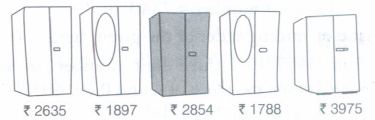
Sohan and Rita went to buy an almirah. There were many almirahs available with their price tags.
(a) Can you arrange their prices in increasing order?
(b) Can you arrange their prices in decreasing order?
175.
Take two digits, say 2 and 3. Make 4-digit numbers using both the digits equal number of times.
(i) Which is the greatest number?
(ii) Which is the smallest number?
(iii} How many different numbers can you make in all?
176.
Make the greatest and the smallest 4-digit numbers using any four different digits with conditions given below.
Digit 1 is always at thousands place.
177.
Make the greatest and the smallest 4-digit numbers using any four different digits with conditions given below.
Digit 9 is always at hundreds place
178.
Make the greatest and the smallest 4-digit numbers using any four different digits with conditions given below:
Digit 4 is always at tens place
179.
Make the greatest and the smallest 4-digit numbers using any four different digits with conditions given below:
Digit 7 is always at one place
180.
Make the greatest and the smallest 4-digit numbers by using anyone digit twice. 8, 5, 1.
181.
Make the greatest and the smallest 4-digit numbers by using anyone digit twice. 0, 4, 9.
182.
Make the greatest and the smallest 4-digit numbers by using anyone digit twice. 9, 0, 5.
183.
Make the greatest and the smallest 4-digit numbers by using anyone digit twice. 3, 8, 7.
184.
Find the greatest and the smallest numbers. 25286, 25245, 25270, 25210.
185.
Find the greatest and the smallest numbers. 15623, 15073, 15189, 15800.
186.
Find the greatest and the smallest numbers. 4536, 4892, 4370, 4452.
187.
Read the number 475320 and write them using placement boxes.
188.
If a car covers 1262 km in 1 h. Then, find the distance will it cover in 26 h.
189.
If the total population of a city is 436926208 and the number of males is 80260204. Then, find the number of females in the city.
190.
The cost of a bench is Rs.6291. Find the cost of 269 benches.
191.
From an iron rod 6 m long, a piece of length 3 m 65 cm is cut-off. What is the length of the remaining piece?
192.
If Amit saves Rs. 8926 every month. How much will he save in 14 yr?
193.
For making 12 shirts of the same size, if 12 m 6 cm of cloth is needed. Then, how much cloth will be required for each such shirt?
194.
A garment factory produced 216315 shirts, 182736 trousers and 58,704 jackets in a year. What is the total production of all the three items in that year?
195.
In a five-digit number, digit at ten's place is 4, digit at unit's place is one fourth of ten's place digit, digit at hundred's place is 0, digit at thousand's place is 5 times of the digit at unit's place and ten thousand's place digit is double the digit at ten's place. Find the number
196.
Chinmay had Rs. 6,10,000. He gave Rs. 87,500 to Jyoti, Rs. 1,26,380to Javed and Rs. 3,50,000 to John. How much money was left with him? What type of value depict by Chinmay?
197.
A person had Rs.10,00,000 with him. He purchased a colour TV for Rs. 16580, a motorcycle for Rs.45,890 and a flat for Rs. 8,70,000. How much money was left with him?
198.
India's population has been steadily increasing from 439 millions in 1961 to 1028 millions in 2001. Find the total increase in population from 1961 to 2001. Write the increase in population in Indian system of numeration, using commas suitably.
199.
Reshma's school is\(\frac{8}{10}\) km away from her house. Daily she walks a distance and then takes a bus to travel \(\frac{1}{2}\) km to reach the school.
(a) How far does she walk?
(b) Why she walk some distance daily?
200.
A box contains 50 packets of biscuits, each weighing 120 g. How many such boxes can be loaded in a van, which cannot carry beyond 900 kg?
201.
Find the sum of greatest and the smallest six-digit numbers formed by digits 2,0,4, 7, 6, 3 using each digit only once.
202.
There was a stock of 17380200 quintal of wheat in a godown of the food corporation of India. Out of this stock, 2756744 quintal of wheat was sent to Delhi and 4863108 quintal to UP. How much is the balance stock now?
203.
Floor of a room measures 4.5 m \(\times\) 3 m. Find the minimum number of complete square marble slabs of equal size required to cover the entire floor
204.
Write in roman numerals.
(i) 73 (ii) 92
205.
The distance between the park and the house of a student is 2 km 260 m. Every day he walks both ways between the parks and his house. Find the total distance covered by him in a week's time.
206.
The monthly fee for a student in a school is Rs.480. If there are 620 students in the school. Then, find the total monthly collection of fees.
207.
Medicine is packed in boxes, each weighing 4 kg 500 g. How many such boxes can be loaded in a van which cannot carry beyond 800 kg?
208.
| Raman's shop | The sales during the last year | |
| Things | Price | Apples 2457 kg |
| Apples | Rs.40 per kg | Oranges 3004 kg |
| Oranges | Rs.30 per kg | Combs 22760 |
| Combs | Rs.3 for one | Toothbrushes 25367 |
| Toothbrushes | Rs.10 for one | Pencils 38530 |
| Pencils | Rs.1 for one | Notebooks 40002 |
| Notebooks | Rs.6 for one | Soapcakes 20005 |
| Soapcakes | Rs.8 for one | |
(a) Can you find the total weight of apples and oranges Raman sold last year?
Weight of apples = ________kg
Weight of oranges = _______kg
Therefore, total weight = __ kg +__ kg = __ kg
(b) Can you find the total money Raman got by selling apples?
(c) Can you find the total money Raman got by selling apples and oranges together?
(d) Make a table showing how much money Raman received from selling each item? Arrange the entries of amount of money received in descending order. Find the item which brought him the highest amount. How much is this amount?
209.
A bus started its journey and reached different places with a speed of 60 km/h. The journey is shown below:
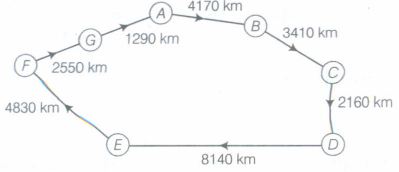
(i) Find the total distance covered by the bus from A to D.
(ii) Find the total distance covered by the bus from D to G.
(iii) Find the total distance covered by the bus, if it starts from A and returns back to A.
(iv) Can you find the difference of distances from C to D and D to E?
(v) Find out the time taken by the bus to reach
(a) A to B (b) C to D (c) E to G (d) Total journey.
210.
Name five large cities in India. Find their population. Also, find the distance (in km) between each pair of these cities.
211.
You have the digits 4, 5, 6, 0, 7 and 8. Using them, make five numbers each with 6-digits.
(a) Put commas for easy reading.
(b) Arrange them in ascending and descending orders.
212.
Read these numbers
(i) 527864
(ii) 95432
(iii) 18950049
(iv) 70002509
(a) Write these numbers using placement boxes and then using commas in Indian system of numeration as well as Intemational system of numeration.
(b) Arrange these in ascending and descending orders.
213.
Read these numbers. Write them using placement boxes and then write their expanded forms.
(i) 475320 (ii) 9847215 (iii) 97645310 (iv) 30458094
(a) Which is the smallest number?
(b) Which is the greatest number?
(c) Arrange these numbers in ascending and descending orders.
214.
Read and expand the numbers wherever there are blanks.
| Number | Number name | Expansion |
| 3,00,000 | Three lakhs | 3 \(\times\) 1,00,000 |
| 3,50,000 | Three lakhs fifty thousands | 3 \(\times\) 1,00,000+ 5 \(\times\)10,000 |
| 3,53,500 | Three lakhs fifty three thousands five hundreds | 3 \(\times\) 1,00,000+ 5 \(\times\) 10,000 + 3 \(\times\) 1,000+ 5 \(\times\) 100 |
| 4,57,928 | ||
| 4,07,928 | ||
| 4,00,829 | ||
| 4,00,029 |
215.
Read and expand the numbers wherever there are blanks.
| Number | Number name | Expansion |
| 20000 | Twenty thousands | 2 \(\times\)10,000 |
| 26000 | Twenty six thousands | 2 \(\times\)10,000+6 \(\times\)1,000 |
| 38400 | Thirty eight thousands four hundreds | 3\(\times\)10,000+8 \(\times\)1,000+4\(\times\)100 |
| 65740 |
Sixty five thousands seven hundreds forty |
6\(\times\)10,000+5\(\times\)1,000+7\(\times\) 100+4\(\times\) 10 |
| 89324 | Eighty nine thousands three hundreds twenty four | 8\(\times\)10,000+9\(\times\)1,000+3\(\times\) 100+2\(\times\) 10+4\(\times\)1 |
| 50000 | ||
| 41000 | ||
| 47300 | ||
| 57630 | ||
| 29485 | ||
| 29085 | ||
| 20085 | ||
| 20005 |
216.
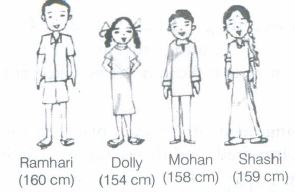
Who is the tallest? Who is the shortest?
(a) Can you arrange them in the increasing order of their heights?
(b) Can you arrange them in the decreasing order of their heights?
217.
Find the greatest and the smallest numbers. 6895, 23787, 24569, 24659.
218.
The population of Pune was 2538473 in 2001. Rounded off to nearest thousands, the population was-----
219.
The number 60 in roman numeral is------
220.
(a) 1m =--- mm (b) 1 cm =----- mm
221.
The smallest 4-digit number with different digits is ------
222.
In Indian system of numeration, the number 61711682 is written, using commas, as -------
223.
1 million = ____ lakhs
224.
1 crore = ____ millions
225.
1 crore = _____ ten lakhs
226.
1 million = _______ hundred thousands
227.
1 lakh = _____ ten thousands
228.
The number formed by interchanging the digits 6 and 2 in 465271 is
467521
425671
165274
None of these
229.
Which of the following roman symbol is never repeated?
I
V
X
C
230.
The greatest natural number is
1 crore
10 crores
10 lakhs
undefine
231.
The expanded form of the number 9578 is
9 \(\times\) 10000 + 5 \(\times\) 1000 + 7 \(\times\)10+ 8 \(\times\)1
9 \(\times\) 1000 + 5 \(\times\) 100 + 7 \(\times\) 10 + 8 \(\times\) 1
9 \(\times\) 1000 + 57 \(\times\) 10 + 8 \(\times\) 1
9 \(\times\) 100 + 5 \(\times\)100 + 7\(\times\) 10 + 8 \(\times\) 1
232.
In Indian system of numeration, the number 58695376 is written as
58,69,53,76
58,695,376
5,86,95,376
586,95,376
233.
Which of the following is true?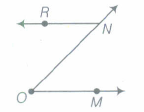
1 million = 1000000
1 lakh = 10000
1crore=100000000
234.
The numbers 4578,4587,5478,5487 are in ascending order.
235.
LXXV is greater than LXXIV.
236.
The number 58663 rounded off to nearest hundred is 58600.
237.
531 = DXXXI
238.
34984 = 3 \(\times\) 1000 + 49 \(\times\) 100 + 8 \(\times\) 10 + 4 \(\times\) 1
239.
Hindu-Arabic numeral form of LXXXIX is
240.
Estimate the sum by rounding off to nearest ten 16472 + 21434 + 65556
241.
10 km is equal to
242.
1 crore is equal to
1.
400
2.
65 km/h
3.
90,000
4.
CXIV
5.
96700
6.
60000
7.
10000023
8.
XLVI =(50 -10) + 5 + 1 = 46
9.
XXIV = 20+ (5-1) = 24
10.
Here, given numbers are 137 and 198.
137= 100+ 30+ 7 = CXXXVIl
198= 100+ 90+ 8 = CXCVIII
11.
Here: 39 is rounded off = 40
and 42 is rounded off = \(\times\) 40
Estimated product = 1600
12.
Here, 945 is rounded off = 900
560 is rounded off = - 600
Estimated difference = 300
13.
Here, rounded form of 945 = 900
and rounded form of 623 = + 600
So, estimated sum = 1500
14.
In 4942, ones digit is 2 < 5.
Then, rounded form of 4942 = 4940
15.
In 3945, we know that, ones digit is 5,
Then, rounded form of 3945 = 3950
16.
We know that,
1 m =100 cm and 1 cm =10 mm
∴ 1 m =100 cm =100\(\times\) 10 mm
=1000 mm
17.
We know that,
1 km =1000 m
and 1 m =100 cm
∴ 1 km =1000 m=1000 \(\times\) 100 cm
=100000 cm
18.
We know that, 1 kg =1000 g, 5 kg =5000 g.
So, 5 kg 290 g =(5000+ 290) g
=5290 g
19.
The place value of 6 in 762540 = 6 \(\times\)10000
=60000
20.
The numeral form is 20,502,632.
21.
According to International system of numeration 7,869,420
22.
According to International system of numeration 2,546,726
23.
Expanded form of given numbers as
986256 =9 \(\times\) 100000 + 8 \(\times\) 10000 + 6 \(\times\) 1000 + 2 \(\times\) 100 + 5 \(\times\) 10 + 6
24.
Expanded form of given numbers as
76496 = 7 \(\times\) 10000 + 6 \(\times\) 1000 + 4 \(\times\) 100 + 9 \(\times\) 10 + 6
25.
According to Indian system of numeration,
68,96,462
26.
According to Indian system of numeration,
24,64,056
27.
Given, digits are 1, 2, 7, 9, 4.
For greatest number, we write the digits in descending order.
So, the greatest five-digit number is 97421.
28.
The ascending order of the given numbers are as follows: 1462 <1562 < 2605 < 3164
29.
Here, given digits are 3, 5, 4, 6. For the smallest number, we write the digits in ascending order. So, the smallest four-digit number is 3456.
30.
In the given numbers, we see that 28706 is the smallest and 87604 is the greatest.
31.
In 15896, ten thousands digit is 1 and ten thousands digit in 26760 is 2. So, 2 > 1.
Hence, 26760> 15896
32.
Here, ten thousands digit is 4 in both numbers.
But thousands digit in 47645 is 7 and thousands digit in 48740 is 8. So, 8 > 7
Hence, 48740 > 47645
33.
76
34.
199
35.
CMLXI
36.
DCCCLXVIII
37.
60000
38.
8000
39.
8000
40.
CCCLXXXIX
41.
CCCXLI
42.
1170000
43.
2943
44.
80000
45.
200
46.
90000
47.
According to the question, sum of 3 and 2 = (3 + 2)
Now, multiplying it by 3, we get 3 \(\times\) (3 + 2)
Again, divide 45 by this result, we have 45 ÷ 3 \(\times\) (3 + 2)
which is the required expression.
48.
According to the question,
Difference of 18 and 6 = (18 - 6)
Now, dividing this difference by 4, we have (18 - 6) ÷ 4
which is the required expression.
49.
According to the question, sum of 9 and 2 = 9 + 2
Now, mutiplying it by 4, we have 4 \(\times\) (9 + 2)
which is the required expression.
50.
We have, 9250\(\times\)29
9250 ⟶ 9000 [rounding off to nearest thousands]
29 ⟶ 30 [rounding off to nearest tens]
∴ Estimated product = 9000 \(\times\) 30
= 2,70,000
51.
We have, 1291\(\times\)592
1291⟶ 1300 [rounding off to nearest hundreds]
592 ⟶ 600 [rounding off to nearest hundreds]
∴ Estimated product = 1300\(\times\) 600
=7,80,000
52.
We have, 5281\(\times\)3491
5281 ⟶ 5000 [rounding off to nearest thousands]
3491 ⟶ 3500 [rounding off to nearest hundreds]
∴ Estimated product = 5060 \(\times\) 3500 = 1,75,00,000
53.
We have, 578 \(\times\) 161
578 ⟶ 600 [rounding off to nearest hundreds]
161 ⟶ 200 [rounding off to nearest hundreds]
∴ Estimated product = 600 \(\times\) 200 = 1,20,000
54.
∵ 28,292 ⟶ 28,000[rounding off to nearest thousands]
21,496 ⟶ 21,000 [rounding off to nearest thousands]
∴ Estimated difference = 28000 - 21000 = 7000
55.
∵12904 ⟶ 13000[rounding off to nearest thousands]
2888 ⟶ 3000 [rounding off to nearest thousands]
∴ Estimated sum = 13000 + 3000 = 16000
56.
∵ 796 ⟶ 800 [rounding off to nearest hundreds]
314 ⟶ 300 [rounding off to nearest hundreds]
∴ Estimated difference = 800 - 300 = 500
57.
∵ 730 ⟶ 700 [rounding off to nearest hundreds]
998 ⟶1000 [rounding off to nearest hundreds]
∴ Estimated sum = 700 + 1000 = 1700.
58.
∵ 958 ⟶ 1000 [rounding off to nearest hundreds]
387 ⟶ 400 [rounding off to nearest hundreds]
∴ Estimated product = 1000 \(\times\) 400 = 4,00,000
59.
∵ 898 ⟶ 900 [rounding off to nearest hundreds]
785 ⟶ 800 [rounding off to nearest hundreds].
∴ Estimated product = 900 \(\times\) 800 = 7,20,000
60.
∵ 9 ⟶ 10 [rounding off to nearest tens]
795 ⟶ 800 [rounding off to nearest hundreds]
∴ Estimated product = 10 \(\times\) 800 = 8,000
61.
∵ 87⟶ 90 [rounding off to nearest tens]
313⟶300 [rounding off to nearest hundreds]
∴ Estimated product = 90 \(\times\) 300 = 27,000
62.
479 = 400 + 70 + 9 = CDLXXIX [∵ 400=500-100=CD, 70=50+10+10=LXX, 1 =I]
63.
596 = 500 +90 + 6= DXCVI [∵ 500= 0, 90=100-10=XC, 6=5 +1= VI]
64.
We have, 92 = XCII [∵ 92=100-10+1+1 i.e.100=C,10=X, 1 = I]
65.
We have, 73 = LXXIII [∵73=50+10+10+1+1+1 i.e. 50=L, 10=X, 1 =I]
66.
We have, 27 \(\times\) 99 = 27 \(\times\) (100 -1) = 2700 - 27 = 2673 [∵ 99 =100-1]
67.
We have, 27 \(\times\) 105 = 27 \(\times\) (100 + 5) = 27 \(\times\) 100 + 27 \(\times\) 5 = 2700 + 135 = 2835 [∵ 105 =100+5]
68.
In 4235, hundred digit is 2 < 5.
∴ The required rounded number 4235 = 4000
69.
Given number is 2936. Here, hundred digit is 9, which is more than 5 i.e. 9 > 5.
∴ The required rounded number 2936 = 3000
70.
Rs.1642
71.
62 km 625 m per hour
72.
292 kg 500 g
73.
Rs.10636875
74.
We know that, 1 kg = 1000 g = (1000 X 1000) mg [∵ 1 g = 1000 mg]
= 1000000 mg
∴ 1000000 milligrams make one kilogram
75.
We know that, 1 km = 1000 m = 1000 \(\times\) 100 cm [∵ 1 m= 100 cm]
=100000 cm
76.
Production of milk in one day = 75678 L 75678
Supply to milk depot in one day = 67689 L -67689
So, the milk left in the dairy = (75678 - 67689) = 7989 L 7989
77.
36436
78.
12356
79.
8621
80.
9 \(\times\)10000 + 6\(\times\)1000+ 2\(\times\)100 + 4\(\times\)10 + 2\(\times\)1
81.
808
82.
7
83.
6 \(\times\) 107 or 60000000
84.
2369
85.
984671
86.
Numbers after commas are as follows: 23, 30, 010.
87.
Numbers after commas are as follows: 58, 423, 202.
88.
Numbers after commas are as follows: 7, 52, 21, 302.
89.
Numbers after commas are as follows: 9, 05, 00, 041.
90.
Numbers after commas are as follows: 73, 75, 307.
91.
10000000 -1 = 9999999
92.
100000 -1 = 99999
93.
10000 -1 = 9999
94.
100 - 1= 99
95.
10 - 1 = 9
96.
Here, descending order of the given digits is 5,4, 3, 0.
∴ Greatest number = 5430
and ascending order of the given digits is 0,3,4, 5.
But 0345 is a three-digit number. So, we have to interchange the place of 3 and 0 i.e 3045.
∴ Smallest number = 3045.
97.
Here, descending order of the given digits is 7, 6, 2, 1
∴ Greatest number = 7621
and ascending order of the given digits is 1,2,6, 7.
∴ Smallest number = 1267.
98.
Here, descending order of the given digits is 7, 5,4, 0.
∴ Greatest number = 7540
and ascending order of the given digits is 0, 4, 5, 7.
But, 0457 is a three-digit number, so we have to interchange the place of 4 and 0 i.e. 4057.
∴ Smallest number = 4057.
99.
Here, descending order of the given digits is 9, 7, 4,1.
∴ Greatest number = 9741
and ascending order of the given digits is 1,4,7,9.
∴ Smallest number = 1479.
100.
Here, descending order of the given digits is 8, 7, 4, 2.
∴ Greatest number = 8742
and ascending order of the given digits is 2, 4, 7, 8.
∴ Smallest number = 2478.
101.
12002 is the greatest number, because it has highest number of digits i.e. 5 and 124 is the smallest number, because it has least number of digits i.e. 3. Yes, it was easy.We just identify the number of digits and locate the greatest and smallest numbers, because greatest number has more digits.
102.
75284 is the greatest number, because it has highest number of digits i.e. 5 and III is the smallest number, because it has least number of digits i.e. 3.
103.
89423 is the greatest number, because it has highest number of digits i.e. 5 and 100 is the smallest number, because it has least number of digits i.e. 3.
104.
59785 is the greatest and 18 is the smallest.
105.
Given, number is 97621.
Hence, place value of 7 is 7000 and face value of 7 is 7.
106.
For getting the smallest number, firstly we convert the numbers into ascending order.
The smallest 4-digit number is 1479.
For getting greatest number, firstly we convert the numbers into descending order.
The greatest 4-digit number is 9741.
107.
For getting the smallest number, firstly we convert the numbers into ascending order.
The smallest 4-digit number is 2478.
For getting greatest number, firstly we convert the numbers into descending order.
The greatest 4-digit number is 8742.
108.
Given, numbers are 819, 5240, 890 and 6249.
To convert numbers into descending order, we arrange numbers greatest to the smallest.
Now, descending order is 6249 > 5240> 890> 819.
109.
Given, numbers are 847, 9754, 8320 and 571.
To convert numbers into ascending numbers, we arrange numbers smallest to the greatest.
Now, ascending order is 571 < 847 < 8320 < 9754.
110.
Both 67454 and 78465 are five-digit numbers. So, we compare them by comparing the digits at ten thousand places. Since, 7> 6. So, 78465> 67454.
111.
Both 97632 and 96543 have same number of digits i.e. five. Now, compare them by looking at the digits at ten thousand place, which is 9 for both the numbers.
Next, compare the second digit from the left. Here, it is 7 in 97632 and 6 in 96543.
Since, 7> 6
So, 97632> 96543
112.
769 is the smallest as it contains minimum number of digits amongst all and 741965 is the greatest as it contains six digits.
113.
29 is the smallest as it contains only 2 digits. 1234 is the greatest as it contains four digits, which is the maximum number of digits amongst all.
114.
1234524
115.
143000 (nearest thousand)
116.
29000 (nearest thousand)
117.
2 m2
118.
1325 g or 1 kg 325 g
119.
Rs. 27666050, ~Rs. 48622530
120.
Rs.124,250
121.
Total number of students in school = 1261
Contribution of money by each student =Rs. 520
∴ Total money =1261 \(\times\) 520 =Rs. 655720
122.
Distance cover in 18 h = 1126 km
Distance cover in 1 h = 1126 ÷ 18 = 62 km 555 m
Hence, the speed of the car is 62 km 555 m per hour.
123.
Total cost of 20 flats = 348642060
Cost of each flat = 348642060 + 20 = Rs. 17432103
124.
Cloth required for 1 shirt =3 m 05 cm
Cloth required for 14 shirts = (3 m 05 cm) \(\times\) 14
=14\(\times\)3+14\(\times\)05=42 m 70 cm
125.
54 \(\times\) 105 = 54 \(\times\) (100 + 5)
= 5400 + 54 \(\times\) 5 = 5400 + 270 = 5670
126.
37\(\times\)108=37\(\times\)(100+8) =37\(\times\)100+37\(\times\)8
= 3700 + 296 = 3996
127.
We have, 8739 \(\times\)102 = 8739 \(\times\) (100 + 2)
= 8739 \(\times\) 100 + 8739 \(\times\) 2
= 873900 + 17478 = 891378
128.
Distance covered in one day = 365 m
Number of days = 120
So, total distance covered by Tony in 120 days
= 365 \(\times\) 120 m = 43800 m
∴ Estimated product = 44000 m = 44 km
129.
Given, mass of a cylinder = 14 kg 250 g
Mass of 20 cylinders = 20 \(\times\) (14 kg + 250 g)
= 280 kg + 5000 g
= 280 kg + 5 kg
= 285 kg
130.
Monthly saving = Rs. 250
We know that, 1 yr = 12 months, 2 yr = 24 months
Total saving in 2 yr = 24 x 250 = Rs. 6000
131.
(i) 5981 rounded off to nearest tens = 5980
4428 rounded off to nearest tens = 4430
∴ Estimated product = 5980 \(\times\) 4430 = 26491400
(ii) 5981 rounded off to nearest hundreds = 6000
4428 rounded off to nearest hundreds = 4400
∴ Estimated product = 6000 \(\times\) 4400 = 26400000
132.
Given, number is 6523689.
Place value of first 6 = 6 \(\times\) 1000000 = 6000000
Place value of second 6 = 6 \(\times\) 100 = 600
∴ Difference between the place values of two 6's
= 6000000 - 600 = 5999400
133.
According to the Indian and International system of numeration, 2004004
134.
According to the Indian and International system of numeration, 32660505
135.
According to the Indian and International system of numeration, 3748763
136.
Here, we have
The greatest five-digit number is 87320.
The smallest five-digit number is 20378.
137.
Here, we have
The greatest five-digit number is 76542.
The smallest five-digit number is 24567.
138.
We can make many situations of this kind, five situations of them are as follows:
Situation 1. Marry is a maid (servant). She charges Rs. 8 per day to clean a house but gives back Rs. 3 to the house owner for saving. What amount does she carry in her hand from 7 houses?
Situation 2. Ankit's pocket money is Rs. 8 per day. He spents Rs. 3 daily. Find his total saving in 7 days.
Situation 3. What will be the seven times the difference of eight and three?
Situation 4. A clerk works 8 h daily in an office, but he remains absent for 3 h daily. In a week, for how many hours did he work?
Situation 5. Seven children with Rs. 8 each went to market. Each of them bought pencils costing Rs. 3. What is total money left with them?
139.
We can make many situations of this kind, three situations of them are as follows:
Situation 1. Prabha read 5 pages of a novel in the evening and 8 pages in the morning. How many pages did Prabha read in 6 days?
Situation 2. Meena and Reena work for 6 days. Meena earns Rs. 5 per day and Reena earns Rs.8 per day. What do they earn together in 6 days?
Situation 3. Ram and Shyam walk for 6 days. Ram walks 5 km in a day and Shyam walks 8 km in a day. How many kilometres do both of them walk in 6 days?
140.
We have, 4,89,348 - 48,365
\(\because \begin{matrix} 4,89,348\rightarrow 4,89,300 \\ 48,365\rightarrow 48,400 \end{matrix}\} [rounding\quad off\quad to\quad nearest\quad hundreds]\)
∴ Rough estimate = 4,89,348 - 48,365
= 4,89,300 - 48,400 = 4,40,900
\(Again\begin{matrix} 4,89,348\rightarrow 4,89,350 \\ 48,365\rightarrow 48,370 \end{matrix}\} [rounding\quad off\quad to\quad nearest\quad tens]\)
and closer estimate = 4,89,348 - 48,365
= 4,89,350 - 48,370 = 4,40,980
141.
We have, 8325 - 491
\(\because \begin{matrix} 8325\rightarrow 8300 \\ 491\rightarrow 500 \end{matrix}\} [rounding\quad off\quad to\quad nearest\quad hundreds]\)
∴ Rough estimate = 8325 - 491 = 8300 - 500 = 7800
\(Again\begin{matrix} 8325\rightarrow 8330 \\ 491\rightarrow 490 \end{matrix}\} [rounding\quad off\quad to\quad nearest\quad tens]\)
and closer estimate = 8325 - 491 = 8330 - 490 = 7840
142.
We have, 1,08,734 - 47599
\(\because \begin{matrix} 1,08,734\rightarrow 1,08,700 \\ 47,599\rightarrow 47,600 \end{matrix}\} [rounding\quad off\quad to\quad nearest\quad hundreds]\)
∴ Rough estimate = 1,08,734 - 47,599
= 1,08,700 - 47,600 = 61,100
\(\because \begin{matrix} 1,08,734\rightarrow 1,08,730 \\ 47,599\rightarrow 47,600 \end{matrix}\} [rounding\quad off\quad to\quad nearest\quad tens]\)
and closer estimate = 1,08,734 - 47,599
=1,08,730 - 47,600 = 61,130
143.
We have, 439 + 334 + 4317
\(\therefore \begin{matrix} 439\rightarrow 400 \\ 334\rightarrow 300 \\ 4317\rightarrow 4300 \end{matrix}\} [rounding\quad off\quad to\quad nearest\quad hundreds]\)
∴ Rough estimate = 439 + 334 + 4317
= 400 + 300 + 4300 = 5000
\(Again\begin{matrix} 439\rightarrow 440 \\ 334\rightarrow 330 \\ 4317\rightarrow 4320 \end{matrix}\} [rounding\quad off\quad to\quad nearest\quad tens]\)
and closer estimate = 439 +334 +4317
= 440 + 330 + 4320 = 5090
144.
The complete table is shown as below:
| Given number | Approximate to nearest | Rounded form |
| 75847 | Tens | 75850 |
| 75847 | Hundreds | 75850 |
| 75847 | Thousands | 76000 |
| 75847 | Ten thousands | 80000 |
145.
On checking the rounding off in respect of given numbers, we find that the rounding off of 7805, 53552 and 3499 are incorrect.
Their correct results should be 7800, 54000 and 3000, respectively.
146.
On checking the rounding off in respect of given numbers, we find that, the rounding off of 286 and 9870 are incorrect. Their correct result should be 300 and 9900, respectively.
147.
We can arrange it as a table
| Number | Rounding off | Number | Rounding off |
| 28 | 30 | 64 | 60 |
| 32 | 30 | 59 | 60 |
| 52 | 50 | 99 | 100 |
| 41 | 40 | 215 | 220 |
| 39 | 40 | 1453 | 1450 |
| 48 | 50 | 2936 | 2940 |
148.
Rs. 16570
149.
51975
150.
152
151.
Rs.112338
152.
Given, capacity of vessel = 4 L 500 mL
= 4 \(\times\)1000 + 500 = 4000 + 500 = 4500 mL. [1L= 1000mL]
and capacity of one glass = 25 mL
∴ Number of glasses of curd filled out of vessel
\(=\frac { Capacity\quad of\quad a\quad vessel }{ Capacity\quad of\quad a\quad glass } =\frac { 4500 }{ 25 } =180\)
Hence, curd can be filled in 180 glasses.
153.
Given, distance between the school and the house
= 1 km 875 m =1\(\times\)1000+875
= 1000 + 875 = 1875 m [∵ 1 km = 1000 m]
∴ Distance covered by the student in one day
= 2\(\times\) 1875 = 3750 m [∵ She walks both ways in one day]
∴ Distance covered in 6 days = 6 x 3750
= 22500 m = (22 \(\times\) 1000 + 500) m
= 22 km 500 m [∵1 km = 1000 m]
154.
Total length of cloth = 40 m = 40 \(\times\) 100 cm [∵1 m =100 cm]
= 4000 cm
Cloth needed for one shirt = 2 m 15 cm
= (2\(\times\)100) cm +15 cm
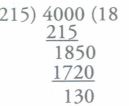
= (200+15) cm = 215 cm
∴ Number of shirts stitched out of total cloth
\(=\frac { Total\quad length\quad of\quad cloth }{ Cloth\quad needed\quad for\quad stitched\quad shirt } \)
\(=\frac { 4000 }{ 215 } =18\frac { 130 }{ 215 } \)
Hence, 18 shirts can be stitched and cloth left over is 130 cm i.e. 1 m 30 cm.
155.
If a student multiplies 7,236 by 65, he will get
= 7,236\(\times\)65
= 4,70,340
According to the question, Student multiplies 7236 by 56 and he will get
= 7,236\(\times\)56= 4,05,216
Now, required difference = Actual answer - Wrong answer
= 4,70,340 - 4,05,216
= 65,124
156.
Given, cost of one radio set = Rs. 1200
Number of radio sets to be purchased = 40
∴ Cost of 40 radio sets = Cost of one radio set \(\times\) Number of radio sets
= 40 \(\times\) 1200 = Rs. 48,000
∵ Total money with the merchant = Rs. 78,592
∴ Money left with the merchant after purchase of
40 radio sets = Total money - Cost of 40 radio sets
= 78,592 - 48,000 = Rs.30,592
Hence, Rs. 30592 will remain with her after the purchase.
157.
Number of screws manufactured by the machine in one day = 2825
We know that, number of days in the month of January =31
∴ Number of screws produced by the machine in the month of January, 2006
= 2,825\(\times\) 31 = 8,7575
Hence, number of screws produced by the machine in the month of january, 2006 are 87,575.
158.
Using the digits 6, 2, 7, 4 and 3, we get
Greatest number = 76,432 and least number = 23,467
∴ Difference = Greatest number - Least number
=76,432 - 23,467 = 52,965.
159.
Given, sale of books in Ist week = Rs. 2,85,891
Sale of books in IInd week = Rs. 4,00,768
Total sales of two weeks =Sale of Ist week + Sale of IInd week
= 2,85,891 + 4,00,768 = Rs. 6,86,659
Since, 4,00,768 > 2,85,891
Thus, sale in the second week is greater.
∴ Difference in the sales amount = 4,00,768 - 2,85,891
= Rs. 1,14,877
Hence, sale in the second week was greater by Rs. 1,14,877.
160.
Given, votes registered by the successful candidate =5,77,500
Votes registered by the nearest rival = 3,48,700
∴ Margin, by which the successful candidate won
= Votes of successful candidate - Votes of nearest rival
= 5,77,500 - 3,48,700 = 2,28,800
161.
Given, number of runs scored by Shekhar = 6,980
Target of runs to be scored = 10,000
∴ Number of runs needed more
= Target of runs - Run scored yet
= 10,000 - 6,980 = 3,020
162.
Given, number of tickets sold on the first day = 1094
Number of tickets sold on the second day = 1812
Number of tickets sold on the third day = 2050
Number of tickets sold on the fourth day = 2751
∴ Total number of tickets sold on all the four days
= 1094 + 1812 + 2050 + 2751 = 7707
Hence, there are 7707 tickets sold on all the four days.
163.
Given, weight of one tablet = 20 mg
Total weight of 200000 tablets in the box = 200000 \(\times\) 20 mg
=4000000 mg
Now, weight in grams =\(\frac{4000000}{1000}g=4000g\) \(\left[ \because \quad 1mg=\frac { 1 }{ 1000 } g \right] \)
Now, weight in kilograms =\(\frac{4000}{1000}kg=4kg\) \(\left[ \because \quad 1g=\frac { 1 }{ 1000 } kg \right] \).
164.
We can draw a table to show these operations:
| Number | Number, using commas in International system of numeration | Number name |
| (a) 78921092 | 78,921,092 | Seventy eight millions nine hundreds twenty one thousands ninety two |
| (b) 7452283 | 7,452,283 | Seven millions four hundreds fifty two thousands two hundreds eighty three |
| (c) 99985102 | 99,985,102 | Ninety nine millions nine hundreds eighty five thousands one hundred two |
| (d) 48049831 | 48,049,831 | Forty eight millions forty nine thousands eight hundreds thirty one. |
165.
We can draw a table to show these operations:
| Number | Number, using commas in Indian system of numeration | Number name |
| (a) 87595762 | 8,75,95,762 | Eight crores seventy five lakhs ninety five thousands seven hundreds sixty two |
| (b) 8546283 | 85,46,283 | Eighty five lakhs forty six thousands two hundreds eighty three |
| (c) 99900046 | 9,99,00,046 | Nine crores ninety nine lakhs forty six |
| (d) 98432701 | 9,84,32,701 | Nine crores eighty four lakhs thirty two thousands seven hundreds one |
166.
Given digits are 3, 0 and 4.
We can make many numbers by using these digits, five of them are as follows:
(i) 330443 (ii) 343404 (iii) 344430 (iv) 434043 (v) 344034
Using commas, these numbers can be rewritten as :
(i) 3,30,443 (ii) 3,43,404 (iii) 3,44,430 (iv) 4,34,043 (v) 3,44,034
167.
Given digits are 4,5,6,7,8 and 9.
We can make many numbers by using these digits, three of them are as follows :
98877456,98877465 and 98877654
Using commas, numbers can be rewritten as
(i) 9,88,77,456
(ii) 9,88,77,465
(iii) 9,88,77,654.
168.
The smallest 8-digit number = 10000000
∴ 1 st next number = 10000000 + 1 = 10000001
2nd next number = 10000000 + 2 = 10000002
3rd next number =10000000 + 3 = 10000003
4th next number =10000000 + 4 = 10000004
5th next number = 10000000 + 5 = 10000005
Now, ascending order of these numbers is as follows:
10000001 < 10000002 < 10000003 < 10000004 < 10000005.
169.
The greatest 6-digit number = 999999
1st previous number =999999 -1 = 999998
2nd previous number = 999999 - 2 = 999997
3rd previous number = 999999 - 3 = 999996
4th previous number =999999 - 4 = 999995
5th previous number = 999999 - 5 = 999994
Now, descending order of these numbers is as follows:
999998 > 999997 > 999996 > 999995 > 999994.
170.
The least 6-digit number is 100000 (one lakh). Now, five examples, where the number of things counted would be more than 6-digit number are as follows:
(i) The number of people in a big city.
(ii) The number of stars in a clear dark night.
(iii) The number of motorcycles in a big town.
(iv) The number of grains in a sack full of wheat.
(v) The number of pages of notebooks of all students in a big town.
171.
(a) We have, 5000, 7500, 85400, 7861
Descending order of given numbers is as follows:
85400> 7861 > 7500 > 5000
(b) We have, 1971,45321,88715,92547
Descending order of given numbers is as follows:
92547> 88715 > 45321 > 1971
172.
(a) We have, 847, 9754, 8320, 571
Ascending order of given numbers is as follows:
571 < 847 < 8320 < 9754
(b) We have, 9801, 25751, 36501, 38802
Ascending order of given numbers is as follows:
9801 < 25751 < 36501 < 38802
173.
Five more situations may be
(i) Prices of 4 different kinds of branded shoes are Rs.4225, Rs.3835, Rs. 2620 and Rs. 2230, respectively.
(ii) The weight of 4 students of Class VI are 33 kg, 38 kg, 35 kg and 37 kg, respectively.
(iii) Marks obtained by 4 students in Mathematics out of 100 are 87, 88, 90 and 78, respectively.
(iv) The tution fee paid by 4 students of different classes are Rs. 170, Rs. 190, Rs. 150 and Rs. 200, respectively.
(v) The runs scored by 4 players A, B, C and D in an innings are 75, 60, 25 and 82, respectively.
174.
(a) Yes, prices can be arranged in increasing order as follows:
Rs.1788 < Rs.1897 < Rs. 2635 < Rs. 2854 < Rs. 3975
(b) Yes, prices can be arranged in decreasing order as follows:
Rs.3975 > Rs. 2854 > Rs. 2635 > Rs. 1897 > Rs. 1788.
175.
Two given digits are 2 and 3. We want to make 4-digit numbers using both the digit equal number of times.
The possible 4-digit numbers are 2233, 3322, 2332, 3223, 2323 and 3232.
(i) The greatest number is 3322.
(ii) The smallest number is 2233.
(iii) We can make 6 different numbers in all.
176.
Digits in ascending order are 0,1,2,3,4,5,6,7,8,9 and digits in descending order are 9,8,7,6,5,4,3,2,1, 0. Also, we know that 0 can never be taken at the leftmost place.
Keeping the digit 1 at thousands place, we can fill hundreds, tens and ones place digit by remaining digits.
Greatest number
| 1 | 9 | 8 | 7 |
[Keeping the greatest digit i.e, 9, 8 and 7 at hundreds, tens and ones place]
Smallest number
| 1 | 0 | 2 | 3 |
[Keeping the smallest digit i.e. 0, 2 and 3 at hundreds, tens and ones place]
177.
Digits in ascending order are 0,1,2,3,4,5,6,7,8,9 and digits in descending order are 9,8,7,6,5,4,3,2,1, 0. Also, we know that 0 can never be taken at the leftmost place.
Keeping the digit 9 at hundreds place, we can fill thousands, tens and ones place by remaining digits.
Greatest number
| 8 | 9 | 7 | 6 |
[Keeping the greatest digit i.e. 8, 7 and 6 at thousands, tens and ones place]
Smallest number
| 1 | 9 | 0 | 2 |
[Keeping the smallest digit l.e. 1, 0 and 2 at thousands, tens and ones place]
178.
Digits in ascending order are 0,1,2,3,4,5,6,7,8,9 and digits in descending order are 9,8,7,6,5,4,3,2,1, 0. Also, we know that 0 can never be taken at the leftmost place.
Keeping the digit 4 at tens place, we can fill other places thousands, hundreds and ones place by remaining number.
Greatest number
| 9 | 8 | 4 | 7 |
[Keeping the greatest digits i.e. 9, 8 and 7 at thousands, hundreds and tens place]
Smallest number
| 1 | 0 | 4 | 2 |
[Keeping the smallest digits i.e. 9, 8 and 7 at thousands, hundreds and tens place].
179.
Digits in ascending order are 0,1,2,3,4,5,6,7,8,9 and digits in descending order are 9,8,7,6,5,4,3,2,1, 0. Also, we know that 0 can never be taken at the leftmost place.
Keeping the digit 7 at ones place, we can fill other places tens, hundreds and thousands by remaining numbers.
Greatest number
| 9 | 8 | 6 | 7 |
-[Keeping the greatest digits i.e. 9, 8 and 6 at thousands, hundreds and tens place]
Smallest number
| 1 | 0 | 2 | 7 |
[Keeping the smallest digits i.e. 0, 1, 2 at hundreds, thousands and tens place. If keep 0 at thousands place, then number will be equal to 3-digit number]
180.
Given digits are 8, 5 and 1.
Here, descending order of the given digits is 8, 8, 5, 1. [∴ greatest digit 8 is taken twice]
∴ Greatest 4-digit number = 8851
and ascending order of the given digits is 1, 1, 5, 8. [∴ smallest digit 1 is taken twice]
∴ Smallest 4-digit number = 1158.
181.
Given digits are 0, 4 and 9.
Here, descending order of the given digits is 9, 9, 4, 0. [∵ greatest digit 9 is taken twice]
∴ Greatest 4-digit number = 9940
and ascending order of the given digit is 0, 0, 4, 9. [∵ smallest digit 0 is taken twice]
But 0049 is a 2-digit number, because 0 at first two leftmost places is meaningless. So, keeping 4 (instead of 0) at the leftmost place and taking the smallest digit o twice, we get 4009.
∴ Smallest 4-digit number = 4009.
182.
Given digits are 9, 0 and 5.
Here, descending order of the given digits is 9, 9, 5, 0. [∵ greatest digit 9 is taken twice]
∴ Greatest 4-digit number = 9950
and ascending order of the given digits is 0,0, 5, 9. [∵ smallest digit 0 is taken twice]
But 0059 is a 2-digit number, because 0 at first two leftmost places is meaningless. So, keeping 5 (instead of 0) at the leftmost place and taking the smallest digit o twice i.e. 5009.
∴ Smallest 4-digit number = 5009
183.
Given digits are 3, 8 and 7.
Here, descending order of the given digits is 8, 8, 7, 3. [∵ greatest digit 8 is taken twice]
∴ Greatest 4-digit number = 8873
and ascending order of the given digits is 3, 3, 7, 8. [∵ smallest digit 3 is taken twice]
∴ Smallest 4-digit number = 3378
184.
We have, 25286, 25245, 25270, 25210
Here, the three leftmost digits 252 are same in each number. So, we compare the tens place digit.

∴The greatest number is 25286 and the smallest number is 25210.
185.
We have, 15623, 15073, 15189, 15800
Here, the two leftmost digits 15 i.e. digits at thousand and ten thousands place are same in each numbers. So, we compare the hundreds place digit

∴ The greatest number is 15800 and the smallest number is 15073.
186.
We have, 4536, 4892, 4370, 4452
Here, each of the given numbers is containing 4-digits and their digits at thousand places are also same. So, we compare the hundreds place digit.
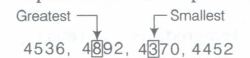
∵ 8>5>4>3
∴ The greatest number is 4892 and the smallest number is 4370.
187.
Given, number is 475320, according to Indian system of numeration,
| Lakhs | Ten thousands (T-th) | Thousands (Th) | Hundreds (H) | Tens (T) | Ones(O) |
| 4 | 7 | 5 | 3 | 2 | 0 |
We read it as, four lakhs seventy-five thousands three hundreds twenty.
According to International system of numeration, using commas it is written as 475,320
188.
32812 km
189.
356666004
190.
Rs.1692279
191.
2 m 35 cm
192.
Rs.1499568
193.
m 5 cm
194.
According to the question,
A garment factory produced shirts = 216315
Produced trousers = 182736
Produced jackets = 58704
∴Total production of all the three items in that year
= Sum of all items
= 216315 + 182736 + 58704 = 457755
Hence, the total production of all the three items in that year is 457755.
195.
According to the question,
Digit at ten's place = 4
Digit at unit's place = \(\frac{1}{4}\) of ten's place digit =\(\frac{1}{4}\times4=1\)
Digit at hundred's place = 0
Digit at thousand's place = 5 x Digit of unit's place
=5\(\times\)1=5
Digit at ten thousand's place = 2 x Digit of ten's place
=2\(\times\)4=8
∴ Required number = 85041
196.
Given, Chinmay's total money =Rs.6,10,000
Money given to Jyoti by Chinmay = Rs. 87,500
Money given to Javed by Chinmay =Rs. 1,26,380
Money given to John by Chinmay = Rs. 3,50,000
∴ Money left with Chinmay = Total money - Distributed money
=6,10,000 -(87,500 + 1,26,380 + 3,50,000)
= 6,10,000 - 5,63,880 =Rs. 46,120
Hence, Rs. 46,120 was left with him.
The value depicted by Chinmay is that he is helpful nature towards his friends.
197.
Given, total money = Rs.10,00,000
Money spent on a colour TV = Rs. 16,580
Money spent on a motorcycle = Rs. 45,890
and money spent on a flat = Rs. 8,70,000
Total amount spent = 16,580 + 45,890 + 8,70,000
= Rs. 9,32,470
∴ Money left with him = 10,00,000 - 9,32,470
= Rs.67,530
Hence, Rs. 67,530 was left with him.
198.
Given, population of India in 1961 = 439 millions
= 439 \(\times\)1000000 = 439000000 [∵ 1million = 1000000]
and population of India in 2001 = 1028 millions
= 1028\(\times\) 1000000 = 1028000000 [∵ 1 million = 1000000]
∴ Total increase in population from 1961 to 2001
= Population in 2001 - Population in 1961
= 1028000000 - 439000000 = 589000000
= 589 \(\times\) 1000000 = 589 millions
So, the increase population in Indian system of numeration = 58,90,00,000
199.
(a) Distance between her house to the school =\(\frac{8}{10}\)km
Distance covered by bus =\(\frac{1}{2}\)km
She walks distance =\(\left( \frac { 8 }{ 10 } -\frac { 1 }{ 2 } \right) =\frac { 8-5 }{ 10 } =\frac { 3 }{ 10 } km\)
\(=\frac { 3\times 1000 }{ 10 } =300m\)
(b) She walk some distance daily, because
(i) its strengthen her heart.
(ii) its lower disease risk.
(iii) it keeps her weight balance.
200.
Given, total number of packets = 50
Weight of each packet = 120 g
Weight of a box = 50 \(\times\) 120 g = 6000 g= 6 kg [∵ 1000 g = 1 kg]
∴ Required number of boxes = \(\frac{900}{6}=150\)
201.
Given digits are 2, 0, 4, 7, 6, 3.
Using each digit only once,
The greatest six-digit number is 764320.
The smallest six-digit number is 203467.
Now, sum of these numbers
= 764320 + 203467 = 967787
202.
We have,
Total stock of wheat = 17380200 quintal
Quantity of wheat sent to Delhi = 2756744 quintal
Quantity of wheat sent to UP = 4863108 quintal
Total quantity of wheat taken out of the godown
= 2756744 + 4863108 = 7619852 quintal
Balance stock of wheat in godown
= (17380200 - 7619852)
= 9760348 quintal
Hence, 9760348 quintal balanced stock wheat in godown.
203.
To find, the minimum number of square slabs to cover the floor, we have to find the greatest size of each such slab.
For this purpose, we have to find the HCF of 450 and 300.
[since, 4.5 m = 450cm and 3 m = 300 cm)
Now, HCF of 450 and 300 = 150
∴ Required size of the slab =150 cm \(\times\) 150 cm
∴ Number of required slabs
\(=\frac { Area\quad of\quad the\quad floor }{ Area\quad of\quad one\quad slab } \)
\(=\frac { 450\times 300 }{ 150\times 150 } =6\)
Hence, the number of slabs is required 6.
204.
In roman numerals, there are seven basic symbols to write any numeral. These symbols are given as below:
| Roman numeral | I | V | X | L | C | D | M |
| General numeral | 1 | 5 | 10 | 50 | 100 | 500 | 1000 |
Now, we will break the given numbers into small numbers in such a way, that these numbers can be written in place of those numbers.
(i) Here, 73 can be written as sum of 50, 10, 10, 1, 1 and 1. Also, we can replace these numbers by Roman numerals easily.
∴ 73 = 70 + 3 = 50 + 10 + 10 + 1 + 1+ 1
Hence, roman numerals = LXXIII
(ii) Similarly, 92= 90 + 2= 90 + 1+1 = (100 - 10) + 1+ 1
Hence, roman numerals = XCII
(If we subtract the smaller value from greater value then, we write symbol for smaller value to the left of symbol of greater value).
205.
31 km 640 m
206.
Rs.297600
207.
Given, van can carry a weight of 800 kg
= 800 \(\times\) 1000 g = 800000 g
According to the question,
Weight of one packet = 4 kg 500 g
= 4 \(\times\) 1000 + 500
= 4000 + 500
= 4500 g
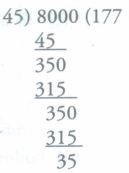
∴ Number of packets that can be loaded in the van\(=\frac { Total\quad weight\quad strength\quad of\quad the\quad van }{ Weight\quad of\quad one\quad packet } \)
\(=\frac { 800000 }{ 4500 } =\frac { 8000 }{ 45 } \)
Hence, only 177 boxes can be loaded in the van.
208.
(a) Weight of apples sold during the last year = 2457 kg
Weight of oranges sold during the last year = 3004 kg
∴ Total weight of apples and oranges Raman sold, during the last year = 2457 + 3004= 5461 kg
(b) Total money Raman got by selling apples
=Total number of apples \(\times\) Cost per kg
= 2457 \(\times\) 40 = Rs. 98280
(c) Total money Raman got by selling oranges
=Total number of oranges \(\times\) Cost per kg
=3004 \(\times\) 30 = Rs. 90120
∴ Total money Raman got by selling apples and oranges together =98280 + 90120 = Rs. 188400
(d) Following table shows the money received from selling items:
| Items | Sales | Rate | Money received |
| Apples | 2457 | Rs.40 per kg | 2457 \(\times\) 40 =Rs. 98280 |
| Oranges | 3004 | Rs.30 per kg | 3004 \(\times\) 30 = Rs. 90120 |
| Combs | 22760 | Rs.3 for one | 22760 \(\times\) 3 = Rs. 68280 |
| Toothbrushes | 25367 | Rs.10 for one | 25367\(\times\) 10 =Rs. 253670 |
| Pencils | 38350 | Rs.1 for one | 38350 \(\times\) 1= Rs. 38350 |
| Notebooks | 40002 | Rs.6 for one | 40002 \(\times\) 6 = Rs. 240012 |
| Soapcakes | 20005 | Rs.8 for one | 20005 \(\times\) 8 = Rs. 160040 |
The entries of amount of money received in descending order are as follows:
Rs. 253670 >Rs. 240012 >Rs. 160040 > Rs. 98280 > Rs. 90120 >Rs. 68280 > Rs. 38350
The item, which brought him the highest amount is tooth brushes. This amount is Rs. 253670.
209.
From the given figure,
(i) Total distance covered by bus from A to D
= AB + BC + CD =4170 +3410 + 2160 =9740 km
(ii) Total distance covered by bus from D to G
= DE + EF + FG = 8140 + 4830 + 2550 = 15520 km
(iii) Total distance covered by bus = Distance from A to D + Distance from D to G + Distance from G to A
=9740+15520+1290 [from (i) and (ii) parts)
=26550 km
(iv) Distance from C to D = 2160 km
Distance from D to E = 8140 km
∴ Difference of distances from C to D and D to E
=8140 - 2160 = 5980 km
(v) To find out the time for individual places, we will use the formula of time i.e.
\(Time=\frac { Distance }{ Speed } \)
(a) Time taken by bus to reach from A to B
\(=\frac { Distance\quad from\quad AtoB }{ Speed } =\frac { 4170 }{ 60 } =\frac { 139 }{ 2 } =69\frac { 1 }{ 2 } h\)
(b) Time taken by bus to reach from C to D
\(=\frac { Distance\quad from\quad CtoD }{ Speed } =\frac { 2160 }{ 60 } =36h\)
(c) Time taken by bus to reach from E to G
\(=\frac { Distance\quad from\quad EtoG }{ Speed } =\frac { 4830+2550 }{ 60 } =\frac { 7380 }{ 60 } =123h\)
(d) Time taken by bus for total journey
\(=\frac { Total\quad distance\quad covered }{ Speed } =\frac { 26550 }{ 60 } =\frac { 885 }{ 2 } =442\frac { 1 }{ 2 } h\).
210.
The names of five large cities in India are Delhi, Bengaluru, Kolkata, Hyderabad and Chennai.
Process of making the pair of cities are given below:
We have, Delhi, Bengaluru, Kolkata, Hyderabad and Chennai
First, we take Delhi as base city
So,
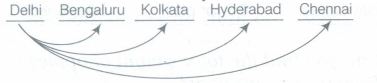
Now, we take Bengaluru as base city.
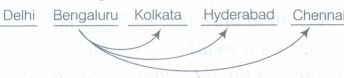
Now, we take Kolkata as base city.
So,

Now, we take Hyderabad as base city.
So,

Their respective population can be taken from a book of general awareness. However, the distance (in kilometres) between each pair of these cities is given below:
| Cities in pair | Distance between two cities (in km) |
| Delhi - Bengaluru | 2019 |
| Delhi - Kolkata | 1442 |
| Delhi - Hyderabad | 1453 |
| Delhi - Chennai | 2157 |
| Bengaluru - Kolkata | 1883 |
| Bengaluru - Hyderabad | 566 |
| Bengaluru- Chennai | 334 |
| Kolkata - Hyderabad | 1516 |
| Kolkata - Chennai | 1678 |
| Hyderabad - Chennai | 704 |
These are the national distances between the cities.
211.
Given digits are 4, 5, 6, 0, 7 and 8.
We can make many numbers by using these digits, five of them are as follows:
876540, 867540, 876450, 876045 and 867405
(a) After putting commas, numbers are as follows:
(i) 8,76,540 (ii) 8,67,540
(iii) 8,76,450 (iv) 8,76,045
(v) 8,67,405
(b) Ascending order of numbers is as follows:
867405 < 867540 < 876045 < 876450 < 876540
Descending order of numbers is as follows:
876540 > 876450 > 876045 > 867540 > 867405.
212.
After reading these number, we have
(i) 527864 Five lakhs twenty seven thousands eight hundreds sixty four.
(ii) 95432 Ninety five thousands four hundreds thirty two.
(iii) 18950049 One crore eighty nine lakhs fifty thousands forty nine.
(iv) 70002509 Seven crores two thousand five hundreds nine.
(a) By USIng placement boxes, gIven number can be written as
By using the commas, given numbers can be written as :
| Number | Crores | Ten lakhs | Lakhs | Ten Thousands | Thousands | Hundreds | Tens | Ones |
| 52786 | - | - | 5 | 2 | 7 | 8 | 6 | 4 |
| 95432 | - | - | - | 9 | 5 | 4 | 3 | 2 |
| 1895004 | 1 | 8 | 9 | 5 | 0 | 0 | 4 | 9 |
| 70002509 | 7 | 0 | 0 | 0 | 2 | 5 | 0 | 9 |
(b) Ascending order of these numbers are as follow:
95432 < 527864 < 18950049 < 70002509
Descending order of these numbers are as follow:
70002509> 18950049> 527864 > 95432.
213.
After reading these numbers, we have
(i) 475320 Four lakhs seventy five thousands three hundred twenty.
(ii) 9847215 Ninety eight lakhs forty seven thousands two hundreds fifteen.
(iii) 97645310 Nine crores seventy six lakhs forty five thousands three hundreds ten.
(iv) 30458094 Three crores four lakhs fifty eight thousands ninety four.
The placement boxes is shown as below:
| Number | Crores | Ten lakhs | Lakhs | Ten thousands | Thousand | Hundreds | Tens | Ones |
| 475320 | - | - | 4 | 7 | 5 | 3 | 2 | 0 |
| 9847215 | - | 9 | 8 | 4 | 7 | 2 | 1 | 5 |
| 97645310 | 9 | 7 | 6 | 4 | 5 | 3 | 1 | 0 |
| 30458094 | 3 | 0 | 4 | 5 | 8 | 0 | 9 | 4 |
Expanded forms of given numbers are as follow:
(i) 475320 = 4 \(\times\)100000 + 7 \(\times\) 10000 + 5\(\times\) 1000 + 3 \(\times\) 100 +2\(\times\)10+ 0 \(\times\) 1
(ii) 9847215 = 9 \(\times\) 1000000 + 8 \(\times\) 100000 + 4 \(\times\) 10000 + 7 \(\times\) 1000 + 2 \(\times\) 100 + 1 \(\times\)10 + 5 \(\times\) 1
(iii) 97645310 = 9 \(\times\) 10000000 + 7 \(\times\) 1000000 + 6 \(\times\) 100000 + 4 \(\times\) 10000 + 5 \(\times\) 1000 + 3 \(\times\) 100 + 1 \(\times\) 10 + 0 \(\times\)1
(iv) 30458094 = 3\(\times\) 10000000 + 4 \(\times\) 100000 + 5 \(\times\) 10000 + 8 \(\times\) 1000 + 0 \(\times\) 100 + 9\(\times\) 10 + 4 \(\times\) 1
(a) The smallest number = 475320
(b) The greatest number = 97645310
(c) Ascending order of given numbers are as follow:
475320 < 9847215 < 30458094 < 97645310
Descending order of given numbers are as follow:
97645310> 30458094 > 9847215> 475320.
214.
The remaining blanks are shown as below with appropriate number, name and expansion
| Number | Number name | Expansion |
| 4,57,928 | Four lakhs fifty seven thousands nine hundreds twenty eigh | 4 \(\times\) 10,00,00 + 5 \(\times\) 10,000 + 7 \(\times\) 1,000+ 9 \(\times\) 100 + 2 \(\times\) 10 + 8 \(\times\)1 |
| 4,07,928 | Four lakhs seven thousands nine hundreds twenty eight | 4 \(\times\) 1,00,000+ 7 \(\times\) 1,000 + 9 \(\times\) 100 + 2 \(\times\) 10 + 8 \(\times\) 1 |
| 4,00,829 | Four lakhs eight hundreds twenty nine | 4 \(\times\) 1,00,000 + 8 \(\times\) 100 + 2 \(\times\) 10 + 9 \(\times\) 1 |
| 4,00,029 | Four lakhs twenty nine | 4 \(\times\) 1,00,000+ 2 \(\times\) 10 + 9 \(\times\) 1 |
215.
The remaining blanks are shown as below with appropriate number, name and expansion:
| Number | Number name | Expansion |
| 50000 | Fifty thousands | 5 \(\times\) 10,000 |
| 41000 | Forty one thousands | 4 \(\times\) 10,000 + 1 \(\times\) 1,000 |
| 47300 | Forty seven thousands three hundreds | 4\(\times\)10,000 + 7 \(\times\) 1,000 + 3 \(\times\) 100 |
| 57630 | Fifty seven thousands six hundreds thirty | 5 \(\times\) 10,000 + 7 \(\times\) 1,000 + 6 \(\times\) 100 + 3\(\times\)10 |
| 29485 | Twenty nine thousands four hundreds eighty five | 2 \(\times\)10,000 + 9\(\times\) 1,000 + 4 \(\times\) 100 + 8 \(\times\) 10 + 5 \(\times\) 1 |
| 29085 | Twenty nine thousands eighty five | 2 \(\times\) 10,000 + 9 \(\times\) 1,000 +8 \(\times\)10+ 5 \(\times\) 1 |
| 20085 | Twenty thousands eighty five | 2\(\times\)10,000 + 8 \(\times\) 10 + 5 \(\times\) 1 |
| 20005 | Twenty thousands five | 2 \(\times\) 10,000 + 5 \(\times\) 1 |
216.
(i) From the given figure, it is clear that,
160> 159> 158> 154
∴ Ramhari is the tallest, because he has the height of 160 cm.
(ii) From the given figure, it is clear that,
154 < 158 < 159 < 160
∴ Dolly is the shortest, because she has the height of 154 cm.
We can arrange height from two types:
(a) Yes, we can arrange their heights in increasing order as follows: Dolly (154 cm) < Mohan (158 cm) < Shashi (159 cm) < Ramhari (160 cm).
(b) Yes, we can arrange their heights in decreasing order as follows: Ramhari (160 cm) > Shashi (159 cm) > Mohan (158 cm) > Dolly (154 cm).
217.
We have, 6895, 23787, 24569, 24659
Here, 6895 is a 4-digit number and other numbers are 5 digits, so it is clear that 6895 is the smallest number. Now, in remaining three numbers, the digit at ten thousands place is same in each number. So, we compare the thousands place digit.

∵ 4>3
Again, in two numbers, digit at thousands place is same. So, we compare the hundreds place digit.

∵ 6>5
∴ The greatest number is 24659 and smallest number is 6895.
218.
Given population is 2538473.
Rounded off to nearest thousands = 2538000
219.
Here, given number is 60 i.e. LX.
220.
()
(a) 1 m =1000 mm (b) 1 cm =10 mm
221.
1023 is required smallest four-digit number.
222.
According to Indian system of numeration, 6,17,11,682.
223.
We know that,
1 million = 1000000 (in digits)
= 10 \(\times\)100000 = ten \(\times\) one lakhs (in number name)
∴1 million = ten lakhs
224.
We know that,
1 crore = 10000000 (in digits) = 10 \(\times\) 1000000
= ten \(\times\) one million (in number name)
∴ 1 crore = ten millions
225.
We know that,
1 crore = 10000000 (in digits) = 10 \(\times\)1000000
= ten \(\times\)ten lakhs (in number name)
∴1 crore = ten ten lakhs
226.
We know that,
1 million = 1000000 (in digits) = 10 \(\times\) 100000
= ten\(\times\) hundred thousands
(in number name)
∴ 1 million = ten hundred thousands
227.
We know that,
1 lakh = 100000 (in digits) = 10 \(\times\) 10000
= ten \(\times\) ten thousand (in number name)
1 lakh = ten ten thousand
228.
(b)
425671
229.
(b)
V
230.
(d)
undefine
231.
(c)
9 \(\times\) 1000 + 57 \(\times\) 10 + 8 \(\times\) 1
232.
(b)
58,695,376
233.
(a)
1 million = 1000000
234.
(a)
235.
(a)
236.
(b)
237.
(a)
238.
(b)
239.
()
89
240.
()
103460
241.
()
10000 m
242.
()
10 millions

6th Standard CBSE Syllabus & Materials
6th Standard CBSE
CBSE 6th Social Science Locating Places on the Earth - New Sample Question Papers Study Material - QB365 Set A
NEW6th Standard CBSE
CBSE 6th Science A Journey Through States of Water - New Sample Question Papers Study Material - QB365 Set A
NEW6th Standard CBSE
CBSE 6th Science Temperature and its Measurement - New Sample Question Papers Study Material - QB365 Set A
NEW6th Standard CBSE
CBSE 6th Science Materials Around Us - New Sample Question Papers Study Material - QB365 Set A



NCERT Books

Syllabus

Exam Pattern

Sample Question Papers

Previous year Question Papers

Important Notes

MCQ Practice test

NCERT Exemplers

Case study Questions

Image Based Questions

Passage based Questions

HOT Questions

Value Based Questions

Model Questions Papers
NCERT ( Book Back ) Questions

Assertion and Reason
Important Questions And Answers

CBSE 6th Standard CBSE Subjects
CBSE Standards