 100% FREE ACCESS
6th Standard CBSE Syllabus & Materials
6th Standard CBSE
CBSE 6th Social Science The Value of Work - New Sample Question Papers Study Material - QB365 Set A
NEW6th Standard CBSE
CBSE 6th Social Science Family and Community - New Sample Question Papers Study Material - QB365 Set A
NEW6th Standard CBSE
CBSE 6th Social Science India's Cultural Roots - New Sample Question Papers Study Material - QB365 Set A
NEW6th Standard CBSE
CBSE 6th Social Science India,That is Bharat - New Sample Question Papers Study Material - QB365 Set A
NEW6th Standard CBSE
CBSE 6th Social Science Timeline and sources of history - New Sample Question Papers Study Material - QB365 Set A
NEW6th Standard CBSE
CBSE 6th Social Science Oceans and Continents - New Sample Question Papers Study Material - QB365 Set A
Published on: 24/10/2025
Download CBSE Class 6th Standard CBSE Mathematics question papers, sample papers, important questions, and previous year solved papers in PDF format. Get free study materials, NCERT solutions, and exam preparation resources for Class 6th Standard CBSE Mathematics
Questions + Answers key
Take MCQ Mathematics Test
1.
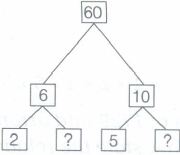
Here is a factor tree for 60. Write the missing number.
2.
A number is divisible by 8. By what other numbers will that number be divisible?
3.
Find the common factors of 20 and 28
4.
Is the number 17152652 divisible by both 4 and 11?
5.
Using divisibility tests, determine the following number are divisible by 11? 10824
6.
Check whether the number 9524624 is divisible by 4 or not.
7.
Find the product of first natural, first whole and first prime number.
8.
What is the greatest prime number between 1 and 10?
9.
Express the following as the sum of two odd prime numbers 34
10.
Is 37 a factor of 460132?
11.
Write all the multiples of 11 upto 110.
12.
Write all the factors of the following number 42
13.
Write first five multiples of 8
14.
Write all the factors of the following number: 21
15.
Find the factors of the first four multiples of 12.
16.
Find the least number of five digits that is exactly divisible by 16, 18, 24 and 30.
17.
Five bells begin to toll together at intervals of 9 s, 6 s, 4 s, 10 s and 58 s, respectively, how many times will they toll together in the span of 1 h?
18.
Give the factorisation of 136
19.
Which of the following numbers are co-prime? 30 and 415
20.
Using divisibility tests, determine the following number is divisible by 6? 1258
21.
Find the largest possible number of 5 digits, which exactly divisible by 32, 36 and 40.
22.
Monica, Heronica and Rajat begin to jog around a circular stadium. They complete their revolution in 42 s, 56 s and 63 s, respectively. How many seconds after will they be together at the starting point?
23.
On a morning walk, three persons step off together and their steps measure 40 cm, 42 cm and 46 cm, respectively.
(a) What is the minimum distance each should walk so that each can cover the same distance in complete steps?
(b) What are the benifits of morning walk?
24.
Fatima wants to mail three parcels to three village schools. She finds that the postal charges are Rs 20, Rs 28 and Rs 36, respectively. If she wants to buy stamps only of one denomination, what is the greatest denomination of stamps she must buy to mail the three parcels?
25.
Write a digit in the blank space of the following number, so that the number formed is divisible by 11. 92___389
26.
The LCM of 5 and 6 is
10
20
30
60
27.
The LCM of 6 and 18 is
6
12
18
36
28.
The greatest common factor of 5, 15 and 25 is
1
5
10
15
29.
The greatest common factor of 8 and 20 is
2
1
4
8
30.
Which of the following statements is true?
The product of two even numbers is always even.
The sum of three odd numbers is even.
All prime numbers are odd.
Prime numbers do not have any factors.
31.
The largest number, which always divides the sum of any pair of consecutive odd numbers is
2
4
6
8
32.
The number of distinct prime factors of the largest 4-digit number is
2
3
5
11
33.
Which of the following is not co-prime?
8. 10
11, 12
1, 3
31, 33
34.
Which of the following numbers is divisible by both 13 and 3?
1625
1296
121229
None of these
35.
Which of the following numbers is divisible by 3?
2592
5493
39583
1.
\(\because\) 6 = 2 x 3 and 10 = 5 x 2
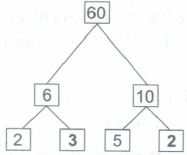
Hence, missing numbers are 3 and 2.
2.
1, 2, 4
3.
Factors of 20 and 28 are as follows:
20 = 1 x 20; 20 = 2 x 10; 20 = 4 x 5 and 28 = 1 x 28; 28 = 2 x 14; 28 = 4 x 7
Now, all factors of 20 = 1, 2, 4, 5, 10, 20 and all factors of 28 = 1, 2, 4, 7, 14, 28
\(\therefore\)Common factors = 1, 2, 4
Hence, common factors of 20 and 28 are 1, 2 and 4.
4.
Yes
5.
We have, 10824,
\(\begin{matrix} 1 \\ \downarrow \\ O \end{matrix}\begin{matrix} 0 \\ \downarrow \\ E \end{matrix}\begin{matrix} 8 \\ \downarrow \\ O \end{matrix}\begin{matrix} 2 \\ \downarrow \\ E \end{matrix}\begin{matrix} 4 \\ \downarrow \\ O \end{matrix}\)
Sum of digits at odd places from right = 4 +8 + 1= 13
Sum of digits at even places from right = 2 + 0 = 2
Now, difference = 13 - 2 = 11
So, 10824 is divisible by 11.
6.
In the number 9524624, the last two digit number is 24, which is divisible by 4. Hence, 9524624 is divisible by 4.
7.
0
8.
Prime numbers between 1 and 10 are 2,3,5 and 7.
Therefore, the greatest prime number between 1 and 10 is 7.
9.
Here, we have 34
34 = 31 + 3 or 29 + 5
10.
Yes
11.
11, 22, 33, 44, 55, 66, 77, 88, 99, 110.
12.
1, 2, 3, 6, 7,14,21,42
13.
Multiples of 8
8 x 1= 8; 8 x 2 = 16; 8 x 3 = 24; 8 x 4 = 32; 8 x 5 = 40
\(\therefore\)First five multiples of 8 are 8, 16, 24, 32 and 40.
14.
We have, 21
21 = 1 x 21; 21 = 3 x 7
\(\therefore\)Factorsof 21 are 1, 3, 7 and 21.
15.
Factor is the exact divisor of that number. So, for finding factors, we use factorisation method.
Factors of 12 = 1, 2, 3, 4, 6 and 12.
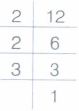
Now, for finding multiples, we multiply 12 with natural numbers.
So, first four multiples of 12 are 12 x 1, 12 x 2, 12 x 3,12 x 4
i.e. 12, 24, 36 and 48.
16.
10080
17.
We have to find the LCM of 9,6,4, 10 and 8.
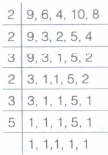
LCM = 2 x 2 x 3x3x5x2=360
In 1 h, the ring will toll together
\(3600\over 360\)times=10times
18.
We have, 136
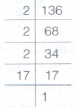
\(\therefore\)136=1x2x2x2x17
19.
We have, 30 and 415
30 = 1 x 30; 30 = 2 x 15; 30 = 3 x 10; 30 = 5 x 6
Factors of 30 are 1,2,3,5,6,10,15 and 30 and 415 = 1 x 415; 415 = 5 x 83
Factors of 415 are 1, 5, 83 and 415.
\(\because\)Common factors of 30 and 415 are 1 and 5.
So, 30 and 415 are not co-prime numbers.
20.
We have, 1258
(i) Divisibility by 2
\(\because\)Unit digit of number = 8, so 1258 is divisible by 2.
(ii) Divisibility by 3
Sum of digits of given number = 1+ 2 + 5 + 8 = 16 is not divisible by 3, so 1258 is not divisible by 3. Now, we see that 1258 is divisible by 2 but not divisible by 3.
Hence, it is not divisible by 6.
21.
99360
22.
Required second of time = LCM of 42, 56 and 63
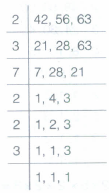
LCM = 2 x 3 x 7 x 2 x 2 x 3 = 504 s
Hence, after 504 s, they will be together at starting point.
23.
(a) The steps measure of each person is 40 cm 42 cm and 46 cm. So, the minimum distance each should walk is the LCM of 40, 42 and 46.
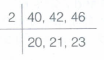
LCM of 40, 42 and 46 = 2 x 20 x 21 x 23
=19320 cm
= 193.2 m
(b) Morning walk benefits us in many ways. It maintain our good health. Some benefits of morning walk are listed below:
(i) Strengthen our heart
(ii) Delays or prevents major diseases or illness
(iii) Reduces blood pressure and the risk of stroke
(iv) Reduces cholestrol
(v) Boost immune system
24.
The given postal charges for three parcels are Rs20, Rs28, Rs 36.
The greatest denomination of stamps is the HCF of 20, 28 and 36.
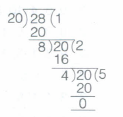

HCF of 20 and 28 is 4.
Now, we.find the HCF of 4 and 36.
HCF of 4 and 36 is 4.
Hence, HCF of 20, 28 and 36 is 4.
\(\therefore\) Fatima would by stamp of denomination of Rs4.
25.
Let the required unknown digit be x.
Then, the number becomes
\(\begin{matrix} 9 \\ \downarrow \\ E \end{matrix}\begin{matrix} 2 \\ \downarrow \\ O \end{matrix}\begin{matrix} x \\ \downarrow \\ E \end{matrix}\begin{matrix} 3 \\ \downarrow \\ O \end{matrix}\begin{matrix} 8 \\ \downarrow \\ E \end{matrix}\begin{matrix} 9 \\ \downarrow \\ O \end{matrix}\)
where, O = Odd and E = Even
Sum of digits at odd places from right = 9 + 3 + 2 = 14
Sum of digits at even places from right = 8 + x + 9 = 17+x
\(\because\)Number is divisible by 11.
\(\therefore\)Difference of digits will be 0 or 11.
\(\Rightarrow\) (17 + x) -14 = 0 or 11
\(\Rightarrow\)17 + x - 14 = 0 or 11 \(\Rightarrow\) x +3 = 0 or 11
Taking difference 0, x +3 = 0
\(\Rightarrow\)x = 0 - 3 = - 3 (not possible)
Taking difference 11, x + 3 = 11 \(\Rightarrow\) x = 11- 3 = 8
So, required digit to write in the blank space is 8.
26.
(c)
30
27.
(c)
18
28.
(b)
5
29.
(c)
4
30.
(a)
The product of two even numbers is always even.
31.
(b)
4
32.
(b)
3
33.
(a)
8. 10
34.
(d)
None of these
35.
(a)
2592

6th Standard CBSE Syllabus & Materials
6th Standard CBSE
CBSE 6th Social Science Locating Places on the Earth - New Sample Question Papers Study Material - QB365 Set A
NEW6th Standard CBSE
CBSE 6th Science A Journey Through States of Water - New Sample Question Papers Study Material - QB365 Set A
NEW6th Standard CBSE
CBSE 6th Science Temperature and its Measurement - New Sample Question Papers Study Material - QB365 Set A
NEW6th Standard CBSE
CBSE 6th Science Materials Around Us - New Sample Question Papers Study Material - QB365 Set A



NCERT Books

Syllabus

Exam Pattern

Sample Question Papers

Previous year Question Papers

Important Notes

MCQ Practice test

NCERT Exemplers

Case study Questions

Image Based Questions

Passage based Questions

HOT Questions

Value Based Questions

Model Questions Papers
NCERT ( Book Back ) Questions

Assertion and Reason
Important Questions And Answers

CBSE 6th Standard CBSE Subjects
CBSE Standards