
 100% FREE ACCESS
6th Standard CBSE Syllabus & Materials
6th Standard CBSE
CBSE 6th Social Science The Value of Work - New Sample Question Papers Study Material - QB365 Set A
NEW6th Standard CBSE
CBSE 6th Social Science Family and Community - New Sample Question Papers Study Material - QB365 Set A
NEW6th Standard CBSE
CBSE 6th Social Science India's Cultural Roots - New Sample Question Papers Study Material - QB365 Set A
NEW6th Standard CBSE
CBSE 6th Social Science India,That is Bharat - New Sample Question Papers Study Material - QB365 Set A
NEW6th Standard CBSE
CBSE 6th Social Science Timeline and sources of history - New Sample Question Papers Study Material - QB365 Set A
NEW6th Standard CBSE
CBSE 6th Social Science Oceans and Continents - New Sample Question Papers Study Material - QB365 Set A

Published on: 24/10/2025
Download CBSE Class 6th Standard CBSE Mathematics question papers, sample papers, important questions, and previous year solved papers in PDF format. Get free study materials, NCERT solutions, and exam preparation resources for Class 6th Standard CBSE Mathematics
Questions + Answers key
Take MCQ Mathematics Test
1.
A man would be 5 minutes late to reach his destination if he rides his bike at 30 km per hour. But he would be 10 minutes early, if he rides at the speed of 40 km per hour. What is the distance of his destination from where he starts?
2.
Which two digit numbers when added to 27 get reversed?
3.
Draw a circle of r = 5 cm. Draw any chord AB not passing through the centre. Draw the bisector of chord AB. Is it passing through the centre?
4.
Construct with ruler and compasses, angle of the following measures 90o.
5.
Draw a rectangle ABCD of length 7 cm and breadth 5 cm. Join AC and construct its perpendicular bisector. Mark the point, where it intersects the rectangle.
6.
Draw an angle of measure of 153° and divide it into four equal parts.
7.
How will you construct a 150° angle?
8.
With \(\bar{PQ}\) of length 6.1 cm as diameter, draw a circle.
9.
Draw any line segment \(\bar{PQ}\). Take any point R not on it. Through R, draw a perpendicular to \(\bar{PQ}\) (use ruler and set-square).
10.
Draw any line segment \(\bar{PQ}\). Without measuring \(\bar{PQ}\), construct a copy of \(\bar{PQ}\).
11.
Construct \(\bar{AB}\) of length 7.8 cm. From this, cut-off \(\bar{AC}\) of length 4.7 cm. Measure \(\bar{BC}\) .
12.
Draw a circle of radius 3.2 cm.
1.
Let the distance of his destination from where he starts be x km.
Time taken in covering this distance at the speed of 30 km per hour
= \(\frac{x}{30}\) hours = \(\frac{x}{30}\) x 60 minutes
= 2x minutes
Time taken in covering this distance at the speed of 40 km per hour
= \(\frac{x}{40}\) hours = \(\frac{x}{40}\) x 60 minutes
= \(\frac{3x}{2}\) minutes
Differene of both the sides
= 5 minutes + 10 minutes
= 15 minutes
∴ 2x - \(\frac{3x}{2}\) =15
⇒ 4x - 3x =30
⇒ x =30
Hence, the distance of his destination from where he starts is 30 km.
2.
Let in the two digit number to be added,
Unit's digit = x and, ten's digit = y
Then, the number to be added = 10y + x
On reversing the digits,
Unit's digit = y and, ten's digit = x
∴ The number to be added = 10x + y
According to the question,
27 + (10y + x) = 10x + y
⇒ 9x- 9y = 27
⇒ x-y=3
⇒ x=y+3
When y = I, x = 4 ∴ Number = 14
When y = 2, x = 5 ∴ Number = 25
When y = 3, x = 6 ∴ Number=36
When y = 4, x = 7 ∴ Number = 47
When y = 5, x = 8 ∴ Number = 58
When y = 6, x = 9 ∴ Number = 69
Hence, the required two digit numbers are 14, 25, 36, 47, 58, 69.
3.
Steps of construction are as follows:
Step I Draw a circle with radius 5 cm.
Step II Draw a chord AB.
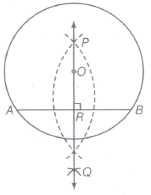
Step III Draw the bisector of the chord AB, which intersect AB at R and passing through the centre of the circle 'O'.
4.
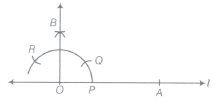
On measuring, \(\angle\)BOA = 90o.
5.
Band D
6.
Here, to divide an angle of measure 153° into four equal parts, we use the following steps:
Step I Draw \(\bar{AB}\) of any length. Place the centre of the protractor at A and the zero edge along \(\bar{AB}\).
Step II Start with zero near B. Mark point C at 153°.
Step III Join AC, then \(\angle\)BAC is an angle of measure 153o.
.png)
Step IV With A as centre and using compasses, draw an arc that cuts both rays of \(\angle\)A at P and Q.
.png)
Step V With P as centre, draw (in the interior of \(\angle\)A) an arc whose radius is more than half the length of PQ.
.png)
Step VI With the same radius and with Qas centre, draw another arc in the interior of \(\angle\)A. Let the two arcs intersect at D. Join \(\bar{AD}\). Let AD cut the arc PQ at I. Then, \(\bar{AD}\) divides the \(\angle\)BAC in two equal parts.
.png)
Step VII Now, with P and I as centre and with radius more than half of length PI, draw two arcs respectively, which cut each other at R.
Step VIII Join \(\bar{AR}\) . Then, \(\bar{AR}\) divides \(\angle\)BAD into two equal parts.
Step IX Now, with Q and I as centre and with radius more than half of length QI, draw two arcs respectively, which cut each other at M.
Step X Join \(\bar{AM}\) . Then, \(\bar{AM}\) divide \(\angle\)CAD into two equal parts.
.png)
Thus, \(\bar{AM},\bar{AD}\) and \(\bar{AR}\) divide BAC into four equal parts.
7.
To construct an angle of 150o, steps of construction are given below:
Step I Draw a line and mark point 0 and A on it such that A is in the right of O.
Step II With O as centre and with any convenient radius draw a semi-circle, cutting the line I at P and S.
Step III Now, take P as centre and radius same as in Step II, draw an arc which intersects the semi-circle at Q.
Step IV Now, take Qas centre and (same as step II) draw an arc which intersects the semi-circle at R.
Step V Now, bisect this angle. For this, take distance more than half of length RS as radius and with R and S as centre draw arcs such that both intersect each other at T.
Step VI Join OT and produce it up to point B.
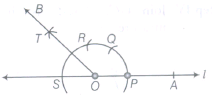
Thus, \(\angle\)AOB = 150o.
8.
To draw a circle, of diameter 6.1 cm, we use the following steps:
Step I Draw a line segment \(\bar{PQ}\) of length 6.1 cm.
.png)
Step II With P as centre, using compasses, draw an arc of a circle (here, we can draw a circle also) with radius more than half of the length of \(\bar{PQ}\) .
Step III With the same radius and with Q as centre, draw another circle using compasses. Let it cut the previous circle at M and N.
.png)
Step IV Now, join \(\bar{MN}\) . It cuts \(\bar{PQ}\) at O.
Therefore, MN is the perpendicular bisector of \(\bar{PQ}\) and O is the mid-point of \(\bar{PQ}\). Now, with O as centre and OP or OQ as radius, draw a circle.
Thus, it is a circle whose diameter is the line segment \(\bar{PQ}\).
Hence, the circle PMQN is the required circle.
9.
To draw a perpendicular to \(\bar{PQ}\) using ruler and set-square, we use the following steps:
Step I Draw a line segment \(\bar{PQ}\) and take a point R, outside of \(\bar{PQ}\).
.png)
Step II Place a set-square on \(\bar{PQ}\) such that one arm of its right angle aligns along \(\bar{PQ}\).
.png)
Step III Place a ruler along the edge opposite to the right angle of the set-square.
.png)
Step IV Hold the ruler fixed. Slide the set-square along the ruler till the point R touches the other arm of the set square.
.png)
Step V Join RS along the edge through R meeting \(\bar{PQ}\) at S.
.png)
Hence, \(\bar{RS}\bot\bar{PQ}\)
10.
To make a copy of \(\bar{PQ}\), we use the following steps
Step I Firstly, draw \(\bar{PQ}\) of any length, because length is not known.
.png)
Step II Fix the compasses pointer on P and the pencil end Q. The opening of the instrument now gives the length of \(\bar{PQ}\).
.png)
Step III Draw any line I and choose a point C on it. Without changing the compasses setting, place the pointer on C.
.png)
Step IV Swing an arc that cuts I at a point, say D. Then, \(\bar{CD}\) is copy of \(\bar{PQ}\).
.png)
11.
Given, \(\bar{AB}\) = 7.8 cm and \(\bar{AC}\) = 4.7 cm. Now, to construct a line segment of length 7.8 cm, we use the following steps:
Step I Draw a line, I. Mark, a point A on this line.
Step II Place the pointer of compasses at the zero mark of the ruler. Open it to place the pencil point up to the 7.8 ern mark.
Step III Without changing the opening to the compasses. Place the pointer on A and swing an arc to cut 1 at B.
Step IV \(\bar{AB}\) is a line segment of length 7.8 cm.
.png)
Now, to cut-off \(\bar{AC}\) of length 4.7 cm from \(\bar{AB}\), we use the following steps:
Step V Now, place the pointer of compasses at the zero mark of the ruler. Open it to the place the pencil point up to 4.7 cm mark.
Step VI Without changing the opening of the compasses, place the pointer on A and swing an arc to cut 1 at C.
.png)
Step VII Now \(\bar{AC}\)is a line segment of length 4.7 cm. On measuring, we get \(\bar{BC}\) =3.1 cm.
.png)
12.
To draw a circle of radius 3.2 ern, we use the following steps:
Step I Open the compasses to take a distance of 3.2 cm for the required radius of circle.
.png)
Step II Mark a point with a sharp pencil for the centre of the circle and name it as O.
.png)
Step III Place the pointer of the compasses on O.
.png)
Step IV Turn the compasses slowly to draw the circle.
.png)
Then, the above figure obtained is of the required circle of radius 3.2 cm.

6th Standard CBSE Syllabus & Materials
6th Standard CBSE
CBSE 6th Social Science Locating Places on the Earth - New Sample Question Papers Study Material - QB365 Set A
NEW6th Standard CBSE
CBSE 6th Science A Journey Through States of Water - New Sample Question Papers Study Material - QB365 Set A
NEW6th Standard CBSE
CBSE 6th Science Temperature and its Measurement - New Sample Question Papers Study Material - QB365 Set A
NEW6th Standard CBSE
CBSE 6th Science Materials Around Us - New Sample Question Papers Study Material - QB365 Set A



NCERT Books

Syllabus

Exam Pattern

Sample Question Papers

Previous year Question Papers

Important Notes

MCQ Practice test

NCERT Exemplers

Case study Questions

Image Based Questions

Passage based Questions

HOT Questions

Value Based Questions

Model Questions Papers
NCERT ( Book Back ) Questions

Assertion and Reason
Important Questions And Answers

CBSE 6th Standard CBSE Subjects
CBSE Standards