
 100% FREE ACCESS
6th Standard CBSE Syllabus & Materials
6th Standard CBSE
CBSE 6th Social Science The Value of Work - New Sample Question Papers Study Material - QB365 Set A
NEW6th Standard CBSE
CBSE 6th Social Science Family and Community - New Sample Question Papers Study Material - QB365 Set A
NEW6th Standard CBSE
CBSE 6th Social Science India's Cultural Roots - New Sample Question Papers Study Material - QB365 Set A
NEW6th Standard CBSE
CBSE 6th Social Science India,That is Bharat - New Sample Question Papers Study Material - QB365 Set A
NEW6th Standard CBSE
CBSE 6th Social Science Timeline and sources of history - New Sample Question Papers Study Material - QB365 Set A
NEW6th Standard CBSE
CBSE 6th Social Science Oceans and Continents - New Sample Question Papers Study Material - QB365 Set A

Published on: 24/10/2025
Download CBSE Class 6th Standard CBSE Mathematics question papers, sample papers, important questions, and previous year solved papers in PDF format. Get free study materials, NCERT solutions, and exam preparation resources for Class 6th Standard CBSE Mathematics
Questions + Answers key
Take MCQ Mathematics Test
1.
Can you think of some more examples where you have to divide a number of things in some ratio? Frame three such examples and ask your friends to solve them.
Two employees donated Rs. 1000 in National Draught Fund. The ratio of the contributions made by both is 5 : 3. Find their respective contributions.
2.
Find two equivalent ratio of 3: 7.
3.
If I spent Rs.126 in 3 weeks. How much do I spend in a year?
4.
Find the value of x, if 16 : 24 : : x : 30.
5.
Find the ratio of the following.
98 to 63
6.
Convert the ratio 20 : 35 in its simplest form.
7.
In a class, there are 40 boys and 80 girls. What is ratio of the number of boys to the number of girls?
8.
Which pair of ratios are equal and why?
(i) \(\frac{2}{3},\frac{4}{6}\)
(ii) \(\frac{8}{4},\frac{2}{1}\)
(iii) \(\frac{4}{5},\frac{12}{20}\)
9.
The temperature dropped 15 degree celsius in the last 30 days. If the rate of temperature drop remains the same, how many degrees will the temperature drop in the next 10 days?
10.
Check whether the given ratios are equal, i.e. they are in proportion. If yes, then write them in the proper form. 15: 45 and 5 : 25
11.
Check whether the given ratios are equal, i.e. they are in proportion. If yes, then write them in the proper form. 1 : 5 and 3 : 15
12.
Saurabh takes 15 min to reach school from his houseand Sachin takes one hour to reach school from his house. Find the ratio of the time taken by Saurabh to the time taken by Sachin.
13.
In a class, there are 20 boys and 40 girls. What is the ratio of the number of boys to the number of girls?
14.
Reena earns Rs. 90000 and save Rs.30000. Find the ratio of the money she earns to the money she saves. Mention the value you depict from this.
15.
Determine, if the following ratios form a proportion.Also, write the middle term and extreme terms, where the ratios form a proportion.
(a) 25 cm : 1 m and Rs.40 : Rs.160
(b) 39 L : 65 L and 6 bottles: 10 bottles
(e) 2 kg: 80 kg and 25 g: 625 g
(d) 200mL : 2.5 L and Rs.4 : Rs.50
16.
In a year, Seema earns Rs. 150000 and saves Rs.50000. Find the ratio of
(a) money that Seema earns to the money she saves.
(b) money that she saves to the money she spends.
17.
There are 20 girls and 15 boys in a class.
(a) What is the ratio of number of girls to the number of boys?
(b) What is the ratio of number of girls to the total number of students in the class?
18.
The ratio 4 : 16 is in its lowest form.
19.
The ratio of 150 cm to 1 m is 1 : 1.5.
20.
If 10: 30 :: 40 : x, then the value of x is 120.
21.
40 persons:200 persons=Rs.15:Rs.75
22.
16 : 24 : : 20 : 30
23.
There are 30 boys and 20 girls in a class. The ratio of the number of girls to the number of boys is
2:3
3:2
2:5
3:5
24.
In a school library, the ratio of Mathematics books to Science books is same as the ratio of Science books to Hindi books. If there are 450 books of Science and 300 books of Hindi, then find the number of books in Mathematics
720
675
300
450
25.
Ifa bus travels 160 km in 4 h and a train travels 320 km in 5 h at uniform speeds, then the ratio of the distances travelled by them in one hour is
1:2
4:5
5:8
8:5
26.
Mathematics textbook for Class VI has 320 pages. The chapter 'Symmetry' runs from page 261 to page 272. The ratio of the number of pages of this chapter to the total number of pages of the book is
11 : 320
3: 40
3: 80
272 : 320
27.
The ratio of 6 books to 30 books is
5 : 1
2 : 3
1 : 5
2: 5
28.
Ratio of 5 paise to 25 paise is the same as the ratio of 20 paise to ______________
29.
A ratio expressed in lowest form has no common factor other than ______________ in its terms.
30.
Maya can walk 6 km in 2 h. In 3 h, she can walk ______________
31.
The cost of 4 pens is Rs. 40. The cost of 11 pens is ____________
32.
See the figure and fill in the blanks.
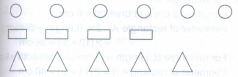
The ratio of the number of rectangles to the circles is __________
1.
Sum of ratios = 5 + 3 = 8
Total contribution = Rs. 1000
\(\therefore\) Contribution made by one employee
= \(\frac { 5 }{ 8 } \times 1000\) = Rs. 625
Contribution made by other employee
= \(\frac { 3 }{ 8 } \times 1000\) = Rs. 375
2.
6 : 14
3.
Rs.2190
4.
20
5.
Ratio=14:9
6.
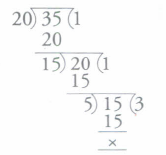
Here, HCF of 20 and 35 is 5.
\(\therefore\frac{20}{35}=\frac{20\div5}{35\div5}=\frac{4}{7}=4:7\)
7.
Given that, number of boys = 40 and number of girls = 80
Ratio of number of boys to the number of girls \(=\frac{Number\ of\ boys}{Number\ of\ girls}=\frac{40}{80}=\frac{1}{2}=1:2\)
8.
(i) \(\frac{2}{3}=2:3\ and\ \frac{4}{6}=2:3\) Hence, \(\frac{2}{3}\ and \frac{4}{6}\) are equal.
(ii) \(\frac{8}{4}=2:1\ and\frac{2}{1}=2:1\) Hence, \(\frac{8}{4}\ and\frac{2}{1}\) are equal.
(iii) \(\frac{4}{5}=4:5\ and\frac{12}{20}=\frac{3}{5}=3:5\) Hence,\(\frac{4}{5}\ and\frac{12}{20}\) are not equal.
9.
Given, in last 30 days, temperature drop = 15 degree
\(\therefore\) In 1 day, temperature drop \(=\frac{15}{30}\) degree
\(=\frac{15\div15}{30\div15}=\frac{1}{2}degree[\because \ HCF\ of\ 15\ and\ 30=15]\)
\(\therefore\) In next 10 days, temperature drop
\(=\frac{1}{2}\times10\ degree=5\ degree\)
Hence, temperature dropped 5 degree in the next 10 days.
10.
We have, 15 : 45 and 5 : 25
Here, \(15:45=\frac{15}{45}=\frac{15\div15}{45\div15}\)
[dividing numerator and denominator both by 15]
\(=\frac{1}{3}=1:3\ and\ 5:25=\frac{5}{25}=\frac{5\div5}{25\div5}=\frac{1}{5}=1:5\)
[dividing numerator and denominator both by 5]
Here, 15 : 45 \(\ne\)5 : 25
Thus, 15 : 45 and 5 : 25 are not in proportion.
11.
We have, 1: 5 and 3: 15
Here, \(3:15=\frac{3}{15}=\frac{3\div3}{15\div3}=\frac{1}{5}=1:5\) [dividing numerator and denominator both by 3]
i.e. 1 : 5 and 3 : 15 are in proportion.
Thus, the proper form is 1 : 5 :: 3: 15.
12.
Here, time taken by Saurabh is in minutes and time taken by Sachin is in hours. So,we have to convert time taken by both into the same unit.
\(\therefore\) Time taken by Sachin = 1 h = 1 X 60 min = 60 min [\(\because\)1 h =60 min]
and time taken by Saurabh = 15 min
\(\therefore\) Ratio of time taken by Saurabh to the time taken by Sachin \(=\frac{Time\ taken\ by\ Saurabh}{Time\ taken\ by\ Sachin}=\frac{15}{60}=\frac{15\div15}{60\div15}=\frac{1}{4}=1:4\) [\(\because\) HCF of 15 and 60=15]
Hence, the required ratio is 1 : 4.
13.
Here, number of boys = 20 and number of girls = 40
\(\therefore\) Ratio of number of boys to the number of girls \(=\frac{Number\ of\ boys}{Number\ of\ girls}=\frac{20}{40}=\frac{2}{4}\)
[dividing numerator and denominator by 10]
\(=\frac{1}{2}=1:2\)
Hence, the required ratio is 1 : 2.
14.
Reena's earning = Rs. 90000
Reena's saving = Rs.30000
Ratio of earning to the saving \(=\frac{90000}{30000}=3:1\)
The value depict here is economic planning for future.
15.
(a) Here, 25 cm : 1 m = 25 cm : 1 x 100 cm [\(\because\)1 m=100em]
= 25 cm: 100 cm
\(=25:100=\frac{25}{100}=\frac{25\div25}{100\div25}=\frac{1}{4}=1:4\)
[dividing numerator and denominator both by 25]
and Rs.40:Rs.160=40:160=\(\frac{40}{160}=\frac{4}{16}=\frac{1}{4}=1:4\)
[dividing numerator and denominator both by 10]
Here, 1: 4 = 1: 4 i.e. 25 cm : 1 m = Rs.40 : Rs.160
So, the ratios of 25 cm : 1 m and Rs.40 : Rs.160 are in proportion.
i.e. 25 cm : 1 m: : Rs.40 : Rs.160
Now, middle terms are 1 m and Rs.40 and extreme terms are 25 cm and Rs.160.
(b) Here,39L:65L=39:65=\(\frac{39}{65}\)
\(=\frac{39\div13}{65\div13}\) [\(\because\) HCF of 39 and 65 = 13]
\(=\frac{3}{5}=3:5\)
and 6 bottles: 10 bottles = 6 :10 \(=\frac{6}{10}\)
\(=\frac{6\div2}{10\div2}=\frac{3}{5}=3:5\)
[dividing numerator and denominator both by 2]
Here, 3 : 5 = 3 :5 i.e. 39 L : 65 L = 6 bottles: 10 bottles.
So, the ratio of 39 L : 65 Land 6 bottles: 10 bottles are in proportion.
i.e. 39 L : 65 L : : 6 bottles: 10 bottles
Now, middle terms of ratios are 65 Land 6 bottles and extreme terms of ratios are 39 Land 10 bottles.
(c) Here, 2kg:80kg=2:80=\(=\frac{2}{80}=\frac{2\div2}{80\div2}=\frac{1}{40}=1:40\)
[dividing numerator and denominator both by 2]
and 25 g : 625 g = 25 :625 \(=\frac{25}{625}=\frac{25\div25}{625\div25}=\frac{1}{25}=1:25\)
[\(\because\)HCF of 25 and 625 = 5 X 5 = 25]
Since, both ratios are not equal.
\(\therefore\) 2 kg : 80 kg \(\ne\) 25 g : 625 g
Hence, the given ratios are not in proportion.
(d) Here, 200mL:2.5L=200 \(\times\frac{1}{1000}L:2.5\ L\)
\([\because\ 1\ mL=\frac{1}{1000}L]\)
\(=\frac{200}{1000}L:2.5L=0.200L:2.5L\)
\(=0.200:2.5=\frac{0.200}{2.5}=\frac{2}{25}=2:25\)
[multiplying numerator and denominator both by 10]
and Rs.4:Rs.50=4:50=\(\frac{4}{50}=\frac{4\div2}{50\div2}=\frac{2}{25}=2:25\)
[dividing numerator and denominator both by 2]
Here, 2 : 25 = 2 : 25 i.e. 200 mL : 2.5 L = Rs. 4 : Rs.50
So, the ratios of 200 mL : 2.5 L and Rs. 4 : Rs. 50 are in proportion.
i.e. 200 mL : 2.5 L: : Rs.4 : Rs. 50
Now, middle terms of ratios are 2.5 L and Rs.4 and extreme terms of ratios are 200 mL and Rs.50.
16.
Given, money earned by Seema = Rs. 150000
and money saved by Seema = Rs. 50000
(a) \(Required\ ratio=\frac{Money\ earned\ by\ Seema}{Money\ saved\ by\ Seema}\)
\(=\frac{Rs.150000}{Rs.50000}=\frac{15000\div50000}{50000\div50000}=\frac{3}{1}=3:1\)
(b) \(\because\) Money spend by Seema = Earned money - Saved money
= Rs.(150000 - 50000) = Rs.100000
\(\therefore\ Required\ ratio=\frac{Money\ saved\ by\ Seema}{Money\ spend\ by\ Seema}=Rs.\frac{50000}{100000}\)
\(=\frac{50000\div50000}{100000\div50000}=\frac{1}{2}=1:2\) [\(\because\) HCF of 50000 and 100000 = 50000]
17.
Given, number of girls = 20 and number of boys = 15
\(\therefore\) Total number of students in the class = 20 +15 = 35
(a) Ratio of number of girls to the number of boys \(=\frac{Number\ of\ girls}{Number\ of\ boys}=\frac{20}{15}\)
\(=\frac{20\div5}{15\div5}=\frac{4}{3}=4:3\) [ \(\because\)HCFof 20 and 15=5]
(b) Ratio of number of girls to the total number of students in the class \(=\frac{Number\ of\ girls}{Total\ number\ of\ students}=\frac{20}{35}\)
\(=\frac{20\div5}{35\div5}=\frac{4}{7}\) [ \(\because\) HCF of 20 and 35 = 5]
18.
(b)
19.
(b)
20.
(a)
21.
(a)
22.
(a)
23.
\(\frac { 20 }{ 30 } =\frac { 2 }{ 3 } \)= 2:3
24.
(b)
675
25.
(c)
5:8
26.
(c)
3: 80
27.
(c)
1 : 5
28.
()
100
29.
()
1
30.
()
9 Km
31.
()
Rs.110
32.
()
2:3

6th Standard CBSE Syllabus & Materials
6th Standard CBSE
CBSE 6th Social Science Locating Places on the Earth - New Sample Question Papers Study Material - QB365 Set A
NEW6th Standard CBSE
CBSE 6th Science A Journey Through States of Water - New Sample Question Papers Study Material - QB365 Set A
NEW6th Standard CBSE
CBSE 6th Science Temperature and its Measurement - New Sample Question Papers Study Material - QB365 Set A
NEW6th Standard CBSE
CBSE 6th Science Materials Around Us - New Sample Question Papers Study Material - QB365 Set A



NCERT Books

Syllabus

Exam Pattern

Sample Question Papers

Previous year Question Papers

Important Notes

MCQ Practice test

NCERT Exemplers

Case study Questions

Image Based Questions

Passage based Questions

HOT Questions

Value Based Questions

Model Questions Papers
NCERT ( Book Back ) Questions

Assertion and Reason
Important Questions And Answers

CBSE 6th Standard CBSE Subjects
CBSE Standards