
 100% FREE ACCESS
6th Standard CBSE Syllabus & Materials
6th Standard CBSE
CBSE 6th Social Science The Value of Work - New Sample Question Papers Study Material - QB365 Set A
NEW6th Standard CBSE
CBSE 6th Social Science Family and Community - New Sample Question Papers Study Material - QB365 Set A
NEW6th Standard CBSE
CBSE 6th Social Science India's Cultural Roots - New Sample Question Papers Study Material - QB365 Set A
NEW6th Standard CBSE
CBSE 6th Social Science India,That is Bharat - New Sample Question Papers Study Material - QB365 Set A
NEW6th Standard CBSE
CBSE 6th Social Science Timeline and sources of history - New Sample Question Papers Study Material - QB365 Set A
NEW6th Standard CBSE
CBSE 6th Social Science Oceans and Continents - New Sample Question Papers Study Material - QB365 Set A
Published on: 24/10/2025
Download CBSE Class 6th Standard CBSE Mathematics question papers, sample papers, important questions, and previous year solved papers in PDF format. Get free study materials, NCERT solutions, and exam preparation resources for Class 6th Standard CBSE Mathematics
Questions + Answers key
Take MCQ Mathematics Test
1.
Find the number of lines of symmetry of figure given below:

2.
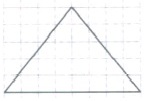
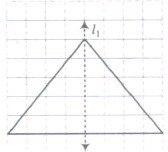
Copy the triangle in each of the following figures on squared paper. In each case, draw the line(s) of symmetry, if any and identify the type of triangle.
3.
How many lines of symmetry are there in a semi-circle?
4.
If you are 100 cm in front of a mirror, where does your image appear to be? If you move towards the mirror, how does your image move?
5.
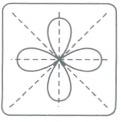
How many lines of symmetry are there for the following figures?
6.
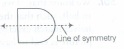
Identify the shapes given below. Check whether, they are symmetric or not. Draw the line of symmetry as well.

7.
List any four symmetrical objects from your home or school.
8.
Draw the mirror images of the following figures.
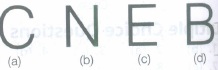
9.
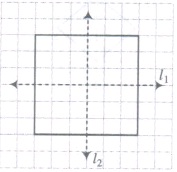
On a squared paper, sketch the following :
A quadrilateral with both horizontal and vertical lines of symmetry.
(Hint It will be helpful, if you first draw the lines of symmetry and then complete the figures.)
10.
Write the letters of the word' MATHEMATICS' which have no line of symmetry.
11.
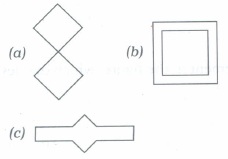
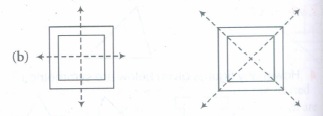
Draw two lines of symmetry in the following figures.
12.
On a squared sheet, draw the figure ABC and find its mirror image A 'B'C' with l as the mirror line.
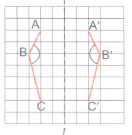
Compare the lengths of
AB and A'B';
BC and B'C;
AC and A'C.
Are they different?
Does reflection change length of a line segment?
Compare the measures of the angles (use protractor to measure) ABC and A 'B'C'. Does reflection change the size of an angle?
Join AA', BB' and CC'. Use your protractor to measure the angles between the lines l and AA', l and BB', I and CC'.
What do you conclude about the angle between the mirror line I and the line segment joining a point and its reflected image?
13.
In figure, the point C is the image of point A in line I and line segment BC intersects the Iine l at P.
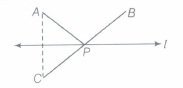
(a) Is the image of P in line I the point P itself?
(b) Is PA = PC?
(c) Is PA + PB = PC + PB?
(d) Is P that point on line I from which the sum of the distances of points A and B is minimum?
14.
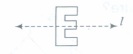
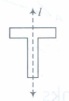
Write the number of lines of symmetry in each letter of the word 'SYMMETRY' and draw the line of symmetry.
15.
How many lines of symmetry does a regular hexagon have?
1
3
4
6
16.
How many lines of symmetry does the figure have?
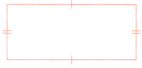
1
2
3
4
17.
How many lines of symmetry are there in the given figure?
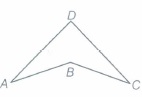
One
Two
Three
Four
18.
The number of lines of symmetry in a circle is
0
2
4
more than 4
19.
The number of lines of symmetry in a scalene triangle is
0
1
2
3
20.
If an angle of measure 80° is reflected in a line of symmetry, then the reflection is an ______ of measure ______.
21.
The number of lines of symmetry in a rectangle and a square are ______. (equal / unequal).
22.
The number of line of symmetry in a picture of Taj Mahal is ______
23.
A scalene triangle has _____ line of symmetry.
24.
A line of _____ divides a figure into two matching parts.
25.
A square and a rectangle have the same number of lines of symmetry.
26.
A parallelogram has no line of symmetry.
27.
A kite has two lines of symmetry.
28.
If a rectangle has more than two lines of symmetry, then it must be a square.
29.
The letter D has one line of symmetry.
30.
Scalene triangle
31.
Regular hexagon
32.
Equilateral triangle
33.
Circle
34.
Isosceles triangle
1.
4
2.
On copying the triangles on squared paper, we get the following figures:
(a) Here, the given triangle is an isosceles right-angled triangle and one angle is 90° and its line of symmetry is l1.
3.
A semi-circle has only one line of symmetry.
4.
We know that, the object and its image are symmetrical with reference to the mirror line. If we are 100 cm in front of a mirror, then our image appears to be 100 cm behind the mirror. If we move towards the mirror, then our image also appears to come closer.
5.
This figure has four lines of symmetry.
6.
The given figure is symmetric and its line of symmetry is shown alongside.
7.
There are many symmetrical objects, which found in our school or home. Some of these are blackboard, table top, wall clock, bucket, photoframe, etc.
8.
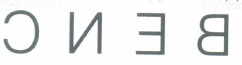
9.
A square is also a quadrilateral and a square has both horizontal and vertical lines of symmetry. On a squared paper, its figure with both horizontal and vertical lines of symmetry, is given alongside:
10.
Here, the letter S has no line of symmetry.
11.
In figures (a) and (c), there ate only two lines of symmetry i. e. horizontal line of symmetry and vertical line of symmetry.
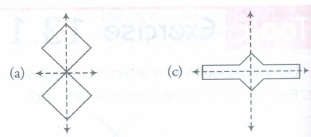
But for figure (b), we can draw more than two lines of symmetry as shown below.
12.
AB = A'B'
BC = B'C'
AC = A'C'
So, these lengths are not different. Rather, these are equal.
The reflection does not change the length of a line segment.
\(\angle ABC =\angle A'B'C'\)
l On measuring using protractor
Thus the reflection does not change the size of an angle.
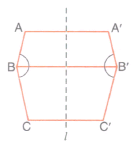
Angle between the lines I and AA' = 90°
Angle between the lines I and BB' = 90°
Angle between the lines I and CC' = 90°
Thus we conclude that the angle between the mirror line I and the line segment joining a point and its reflected image is 90°.
13.
Given, in figure, the image of the point A is C, in the line l.
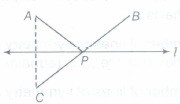
(a) Yes, the image of P in line is the point P itself.
(b) Yes, PA = PC
(c) Yes, PA + PB = PC + PB because the distance PA=PC.
(d) Yes, from the point P in the line I, the sum of the distances of points A and B is minimum.
14.
The given word is 'SYMMETRY' The letter S has no line of symmetry. Letter Y has one line of symmetry.

The letter M has one line of symmetry

The letter E has one line of symmetry
The letter T has one line of symmetry
The letter R has no line of symmetry.
15.
(d)
6
16.
(b)
2
17.
(a)
One
18.
(d)
more than 4
19.
(a)
0
20.
()
80°.
21.
()
unequal.
22.
()
one.
23.
()
zero
24.
()
symmetry
25.
(b)
26.
(a)
27.
(b)
28.
(a)
29.
(a)
30.
()
0
31.
()
6
32.
()
3
33.
()
infinitely many
34.
()
1

6th Standard CBSE Syllabus & Materials
6th Standard CBSE
CBSE 6th Social Science Locating Places on the Earth - New Sample Question Papers Study Material - QB365 Set A
NEW6th Standard CBSE
CBSE 6th Science A Journey Through States of Water - New Sample Question Papers Study Material - QB365 Set A
NEW6th Standard CBSE
CBSE 6th Science Temperature and its Measurement - New Sample Question Papers Study Material - QB365 Set A
NEW6th Standard CBSE
CBSE 6th Science Materials Around Us - New Sample Question Papers Study Material - QB365 Set A

NCERT Books

Syllabus

Exam Pattern

Sample Question Papers

Previous year Question Papers

Important Notes

MCQ Practice test

NCERT Exemplers

Case study Questions

Image Based Questions

Passage based Questions

HOT Questions

Value Based Questions

Model Questions Papers
NCERT ( Book Back ) Questions

Assertion and Reason
Important Questions And Answers

CBSE 6th Standard CBSE Subjects
CBSE Standards