
 100% FREE ACCESS
6th Standard CBSE Syllabus & Materials
6th Standard CBSE
CBSE 6th Social Science The Value of Work - New Sample Question Papers Study Material - QB365 Set A
NEW6th Standard CBSE
CBSE 6th Social Science Family and Community - New Sample Question Papers Study Material - QB365 Set A
NEW6th Standard CBSE
CBSE 6th Social Science India's Cultural Roots - New Sample Question Papers Study Material - QB365 Set A
NEW6th Standard CBSE
CBSE 6th Social Science India,That is Bharat - New Sample Question Papers Study Material - QB365 Set A
NEW6th Standard CBSE
CBSE 6th Social Science Timeline and sources of history - New Sample Question Papers Study Material - QB365 Set A
NEW6th Standard CBSE
CBSE 6th Social Science Oceans and Continents - New Sample Question Papers Study Material - QB365 Set A
Published on: 24/10/2025
Download CBSE Class 6th Standard CBSE Mathematics question papers, sample papers, important questions, and previous year solved papers in PDF format. Get free study materials, NCERT solutions, and exam preparation resources for Class 6th Standard CBSE Mathematics
Questions + Answers key
Take MCQ Mathematics Test
1.
What is the additive identity of 498?
2.
Find using distributive property 5437 x 1001.
3.
Using distributive property, find the product of the following whole number 13, 30.
4.
Find the product by suitable rearrangement 285 x 5 x 60.
5.
Write the successor and predecessor of 2192.
6.
Write the successor of
(a) 2440701
(b) 100199
(c) 1099999
(d) 2345670.
7.
Find the value of the following on the number line 3 + 6.
8.
Study the following patterns.
1 =12, 1 + 3 = 22, 1 + 3 + 5 = 32, 1 + 3 + 5 + 7 = 42
Hence, find the sum of
(a) First 19 odd numbers.
(b) First 21 odd numbers.
9.
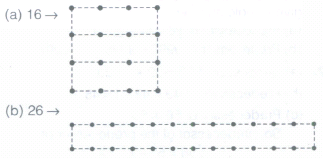
Write the following numbers as directed using dots.
(a) 16 as a square
(b) 26 as a rectangle.
10.
If the product of two whole numbers is zero, can we say that one or both of them will be zero? Justify through examples.
11.
The greatest number which always divides the product of the predecessor and successor of an odd natural number other than 1, is
6
4
16
32
12.
Which of the following is not zero?
0 x 0
\(\frac{0}{2}\)
\(\frac{(8-8)}{2}\)
2 + 0
13.
The successor of 1 million is
2 million
1000001
100001
10001
14.
The predecessor of 1 lakh is
99000
99999
999999
100001
15.
77 + 23 = 23 + 77 is an example of
closure property
associative property
commutative property
distributive property
16.
The product of non-zero whole number and its successor is always
an even number
an odd number
a prime number
divisible by 3
17.
24 x 25 = 24 x \(\frac{\Box}{4}\) = 600.
18.
1001 x 2002 = 1001 x (1001 + ______).
19.
Division of whole number by __________ is not defined.
20.
300 is the predecessor of ____________.
21.
Using properties of whole numbers, simplify the following:
(i) 5712 x 75 - 72 x 5712
(ii) 2103 x 68 - 32 x 2103.
1.
We know that additive identity of any whole number is 0. So, additive identity of 498 is 0.
i.e. 0 + 498 = 498.
2.
We have, 5437 x 1001 = 5437 x (1000 + 1)
= 5437 x 1000 + 5437 x 1 [by distributive property of multiplication over addition]
= 5437000 + 5437 = 5442437.
3.
390.
4.
We have, 285 x 5 x 60 = (5 x 60) x 285
= 300 x 285 = 85500.
5.
2193, 2191.
6.
The successor of given numbers are as follows:
| Given number | Successor | |
| (a) | 2440701 | 2440701 + 1 = 2440702 |
| (b) | 100199 | 100199 + = 100200 |
| (c) | 1099999 | 1099999 + 1 = 1100000 |
| (d) | 2345670 | 2345670 + 1 = 2345671 |
7.
For 3 + 6, start from 3 and make 6 jumps to the right by unit distance each. Then, we reach at 9.
.png)
So, 3 + 6 = 9.
8.
(a) 361
(b) 441.
9.
According to the patterns of whole number,
10.
Yes, if the product of two whole numbers is zero, then one or both of them will be zero. Since, we know that the product of any whole number with zero is always zero i.e. a x 0 = 0, where a is any whole number and 0 x 0 = 0. Some examples are as follows:
| Whole number | Product | Is the product zero? | |
| (a x 0) | (0 x a) | ||
| 5 | 5 x 0 = 0 | 0 x 5 = 0 | Yes |
| 3 | 3 x 0 = 0 | 0 x 3 = 0 | Yes |
| 0 | 0 x 0 = 0 | 0 x 0 = 0 | Yes |
| 4 | 4 x 0 = 0 | 0 x 4 = 0 | Yes |
| 25 | 25 x 0 = 0 | 0 x 25 = 0 | Yes |
11.
Let an odd natural number other than 1 be 3.
Predecessor of 3 = 3 - 1 = 2
Successor of 3 = 3 + 1 = 4
\(\therefore\) Product = 2 x 4 = 8
Now, LCM of predecessor and successor = 2 x 2 = 4
\(\therefore\) The greatest number which always divides the product of predecessor and successor of an odd natural number other than 1 is 4.
12.
Here, we have
(a) 0 x 0 = 0
(b) \(\frac{0}{2}=0\)
(c) \(\frac{8-8}{2}=\frac{0}{2}=0\)
(d) 2 + 0 = 2
Hence, 2 + 0 = 2 is not zero.
13.
1 million = 1000000
So, successor of 1000000 = 1000000 + 1
= 1000001.
14.
We have, 1 lakh = 100000
\(\therefore\) Predecessor of 100000 = 100000 - 1 = 99999.
15.
If a and b are any two whole numbers, then a + b = b + a. This is commutative property.
16.
The product of non-zero whole number and its successor is always an even number.
17.
()
100
18.
()
1001
19.
()
0
20.
Here, we will find successor of 300, 300 + 1 = 301
So, 300 is the predecessor of 301.
21.
(i) 17136
(ii) 75708.

6th Standard CBSE Syllabus & Materials
6th Standard CBSE
CBSE 6th Social Science Locating Places on the Earth - New Sample Question Papers Study Material - QB365 Set A
NEW6th Standard CBSE
CBSE 6th Science A Journey Through States of Water - New Sample Question Papers Study Material - QB365 Set A
NEW6th Standard CBSE
CBSE 6th Science Temperature and its Measurement - New Sample Question Papers Study Material - QB365 Set A
NEW6th Standard CBSE
CBSE 6th Science Materials Around Us - New Sample Question Papers Study Material - QB365 Set A


NCERT Books

Syllabus

Exam Pattern

Sample Question Papers

Previous year Question Papers

Important Notes

MCQ Practice test

NCERT Exemplers

Case study Questions

Image Based Questions

Passage based Questions

HOT Questions

Value Based Questions

Model Questions Papers
NCERT ( Book Back ) Questions

Assertion and Reason
Important Questions And Answers

CBSE 6th Standard CBSE Subjects
CBSE Standards