 100% FREE ACCESS
6th Standard CBSE Syllabus & Materials
6th Standard CBSE
CBSE 6th Social Science The Value of Work - New Sample Question Papers Study Material - QB365 Set A
NEW6th Standard CBSE
CBSE 6th Social Science Family and Community - New Sample Question Papers Study Material - QB365 Set A
NEW6th Standard CBSE
CBSE 6th Social Science India's Cultural Roots - New Sample Question Papers Study Material - QB365 Set A
NEW6th Standard CBSE
CBSE 6th Social Science India,That is Bharat - New Sample Question Papers Study Material - QB365 Set A
NEW6th Standard CBSE
CBSE 6th Social Science Timeline and sources of history - New Sample Question Papers Study Material - QB365 Set A
NEW6th Standard CBSE
CBSE 6th Social Science Oceans and Continents - New Sample Question Papers Study Material - QB365 Set A

Published on: 24/10/2025
Download CBSE Class 6th Standard CBSE Science question papers, sample papers, important questions, and previous year solved papers in PDF format. Get free study materials, NCERT solutions, and exam preparation resources for Class 6th Standard CBSE Science
Questions + Answers key
Take MCQ Science Test
1.
Give an experiment to show that one-fifth of air is oxygen.
2.
How can you say that air contains dust particles?
3.
Air present in atmosphere will be defined as what? Name the major constituents of air. Give their volume proportions in air.
4.
Paheli kept some water in a beaker for heating. She observed that tiny bubbles appeared before the water started to boil. She boiled the water for about 5 min and filled it in a bottle upto the brim and kept the bottle airtight till cooled down to room temperature.
(a) Why did the tiny bubbles appeared?
(b) Do you think tiny bubbles will appear on heating the water taken out from the bottle? Justify your answer.
5.
Ravi visited his grandmother's home. All rooms were locked and lights were off. Ravi came into a dark room and started finding a light switch. When he came across a hole in a dark curtain. He saw that through the passing beam of light, tiny particles were moving in the room. He asked questions pertaining to this observation to his teacher.
(a) What has Ravi actually observed in the room?
(b) We breathe air regularly so how do we prevent these particles from entering our body? From where does these dust particles come?
(c) Does breathing through mouth a good practice?
(d) Do you observe any good values in Ravi?
6.
Explain what makes the carbon dioxide gas present in air necessary for all in the atmosphere.
7.
Humans and animals use oxygen for respiration and plants require carbon dioxide for photosynthesis. How are these two processes related?
8.
Explain the following observations briefly.
(a) A firki does not rotate in a closed area.
(b) The arrow of weather cock points towards a particular direction at a particular moment.
(c) An empty glass in fact is not empty.
(d) Breathing through mouth may harm you.
9.
Write a few sentences for an imaginary situation if any of the following gases disappear from the atmosphere.
(a) Oxygen (b) Nitrogen (c) Carbon dioxide
10.
Akshay went on an adventurous trip with his friends. He went climbing sky diving and underground water diving. He observed that while all the activities were pleasant during water diving, he and his friends felt nauseous and had breathing difficulties. He was aware of same thing happening to his friends a few year back as he was mountain climbing.
(a) Can you suggest a reason behind all the symptoms faced by Akshay and his friends?
(b) How can one recover from this situation?
(c) Give two more special situations where - same symptoms can develop?
(d) If we suffer from breathing problems in deep water. How do plants and animals living in water cope?
(e) Have you observed any good values in Akshay?
1.
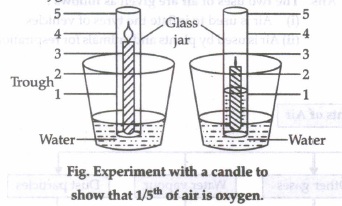
Take a candle and fix it at the centre of a glass vessel. Add some quantity of water in the vessel. Now place an empty dry glass jar over it. Mark five lines at an equal distance above the water surface. Now, carefully light the candle and cover the glass jar. Wait for a few seconds and how the flame will be extinguished due to absence of oxygen to bum.
Now, we can observe that the water level raised in the glass jar is 1/5 of the volume of air present in the glass jar
This experiment shows that one-fifth of air is oxygen
2.
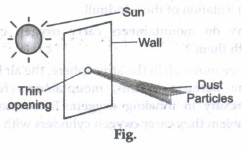
On a sunny day, go to a room which is a little bit dark. In this room, choose a thin opening through which light can enter the room. If, there is no opening in the room, then make one. From this opening we will see that a sharp beam of sunlight enters the room. In this beam, we will observe that there are some tiny solid-like particles moving freely. These particles are the dust particles, and this shows the presence of dust particles in air.
3.
Air is a mixture of gases. The major composition of air are oxygen, nitrogen, carbon dioxide, etc. The percentage composition of These dust particles are produced due to constituents of air are given below:
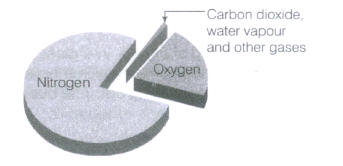
Nitrogen - 78%, oxygen - 20.9%, argon - 0.9%, carbon dioxide - 0.035 - 0.0,45%, water vapour - 0.03%, dust, etc.
4.
(a) Air is dissolved in water in the form of oxygen. Tiny bubbles are formed, when air present in the water escape on boiling it. So, tiny bubbles appeared due to the evolution of air dissolved in water.
(b) No, tiny bubbles will not appear as there is no dissolved air in this water.
5.
(a) Ravi observed the presence of dust particles in air. These particles are present at all times in air.
(b) Our nostrils contain small hairs and mucous lining covers the entire respiratory tract. The hairs and mucous trap these dust particles when they enter during inhalation and push them out through sneezing.These dust particles are produced due to regular activities like cleaning and dusting of house, construction of buildings, vehicles driving, etc.
(c) No, breathing through mouth allows the entry of harmful things in our body like dust particles, microorganisms, etc as mouth has no ways to prevent their entry.
(d) Ravi is an intelligent and curious boy
6.
The presence of small amount of carbon dioxide gas in the atmosphere is essential for the growth and existence of living beings. The desirable proportion of carbon dioxide in the atmosphere is 0.03%. The importance of carbon dioxide in atmosphere is as follows
(i) It causes greenhouse effect, leading to the heating of the earth and its atmosphere which is essential for our survival.
(ii) It takes part in the photosynthesis process carried out by green plants to prepare food for plants and animals.
7.
Humans and animals use oxygen present in the environment to carry out respiration and release CO2 as a by- product of this process. Plants perform photosynthesis by using this CO2 present in the atmosphere accumulated due to activities of humans and animals. They release oxygen as their reaction by product which also gets out in the atmosphere. Plants depend on humans and the activities performed by them like burning of fuels, etc for CO2 and humans depend on plants for a continuous oxygen supply. Thus, these two processes maintain a unique balance between O2 and CO2 concentration in our environment.
8.
(a) Motion of firki is based on the pressure/force applied by air on the blades of the firki. A firki does not rotate in a closed area because of lack of air movement.
(b) The arrow of weather cock points towards a particular direction as it shows the direction in which the air is moving at that place at a particular moment.
(c) An empty glass in fact is not empty. It is filled with air. Air is present everywhere.
(d) Breathing through mouth may harm us because we may inhale dust if present in air which is harmful.
9.
(a) There will be no life on the earth. Oxygen is vital for life. It helps in burning, respiration, photosynthesis, etc. Oxygen is basic need of all living beings.
(b) Nitrogen does not support burning. If nitrogen gas disappear from the atmosphere, things will burn very fast.
(c) Carbon dioxide is needed for photosynthesis which occurs in green plants. In its absence, plants will not be able to prepare their food and hence, there will be no life on the earth.
10.
(a) Akshay and his friends went deep sea diving where the level of oxygen is reduced. Due to lack of sufficient oxygen supply, problems in breathing occur.
(b) By carrying oxygen cylinders, this situation can be overcome.
(c) Two more situations include (i) Mountain climbing. (ii) Patients with breathing problems.
(d) Plants and animals living in the water use dissolved oxygen, i.e. oxygen gas dissolved in water for respiration through special organs or pores.
(e) Akshay is responsible and adventurous. He is cautious and observant of his surroundings.

6th Standard CBSE Syllabus & Materials
6th Standard CBSE
CBSE 6th Social Science Locating Places on the Earth - New Sample Question Papers Study Material - QB365 Set A
NEW6th Standard CBSE
CBSE 6th Science A Journey Through States of Water - New Sample Question Papers Study Material - QB365 Set A
NEW6th Standard CBSE
CBSE 6th Science Temperature and its Measurement - New Sample Question Papers Study Material - QB365 Set A
NEW6th Standard CBSE
CBSE 6th Science Materials Around Us - New Sample Question Papers Study Material - QB365 Set A



NCERT Books

Syllabus

Exam Pattern

Sample Question Papers

Previous year Question Papers

Important Notes

MCQ Practice test

NCERT Exemplers

Case study Questions

Image Based Questions

Passage based Questions

HOT Questions

Value Based Questions

Model Questions Papers
NCERT ( Book Back ) Questions

Assertion and Reason
Important Questions And Answers

CBSE 6th Standard CBSE Subjects
CBSE Standards