 100% FREE ACCESS
6th Standard CBSE Syllabus & Materials
6th Standard CBSE
CBSE 6th Social Science The Value of Work - New Sample Question Papers Study Material - QB365 Set A
NEW6th Standard CBSE
CBSE 6th Social Science Family and Community - New Sample Question Papers Study Material - QB365 Set A
NEW6th Standard CBSE
CBSE 6th Social Science India's Cultural Roots - New Sample Question Papers Study Material - QB365 Set A
NEW6th Standard CBSE
CBSE 6th Social Science India,That is Bharat - New Sample Question Papers Study Material - QB365 Set A
NEW6th Standard CBSE
CBSE 6th Social Science Timeline and sources of history - New Sample Question Papers Study Material - QB365 Set A
NEW6th Standard CBSE
CBSE 6th Social Science Oceans and Continents - New Sample Question Papers Study Material - QB365 Set A

Published on: 24/10/2025
Download CBSE Class 6th Standard CBSE Science question papers, sample papers, important questions, and previous year solved papers in PDF format. Get free study materials, NCERT solutions, and exam preparation resources for Class 6th Standard CBSE Science
Questions + Answers key
Take MCQ Science Test
1.
Air takes the shape, smell, etc from the object/ place it is present in. Explain.
2.
When an empty glass bottle is inverted and inserted into a trough filled with water, water does not enter the bottle. Specify.
3.
List five activities that are possible due to the presence of air
4.
How will you show that air is dissolved in water?
5.
What is the composition of air?
6.
Why do you think mountaineers carry oxygen cylinders with them, while climbing high mountains?
7.
How will you prove that air supports burning?
8.
Have you ever seen air ?
9.
Policemen use the masks for what reason?
10.
Name the major part of air that does not support burning.
11.
Air present in atmosphere will be defined as what? Name the major constituents of air. Give their volume proportions in air.
12.
Humans and animals use oxygen for respiration and plants require carbon dioxide for photosynthesis. How are these two processes related?
13.
Respiration can occur only in the presence of nitrogen
14.
Green plants need carbon dioxide gas to make food
15.
Air is a mixture of many gases.
16.
Atmosphere is essential for life on the earth.
17.
The composition of air is always exactly the same
18.
Mountaineers carry oxygen ___________ with them, while climbing high mountains.
19.
Air helps in the dispersal of ____ and _______ of flowers of several plants.
20.
Aquatic animals use dissolved ________ in water for respiration
21.
The _________ particles can be seen moving in a beam of sunlight in a dark room.
22.
The component of air used by green plants to make their food is _________
23.
CNG means:
Common Natural Gas
Compressed Natural Gas
Common Natural Gasoline
Compressed Natural Gasoline
24.
Which of the following statements is incorrect?
All living things require air to breathe
We can feel air but we cannot see it
Moving air makes it possible to fly a kite
Air is present everywhere but not in soil
25.
Wind does not help in the movement of which of the following?
Firki
Weather cock
ceiling fan
Sailing yacht
26.
Which of the following components of air is present in the largest amount in the atmosphere?
Nitrogen
Oxygen
Water vapour
Carbon dioxide
27.
About one fifth of ordinary air is
nitrogen
carbon dioxide
water vapour
oxygen
1.
i) Air does not have a fixed shape or size of its own because it is a gaseous mixture whose particles are very loose, thus not able to form a fixed shape.
ii) If air is blown in a balloon of round shape, it takes its shape. Similarly, air can be enclosed in packets of chips different in shape and size.
iii) Like water, air also has no smell. It carries the odour of whatever is present in the surroundings. We can smell a nice perfume or a bad smell because air carries the smell.
2.
Water does not enter into an inverted glass bottle because even when the bottle appears empty, its not. Air is present inside the bottle or any other area which is empty. All the space in the bottle is occupied by air. This air prevents the water from entering inside the bottle.
As we tilt the bottle, air present inside moves out. As air comes out, the space becomes empty allowing the entry of water. The space vacated by leaving of air is then occupied by water.
3.
The following activities are possible due to the presence of air
(i) Respiration by animals.
(ii) Photosynthesis by plants.
(iii) Power generation by windmills.
(iv) Burning of fuels and substances.
(v) Scattering of seeds and pollens of plants (pollination).
(vi) Movements of sailing yachts, gliders, parachutes and aeroplanes.
4.
Take some water in a glass vessel or beaker. Heat it slowly on a tripod stand well before the water begins to boil. Look carefully at the inner surface of the vessel, you will see tiny bubbles inside. These bubbles come from the air dissolved in water.
5.
Air is a mixture of gases, water vapour and dust particles. Largely, it consists of
(i) Nitrogen (78%)
(ii) Oxygen (21%)
(iii) Carbon dioxide (0.03%)
(iv) Other gases like helium, hydrogen, etc (0.17%)
(v) Water vapour and dust particles.
6.
The amount of oxygen decreases at high altitude. So, for normal breathing, mountaineers carry oxygen cylinders with them, while climbing high mountains.
7.
Take a burning candle which is fixed in a tumbler containing water. The candle is covered by an inverted glass. After some time, the covered candle gets extinguished and water rises upto 1/5th of the glass. It shows that air supports burning.
8.
We might not have seen air but its presence can be felt.
9.
To prevent inhalation of smoke given out by automobiles, policemen use masks.
10.
Nitrogen does not support burning.
11.
Air is a mixture of gases. The major composition of air are oxygen, nitrogen, carbon dioxide, etc. The percentage composition of These dust particles are produced due to constituents of air are given below:
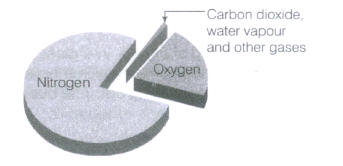
Nitrogen - 78%, oxygen - 20.9%, argon - 0.9%, carbon dioxide - 0.035 - 0.0,45%, water vapour - 0.03%, dust, etc.
12.
Humans and animals use oxygen present in the environment to carry out respiration and release CO2 as a by- product of this process. Plants perform photosynthesis by using this CO2 present in the atmosphere accumulated due to activities of humans and animals. They release oxygen as their reaction by product which also gets out in the atmosphere. Plants depend on humans and the activities performed by them like burning of fuels, etc for CO2 and humans depend on plants for a continuous oxygen supply. Thus, these two processes maintain a unique balance between O2 and CO2 concentration in our environment.
13.
(b)
14.
(a)
15.
(a)
16.
(a)
17.
(b)
18.
()
cylinders
19.
()
seeds, pollen
20.
()
oxygen
21.
()
dust
22.
()
carbon dioxide
23.
(b)
Compressed Natural Gas
24.
(d)
Air is present everywhere but not in soil
25.
(c)
ceiling fan
26.
(a)
Nitrogen
27.
(d)
oxygen

6th Standard CBSE Syllabus & Materials
6th Standard CBSE
CBSE 6th Social Science Locating Places on the Earth - New Sample Question Papers Study Material - QB365 Set A
NEW6th Standard CBSE
CBSE 6th Science A Journey Through States of Water - New Sample Question Papers Study Material - QB365 Set A
NEW6th Standard CBSE
CBSE 6th Science Temperature and its Measurement - New Sample Question Papers Study Material - QB365 Set A
NEW6th Standard CBSE
CBSE 6th Science Materials Around Us - New Sample Question Papers Study Material - QB365 Set A



NCERT Books

Syllabus

Exam Pattern

Sample Question Papers

Previous year Question Papers

Important Notes

MCQ Practice test

NCERT Exemplers

Case study Questions

Image Based Questions

Passage based Questions

HOT Questions

Value Based Questions

Model Questions Papers
NCERT ( Book Back ) Questions

Assertion and Reason
Important Questions And Answers

CBSE 6th Standard CBSE Subjects
CBSE Standards