
 100% FREE ACCESS
6th Standard CBSE Syllabus & Materials
6th Standard CBSE
CBSE 6th Social Science The Value of Work - New Sample Question Papers Study Material - QB365 Set A
NEW6th Standard CBSE
CBSE 6th Social Science Family and Community - New Sample Question Papers Study Material - QB365 Set A
NEW6th Standard CBSE
CBSE 6th Social Science India's Cultural Roots - New Sample Question Papers Study Material - QB365 Set A
NEW6th Standard CBSE
CBSE 6th Social Science India,That is Bharat - New Sample Question Papers Study Material - QB365 Set A
NEW6th Standard CBSE
CBSE 6th Social Science Timeline and sources of history - New Sample Question Papers Study Material - QB365 Set A
NEW6th Standard CBSE
CBSE 6th Social Science Oceans and Continents - New Sample Question Papers Study Material - QB365 Set A

Published on: 24/10/2025
Download CBSE Class 6th Standard CBSE Science question papers, sample papers, important questions, and previous year solved papers in PDF format. Get free study materials, NCERT solutions, and exam preparation resources for Class 6th Standard CBSE Science
Questions + Answers key
Take MCQ Science Test
1.
Why are parents advised to discourage their children from eating chips and junk foods?
2.
Minerals and vitamins are needed in very small quantities by our body as compared to other components, yet these are important parts of a balanced diet. Explain the statement.
3.
Name the major nutrients in our food.
4.
Deficiency of _________ causes swelling of the thyroid gland.
5.
________ is required for healthy eyes.
6.
Deficiency of vitamin-C causes a disease known as ____________ .
7.
Deficiency of __________ causes a disease known as beri-beri.
8.
______________ is caused by deficiency of vitamin-D.
9.
It is said that milk is a wholesome food as it contains most of the nutrients. Do you think that you can remain healthy by consuming only milk as your regular diet?
10.
'Modernisation has led to the development of life style disorders'. Find out what life style diseases are. How can they be prevented?
11.
Do people of all ages and different professional backgrounds need some type of diet?
12.
Observe the items given in fig. carefully and answer the questions that follow.
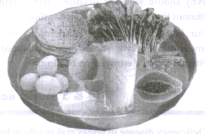
(a) Food item rich in carbohydrates is _______
(b) Egg is a rich source of protein, the mineral, ________ and vitamin _________
(c) _______ is a rich source of fat.
(d) Milk provides ________, vitamin D and ________ (mineral)
(e) _______ (fruit) is a rich source of vitamin A.
(f) Spinach is a good source of the mineral _________
(g) Both eggs and ________ are rich in ________.
13.
Radha came back from school hungry and went to her mother in kitchen. Radha's mother was peeling vegetables. She noted that the peels were very thick and her mother then started washing vegetables. Radha asked her to stop washing the vegetables. Her mother was surprised and asked why? Radha told her all she knew about how nutrients are washed away if we peel and then wash them?
(a) If thick peels are removed from vegetables, what happens?
(b) Washing of vegetables after peeling is not a good practice. Can you tell why?
(c) What are those components that get washed away?
(d) Give two examples of vitamins and minerals containing food.
(e) Do you think Radha has any values? Name them.
14.
Deficiency of vitamin A causes:
Night blindness
Beri-Beri
Scurvy
Rickets
15.
Which vitamin deficiency causes rickets?
Vitamin A
Vitamin B
Vitamin C
Vitamin D
16.
Which one of the following food item does not provide dietary fibre?
Whole grains
Whole pulses
Fruits and vegetables
Milk
17.
Which of the following sources of protein is different from others?
Peas
Grams
Soybeans
Cottage cheese (paneer)
18.
Which one of the following food items does not provide dietary fibre?
Whole grains
Whole pulses
Fruits and vegetables
Milk
19.
We require different foods to get different nutrients.
20.
Our food is derived from plants or animals or both.
21.
Roughage is a very good source of energy.
22.
Amla is the richest source of vitamin-C.
23.
Carbohydrates are called body building food.
24.
B2
25.
B1
26.
A
27.
Test for protein
28.
Test of the starch
29.
Which nutrients are regarded as energy-providing nutrients in our food?
30.
Which of the following food items does not provide any nutrient?
Milk, Water, Orange juice, Tomato soup
1.
Parents are advised to discourage their children from eating chips and junk foods due to following reasons:
(i) Junk foods cause obesity
(ii) They may cause loss of appetite.
(iii) They cause mental problems.
(iv) These food items lead to wastage of money.
2.
Though minerals and vitamins are needed in very small quantities by our body yet these are important parts of balanced diet because
(i) vitamins are necessary for good eyesight (vitamin-A), growth (vitamin-B1), keeping teeth gums and joints healthy (vitamin-C) and normal growth of bones (vitamin-D).
(ii) minerals are needed in our body for building bones and teeth (calcium and phosphorus), formation of blood (iron), coagulation of blood and functioning of muscles (calcium) and functioning of thyroid gland (iron).
3.
The major nutrients in our food are
(i) Carbohydrates
(ii) Proteins
(iii) Fats
(iv) Vitamins
(v) Minerals
(vi) Water and roughage
4.
()
Iodine
5.
()
Vitamin A
6.
()
scurvy
7.
()
vitamin-B
8.
()
Rickets
9.
No, I do not think that we can remain healthy by consuming only milk as our regular diet, because, certain nutrients like vitamin C are not found in milk.
10.
'Modernisation' has led to the development of life style disorders. The life style disorders are obesity, fatigue, loss of vision, mental weakness etc. These disorders occur due to junk foods like pizza, burger etc. They can be prevented by taking balanced diet including carbohydrates, fats, proteins, vitamins and minerals.
11.
No, the people of all ages and different professions require different types of nutrients according to their physical work.
12.
(a) chapati
(b) calcium, D
(c) Butter
(d) protein, calcium
(e) Papaya
(f) iron
(g) peas, proteins.
13.
(a) Many vegetables contain most of the nutrients just below their skin surface. Thick peeling may lead to their removal.
(b) Washing of vegetables after peeling or cutting removes the water soluble vitamins and minerals from them and lowers their nutritive value.
(c) These components are called nutrients like minerals (iron, calcium, phosporous) and vitamins (B, A, C, D, E).
(d) Vegetables like tomatoes, potatoes, green leafy vegetables, etc.
(e) Yes, Radha is sincere, observant, helpful and knowledgeable. She used her knowledge in right place and stopped her mother for doing incorrect work.
14.
(a)
Night blindness
15.
(d)
Vitamin D
16.
(d)
Milk
17.
(d)
Cottage cheese (paneer)
18.
(d)
Milk
19.
(a)
20.
(a)
21.
(b)
22.
(a)
23.
(b)
24.
()
Yeast, egg, meat, peas
25.
()
Sea food, milk, cereals
26.
()
Milk, butter, egg, leafy vegetables
27.
()
Copper sulphate and caustic soda
28.
()
Iodine
29.
()
Carbohydrates and fats.
30.
()
Water does not provide any nutrient.
6th Standard CBSE Syllabus & Materials
6th Standard CBSE
CBSE 6th Social Science Locating Places on the Earth - New Sample Question Papers Study Material - QB365 Set A
NEW6th Standard CBSE
CBSE 6th Science A Journey Through States of Water - New Sample Question Papers Study Material - QB365 Set A
NEW6th Standard CBSE
CBSE 6th Science Temperature and its Measurement - New Sample Question Papers Study Material - QB365 Set A
NEW6th Standard CBSE
CBSE 6th Science Materials Around Us - New Sample Question Papers Study Material - QB365 Set A

NCERT Books

Syllabus

Exam Pattern

Sample Question Papers

Previous year Question Papers

Important Notes

MCQ Practice test

NCERT Exemplers

Case study Questions

Image Based Questions

Passage based Questions

HOT Questions

Value Based Questions

Model Questions Papers
NCERT ( Book Back ) Questions

Assertion and Reason
Important Questions And Answers

CBSE 6th Standard CBSE Subjects
CBSE Standards