
 100% FREE ACCESS
6th Standard CBSE Syllabus & Materials
6th Standard CBSE
CBSE 6th Social Science The Value of Work - New Sample Question Papers Study Material - QB365 Set A
NEW6th Standard CBSE
CBSE 6th Social Science Family and Community - New Sample Question Papers Study Material - QB365 Set A
NEW6th Standard CBSE
CBSE 6th Social Science India's Cultural Roots - New Sample Question Papers Study Material - QB365 Set A
NEW6th Standard CBSE
CBSE 6th Social Science India,That is Bharat - New Sample Question Papers Study Material - QB365 Set A
NEW6th Standard CBSE
CBSE 6th Social Science Timeline and sources of history - New Sample Question Papers Study Material - QB365 Set A
NEW6th Standard CBSE
CBSE 6th Social Science Oceans and Continents - New Sample Question Papers Study Material - QB365 Set A

Published on: 24/10/2025
Download CBSE Class 6th Standard CBSE Science question papers, sample papers, important questions, and previous year solved papers in PDF format. Get free study materials, NCERT solutions, and exam preparation resources for Class 6th Standard CBSE Science
Questions + Answers key
Take MCQ Science Test
1.
State the ways through which a magnet can be demagnetised.
2.
Priya went a place for her summer vacation with her sister Monami Mukherji. As the day was dark, so she didn't confirm that in which direction is east. Her sister had a magnetic compass and she told Priya to find the direction with the compass.
(a) State the values that Monami Mukherji reflect here.
(b) Mention what happen to a freely suspended magnet.
3.
Explain how will you test that the 'tea dust' is not adulterated with iron powder.
4.
Kanchan is a class VI student. She has to show an activity in school exhibition. But, she has no idea. Her friend Suresh advised her to do an activity in which rope stands without any support with the help of magnet and ask her to take a small rope, a magnet, a cup and a stand.
(a) State the values that Suresh reflect here?
(b) Name some non-magnetic materials.
5.
Suggest an arrangement to store a U-shaped magnet. How is this different from storing a pair of bar magnets?
6.
Boojho kept a magnet close to an ordinary iron bar. He observed that the iron bar attracts a pin as shown in figure.

What inference could he draw from this observation? Explain.
7.
A toy car has a bar magnet laid hidden inside its body along its length. Using another magnet, how will you find out which pole of the magnet is facing the front of the car?
8.
Explain whether the magnetic poles exist separately like charges or not.
9.
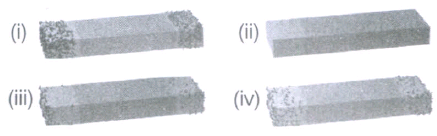
Four identical iron bars were dipped in a heap of iron filings one by one. Figure shows the amount of iron filings sticking to each of them.
(a) Which of the iron + bar is likely to be the strongest magnet?
(b) Which of the iron bar is not a magnet? Justify your answer.
10.
You are given an iron strip. How will you make it into a magnet?
11.
A bar magnet has no markings to indicate its poles. How would you find out near which end is its North pole located?
12.
Where are poles of a bar magnet located?
13.
Write any two properties of a magnet.
14.
Column I shows different positions in which one pole of a magnet is placed near that of the other. Column II indicates the resulting action between them for each situation. Fill in the blanks.
| Column I | Column II |
| N-N | |
| N- | Attraction |
| S-N | |
| -S | Repulsion |
15.
It was observed that a pencil sharpener gets attracted by both the poles of a magnet although its body is made of plastic. Name a material that might have been used to make some part of it
1.
There are following two ways to demagnetise a magnet
(i) by heating
(ii) by hammering
2.
(b) A freely suspended magnet orients itself in North-South direction of the earth.
(a) Monami is intelligent and caring girl.
3.
We can do simple experiment for this
(i) Take tea dust on a paper.
(ii) Take a bar magnet in your hand.
(iii) Shake the bar magnet over this dust.
(iv) If some particles are attracted strongly towards this magnet, then definitely tea dust will have iron powder.
4.
(i) Suresh is cooperative, intelligent and creative boy.
(ii) Some non-magnetic materials are plastic, stainless steel, glass, fibre, etc.
5.
It is a suggested way shown in figure below
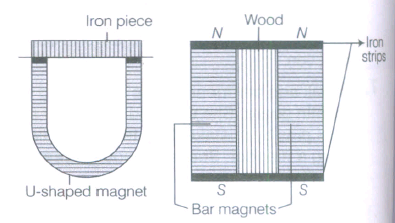
U-shaped magnet is kept along with an iron piece while bar magnets are kept along with iron strips and magnets separated by wood along their length.
6.
When we place any iron bar near a bar magnet, it becomes a magnet temporary and small objects like pin, iron filings can be attracted by it. But when we remove this bar from magnet, it again becomes an iron bar and does not attract the small iron objects.
7.
If we face North pole towards the front side of the car and the car is attracted, it means its front side pole is South pole and if it is going away, it means its front side is North pole.
8.
When we break a magnet from its middle, then we get two new magnets. Even if an extremely small magnet is broken into two pieces, then they will have North and south poles, i.e. a small bar magnet is obtained. So, it is not possible for the magnetic poles to be existed separately like charges.
9.
(a) Iron bar (i) seems to be the strongest magnet because it has maximum amount of iron filings attracted.
(b) Iron bar (ii) is not a magnet because no iron filings have been attracted by it.
10.
We can convert an iron strip into a bar magnet by the following method
(i) Take an iron strip
(ii) Place it on the table.
(iii) Now, take a bar magnet and place one of its poles near one edge of the bar of iron.
(iv) Without lifting the bar magnet, move it along the length of iron strip,tiII we reach the other end.
(v) Now, lift the magnet and bring the pole (the same pole we started with) to the same point of the iron strip from which we began.
(vi) Now, move the magnet again along the iron bar in the same direction as we did before.
(vii) Repeat this process about 30-40 times.
(viii) Bring a pin or some iron fillings near the iron strip to check whether it has become a magnet. If not, continue the process for some more time.
11.
We can find out a direction by freely suspended a bar magnet. We will find that freely suspended bar magnet always comes to rest in the North-South direction. The end of the magnet that points towards North is called North pole. The other end that points towards South is called South pole.
12.
The poles of a bar magnet are located at the two ends of a bar magnet as shown below:
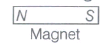
These two poles are North pole (N) and South pole (S).
13.
The two properties of a magnet are as follow
(i) A magnet has two poles, i.e. north and south.
(ii) It attracts magnetic materials like iron, nickel or cobalt.
14.
As, we know that like poles of a magnet repel each other and unlike poles attract each other.
Thus, the complete table is shown as below:
| Column I | Column II |
| N-N | Repulsion |
| N-S | Attraction |
| S-N | Attraction |
| S-S | Repulsion |
15.
Since, a pencil sharpener contains a blade which is made up of iron. Hence, it gets attracted by both the poles of a magnet.

6th Standard CBSE Syllabus & Materials
6th Standard CBSE
CBSE 6th Social Science Locating Places on the Earth - New Sample Question Papers Study Material - QB365 Set A
NEW6th Standard CBSE
CBSE 6th Science A Journey Through States of Water - New Sample Question Papers Study Material - QB365 Set A
NEW6th Standard CBSE
CBSE 6th Science Temperature and its Measurement - New Sample Question Papers Study Material - QB365 Set A
NEW6th Standard CBSE
CBSE 6th Science Materials Around Us - New Sample Question Papers Study Material - QB365 Set A



NCERT Books

Syllabus

Exam Pattern

Sample Question Papers

Previous year Question Papers

Important Notes

MCQ Practice test

NCERT Exemplers

Case study Questions

Image Based Questions

Passage based Questions

HOT Questions

Value Based Questions

Model Questions Papers
NCERT ( Book Back ) Questions

Assertion and Reason
Important Questions And Answers

CBSE 6th Standard CBSE Subjects
CBSE Standards