
 100% FREE ACCESS
6th Standard CBSE Syllabus & Materials
6th Standard CBSE
CBSE 6th Social Science The Value of Work - New Sample Question Papers Study Material - QB365 Set A
NEW6th Standard CBSE
CBSE 6th Social Science Family and Community - New Sample Question Papers Study Material - QB365 Set A
NEW6th Standard CBSE
CBSE 6th Social Science India's Cultural Roots - New Sample Question Papers Study Material - QB365 Set A
NEW6th Standard CBSE
CBSE 6th Social Science India,That is Bharat - New Sample Question Papers Study Material - QB365 Set A
NEW6th Standard CBSE
CBSE 6th Social Science Timeline and sources of history - New Sample Question Papers Study Material - QB365 Set A
NEW6th Standard CBSE
CBSE 6th Social Science Oceans and Continents - New Sample Question Papers Study Material - QB365 Set A

Published on: 24/10/2025
Download CBSE Class 6th Standard CBSE Science question papers, sample papers, important questions, and previous year solved papers in PDF format. Get free study materials, NCERT solutions, and exam preparation resources for Class 6th Standard CBSE Science
Questions + Answers key
Take MCQ Science Test
1.
Water is one of our most precious commodities and no life can survive without it It has been predicted that water scarcity will become the subject of "Wars"in the near future. Write any two ways in which water is getting polluted. Write any two measures to stop water pollution at your level
2.
Vineet was feeling very thirsty so he took out some ice cubes to add into water and forgot to keep the ice tray back. After sometime, when he came back he saw all the ice present in tray has changed into water. He got confused and asked his teacher to explain the reason behind it.
(a) Does water exist in any other form?
(b) What happens to ice when kept at room temperature?
(c) What values you observed in Vineet?
3.
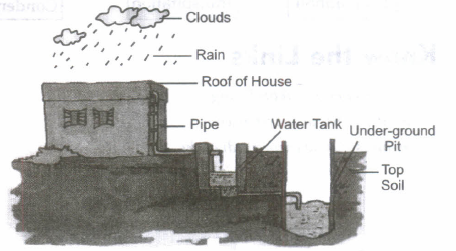
Explain the process of rooftop rain water harvesting with the help of a suitable diagram.
4.
State different uses of water
5.
Dissolve two spoons of common salt in half a cup of water. Now, if you want to get the salt back, what will you do?
6.
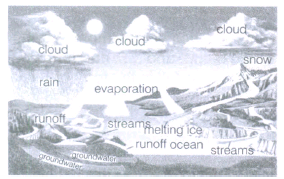
Draw a diagram to show how sea water reaches a lake or pond?
7.
Most of the water that falls on the land as rain and snow, sooner or later goes back to a sea or an ocean. Explain how it happens.
8.
Explain the process of cloud formation with the help of diagram.
1.
Water is getting polluted:
(i) By industrial waste
(ii) By human activities
Measures to stop water pollution:
(i) We should not throw waste materials and garbage into water.
(ii) We should sensitize people about harmful effects of water pollution.
Associated Value : We should discourage any activity in our life that may cause water pollution
2.
(a) Yes, water exists in three phases:
(i) Water which is liquid phase.
(ii) Ice represents solid phase.
(iii) Steam is the gas phase.
(b) When ice is kept at room temperature, it melts, loosing its solid phase and entering liquid phase by turning into water.
(c) Vineet is an observant and curious person. He asks questions to satisfy his curiosity and readily accepts concepts.
3.
In this process, the rain water is collected from the rooftop to a storage tank, through pipes. This water may contain soil from the roof and need filtering before it is used. Instead of collecting rain water in the tank, the pipes can go directly into a pit in the ground. This then seeps into the soil to recharge the ground water.
4.
Water is used:
(i) for drinking and cooking
(ii) for bathing and cleaning.
(iii) in agriculture, to produce food.
(iv) in Industries, to perform different activities
5.
The common salt dissolved in half a cup of water can be recovered by removing the water from the salt solution. This can be done by heating the solution on a gas stove or keeping it under the sun in a plate for few hours. Due to evaporation of water in both the processes, we will get the salt back.
6.
Sea water reaches a lake or pond is represented by a diagram:
7.
The process by which land water returns back to a sea or an ocean is as follows:
(i) Snow/Rain falling on the mountains melts into water that flows down in the form of streams and rivers.
(ii) A part of the rainwater gets absorbed into the ground and rest also flow in the form of stream or rivers.
(iii) The river water after passing through various regions ultimately reaches into a sea or an ocean
8.
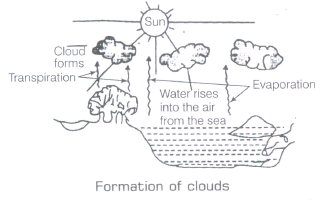
The climate close to the earth's surface is warm. It gets cooled as one go up in atmosphere. Water vapour being lighter, rises up in the atmosphere. At the upper layer of atmosphere, where the temperature is lower the vapour get condensed into tiny water droplets and forms cloud.

6th Standard CBSE Syllabus & Materials
6th Standard CBSE
CBSE 6th Social Science Locating Places on the Earth - New Sample Question Papers Study Material - QB365 Set A
NEW6th Standard CBSE
CBSE 6th Science A Journey Through States of Water - New Sample Question Papers Study Material - QB365 Set A
NEW6th Standard CBSE
CBSE 6th Science Temperature and its Measurement - New Sample Question Papers Study Material - QB365 Set A
NEW6th Standard CBSE
CBSE 6th Science Materials Around Us - New Sample Question Papers Study Material - QB365 Set A



NCERT Books

Syllabus

Exam Pattern

Sample Question Papers

Previous year Question Papers

Important Notes

MCQ Practice test

NCERT Exemplers

Case study Questions

Image Based Questions

Passage based Questions

HOT Questions

Value Based Questions

Model Questions Papers
NCERT ( Book Back ) Questions

Assertion and Reason
Important Questions And Answers

CBSE 6th Standard CBSE Subjects
CBSE Standards