
 100% FREE ACCESS
6th Standard CBSE Syllabus & Materials
6th Standard CBSE
CBSE 6th Social Science The Value of Work - New Sample Question Papers Study Material - QB365 Set A
NEW6th Standard CBSE
CBSE 6th Social Science Family and Community - New Sample Question Papers Study Material - QB365 Set A
NEW6th Standard CBSE
CBSE 6th Social Science India's Cultural Roots - New Sample Question Papers Study Material - QB365 Set A
NEW6th Standard CBSE
CBSE 6th Social Science India,That is Bharat - New Sample Question Papers Study Material - QB365 Set A
NEW6th Standard CBSE
CBSE 6th Social Science Timeline and sources of history - New Sample Question Papers Study Material - QB365 Set A
NEW6th Standard CBSE
CBSE 6th Social Science Oceans and Continents - New Sample Question Papers Study Material - QB365 Set A

Published on: 25/10/2025
Download CBSE Class 6th Standard CBSE Social Science question papers, sample papers, important questions, and previous year solved papers in PDF format. Get free study materials, NCERT solutions, and exam preparation resources for Class 6th Standard CBSE Social Science
Questions + Answers key
Take MCQ Social Science Test
1.
Why did Thulasi and Raman have to sell their cow?
2.
What do you think the government can do to help farmers like Sekar when they get into debt? Discuss.
3.
Imagine you are a member of a fishing family and you are discussing whether to take a loan from the bank for an engine. What would you say?
4.
You have probably noticed that people in Kalpattu are engaged in a variety of non-farm work. List five of these.
The people of Kalpattu village are engaged in non-farm activities like:
5.
In what ways would her way of earning a living have been different if Thulasi owned some farmland? Discuss.
6.
When did they go to the sea?
At 2 am
At noon
At 4 am
At evening
7.
Who has a hybrid cow?
Raman
Sekar
Ramalingam
Aruna
8.
Who is Karuthamma?
Ramalingam's wife
A labourer
Thulasi's friend
Sekar's wife
9.
Kalpattu village is surrounded by which of the following land features?
High hills
Mountain ranges
Plain land
Low hills
10.
How much rural families are dependent on agricultural labour?
11.
What does Thulasi do apart from working on the land?
12.
Who is Thulasi?
13.
Find the variety of small shops in the village's main street.
14.
Name the work of people who reside in the village?
15.
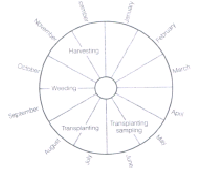
Based on the above diagram would you say that Thulasi earns money throughout the year?
16.
Give a brief account on rural livelihoods.
17.
The people of Chizami belong to the Chakhesang community.
18.
Only 20 per cent of India's farmers are like Ramalingam.
19.
Ramalingam has 20 acres of paddy fields in Kalpattu.
20.
Thulasi lives in Pudupet village.
21.
Aruna and her family suffered a lot because of monsoon.
22.
Phek
23.
Aruna
24.
Ramalingam
25.
Sekar
26.
Thulasi
1.
Thulasi and Raman's one of the daughters fell ill and had to be taken to the hospital in town. They borrowed money from Ramalingam, so to pay back the money they had to sell their cow.
2.
Their debt must be pardoned. Rate of interest might be decreased. Government can also give them sufficient time to return the debt. In case of natural hazard, the loss should immediately be calculated and also some relaxation on debt be given.
3.
If I were a member of fishing family, I would say, we must take loan from the bank to improve the condition of our occupation because:
(i) The best quality net for fishing costs very high.
(ii) Catamaran engines are very useful for fishing because with the help of these we can go far away to catch fishes.
(iii) Poor fishermen cannot purchase these items because they are very costly. So, we must take loan from the bank to improve our social status.
4.
(I) Making pots
(ii) Making basket
(iii) Making bricks
(iv) Making utensils
(v) Making bullock-carts
5.
If Thulasi had owned some farmland, she would have cultivated her field. The whole produce and the money she got after selling would have belonged to her. If she had purchased fertilisers and seeds from the traders on loan, she would have to pay it back.
6.
(a)
At 2 am
7.
(b)
Sekar
8.
(a)
Ramalingam's wife
9.
(d)
Low hills
10.
()
In India, about two out of every five rural families are agricultural labourer families. All of them depend on the work they do on other people's fields to earn a living.
11.
()
Apart from working on the land, Thulasi does all household tasks such as cooking, cleaning, washing clothes etc.
12.
()
Thulasi is a labourer who works in Ramalingam's paddy fields.
13.
()
The variety of small shops in the village's main street are such as tea shops, grocery shops, barber shops, a cloth shop, a tailor shop, and two fertiliser and seed shops.
14.
()
People here do many kirfds of work. Here people do both kinds of work i.e. non-farming and farming. Non-farm works such as making baskets, utensils, pots, bricks, bullock-carts etc.
15.
Thulasi earns money only for SIX months in a year.
Transplanting of paddy : July and
August
Weeding : September and October
Harvesting : November and December
She does not have work throughout the year.
16.
There are several ways to earn a living of rural areas. These are farming and non-farming activities.
The farming activities are:
(i) Preparing the land
(ii) Sowing
(iii) Harvesting
(iv) Weeding
(v) Transplanting
People of rural areas are dependent upon the seasons, sometime they face problem such as failure of crops etc.
Non-farming activities are:
(i) Making baskets
(ii) Making utensils
(iii) Making pots
(iv) Making bricks
(v) Making bullock-carts
(vi) Fishing
(vii) Crafting
Some of the people have shops such as blacksmith's shop, tea shop, grocery shop, barber shop, cycle repair shop etc.
17.
(a)
18.
(a)
19.
(a)
20.
(b)
21.
(b)
22.
()
Nagaland
23.
()
A villager of Pudupet
24.
()
A rice mill owner
25.
()
Has not much land
26.
()
A labourer
6th Standard CBSE Syllabus & Materials
6th Standard CBSE
CBSE 6th Social Science Locating Places on the Earth - New Sample Question Papers Study Material - QB365 Set A
NEW6th Standard CBSE
CBSE 6th Science A Journey Through States of Water - New Sample Question Papers Study Material - QB365 Set A
NEW6th Standard CBSE
CBSE 6th Science Temperature and its Measurement - New Sample Question Papers Study Material - QB365 Set A
NEW6th Standard CBSE
CBSE 6th Science Materials Around Us - New Sample Question Papers Study Material - QB365 Set A

NCERT Books

Syllabus

Exam Pattern

Sample Question Papers

Previous year Question Papers

Important Notes

MCQ Practice test

NCERT Exemplers

Case study Questions

Image Based Questions

Passage based Questions

HOT Questions

Value Based Questions

Model Questions Papers
NCERT ( Book Back ) Questions

Assertion and Reason
Important Questions And Answers
CBSE 6th Standard CBSE Subjects
CBSE Standards