
 100% FREE ACCESS
6th Standard CBSE Syllabus & Materials
6th Standard CBSE
CBSE 6th Social Science The Value of Work - New Sample Question Papers Study Material - QB365 Set A
NEW6th Standard CBSE
CBSE 6th Social Science Family and Community - New Sample Question Papers Study Material - QB365 Set A
NEW6th Standard CBSE
CBSE 6th Social Science India's Cultural Roots - New Sample Question Papers Study Material - QB365 Set A
NEW6th Standard CBSE
CBSE 6th Social Science India,That is Bharat - New Sample Question Papers Study Material - QB365 Set A
NEW6th Standard CBSE
CBSE 6th Social Science Timeline and sources of history - New Sample Question Papers Study Material - QB365 Set A
NEW6th Standard CBSE
CBSE 6th Social Science Oceans and Continents - New Sample Question Papers Study Material - QB365 Set A

Published on: 25/10/2025
Download CBSE Class 6th Standard CBSE Social Science question papers, sample papers, important questions, and previous year solved papers in PDF format. Get free study materials, NCERT solutions, and exam preparation resources for Class 6th Standard CBSE Social Science
Questions + Answers key
Take MCQ Social Science Test
1.
What was the plan of Harpreet and Vandana?
2.
Discuss the working condition of Nirmala.
3.
Fill in the following table to show the services provided by people in the markets which you visit frequently.
4.
Describe the working conditions of people like Nirmala keeping in mind the following: working hours, conditions in the workplace, earnings and the days of work available.
5.
Some parts of the city are different from others. What differences do you notice in this illustration?
6.
Most of the businessmen are
Self employed
Municipal Corporation
Central Government
Court
7.
Where do labourers stand?
At labour chowk
At cinema halls
At ramlila ground
At home
8.
How much salary does Sudha get?
Rs 10,000 PM
Rs. 20,000 PM
Rs 15,000 PM
Rs 30,000 PM
9.
In a survey of Ahmedabad city how many workers were found to be working on the street?
13 per cent
15 per cent
45 per cent
12 per cent
10.
Bachchu Manjhi is a/an
engineer
auto-rickshaw-driver
rickshaw-puller
worker
11.
What are the ways to run a showroom properly?
12.
Describe the scene of the factory area.
13.
How many street vendors work in the urban areas?
14.
What is the report of a survey of Ahmedabad city?
15.
Why was the vegetable vendor busy?
16.
Look at the pictures given below carefully and answer the following questions:
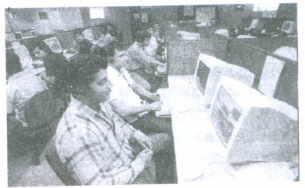
(i) Describe the work condition at all centres. Why are many call centres set up in India?
(ii) Where do we find a labour?
17.
Discuss the lives of hawkers in the city.
18.
Some materials of Vandana's and Harpreet's showroom come from Noida and Gurgaon.
19.
A dentist's clinic is also at the starting place of the market
20.
Vendors sell things that are often prepared at home by their families.
21.
Bachchu Manjhi came from a village in Uttar Pradesh.
22.
Sudha works in a factory where garments work was done.
23.
Bachchu Manjhi
24.
Municipal Corporation
25.
Showroom
26.
Factory
27.
Company
1.
Harpreet and Vandana planned to buy the building in the market in which their showroom was located. Ever since the market has become the main market for people living in the surrounding apartments, their business has grown. They have been able to buy a car and book a flat in an apartment complex nearby.
2.
Nirmala have to work very long hours in the months from December to April. A normal working day begins at 9 am and finishes only by 10 pm, sometimes even later.
She works for six days a week. At time when the work needs to be done urgently, she works on Sundays too.
3.
| Name of the shop or office | Nature of the service provided |
|---|---|
| General store | Grocery items |
| Book store | Books of different levels, stationery, items, pens, pencils etc. |
| Chemist shop | Different t}pes of medicine |
| Mother dairy booth | Milk, curd, ice-cream and different types of vegetables. |
| Electricity office | To deposit electricity bill and to complain against the quality of electric supply, if any. |
4.
Workers like Nirmala have to work very long hours in the months from December to April. A normal working day begins at 9 am and finishes only by 10 pm, sometimes even later. She works for six days a week. At times when the work needs to be done urgently, she works on Sundays too. Nirmala is paid Rs 80 per day for eight hours and Rs 40 extra for working late. By June the work is over and the factory reduces its staff. Nirmala will also be asked to leave. For about three or four months in the year, there is no work for her.
5.
Some parts of the city have high rise buildings. Some parts of the city are crowded and congested as they are occupied by pavement shops and vendors. The smoke of industry also pollutes the atmosphere.
6.
(a)
Self employed
7.
(a)
At labour chowk
8.
(d)
Rs 30,000 PM
9.
(d)
12 per cent
10.
(c)
rickshaw-puller
11.
()
There are several ways to run a showroom properly.
These are:
(i) To advertise in various newspapers
(ii) To advertise in cinema theatres, television and radio channels.
(iii) Buy good materials.
12.
()
The factory area was full of small workshops, people worked on sewing machines in a sm8.11room and were stitching clothes and stacked them in one corner.
13.
()
There are almost one crore street vendors in the country working in the urban areas.
14.
()
In a survey of Ahmedabad city, it was found that 12 per cent of all the workers in the city were people working on the street. They sometimes sell things or repair them or provide a service
15.
()
The vegetable vendor was busy in arranging tomatoes, carrots and cucumbers in baskets at her stall.
16.
(i) Call centres are generally set-up as large rooms with work stations that include a computer, a telephone set and supervisor's stations. India has become a major centre not only for Indian companies but also foreign companies. They set-up call centres here as they can get people who can speak English and will work for lower wages.
(ii) We find labour at labour chowk where many people were sitting on railings or in groups at the crossing These labourers are daily wage labourers.
17.
The hawkers face many things per day.
These are following:
(i) They work on their own, they are not employed by anyone. They sell their products from one place to another.
(ii) Their shops are usually temporary structures like some boards or papers spread over discarded boxes or may be a canvas sheet hung up on a few poles.
(iii) They may also use their own carts or simply a plastic sheet spread on the pavement.
(iv) They can be asked to dismantle their shops at any time by the police.
(v) There are certain parts of the city where these hawkers are not allowed to enter.
18.
(b)
19.
(b)
20.
(a)
21.
(b)
22.
(b)
23.
()
A rickshaw-puller
24.
()
A big cities
25.
()
Vandana
26.
()
Nirmala
27.
()
Sudha

6th Standard CBSE Syllabus & Materials
6th Standard CBSE
CBSE 6th Social Science Locating Places on the Earth - New Sample Question Papers Study Material - QB365 Set A
NEW6th Standard CBSE
CBSE 6th Science A Journey Through States of Water - New Sample Question Papers Study Material - QB365 Set A
NEW6th Standard CBSE
CBSE 6th Science Temperature and its Measurement - New Sample Question Papers Study Material - QB365 Set A
NEW6th Standard CBSE
CBSE 6th Science Materials Around Us - New Sample Question Papers Study Material - QB365 Set A



NCERT Books

Syllabus

Exam Pattern

Sample Question Papers

Previous year Question Papers

Important Notes

MCQ Practice test

NCERT Exemplers

Case study Questions

Image Based Questions

Passage based Questions

HOT Questions

Value Based Questions

Model Questions Papers
NCERT ( Book Back ) Questions

Assertion and Reason
Important Questions And Answers

CBSE 6th Standard CBSE Subjects
CBSE Standards