
 100% FREE ACCESS
6th Standard CBSE Syllabus & Materials
6th Standard CBSE
CBSE 6th Social Science The Value of Work - New Sample Question Papers Study Material - QB365 Set A
NEW6th Standard CBSE
CBSE 6th Social Science Family and Community - New Sample Question Papers Study Material - QB365 Set A
NEW6th Standard CBSE
CBSE 6th Social Science India's Cultural Roots - New Sample Question Papers Study Material - QB365 Set A
NEW6th Standard CBSE
CBSE 6th Social Science India,That is Bharat - New Sample Question Papers Study Material - QB365 Set A
NEW6th Standard CBSE
CBSE 6th Social Science Timeline and sources of history - New Sample Question Papers Study Material - QB365 Set A
NEW6th Standard CBSE
CBSE 6th Social Science Oceans and Continents - New Sample Question Papers Study Material - QB365 Set A

Published on: 24/10/2025
Download CBSE Class 6th Standard CBSE Social Science question papers, sample papers, important questions, and previous year solved papers in PDF format. Get free study materials, NCERT solutions, and exam preparation resources for Class 6th Standard CBSE Social Science
Questions + Answers key
Take MCQ Social Science Test
1.
Where do labourers stand?
At labour chowk
At cinema halls
At ramlila ground
At home
2.
Where does Nirmala work?
In an export garment unit
In a ticket booking centre
In Sudha's office
In a market street
3.
In a survey of Ahmedabad city how many workers were found to be working on the street?
13 per cent
15 per cent
45 per cent
12 per cent
4.
How much does Bachchu Manjhi earn per day?
Rs 40
Rs 180
Rs 100
Rs 50
5.
Bachchu Manjhi is a/an
engineer
auto-rickshaw-driver
rickshaw-puller
worker
6.
Name some activities which are carried out on the streets.
7.
"My aunt is a Marketing Manager in a company which manufactures biscuits". Discuss the role of Sudha.
8.
Describe the shifts in a factory?
9.
Describe the scene of the factory area.
10.
Describe the readymade garments showroom.
11.
What are the plans of government regarding hawkers?
12.
Why did Bachchu Manjhi come to the city?
13.
What suggestions have been made so that street vendors have a place to work and that these is also a free flow of traffic to the people?
14.
"I wanted to have zari work done on one of my dresses which I needed for a special occasion". Comment.
15.
What do you understand by a call centre?
16.
"Saving for old age". Discuss.
17.
Look at the pictures given below carefully and answer the following questions:
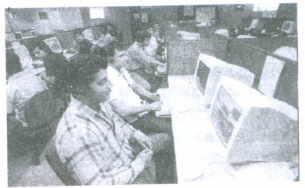
(i) Describe the work condition at all centres. Why are many call centres set up in India?
(ii) Where do we find a labour?
18.
Describe the challenges which are faced by the rural and urban women in our country.
19.
Often workers who make a living in the city are forced to set up their _____________ on the ____________ as well.
20.
Those who sell food or snacks on the street prepare most of these ______________
21.
We decided to take ___________ to the market
22.
My wife also earns from ___________ work that she gets once in a while.
23.
Some materials of Vandana's and Harpreet's showroom come from Noida and Gurgaon.
24.
A dentist's clinic is also at the starting place of the market
25.
Vendors sell things that are often prepared at home by their families.
26.
Bachchu Manjhi came from a village in Uttar Pradesh.
27.
Sudha works in a factory where garments work was done.
28.
Bachchu Manjhi
29.
Municipal Corporation
30.
Showroom
31.
Factory
32.
Company
1.
(a)
At labour chowk
2.
(a)
In an export garment unit
3.
(d)
12 per cent
4.
(c)
Rs 100
5.
(c)
rickshaw-puller
6.
()
Hair-cutting, shoe-repairinq, flower -selling, craft-marking.
7.
()
Sudha supervises the work of 50 salespersons who travel to different parts of the city. They get orders from shopkeepers and collect payments from them. Sudha has divided the city into six regions and once a week she meets the- salespersons of each region She discusses the plan, problems they face, etc.
8.
()
The workers work in a factory on day and night shifts. with each shift lasting 12 hours. One worker works on one machine for 12 hours and then is replaced by another on the same machine for the next 12 hours.
9.
()
The factory area was full of small workshops, people worked on sewing machines in a sm8.11room and were stitching clothes and stacked them in one corner.
10.
()
The readymade garment's showroom had three floors. At the third floor, clothes for girls were kept.
11.
()
The government is thinking about modifying the law that banned street vendors, so that they have a place to work and that there is also a free flow of traffic and people.
12.
Bachchu Manjhi came to the city to find work. He did not get masonry work regularly. The income that he earned was not sufficient to sustain his family.
13.
Following suggestions have been made:
(a) Hawking zones have been suggested for towns and cities.
(b) Mobile vendors should be allowed to more around freely.
(c) Hawkers need to be part of committees that are set up to take these and other decisions relating to them.
14.
This is a story of a city where a factory was established. There were garments work being done. My cousin knew a being employee whose name was Nirmala. Nirmala's neighbours did zari work and embroidery.
So, we (I and my cousin) caught a bus and headed towards the factory area where. Nirmala promised to get zari work done on my dress.
15.
A call centre is a centralised office that deals with problems and questions that consumers or customers have regarding goods purchased and services like banking, ticket booking etc.
16.
A part of the salary is kept in a fund with the government. These savings give interest on funds. After retirement, everyone who does work in a government or other companies / factories get this money and can then live on that.
17.
(i) Call centres are generally set-up as large rooms with work stations that include a computer, a telephone set and supervisor's stations. India has become a major centre not only for Indian companies but also foreign companies. They set-up call centres here as they can get people who can speak English and will work for lower wages.
(ii) We find labour at labour chowk where many people were sitting on railings or in groups at the crossing These labourers are daily wage labourers.
18.
Challenges faced by rural women are:
(i) Poor resource base and resource quality (small or no agricultural land and water).
(ii) Illiteracy and lack of skill.
(iii) Lack of awareness about different government schemes and programmes.
(iv) Lack of knowledge of disasters.
Challenges faced by urban women are:
(i) Lack of employment and irregular jobs.
(ii) Lack of job security and low wages.
(iii) Lack of sufficient and timely credit support system for petty trade.
(iv) Fear of eviction by police and civic bodies.
(v) Congested and hazardous working conditions.
19.
()
homes, street
20.
()
at home
21.
()
rickshaw
22.
()
agriculture
23.
(b)
24.
(b)
25.
(a)
26.
(b)
27.
(b)
28.
()
A rickshaw-puller
29.
()
A big cities
30.
()
Vandana
31.
()
Nirmala
32.
()
Sudha

6th Standard CBSE Syllabus & Materials
6th Standard CBSE
CBSE 6th Social Science Locating Places on the Earth - New Sample Question Papers Study Material - QB365 Set A
NEW6th Standard CBSE
CBSE 6th Science A Journey Through States of Water - New Sample Question Papers Study Material - QB365 Set A
NEW6th Standard CBSE
CBSE 6th Science Temperature and its Measurement - New Sample Question Papers Study Material - QB365 Set A
NEW6th Standard CBSE
CBSE 6th Science Materials Around Us - New Sample Question Papers Study Material - QB365 Set A



NCERT Books

Syllabus

Exam Pattern

Sample Question Papers

Previous year Question Papers

Important Notes

MCQ Practice test

NCERT Exemplers

Case study Questions

Image Based Questions

Passage based Questions

HOT Questions

Value Based Questions

Model Questions Papers
NCERT ( Book Back ) Questions

Assertion and Reason
Important Questions And Answers

CBSE 6th Standard CBSE Subjects
CBSE Standards