
8th Standard CBSE Syllabus & Materials
8th Standard CBSE
CBSE 8th Standard Social Science Dis - Man-made Disasters - An Overview Important Questions And Answers Study Material - QB365
NEW8th Standard CBSE
CBSE 8th Standard Social Science Dis - Drought Important Questions And Answers Study Material - QB365
NEW8th Standard CBSE
CBSE 8th Standard Social Science Dis - Floods Important Questions And Answers Study Material - QB365
NEW8th Standard CBSE
CBSE 8th Standard Social Science Dis - Cyclones Important Questions And Answers Study Material - QB365
NEW8th Standard CBSE
CBSE 8th Standard Social Science Dis - Earthquakes Important Questions And Answers Study Material - QB365
NEW8th Standard CBSE
CBSE 8th Standard Social Science Dis - Being Prepared-A Vital Part of Disaster Management Important Questions And Answers Study Material - QB365
Published on: 21/10/2025
Download CBSE Class 8th Standard CBSE Mathematics question papers, sample papers, important questions, and previous year solved papers in PDF format. Get free study materials, NCERT solutions, and exam preparation resources for Class 8th Standard CBSE Mathematics
Questions + Answers key
Take MCQ Mathematics Test
1.
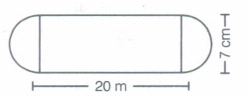
The shape of a garden is rectangular in the middle and semi-circular at the ends as shown in the diagram. Find the area and the perimeter of this garden. Length of rectangle is 20- (3.5+ 3.5) m.
2.
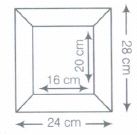
Diagram of the adjacent picture frame has outer dimensions 24 cm \(\times\) 28 cm and inner dimensions 16 cm \(\times\) 20 cm.Find the area of each section of the frame, it the width of each section is same.
3.
Evaluate using suitable identities
(i) (48)2
(ii) 1812-192
(iii) 497x 505
(iv) 2.07x1.93
4.
Find the multiplicative increase of X2, if \((\frac{2}{5})^{-3}\times (\frac{2}{5})^{5}=(\frac{2}{5})^{x}\)
5.
The weight of 3 bags of rice is 120 kg. Find
(a) how many bags will weigh 360 kg.
(b) the weight of 11 bags of rice.
6.
A mixture of paint is prepared by mixing 1 part of green pigments with 6 parts of the base. In the following table, find the parts of base needed to be added.
| Parts of green pigment | 1 | 4 | 5 | 6 |
| Parts of base | 6 | x1 | x2 | x3 |
7.
Draw a graph for the following:
| Side of square (in cm) | 2 | 3 | 4 | 5 | 6 |
| Perimeter (in cm2) | 4 | 9 | 16 | 25 | 36 |
Is it a linear graph?
8.
What is the area of a square having perimeter 68 cm?
9.
Multiply the product:3x (13x+ 12z- 2y)
10.
How are prisms and cylinders alike?
11.
Using identities, evaluate: 9982
12.
Find the value of {\((\frac{-2}{3})^{-2}\)}2
13.
Evaluate \(16^{5/4}\)
14.
Find the value of \(\frac { 198\times 198-102\times 102 }{ 96 } \)
15.
Check the divisibility of 1052896 by 9.
16.
Write the x-coordinate (abscissa) of the given points.
(7, 3)
17.
Write the y-coordinate (ordinate) of the given points.
(3, 5)
18.
If x varies inversely as y and y = 40 when x = 1.5. Find x, when y = 6.0.
19.
Factorise: ax + bx - ay - by
20.
Subtract 3l (l- 4m + 5n) from 41 (10n- 3m + 21)
21.
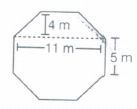
Top surface of a raised platform is in the shape of a regular octagon as shown in the figure. Find the area of the octagonal surface.
22.
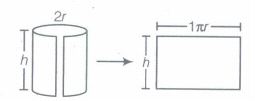
The lateral surface area of a hollow cylinder is 4224 cm2 . It is cut along its height and formed a rectangular sheet of width 33 cm. Find the perimeter of rectangular sheet.
23.
If \(\frac{5^{m}\times5^{3}\times5{-2}}{5^{-5}}=5^{12}\)then find the value of m.
24.
A batch of bottles were packed in 25 boxes with 12 bottles in each box. If the same batch is packed using 20 bottles in each box, how many boxes would be filled?
25.
Factorise the following expressions: (2p + q)2 - (2p - q)2
26.
Factorise the expressions and divide them as directed.
(5p2 -25p+ 20)÷(p- 1)
27.
What is Euler's formula? Verify the Euler's formula for a pentagonal prism.
28.
Simplify: \(\frac { { 2 }^{ -5 }\times { 3 }^{ -5 }\times 125 }{ { 5 }^{ -4 }\times { 6 }^{ -5 } } \)
29.
Divide: 81x3(50x2 - 98) by 27x2(5x + 7)
30.
In a solid, if F = V = 5, then the number of edges in this shape is
6
4
2
8
31.
Area of a rectangle with length 5ab and breadth 13ac2 is
65a2bc
35a2bc2
65a2bc2
65abc2
32.
Three cubes of metal whose edges are 6 cm, 8 cm and 10 cm respectively, are melted to form a single cube. The edge of the new cube is
6 cm
12 cm
8 cm
18 cm
33.
The reciprocal of \((\frac{3}{7})^{-1}\)is
\(\frac{7}{3}\)
\(-\frac{3}{7}\)
\(-\frac{7}{3}\)
\(\frac{3}{7}\)
34.
If 5A + 15 is equal to B3. Then, the value of A+B is
15
16
8
7
35.
A point which lies on both the axes is
(0,0)
(0, 1)
(1,0)
(1, 1)
36.
An irreducible factor of 24x2 y2 is
x2
y2
x
24x
37.
Radius of a circle is 7cm. Its perimeter
44 cm
36 cm
58 cm
154 cm
38.
10 metres of cloth cost Rs.1000. What will 4 metres cost?
Rs.400
Rs.800
Rs.200
Rs.100
39.
1 L =
10 cm3
100 cm3
1000 cm3
10000 cm3
40.
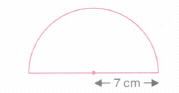
The area of the figure is
77 cm2
154 cm2
38.5 cm2
none of these
41.
The base radius and height of a right circular cylinder are 5 cm and 10 cm. Its total surface area is
150\(\pi\)cm2
300\(\pi\)cm2
150cm2
300 cm2
42.
The value of (a + b)2 - (a - b)2 is__________
43.
All six faces of a cuboid are_____in shape and of____area.
44.
The value of [2-1 +3-1 +4-1 +5-1]0 is _____________
45.
If xy = 10, then x and y vary__________ with each other.
46.
The distance of any point from the Y-axis is the ____________ coordinate.
47.
The coefficient of -5x is______
48.
What is the distance of the point (7,2) from the y-axis?
49.
What is Euler's formula? Using Euler's formula, find the number of faces of tetrahedron having vertices as 4 and 6 edges.
50.
Find the value of \({ x }^{ 2 }+\frac { 1 }{ { x }^{ 2 } } +2x\) at x =1
51.
Factorise 2xy+ 2y + 3x + 3
52.
Factorise: 49y2 - 1
53.
divide 24x2yz \(\div \)8xyz
1.
Given, the shape of a garden is rectangular in middle and semi-circular at both ends.
Also, diameter of circular part = 7 m
∴ Radius of circular part = \(\frac { 7 }{ 2 } \)= 3.5 m
Then, length of rectangular part = 20m -(3.5+3.5)m and breadth of rectangular part = 7 m
Now,area of one semi-circular part = \(\frac { 1 }{ 2 } { \pi r }^{ 2 }\)
where, r is the radius of semi-circle.
∴ Area of both semi-circular parts = \(2\times \frac { 1 }{ 2 } { \pi r }^{ 2 }={ \pi r }^{ 2 }\)
= \(\frac { 22 }{ 7 } \times \left( \frac { 7 }{ 2 } \right) ^{ 2 }\) \(\left[ \because \pi =\frac { 22 }{ 7 } \right] \)
= \(\frac { 22 }{ 7 } \times \frac { 49 }{ 7 } =\frac { 77 }{ 2 } \) m2
Area of rectangular part = Length \(\times\) Breadth
= 13m\(\times\) 7m = 91m2
∴ Area of garden = Area of both circular parts + Area of rectangular part
=\(\frac { 77 }{ 2 } \) + 91 m2
=\(\left( \frac { 77+182 }{ 2 } \right) { m }^{ 2 }\)= 129.5 m2
Now, Perimeter of one semi-circle part = \(\frac { 2\pi r }{ 2 } =\pi r\)
∴ Perimeter of both semi-circle parts = \(2\times \frac { 22 }{ 7 } \times \frac { 7 }{ 2 } \) =22m
Here, rectangular part is in between two semi-circular parts, so for perimeter of garden, we will take only length of rectangular part.
∴ Perimeter of garden = Perimeter of both circular parts + 22 \(\times\) Length of rectangular part
= 22 + 2 \(\times\)13 = (22+26) m = 48m
2.
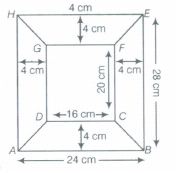
The diagram of the picture frame is as shown in the figure: The picture frame has four trapezium shaped sections, which are ABCD, BEFC, EHGF and HADG.
Out of these four sections, the area of opposite sections will be same
i.e area of section ABCD = Area of section EHGF and area of section BEFC = Area of section HADG
Width of section ABCD =\(\frac { (AH-DG) }{ 2 } =\frac { (28-20) }{ 2 } =\frac { 8 }{ 2 }\) = 4cm
[∵ width of EFGH and ABCD is same]
Then, width of each section is 4 cm.
Now, area of trapezium ABCD
=\(\frac { 1 }{ 2 } \) (AB+CD)\(\times\) Width of frame
= \(\frac { 1 }{ 2 } \)\(\times\)(24+16)\(\times\) 4 =\(\frac { 1 }{ 2 } \) 40\(\times\) 4 = 80 m2
and area of trapezium BEFC
= \(\frac { 1 }{ 2 } \)(BE + CF) \(\times\)Width of frame
= \(\frac { 1 }{ 2 } \)(28 + 20)\(\times\) 4 =\(\frac { 1 }{ 2 } \) \(\times\)48\(\times\) 4 = 96m2
∴ Area of section ABCD =Area of section EHGF = 80 cm2 and area of section BEFC = Area of section HADG = 96 cm2
3.
(i)(48)2=(50-2)2
Since, (a - b)2 = a2 - 2ab + b2
(50-2)2=(50)2-2x50x2+(2)2
= 2500 - 200 + 4 (a-b)2=a2-2ab+b2
= 2504 - 200 = 2304
(ii) 1812 -192 =(181-19)(181+ 19)
where, a = 50 and b = 2
= 162 x 200 = 32400
(iii) 497 x 505 =(500 - 3)(500 + 5)
= 5002 + (-3 + 5) x 500 + (-3)(5)
[.: (x + a)(x + b) = x2 + (a +. b) x + ab]
= 250000 + 1000 -15 = 250985
(iv) 2.07 x1.93 = (2 + 0.07)(2 - 0.07)
= 22 -(0.07)2
[.: where, a = 50 and b = 2]
= 3.9951
4.
\(\frac{1}{4}\)
5.
(a) 9 bags
(b) 440 kg
6.
Here, as the base increased, the required number of green pigments will also increase.
\(\therefore\) The quantity vary directly:
i.e.,\(\frac { 1 }{ 6 } =\frac { 4 }{ { x }_{ 1 } } =\frac { 5 }{ { x }_{ 2 } } =\frac { 6 }{ { x }_{ 3 } } \)
\(\therefore\) \(\frac { 4 }{ { x }_{ 1 } } =\frac { 1 }{ 6 } \Rightarrow 1\times { x }_{ 1 }=4\times 6\Rightarrow { x }_{ 1 }=24\)
\(\frac { 1 }{ 6 } =\frac { 5 }{ { x }_{ 2 } } \Rightarrow 1\times { x }_{ 2 }=5\times 6\)
\(\Rightarrow { x }_{ 2 }=\frac { 5\times 6 }{ 1 } =30\)
\(\frac { 1 }{ 6 } =\frac { 6 }{ { x }_{ 3 } } \Rightarrow 1\times { x }_{ 3 }=6\times 6\)
\(\Rightarrow \ { x }_{ 3 }=\frac { 6\times 6 }{ 1 } =36\)
Thus, the required unknown quantities are: x1 = 24, x2 = 30, and x3 = 36.
7.
.PNG)
Scale:
On horizontal axis: 2 units = 2 cm
On vertical axis: 1 unit = 2 cm
1. Mark side of the square (in em) on horizontal axis.
2. Mark area (in cm2) on vertical axis.
3. Plot the points (2, 4) (3, 9), (4, 16), (5, 25) and (6, 36).
4. Join the points.
The graph we get is not linear.
8.
289 cm2
9.
We have, 3x x (13x + 12z - 2y) = 3xx13x + 3x x 12z - 3xx2y = 39x2+ 36xz -6xy
10.
We know that, a prism is a polyhedron whose base and top are congruent polygons and whose other faces, i.e lateral faces are parallelograms in shape. Here, top and base of a prism and of a cylinder are congruent and parallel to each other and a prism becomes a cylinder if the number of sides of its base becomes larger and larger.
11.
∵ 998 = 1000 - 2
∴ (998i= (1000 - 2)2
= (1000)2 - 2(1000)(2) + (2)2 [Using (a - b)2 = a2 - 2ab + b2]
= 1000000 - 4000 + 4 = 996004
12.
\({ \left\{ { \left( \frac { -2 }{ 3 } \right) }^{ -2 } \right\} }^{ 2 }\) \(\because \quad ({ a }^{ m }{ ) }^{ n }={ a }^{ mn }\)
\(\therefore \quad { \left\{ { \left( \frac { -2 }{ 3 } \right) }^{ -2 } \right\} }^{ 2 }={ \left( \frac { -2 }{ 3 } \right) }^{ (-2)\times 2 }={ \left( \frac { -2 }{ 3 } \right) }^{ -4 }\)
=\(\frac { { (-2) }^{ -4 } }{ { (3) }^{ -4 } } \left[ \because { \left( \frac { a }{ b } \right) }^{ m }=\frac { { a }^{ m } }{ { b }^{ m } } \right] \)
\(=\frac { { 3 }^{ 4 } }{ { (-2) }^{ 4 } } =\frac { 3\times 3\times 3\times 3 }{ (-2)\times (-2)\times (-2)\times (-2) } =\frac { 81 }{ 16 } \)
13.
32
14.
300
15.
To check the divisibility of 1052896
1+ 0 + 5 + 2 + 8 + 9 + 6 = 31
Since, 31 is not divisible by 9. Hence, this number is not divisible by 9.
16.
Given, (7, 3)
In this point, x-coordinate (abscissa) is 7 i.e.
x =7.
17.
Given, (3, 5)
In this point, y-coordinate (ordinate) is 5 i.e. y = 5.
18.
x = 10
19.
ax + bx - ay - by
= x[a + b] + (-y)[a + b]
=(x - y)[a + b]
20.
First expression = 3l(l - 4m + 5n)
= (3l) x (l) - (3l) x (4m) + (3l) x (5n)
= 3l2 -12lm + 15ln
Second expression = 4l(10n - 3m + 2l)
= (4l)x (I0n) - (4l) x (3m) + (4l) x (2l)
= 40ln -12lm + 8l2
On subtracting first expression from second expression, we get
40ln -12lm + 8l2
15ln - 12lm + 3l2
(-) (+) (-)
___________________
25ln + 0 + 5l2
___________________
= 25ln + 5l2
21.
Let ABCDEFGH be the regular octagonal surface as shown below in the figure:
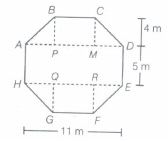
Given, each side of octagon = 5m,AD = 11 m
perpendicular from B to AD i.e. BP =4m .Join HE
Since, it is a regular octagon, so trapeziums ABCD and HEFG will be congruent and ADEH is a rectangle.
Now, area of trapezium ABCD = Area of trapezium HEFG
= (AD+BC)BP
= \(\frac { 1 }{ 2 } \)(11+5)\(\times\) 4 =\(\frac { 1 }{ 2 } \) \(\times\)16\(\times\)4
= 8 \(\times\)4 =32 m2
and area of rectangle ADEH = AD\(\times\) DE =11 \(\times\)5 =55m2
Now, area of octagon ABCDEFGH
= Area of trapezium ABCD +Area of rectangle ADEH +Area of trapezium HFGH
= 32 + 55 + 32= 119 m2
Hence, required area of octagonal surface is 119 m2
22.
According to the question, on cutting the cylinder along its height, we get a rectangular sheet of width 33 cm which is height of cylinder. So, the height of cylinder, h = 33 cm. Let radius of cylinder be r cm.
Given, lateral surface area of cylinder = 4224 cm2
∴ 2\(\pi\)r = 4224 ⇒ \(2\times \frac { 22 }{ 7 } \times r\times 33\)=4224
⇒ \(r=\frac { 7\times 4224 }{ 2\times 22\times 33 } =\frac { 7\times 96 }{ 33 } =\frac { 7\times 32 }{ 11 } cm\)
Also, on cutting the hollow cylinder, the perimeter of base becomes the length of the rectangular sheet
∴ Length of rectangular sheet = Perimeter of circular base
= 2\(\pi\)r
\(2\times \frac { 22 }{ 7 } \times \frac { 7\times 32 }{ 11 } \) = 128 cm
and breadth of rectangular sheet = 33 cm
∴ Perimeter of rectangular sheet = 2(1 + b) = 2(128 +33) = 2\(\times\)161 =322 cm
23.
Given, \(\frac{5^{m}\times5^{3}\times5{-2}}{5^{-5}}=5^{12}\)
⇒ \(\frac{5^{m+3-2}}{5^{-5}}=5^{12}\)
⇒ 5m+1+5 = 512
⇒ (5)m+6 = (5)12
⇒ m + 6 = 12 [ ∵ bases are same]
⇒ m= 12 - 6 = 6
24.
Let the number of boxes filled be x.
Then, we have the following table:
| Number of bottles in a box | 12 | 20 |
| Number of boxes | 25 | x |
Here, more the number of bottles in a box, less would be the number of boxes. Therefore, it is a case of inverse proportion.
So, \(12\times 25=20\times x\Rightarrow x=\frac { 12\times 25 }{ 20 } =\frac { 12\times 5 }{ 4 } \)
[dividing numerator and denominator by 5]
x = 15
Hence, 15 boxes would be filled, if the same batch is packed using 20 bottles in each box.
25.
8pq
26.
Here, 5P2-25P+20 = 5(p2-5P + 4)
= 5[p2 +(-4-1)p+4]
= 5(p2-4p-P+ 4) [∵ ab = 4 and a + b= -5, ஃ a= -4, b= -1]
= 5[p(p-4)-1(p-4)]
= 5(p-4)(p-1)
Now, (5p2-25p + 20) ÷ (p-1)
=\(\frac{5p^{2}-25p+20}{(p-1)}\)
=\(\frac{5(p-4)(p-1)}{(p-1)}=5(p-4)\)
27.
If a polyhedron is having number of faces as F, number of edges as E and the number of vertices as V, then the relationship
F+ V=E+2
is known as Euler's formula. Following figure is a solid pentagonal prism.
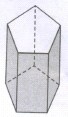
It has:
Number of faces (F) = 7
Number of edges (E) = 15
Number of vertices (V) = 10
Substituting the values of F, E and V in the relation,
F+ V=E+2
We have
7 + 10 = 15 + 2
⇒ 17 = 17
which is true, the Euler's formula is verified.
28.
Since 125 = 5 \(\times\)5\(\times\)5=53
6-5=(2\(\times\)3)-5 = 2-5 \(\times\) 3-5
\(\therefore \frac { { 2 }^{ -5 }\times { 3 }^{ -5 }\times 125 }{ { 5 }^{ -4 }\times { 6 }^{ -5 } } =\frac { { 2 }^{ -5 }\times { 3 }^{ -5 }\times { 5 }^{ 3 } }{ { 5 }^{ -4 }\times { 2 }^{ -5 }\times { 3 }^{ -5 } } \)
\(=\frac { { 2 }^{ -5 } }{ { 2 }^{ -5 } } \times \frac { { 3 }^{ -5 } }{ { 3 }^{ -5 } } \times { 5 }^{ 3+4 }=1\times { 5 }^{ 7 }\)
=5 \(\times\)5\(\times\)5\(\times\)5\(\times\)5\(\times\)5\(\times\)5 = 78125.
29.
We have 50x2 - 98 = 2(25x2 - 49)
= 2[(5x)2 - (7)2] == 2[(5x + 7)(5x - 7)] [Using a2 - b2 = (a + b)(a - b)]
= \(\frac { 81x^{ 3 }[50x^{ 2 }-98] }{ 27x^{ 2 }[5x+7] } \)
=\(\frac { { 81x }^{ 3 } }{ { 27x }^{ 2 } } \left[ \frac { 2(5x-7)(5x+7) }{ (5x+7) } \right] =3x[2(5x-7)]\)
= 3x\(\times \)2\(\times \)(5x- 7) = 6 x (5x - 7)
30.
(d)
8
31.
(c)
65a2bc2
32.
(b)
12 cm
33.
(d)
\(\frac{3}{7}\)
34.
(a)
15
35.
(a)
(0,0)
36.
(c)
x
37.
(b)
36 cm
38.
\({10\over 1000}={4\over ?}⇒?=400\)
39.
(c)
1000 cm3
40.
Area = \(\frac { 1 }{ 2 } \times \frac { 22 }{ 7 } \)x7x7 = 77 cm2
41.
Total surface area = 2\(\pi\)r(h+r)
=2\(\pi\)5(10+5) = 150\(\pi\) cm2
42.
()
(a+b)2-(a-b)2=(a2+2ab+b2)-(a2+b2-2ab)
43.
()
Rectangular, different
44.
()
1
45.
()
inversely
46.
()
X
47.
()
-5
48.
()
7
49.
()
F + V = E + 2; Four
50.
()
4
51.
()
(x+1)(2y+3)
52.
()
(7y-1)(7y+1)
53.
()
3x

8th Standard CBSE Syllabus & Materials
8th Standard CBSE
CBSE 8th Standard Social Science CIV - Law and Social Justice Important Questions And Answers Study Material - QB365 Set C
NEW8th Standard CBSE
CBSE 8th Standard Social Science CIV - Law and Social Justice Important Questions And Answers Study Material - QB365 Set B
NEW8th Standard CBSE
CBSE 8th Standard Social Science CIV - Law and Social Justice Important Questions And Answers Study Material - QB365 Set A
NEW8th Standard CBSE
CBSE 8th Standard Social Science CIV - Public Facilities Important Questions And Answers Study Material - QB365 Set C



NCERT Books

Syllabus

Exam Pattern

Sample Question Papers

Previous year Question Papers

Important Notes

MCQ Practice test

NCERT Exemplers

Case study Questions

Image Based Questions

Passage based Questions

HOT Questions

Value Based Questions

Model Questions Papers
NCERT ( Book Back ) Questions

Assertion and Reason
Important Questions And Answers

CBSE 8th Standard CBSE Subjects
CBSE Standards