 100% FREE ACCESS
8th Standard CBSE Syllabus & Materials
8th Standard CBSE
CBSE 8th Social Science Theme D - Factors of Production - New Model Questions Papers Study Material - QB365 Set A
NEW8th Standard CBSE
CBSE 8th Social Science Theme C - Universal Franchise and India's Electoral System - New Model Questions Papers Study Material - QB365 Set A
NEW8th Standard CBSE
CBSE 8th Social Science Theme B - The Rise of the Marathas - New Model Questions Papers Study Material - QB365 Set A
NEW8th Standard CBSE
CBSE 8th Social Science Theme B - Reshaping India's Political Map - New Model Questions Papers Study Material - QB365 Set A
NEW8th Standard CBSE
CBSE 8th Social Science Theme A - Natural Resources and Their Use - New Model Questions Papers Study Material - QB365 Set A
NEW8th Standard CBSE
CBSE 8th Science Keeping Time with Skies - New Model Questions Papers Study Material - QB365 Set A

Published on: 21/10/2025
Download CBSE Class 8th Standard CBSE Mathematics question papers, sample papers, important questions, and previous year solved papers in PDF format. Get free study materials, NCERT solutions, and exam preparation resources for Class 8th Standard CBSE Mathematics
Questions + Answers key
Take MCQ Mathematics Test
1.
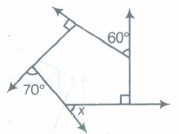
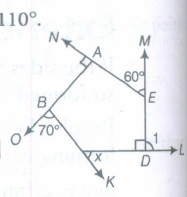
Find x, in the following figures.
2.
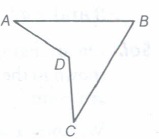
These quadrilaterals were convex. What would happen, if the quadrilateral is not convex? Consider quadrilateral ABCD. Split it into two triangles and find the sum of the interior angles in adjoining figure.
3.
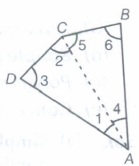
Take any quadrilateral, say ABCD in the adjoining figure. Divideit into two triangles, by drawing a diagonal. You get six angles 1, 2, 3, 4, 5 and 6. Use angle sum property of a triangle and argue how the sum of the measures of ㄥA, ㄥB, ㄥC and ㄥD amounts to 180°+180°= 360°.
4.
A rectangular MORE is shown below:
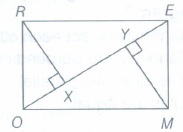
Answer the following questions by giving appropriate reason.
(i) Is RE = OM?
(ii) Is ㄥMYO = ㄥRXE?
(iii) Is ㄥMOY = ㄥREX?
(iv) Is ΔMYO ≅ RXE?
(v) Is MY = RX?
5.
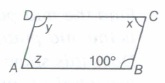
Consider the following parallelograms. Find the values of the unknowns x, y and z.
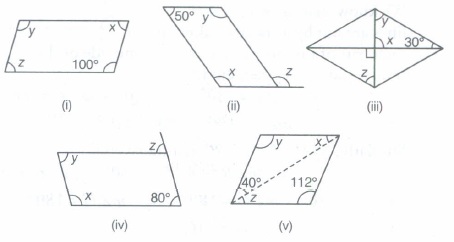
6.
Given here are some figures.
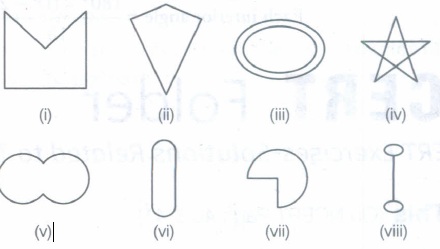
Classify each of them on the basis of the following.
(a) Simple curve
(b) Simple closed curve
(c) Polygon
(d) Convex polygon
(e) Concave polygon
7.
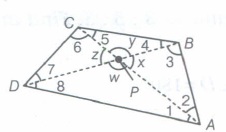
As before, consider quadrilateral ABCD in adjoining figure. Let P be any point in its interior. Join P to vertices A, B, C and D. In the given figure, consider ΔPAB. From this, we see x= 180°- mㄥ2 - mㄥ3; similarly from ΔPBC, y = 1800- mㄥ4 - mㄥ5; from ΔPCD, z = 180° - mㄥ6 - mㄥ7 and from ΔPDA, w= 180°- mㄥB - mㄥ1. Use this to find the total measure mㄥ1 + mㄥ2 + ... + mㄥ8. Does it help you to arrive at the result?
8.
In a parallelogram if measures of two adjacent angles are in the ratio of 4:5, find all the angles
9.
Find the length of the diagonal of a rectangle, whose sides are (2x + 8) cm, (2x + 1) cm and perimeter is 34 cm, also find its sides.
10.
In a rectangle ABCD, AB = 25 cm and BC = 15 cm. In what ratio does the bisector of ㄥC divides AB?
11.
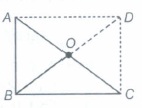
ABC is a right angled triangle and O is the mid-point of the side opposite to the right angle. Explain, why O is equidistant from A, B and C? (The dotted lines are drawn additionally to help you).
12.
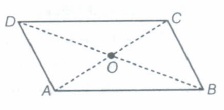
Take a cut-out of a parallelogram, say ABCD in adjoining figure. Let its diagonals \(\bar { AC } \) and \(\bar { DB } \) meet at O. Find the mid-point of \(\bar { AC } \) by a fold, placing C on A. Is the mid-point same as O? Does this show that diagonal \(\bar { DB } \) bisects the diagonal \(\bar { AC } \) at the point O? Discuss it with your friends. Repeat the activity to find where the mid-point of \(\bar { DB } \) could lie.
13.
Can it be an interior angle of a regular polygon? Why?
14.
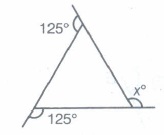
Find x in the following figures.
15.
Find the sum of interior angles of a regular polygon having 11 sides.
16.
Which of the following is the sum of an exterior angle and its adjacent interior angle?
A straight angle
A right angle
A complete angle
Reflex angle
17.
In an isosceles parallelogram, we have:
pair of parallel sides equal
pair of non-parallel sides equal
pair of non-parallel sides as perpendicular
none of these.
18.
Which of the following can be four interior angles of a quadrilateral?
70°, 90°, 45°, 130°
35°, 49°, 9r, 17°
140°, 60°, 60°, 90°
25°, 145°, 85°, 105°
19.
Prisha has a farm land, which is triangular shape. What is the sum of all the exterior angles taken in an order of the farm land?
90°
180°
360°
Cannot be determined
20.
The measure of each exterior angle of a regular polygon of 12 sides is
30°
45°
24°
60°
1.
Let given polygon be
ABCDE It is clear that, AB is a straight line.
90° + ㄥ1 = 180°
[by linear pair angle]
⇒ ㄥ1 = 1800 - 900 = 900
Now, x +90° +60° +90° + 70° = 360°
The sum of the exterior angles of any polygon is 360°.
⇒ x + 3100 = 360°
⇒ x = 3600-3100= 50°
Hence, the measure of angle x is 50°.
2.
If a quadrilateral is not convex, then it will be concave. In the quadrilateral ABCD, join BD. Then, quadrilateral split into two triangles.
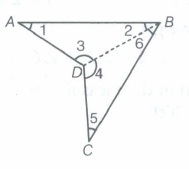
In ΔADB, we have
mㄥ1 + mㄥ2 + mㄥ3 = 180°
[using angle sum property of a traingle] ... (i)
In ΔBDC, we have
mㄥ4 + mㄥ5 + mㄥ6 = 180°
[using angle sum property of a triangle] ... (ii)
On adding Eqs. (i) and (ii), we get
mㄥ1 + mㄥ2 + mㄥ3 + mㄥ4 + mㄥ5 +mㄥ6 = 180°+180°
⇒ mㄥ1 + mㄥ2 + mㄥ6+ mㄥ5 + (mㄥ3 + mㄥ4) = 360°
∴ mㄥA + mㄥB + mㄥC + mㄥD = 360°
Hence, the sum of the interior angles of a quadrilateral is 360°.
3.
Given,ABCDis a quadrilateral and AC is one of its diagonal.
Clearly, ㄥ1 + ㄥ4 = ㄥA ......(i)
and ㄥ2 + ㄥ5 = ㄥC ......(ii)
Also, diagonal AC divides quadrilateral ABCD into two triangles i.e. ΔABC and ΔADC.
We know that, the sum of all angles of a triangle is 180°.
Therefore,
In ΔABC, we have ㄥ4+ㄥ5+ㄥ6=1800 .....(iii)
In ΔACD, we have ㄥ1+ㄥ2+ㄥ3=1800 .....(iv)
On adding Eqs. (iii) and (iv), we get
ㄥ1 + ㄥ2 + ㄥ3 + ㄥ4 + ㄥ5 + ㄥ6 = 180° +180°
⇒ (ㄥ1 + ㄥ4) + (ㄥ2 + ㄥ5) + ㄥ3 + ㄥ6 = 360°
∴ ㄥA + ㄥC + ㄥD + ㄥB = 360° [from Eqs. (i) and (ii)]
Hence, the sum of the measures of ㄥA, ㄥB, ㄥC and ㄥD is 360°.
4.
(i) Yes, RE = OM
Given, the above rectangle, opposite sides are equal. .
(ii) Yes, ㄥMYO = ㄥRXE
Here, MY and RX are perpendicular to OE.
Since, ㄥRXO = 90° ⇒ ㄥRXE = 900
and ㄥMYE = 90° ⇒ ㄥMYO = 90°
(iii) Yes, ㄥMOY = ㄥREX
Since, these are alternate interior angles.
∵ RE || OM and EO is a transversal.
∴ ㄥMOE = ㄥOER
⇒ ㄥMOY = ㄥREX
(iv) Yes, ΔMYO ≅ RXE
In ΔMYO and ΔRXE, we see that
MO=RE [proved]
ㄥMOY = ㄥREX [proved]
ㄥMYO = ㄥRXE [proved]
∴ ΔMYO ≅ ΔRXE [by AAS]
(v) Yes, MY = RX
Since, these are corresponding part of congruent triangles.
5.
(i) Given, ABCD is a parallelogram in which ㄥB = 100°.
We know that, the sum of any two adjacent angles of a parallelogram is 180°.
ㄥA + ㄥB = 180°
[∴ ㄥA and ㄥB are adjacent angles]
⇒ z+1000=180° ⇒ z=1800-100° =80°
Also, opposite angles of a parallelogram are of equal measure.
∴ ㄥD=ㄥB ⇒ y=1000
and ㄥC=ㄥA ⇒ x=z=80°
Hence, the measure of x, y and z are 80°,100° and 80°, respectively.
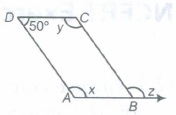
(ii) Let a parallelogram be ABCD in which ㄥD = 50° .
We know that, the sum of any two adjacent angles of a parallelogram is 180°.
∴ ㄥA + ㄥD=50° ⇒ x + 500= 180°
⇒ x = 180°-50° = 130°
Also, opposite angles of a parallelogram are of equal measure.
∴ ㄥC=ㄥA ⇒ y=x=1300 and ㄥB=ㄥD=50°
Now, ㄥB + exterior ㄥB = 180°
⇒ 50° + z = 180° [by linear pair angle]
⇒ z = 1800- 50° = 130°
Hence, the measure of angles x, y and z are 130°, 130° and 130° , respectively.
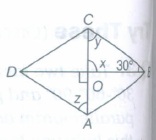
(iii) Let a parallelogram be ABCD, in which ㄥCBO = 30°. Here, AC and BD intersect each other at O and ㄥAOD=90°.
∴ ㄥCOB = ㄥAOD=90°
[vertically opposite angles]
We know that, the sum of three angles of a triangle is 180°.
In ΔOBC,
ㄥCOB + ㄥOCB + ㄥCBO = 180°
⇒ 90° +y +30° = 180° ⇒ Y + 120° = 1800
y=1800 - 1200= 600
As AD II BC and AC is a transversal.
y = z = 60° [alternate interior angles]
Hence, the measure of angles x, y and z are 90°, 60 and 60° , respectively.
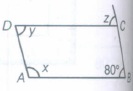
(iv) Let parallelogram be ABCD, in which ㄥB = 80°
We know that, the sum of any two adjacent angles of a parallelogram is 180°.
∴ ㄥB + ㄥC = 180° ⇒ 800+ ㄥC= 180°
⇒ ㄥC = 180° - 80°= 100°
Also, ㄥC + exterior ㄥC = 180° [by linear pair
:. exterior LC or z = 180° - 80°= 100°
Also, opposite angles of a parallelogram are of equal measure.
So, ㄥA = ㄥC ⇒ x = 100°
and ㄥD = ㄥB ⇒ y = 80°
Hence, the measure of angles x, y and z are 100°,80° and 100°, respectively.
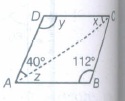
(v) Let parallelogram be ABCD, in which
ㄥB = 112° and ㄥDAC = 40°.
We know that, the sum of any two adjacent angles of a parallelogram is 180°.
∴ ㄥA + ㄥB = 180°
⇒ (40° + z) + 112° = 180°
⇒ 400 + z + 112° = 180° ⇒ z+152°=1800
⇒ z = 1800-152°=280
Also, opposite angles of a parallelogram are of equal measure.
So, ㄥD = ㄥB ⇒ y=112°
Now, in ㄥACD, using angle sum property of a triangle,
ㄥCAD + ㄥD + ㄥDCA = 1800
⇒ 400+y+x=1800
⇒ 40° +112° + x = 180°
⇒ 152° + x =1800 - x=1800-152°=280
Hence, the values of x, y and z are 280, 112° and 28°, respectively.
6.
(a) Simple curve A plane figure formed by joining a number of points without lifting a pencil from the paper and without returing any portion of the drawing other than single points is called a simple curve or curve. In the given figures, simple curves are figures (i), (ii), (v), (vi) and (vii).
(b) Simple closed curve A closed curve, which does not intersect itself, is called a simple closed curve. In the given figures, simple closed curves are figures (i), (ii), (v), (vi) and (vii).
(c) Polygon A polygon is a closed curve formed by the line segments such that
(i) no two line segments intersect except at their end points.
(ii) no two line segments with a common end points are coincide. In other words, a simple dosed curve made upto only line segments is called a polygon. In the given figures, polygons are figures (i) and (ii).
(d) Convex polygon A convex polygon is a polygon in which each interior angle has a measure less than 180°. In other words, a polygon is convex, if noportion of their diagonals in their exterior. In the given figures, convex polygon is figure (ii).
(e) Concave polygon A concave polygon is a polygon, which atleast one interior angle has measure more than 180°, i.e. atleast one segment connecting two vertices is outside the polygon. In the given figure, concave polygons are figures (i) and (iv).
7.
We know ,that, the sum of all angles of a triangle is 180°. Therefore
In ΔAPB, we have
ㄥx + ㄥ2 + ㄥ3 =180° ⇒ ㄥx=1800 - ㄥ2- ㄥ3 ... (i)
In ΔBPC, we have
ㄥy + ㄥ4 + ㄥ5 = 180° ⇒ ㄥy = 180°- ㄥ4 - ㄥ5 ... (ii)
In ΔCPD, we have
ㄥz + ㄥ6 + ㄥ7 = 180° ⇒ ㄥz = 180°- ㄥ6 - ㄥ7 ... (iii)
In ΔDPA, we have
ㄥw + ㄥ8 + ㄥ1=180° ⇒ w=1800 - ㄥ8 - ㄥ1 ... (iv)
On adding Eqs. (i), (ii), (iii) and (iv), we get
ㄥx+ ㄥy+ ㄥz + ㄥw
=720° - (ㄥ1 + ㄥ2 + ㄥ3 + ㄥ4+ ㄥ5 + ㄥ6 + ㄥ7 + ㄥ8)
But, at point P, ㄥx + ㄥy + ㄥz + ㄥw = 360°
∴ 360°= 720° - [(ㄥ1 + ㄥ2) + (ㄥ3 + ㄥ4)+(ㄥ5 + ㄥ6) + (ㄥ7 + ㄥ8)]
⇒ 360°-720° = -(ㄥA + ㄥB + ㄥC + ㄥD)
⇒ -360° = -(ㄥA + ㄥB + ㄥC + ㄥD)
or ㄥA + ㄥB + ㄥC + ㄥD = 360°
Thus, this helps us to arrive at the result that the sum of all angles of a quadrilateral is 360°.
8.
80o, 100o, 80o, 100o
9.
Sides are 12 cm, 5 cm and diagonal is 13 cm.
10.
2: 3
11.
Given, ABC is a right angled triangle and O is the mid-point of the side AC. Now, produce BO to D such that OB = OD and then join AD and CD. Thus, ABCD is a
rectangle, BD and AC are its diagonals, which intersect each other at O. We know that in a rectangle, the diagonals are equal in length and bisect each other.
∴ OA = OC and OB = OD
Also, AC = BD
Therefore, OA = OB = OC = OD
Thus, O is equidistant om A, B and C.
12.
To find the mid-point of \(\bar { AC } \) we fold it by placing C on A. Then, we get the point O, which is the intersecting point of diagonals \(\bar { AC } \) and .\(\bar { DB } \)
Thus, it shows that diagonal \(\bar { DB } \) bisects the diagonal \(\bar { AC } \) at the point O.
13.
No, it cannot be an interior angle of a regular polygon, because if interior angle is 22°, then each exterior angle is (180° - 22°) = 158°, which is not a divisor of 360°.
14.
(a) We know that, the sum of the exterior angles of any polygon is 360°.
∴ x+125°+125°=360°
⇒ x + 250° = 360°
⇒ x = 360° - 250° = 110°
Hence, the measure of angle x is 110°.
15.
1620°
16.
(a)
A straight angle
17.
(b)
pair of non-parallel sides equal
18.
(d)
25°, 145°, 85°, 105°
19.
(c)
360°
20.

8th Standard CBSE Syllabus & Materials
8th Standard CBSE
CBSE 8th Science Particulate Nature of Matter - New Model Questions Papers Study Material - QB365 Set A
NEW8th Standard CBSE
CBSE 8th Science Pressure, Winds, Stroms and Cyclones - New Model Questions Papers Study Material - QB365 Set A
NEW8th Standard CBSE
CBSE 8th Mathematics Quadrilaterals - New Model Questions Papers Study Material - QB365 Set A
NEW8th Standard CBSE
CBSE 8th Mathematics A story of Numbers - New Model Questions Papers Study Material - QB365 Set A



NCERT Books

Syllabus

Exam Pattern

Sample Question Papers

Previous year Question Papers

Important Notes

MCQ Practice test

NCERT Exemplers

Case study Questions

Image Based Questions

Passage based Questions

HOT Questions

Value Based Questions

Model Questions Papers
NCERT ( Book Back ) Questions

Assertion and Reason
Important Questions And Answers

CBSE 8th Standard CBSE Subjects
CBSE Standards