
 100% FREE ACCESS
9th Standard CBSE Syllabus & Materials
9th Standard CBSE
CBSE 9th Science Is matter around us pure? - New Model Questions Papers Study Material - QB365 Set A
NEW9th Standard CBSE
CBSE 9th Science Matter in our surroundings - New Model Questions Papers Study Material - QB365 Set A
NEW9th Standard CBSE
CBSE 9th Mathematics Heron's Formula Sample Question Papers Study Material - QB365 Set A
NEW9th Standard CBSE
CBSE 9th Mathematics Circles Sample Question Papers Study Material - QB365 Set A
NEW9th Standard CBSE
CBSE 9th Mathematics Quadrilaterals Sample Question Papers Study Material - QB365 Set A
NEW9th Standard CBSE
CBSE 9th Mathematics Triangles Sample Question Papers Study Material - QB365 Set A
Published on: 20/10/2025
Download CBSE Class 9th Standard CBSE Social Science question papers, sample papers, important questions, and previous year solved papers in PDF format. Get free study materials, NCERT solutions, and exam preparation resources for Class 9th Standard CBSE Social Science
Questions + Answers key
Take MCQ Social Science Test
1.
2.
3.
The Military Revolutionary Committee was headed by:
Leon Trotskii
Vladimir Lenin
Pro Tsarists
Stalin
4.
The Kullu valley lies in which state?
Jammu and Kashmir
Himachal Pradesh
Uttarakhand
Rajasthan
5.
Elections Commission has ensured which of the following identity of voters?
Electoral card
Election form
Election photo identity card
PAN card
6.
Name of the first captain of the Indian hockey team who was a member of the Constituent Assembly.
Baldev Singh
Somnath Lahiri
Jaipal Singh
K.M. Munshi
7.
Which of these is not a valid reason for arguing that there is a lesser possibility of famine in a democratic country?
Opposition parties can draw attention to hunger and starvation
Free press can report suffering from famine in different parts of the country
Government fears its defeat in the next elections
People are free to believe in and practice any religion
8.
Which of the following pair of river flows west and makes estuaries?
Narmada and Tapi
Narmada and Ganga
Tapi and Brahmaputra
Brahmaputra and Ganga
9.
India's latitudinal extent is
80N to 370N
802'N to 3704'N
6045'N to 3706'N
806'N to 3708'N
10.
Who advocated government based on 'Social Contract'?
Darwin
Spencer
Rousseau
Montesquieu
11.
What was the main purpose of the 'Legal Framework Order' issued under General Pervez Musharraf in Pakistan?
12.
What are the other names of the Godavari ?
13.
What were the pre-requisites for the status of an active citizen?
14.
Where does the river Godavari rise?
15.
Do the women of Saudi Arabia have the right to vote?
16.
Which range of Himalayas is the most continuous range?
17.
What is the longitudinal extent of India?
18.
Which group of workers were regarded as aristocrats among workers?
19.
Who led the representatives of the third estate in Versailles on 20th June, 1789?
20.
Mention three instances which are exceptions of the principle of 'one person, one vote and one value'.
21.
"The Constitution of India was drawn up under very difficult circumstances". Explain.
22.
How did socialists view private property?
23.
Write a short note on the Directory.
24.
What is the significance of health in an economy? State two provisions of the National Health Policy of India.
25.
Mention any three negative effects of the Green Revolution.
26.
Explain the challenges and limitation to free and fair elections in India.
27.
Imagine that you are a middle-level wheat farmer in Russia after collectivisation. You have decided to write a letter to Stalin explaining your objections to collectivisation. What would you write about the conditions of your life? What do you think would be Stalin’s response to such a farmer?
28.
What message is Young trying to convey here? Whom does he mean when he speaks of‘ ‘slaves’? Who is he criticising? What dangers does he sense in the situation of 1787?
29.
30.
31.
Read the following extract and answer the questions that follow:
This is a letter written by a peasant who did not want to join the collective farm.
To the newspaper Krestianskaia Gazeta (Peasant Newspaper)
‘… I am a natural working peasant born in 1879 … there are 6 members in my family, my wife was born in 1881, my son is 16, two daughters 19, all three go to school, my sister is 71. From 1932, heavy taxes have been levied on me that I have found impossible. From 1935, local authorities have increased the taxes on me … and I was unable to handle them and all my property was registered: my horse, cow, calf, sheep with lambs, all my implements, furniture and my reserve of wood for repair of buildings and they sold the lot for the taxes. In 1936, they sold two of my buildings … the kolkhoz bought them. In 1937, of two huts I had, one was sold and one was confiscated …’ Afanasii Dedorovich Frebenev, an independent cultivator.
From: V. Sokolov (ed), Obshchestvo I Vlast, v 1930-ye gody.
(i) Why did the peasant not want to join the collective farm?
(ii) What were the reasons that made the conditions of the Russian peasants so deplorable?
32.
Read the following extract and answer the questions that follow:
Some of the basic rights set forth in Olympe de Gouges’ Declaration.
1. Woman is born free and remains equal to man in rights.
2. The goal of all political associations is the preservation of the natural rights of woman and man: These rights are liberty, property, security, and above all resistance to oppression.
3. The source of all sovereignty resides in the nation, which is nothing but the union of woman and man.
4. The law should be the expression of the general will; all female and male citizens should have a say either personally or by their representatives in its formulation; it should be the same for all. All female and male citizens are equally entitled to all honours and public employment according to their abilities and without any other distinction than that of their talents.
5. No woman is an exception; she is accused, arrested, and detained in cases determined by law. Women, like men, obey this rigorous law.
(a) How did Olympe de Gouges, view women?
(b) What should be the goal of all political associations according to her?
(c) What was her opinion about law?
33.
Years ago, writing in his magazine 'Young India' in 1931, Mahatma Gandhi had spelt out what he wanted the Indian Constitution to do:
Now answer the following questions:
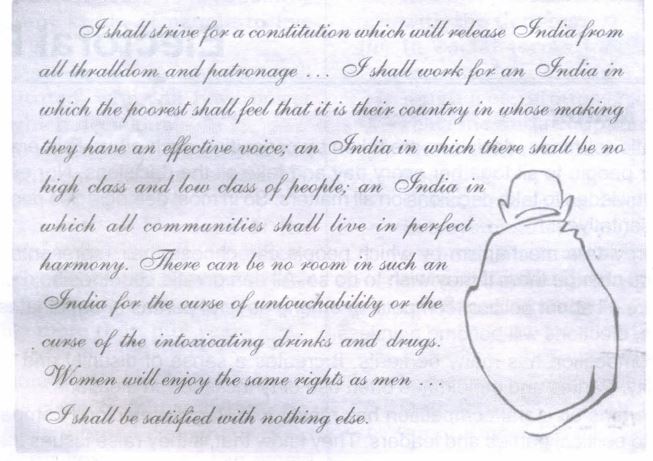
(i) What was Gandhiji's dream for India?
(ii) Mention two evils from which Gandhiji wanted to keep away his dream India.
(iii) What did Gandhiji want for the Indian women?
34.
Observe the picture given below and answer the following questions.
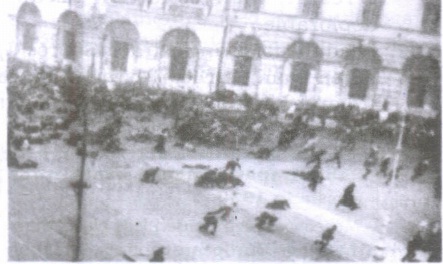
The above picture is of pro-Bolshevik demonstration on 17th July which get fired upon by the army.
(i) Who were Bolsheviks and who was their leader?
(ii) Why and by whom was the popular demonstration by the Bolsheviks in July 1917 harshly repressed?
35.
Mention any five values which are associated with Declaration of the Right of Man and Citizen.
36.
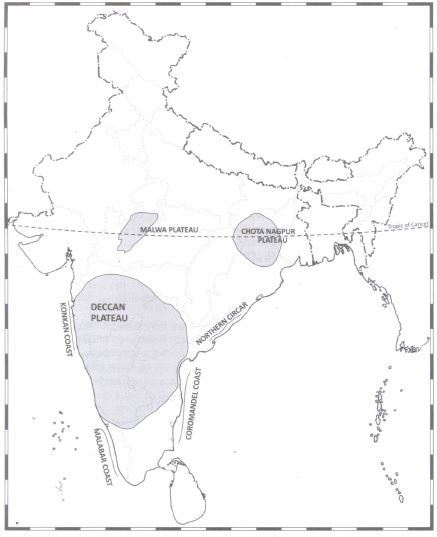
On an outline map of India, locate and label the following:
(I) Plateau: Deccan Plateau, Chota Nagpur Plateau, Malwa Plateau.
(il) Coastal Plains: Konkan, Malabar, Coromandel and Northern Circar
37.
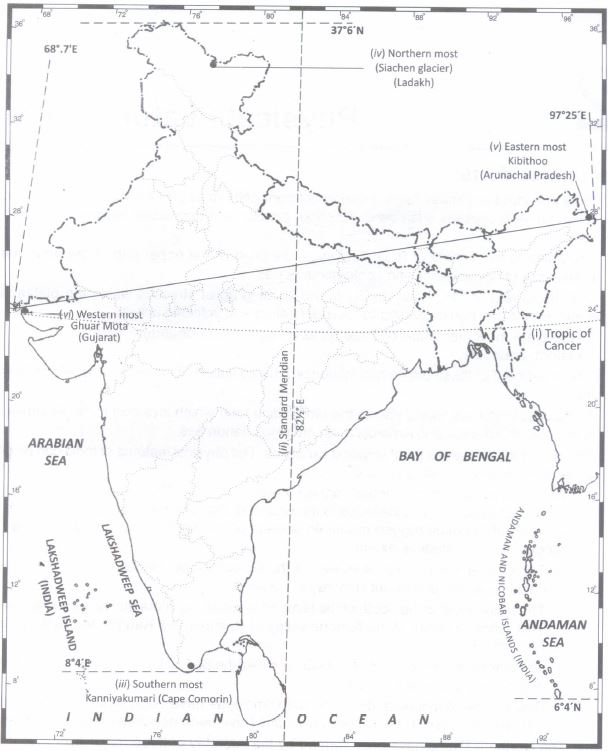
On an outline map of India, locate and label the following:
(i) Tropic of Cancer, (ii) Standard Meridian, (iii) Southern most, (iv) Northern most, (v) Eastern most, (vi) Western most point of India.
38.
39.
40.
41.
1.
(d)
2.
(c)
3.
(a)
Leon Trotskii
4.
(b)
Himachal Pradesh
5.
(c)
Election photo identity card
6.
(c)
Jaipal Singh
7.
(d)
People are free to believe in and practice any religion
8.
(a)
Narmada and Tapi
9.
(c)
6045'N to 3706'N
10.
(c)
Rousseau
11.
(i) In August 2002 issued a 'Legal Framework Order' under General Pervez Musharraf that amende the constitution of Pakistan.
(ii) According to this Order, the president can dismiss the national or provincial assemblies.
(iii) The work of the civilian cabinet was supervised by a National Security Council which was dominated by military officers.
12.
Vridha Ganga and Dakshin Ganga.
13.
The pre-requisites were, only men above 25 years of age who paid taxes equal to at least 3 days of a labourer's wage, were given the status of active citizens.
14.
()
The river Godavari rises from the slopes of the Western Ghats in the Nasik district of Maharashtra.
15.
()
Till 2011, the women of Saudi Arabia did not have the right to vote. But now they have been given this right.
16.
()
The northernmost range which is also known as Himadri or Inner Himalayas, is the most continuous range of Himalaya.
17.
()
The longitude extent of India is from 68\(°\)7' East (westernmost point of India in Gujarat) to 97\(°\)25' East (earnmost point of India in Arunachal Pradesh ).
18.
()
The metal-workers were regarded as aristocrats among workers.
19.
()
The representatives of the third estate were led by Mirabeau and Abbe Sieyes.
20.
Democracy is based on a fundamental principle of political equality. In a democracy, each adult citizen must have one vote and each vote must have one value. But there are many instances of denial of equal right to vote:
(i) In Saudi Arabia, women do not have the right to vote.
(ii) Estonia has made its citizenship rules in such a way that people belonging to Russian minority find it difficult to get the right to vote.
(iii) In Fiji,the electoral system is such that the vote of an indigenous Fiji has more value than that of an Indian-Fijian.
21.
(i) The making of the Constitution for a huge and diverse country like India was a tough task. At that time the people of India were emerging from the status of subjects to that of citizens.
(ii) The country was born through a partition on the basis of religious differences. This was a traumatic experience for the people of India and Pakistan. At least ten lakh people were killed on both sides of the border in partition-related violence.
(iii) The British had left it to the rulers of the princely states to decide whether they wanted to merge with India or with Pakistan or remain independent. The merger of these princely states was a difficult task.
(iv) When the Constitution was being written, the future of the country did not look very secure. The makers of the Constitution had considered about the present and the future of India.
22.
(i) Socialists were against private property. They saw it as the root of all social ills of the time.
(ii) They argued that individuals owned the property that gave employment but the propertied were concerned only with personal gain and not with the welfare of those who made the property productive.
(iii) So, if society as a whole rather than single individuals controlled property, more attention would be paid to collective social interests.
(iv) Socialists wanted this change and campaigned for it.
23.
After the fall of Robespierre's government, the wealthier middle classes came forward to seize power. A new constitution was introduced which denied the vote to non propertied sections of the society. It provided for two elected legislative councils. These then appointed a Directory, an executive made up of five members. This was meant as a safeguard against the concentration of power in a one-man executive as under the Jacobins. However the Directors often clashed with the legislative councils, who then sought to dismiss them. Thus, the Directory became the victim of political instability which paved the way for the rise of Napoleon Bonaparte.
24.
Health of the population is a significant factor in determining health of the economy in general. The good health of a person enables him to realise his full potential. Conversely, an unhealthy person becomes a liability for the economy. In fact, health is an indispensable basis for realising one's well being.
Provisions or features of the National Health Policy of India are
(i) Improvement of access to health care, particularly for rural people.
(ii) It is focussed on family welfare.
(iii) It provides nutritional services, particularly for the underprivileged sections
25.
The negative effects of the Green Revolution are
(i) Modern farming methods used in the Green Revolution have overused the natural resource base. All the nutrients in the soil are finished.
(ii) Soil fertility has been lost due to increased use of chemical fertilisers, The chemicals have killed the bacteria which used to keep the soil fertile earlier.
(iii) Continuous use of groundwater for irrigation through tube wells has reduced the water table below the ground, which was built up over a number of years.
26.
Important issues which bring many limitations and challenges of Indian elections to our attention are following
(i) Candidates and parties with lot of money enjoy a big and unfair advantage over smaller parties or independent candidates.
(ii) Candidates with criminal records have been able to push others out of electoral race and secure a ticket from major parties.
(iii) Some families tend to dominate political parties and secure tickets for their own family members.
(iv) Smaller parties and independents suffer a huge disadvantage compared to bigger parties.
27.
Respected Sir,
I am a middle level wheat farmer after collectivisation. My family is big and now it is quite difficult for me to look after it properly. We are in fact dying of starvation. Your collectivisation technique has ruined me and my family. I had made assets of land with great effort. And now it has been taken away from me in a second. It is not justified. I, therefore, request you to please do me a favour and return my land to me.
The letter would not have produced desired effect on Stalin. He would have sent his men to imprison this farmer.
28.
A social iset up which is based on inequalities and injustice is bound to collapse soon or later. When Young speaks of 'slaves' he means the unprivileged class of people. He is criticising those who belonged to privileged class i.e. clergy and nobles. He senses dangers of violence or riot.
29.
30.
31.
(i) The peasant did not want to join the collective farm because all of his land and implements would be transferred to the ownership of collective farms.
(ii) Stalin forced the peasants of Russia to cultivate in collective farms known as Kolkhoz. The bulk of land and implements were transferred to the ownership of collective farms Peasants worked on the land, and the Kolkhoz profit was shared. Some peasants tried to resist but they could not get success. As a result, their condition became deplorable.
32.
(a) Olympe de Gouges opined that woman was born free and, therefore, she should remain equal to man in rights. There should not be any disparity between both the sexes.
(b) According to Olympe de Gouges, the goal of all political associations should be the preservation of all the natural rights (liberty, property, security and resistance to oppression) of woman and man.
(c) She was of the opinion that the law should be the expression of the general will. All female and male citraens should have a say either personally or by their representatives in its formulation, it should be the same for all.
33.
(i) Gandhiji wanted India to be free from all thralldom and patronage. There should be no high class and low class people. In his dream India all communities must live in perfect harmony.
(ii) (a) The curse of untouchability.
(b) The curse of the intoxicating drinks or drugs.
(iii) Gandhiji believed in equality of man and woman. But the Indian women were not allowed equal status in the society. He wanted them to enjoy the same rights as men.
34.
(i) Bolsheviks were the majority group of the workers of Russia and their leader was Lenin.
(ii) The popular demonstration by the Bolsheviks was harshly repressed by the Provisional Government because Bolshevik influence was growing fast and the government was afraid that it might give rise to another revolution.
35.
The five values associated with Declaration of the Rights of Man and Citizen are:
(i) Right to Life: Everyone has the right to live in his/her own way. There would not be any restriction from the state.
(ii) Freedom of Speech: Every citizen is entitled to speak whatever he/she thinks right.
(iii) Freedom of Opinion: Every citizen is entitled to write or express his/her own opinion freely.
(iv) Equality before Law: Law is the expression of the general will. All citizens have the right to participate in its formation, personally or through their representatives. All citizens are equal before it.
(v) Liberty: It consists of the power to do whatever is not injurious to others.
36.
37.
38.
39.
40.
41.

9th Standard CBSE Syllabus & Materials
9th Standard CBSE
CBSE 9th Mathematics Lines and Angles Sample Question Papers Study Material - QB365 Set A
NEW9th Standard CBSE
CBSE 9th Mathematics Introduction to Euclid's Geometry Sample Question Papers Study Material - QB365 Set A
NEW9th Standard CBSE
CBSE 9th Mathematics Linear Equations in Two Variables Sample Question Papers Study Material - QB365 Set A
NEW9th Standard CBSE
CBSE 9th Mathematics Coordinate Geometry Sample Question Papers Study Material - QB365 Set A


NCERT Books

Syllabus

Exam Pattern

Sample Question Papers

Previous year Question Papers

Important Notes

MCQ Practice test

NCERT Exemplers

Case study Questions

Image Based Questions

Passage based Questions

HOT Questions

Value Based Questions

Model Questions Papers
NCERT ( Book Back ) Questions

Assertion and Reason
Important Questions And Answers

CBSE 9th Standard CBSE Subjects
CBSE Standards