
 100% FREE ACCESS
9th Standard CBSE Syllabus & Materials
9th Standard CBSE
CBSE 9th Science Is matter around us pure? - New Model Questions Papers Study Material - QB365 Set A
NEW9th Standard CBSE
CBSE 9th Science Matter in our surroundings - New Model Questions Papers Study Material - QB365 Set A
NEW9th Standard CBSE
CBSE 9th Mathematics Heron's Formula Sample Question Papers Study Material - QB365 Set A
NEW9th Standard CBSE
CBSE 9th Mathematics Circles Sample Question Papers Study Material - QB365 Set A
NEW9th Standard CBSE
CBSE 9th Mathematics Quadrilaterals Sample Question Papers Study Material - QB365 Set A
NEW9th Standard CBSE
CBSE 9th Mathematics Triangles Sample Question Papers Study Material - QB365 Set A
Published on: 20/10/2025
Download CBSE Class 9th Standard CBSE Social Science question papers, sample papers, important questions, and previous year solved papers in PDF format. Get free study materials, NCERT solutions, and exam preparation resources for Class 9th Standard CBSE Social Science
Questions + Answers key
Take MCQ Social Science Test
1.
Describe the wide-ranging powers of the Election Commission of India.
2.
Highlight the salient features of the Constitution of India.
3.
Explain the 'National River Conservation Plan' (NRCP) in brief.
4.
India is said to enjoy a strategic position with reference to international trade routes. In your view, which features provide India a strategic advantage?
5.
Which groups of French society benefited from the revolution? Which groups were forced to relinquish power? Which sections of society would have been disappointed with the outcome of the revolution?
6.
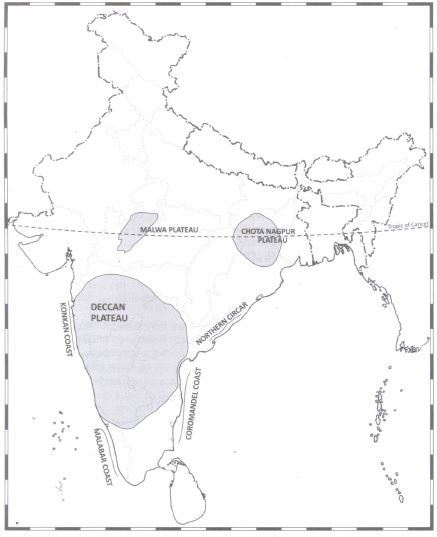
On an outline map of India, locate and label the following:
(I) Plateau: Deccan Plateau, Chota Nagpur Plateau, Malwa Plateau.
(il) Coastal Plains: Konkan, Malabar, Coromandel and Northern Circar
7.
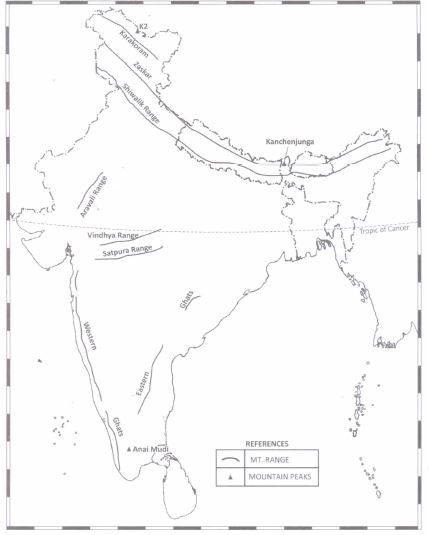
On an outline map ofIndia, show the following:
(i) Mountain ranges: The Karakoram, the Zaskar, the Shiwalik, the Aravali, the Vindhya, the Satpura, Western and Eastern Ghats
(ii) Mountain peaks: K2, Kanchanjunga, Anai Mudi.
8.
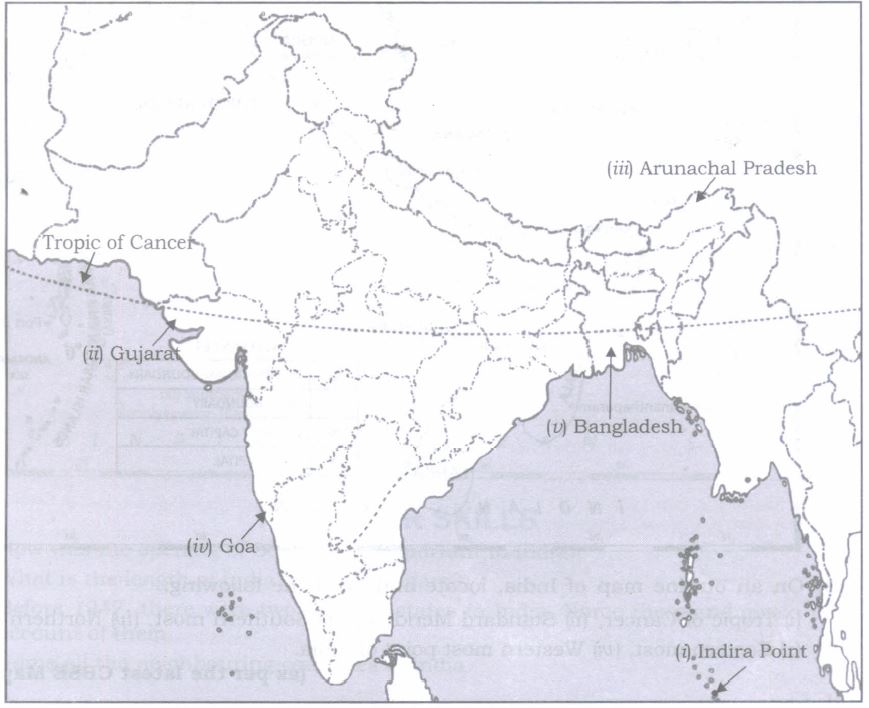
Locate and label the following on the political map of India:
(i) Southernmost point of the Indian Union
(ii) State situated on the extreme west
(iii) State situated on the extreme east
(iv) Smallest state of India
(v) A country lying east of India
9.
10.
11.
12.
13.
1.
In our country, elections are conducted by an independent and very powerful Election Commission (EC). The Chief Election Commissioner (CEC) is appointed by the President of India. But once appointed, the Chief Election Commissioner is not answerable to the President or the government. Even if the ruling party or the government does not like what the Commission does, it is virtually impossible for it to remove the CEC. The Election Commission of India enjoys wideranging powers:
(i) EC takes decisions on every aspect of conduct and control of elections from the announcement of elections to the declaration of results.
(ii) It implements the code of conduct and punishes any candidate or party that violates it.
(iii) During the election period, the EC can order the government to follow some questions, to prevent use and misuse of governmental power, to enhance its chances to win elections, or to transfer some government officials.
(iv) When on election duty, government officers work under the control of the EC and not the government.
2.
The salient features of the Constitution of India are
(i) Though we have borrowed many features from the constitutions of other countries, we have not accepted them as they are.We have modified those provisions to suit our needs. Hence, altogether new provisions have been created and assimilated in the Indian Constitution.
(ii) With the help of Article 368, Parliament can amend the Constitution. Every part of the Constitution can be amended by Parliament except its 'basic structure'. Any law which violates the basic structure of the Constitution is declared unconstitutional and invalid by the court.
(iii) The Constitution provides certain fundamental rights to the citizens which are legally enforceable by a court of law.
(iv) It provides a novel feature called "Directive Principles of State Policy", which are not legally enforceable by a Court of law. These principles promote social and economic democracy and aim to establish India as a welfare state.
(v) It provides for universal adult franchise as a basis of elections to the Lok Sabha and the state legislative assemblies. (Those above the age of 18 can vote.)
3.
1. The Central Government sponsored scheme of National River Conservation Plan (NRCP) is being implemented by the Central Government jointly with the State Governments on a
cost-sharing basis.
2. The pollution abatement work under NRCP presently covers polluted stretches of 39 major rivers and 185 towns spread over 20 states in the country.
3. The activities of Ganga Action Plan (GAP) Phase-I initiated in 1985, were declaired closed on 31st March, 2000.
4. The steering committee of the National River Conservation Authority reviewed the progress of the GAP and necessary correction was made on the basis of lessons learnt and experience gained from GAP Phase-I.
5. These have been applied to the major polluted rivers of the country by the NRCP. The Ganga Action Plan (GAP) Phase-Il has been merged with NRCP. A total of 215 schemes of pollution abatement have been sanctioned. So far, 69 schemes have been completed under this action plan. A million litres of sewage per day is targeted to be intercepted, diverted and treated.
4.
1. India occupies a unique position on the globe. It enjoys a unique proximity with Europe, Africa and Australia. The Indian landmass has a central location between East and West Asia.
2. India is the southward extension of Asia; thus, it forms the South-Central Peninsula of the world's largest continent. The Deccan Peninsula, India's southward extension, extends towards the Indian ocean and divides it into two seas, the Arabian Sea on the West and the Bay of Bengal on its East.
3. The Deccan Peninsula helps India to establish easy contact with West Asia, East Africa and Europe from the Western coast and with South-East Asia, East Asia and Australia from the Eastern coast. India has the longest coastline on the Indian Ocean. These geographical features provide India a significant edge in international trade.
5.
The groups which gained from the revolution were people of the third estate. These included the new middle class including big businessmen, merchants, court officials, and other professionals like lawyers. Formerly they had to pay all the taxes and were humiliated both by the clergy and nobles. After the revolution, they began to be treated equally with the upper sections of society. Certain sections of the third estate were also given political rights.
1. Relinquish Power:
The classes, which formed the privileged sections of society like the nobility, clergy, and aristocracy were forced to relinquish their special privileges. Now the French society was organized on the basis of social equality. The revolution also led to the nationalism of church property.
2. Disappointed:
(a) The less privileged classes in terms of money, land and education i.e., small peasants, landless laborers, sharecroppers, servants, artisans, daily wage earners and
(b) The erstwhile privileged classes i.e., the clergy and the nobility were disappointed because all their privileges were taken away from them.
6.
7.
8.
9.
10.
11.
12.
13.

9th Standard CBSE Syllabus & Materials
9th Standard CBSE
CBSE 9th Mathematics Lines and Angles Sample Question Papers Study Material - QB365 Set A
NEW9th Standard CBSE
CBSE 9th Mathematics Introduction to Euclid's Geometry Sample Question Papers Study Material - QB365 Set A
NEW9th Standard CBSE
CBSE 9th Mathematics Linear Equations in Two Variables Sample Question Papers Study Material - QB365 Set A
NEW9th Standard CBSE
CBSE 9th Mathematics Coordinate Geometry Sample Question Papers Study Material - QB365 Set A

NCERT Books

Syllabus

Exam Pattern

Sample Question Papers

Previous year Question Papers

Important Notes

MCQ Practice test

NCERT Exemplers

Case study Questions

Image Based Questions

Passage based Questions

HOT Questions

Value Based Questions

Model Questions Papers
NCERT ( Book Back ) Questions

Assertion and Reason
Important Questions And Answers

CBSE 9th Standard CBSE Subjects
CBSE Standards