
 100% FREE ACCESS
9th Standard Syllabus & Materials
9th Standard
TN 9th Tamil உள்ளத்தின் சீர் -கற்கண்டு (இலக்கணம்) - தொடர் இலக்கணம், ஆகுபெயர் Important Questions And Answers Study Material - QB365 Set A
NEW9th Standard
TN 9th Tamil உள்ளத்தின் சீர் -விரிவானம் (துணைப்பாடம்) - தாய்மைக்கு வறட்சி இல்லை! Important Questions And Answers Study Material - QB365 Set A
NEW9th Standard
TN 9th Tamil உள்ளத்தின் சீர் -கவிதை பேழை (செய்யுள்) - மார்கழி பெருவிழா Important Questions And Answers Study Material - QB365 Set A
NEW9th Standard
TN 9th Tamil உயிருக்கு வேர்-இலக்கணம் - பகுபத உறுப்பிலக்கணம் Important Questions And Answers Study Material - QB365 Set A
NEW9th Standard
TN 9th Tamil அமுதென்று பேர் - இலக்கணம்-எழுத்து -அளபெடை Important Questions And Answers Study Material - QB365 Set A
NEW9th Standard
TN 9th Tamil அமுதென்று பேர்-துணைப்பாடம் - ஆறாம்திணை Important Questions And Answers Study Material - QB365 Set A

Published on: 13/05/2022
QB365 provides detailed and simple solution for every book back questions in class 9 Maths subject.It will helps to get more idea about question pattern in every book back questions with solution.
latest Book back QuestionsDownload Tamil Nadu 9th Standard Maths question papers, model tests, one-mark questions, important questions, and public exam papers in PDF format. Free study materials and answer keys for TN State Board students.
Questions + Answers key
Take MCQ Maths Test1.
Show that the following points taken in order form an equilateral triangle in each case
\(A\left( \sqrt { 3 } ,2 \right) ,B\left( 0,1 \right) ,C\left( 0,3 \right) \)
2.
The radius of a circle with centre at origin is 30 units. Write the coordinates of the points where the circle intersects the axes. Find the distance between any two such points.
3.
Show that the point (11, 2) is the centre of the circle passing through the points (1, 2), (3, –4) and (5, -6)
4.
Find the perimeter of the triangle whose vertices are (3, 2), (7, 2) and (7, 5).
5.
Let A(2, 3) and B(2, –4) be two points. If P lies on the x-axis, such that AP = \(\frac{3}{7}\) AB, find the coordinates of P.
6.
The point (x, y) is equidistant from the points (3, 4) and (–5, 6). Find a relation between x and y.
7.
The abscissa of a point A is equal to its ordinate, and its distance from the point B(1, 3) is 10 units, What are the coordinates of A?
8.
Calculate the distance between the points A (7, 3) and B which lies on the x-axis whose abscissa is 11.
9.
Show that the points A(–4, –3), B(3, 1), C(3, 6), D(–4, 2) taken in that order form the vertices of a parallelogram.
10.
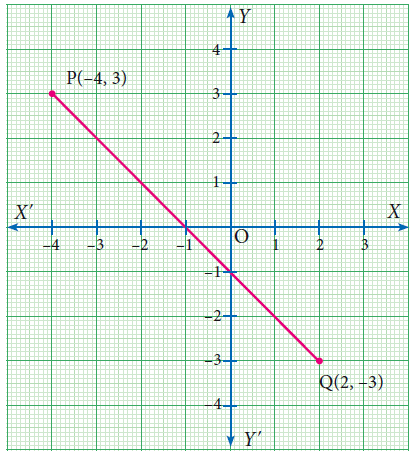
Find the distance between the points (–4, 3), (2, –3).
1.
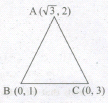
Distance =\(\sqrt{(x_2-x_1)^2+(y_2-y_1)^2}\)
AB =\(\sqrt{(0-\sqrt{3})^2+(1-2)^2}\)
=\(\sqrt{(-\sqrt{3})^2+(-1)^2}=\sqrt{3+1}=\sqrt{4}=2\)
BC =\(\sqrt{(0-0)^2+(3-1)^2}\)
=\(\sqrt{0^2+2^2}\)=\(\sqrt{4}\) = 2
AC =\(\sqrt{(0-\sqrt{3})^2+(3-2)^2}\)
=\(\sqrt{(-\sqrt{3})^2+1^2}=\sqrt{3+1}\)
=\(\sqrt{4}\) = 2
AB = BC = AC (Three sides are equal)
ABC is an equilateral triangle.
2.
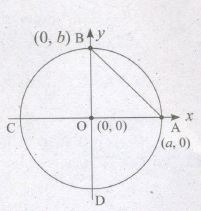
Radius of the circle = 30 units. The point O is (0, 0).
Let a intersect the x - axis and b intersect the y - axis
∴ The point A is (a, 0) and B is (0, b)
Distance = \(\sqrt { ({ x }_{ 2 }-{ x }_{ 1 })^{ 2 }+(y_{ 2 }-y_{ 1 })^{ 2 } } \)
OA =\(\sqrt { (a-0)^{ 2 }+(0-0)^{ 2 } } \)
30 = \(\sqrt { a^{ 2 } } \)
Squaring on both sides
302 = a2
∴ a = 30
The point A is (30, 0)
OB = \(\sqrt { (0-0)^{ 2 }+(b-0)^{ 2 } } \)
= \(\sqrt { 0+{ b }^{ 2 } } \)
30 = \(\sqrt {b^{ 2 } } \)
Squaring on both sides
302 = b2
∴ b = 30
The point B is (0, 30)
Distance AB =\(\sqrt { (30-0)^{ 2 }+(0-30)^{ 2 } } \)
= \(\sqrt { 30^{ 2 }+30^{ 2 } } =\sqrt { 900+900 } \)
= \(\sqrt { 1800 } =\sqrt { 2\times 900 } =30\sqrt { 2 } \)
∴ Distance between the two points = 30\(\sqrt { 2 } \)
3.
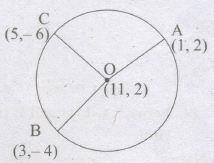
Distance =\(\sqrt { ({ x }_{ 2 }-{ x }_{ 1 })^{ 2 }+(y_{ 2 }-y_{ 1 })^{ 2 } } \)
OA = \(\sqrt { (11-1)^{ 2 }+(2-2)^{ 2 } } \)
= \(\sqrt { { 10 }^{ 2 }+{ 0 }^{ 2 } } \)
= \(\sqrt { 100 } \) = 10
OB =\(\sqrt { (11-3)^{ 2 }+(2+4)^{ 2 } } \)
= \(\sqrt { { 8 }^{ 2 }+6^{ 2 } } =\sqrt { 64+36 } \)
= \(\sqrt { 100 } \) = 10
OC = \(\sqrt { (11-5)^{ 2 }+(2+6)^{ 2 } } \)
= \(\sqrt { { 6 }^{ 2 }+8^{ 2 } } =\sqrt { 36+64 } \)
= \(\sqrt { 100 } \) = 10
OA = OB = OC = 10 units
O is the centre of the circle passing through A, B and C.
4.
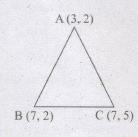
Distance = \(\sqrt { ({ x }_{ 2 }-{ x }_{ 1 })^{ 2 }+(y_{ 2 }-{ y }_{ 1 })^{ 2 } } \)
AB= \(\sqrt { (7-3)^{ 2 }+(2-2)^{ 2 } } \)
= \(\sqrt { { 4 }^{ 2 }+0^{ 2 } } \)
= \(\sqrt { 16 } =4\)
BC = \(\sqrt { (7-7)^{ 2 }+(5-2)^{ 2 } } \)
= \(\sqrt { 0+(3)^{ 2 } } \)
= \(\sqrt { 9 } =3\)
AC = \(\sqrt { (7-3)^{ 2 }+(5-2)^{ 2 } } \)
= \(\sqrt { { 4 }^{ 2 }+{ 3 }^{ 2 } } \)
= \(\sqrt { 16+9 } =\sqrt { 25 } =5\)
Perimeter of ΔABC = AB + BC + AC
= 4 + 3 + 5 =12 units
5.
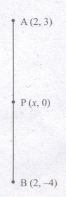
Given points are A(2, 3) and B(2, -4)
The point P lies on the x-axis.
∴ The point P is (x, 0)
AP = \(\frac { 3 }{ 7 } \) AB
\(\frac { AP }{ AB } \) = \(\frac { 3 }{ 7 } \)
\(\frac { AP }{ PB } \) = \(\frac { 3 }{ 7 } \) ........(1)
Distance =\(\sqrt { ({ x }_{ 2 }-{ x }_{ 1 })^{ 2 }+(y_{ 2 }-y_{ 1 })^{ 2 } } \)
AP = \(\sqrt { (x-2)^{ 2 }+(0-3)^{ 2 } } \)
= \(\sqrt { { x }^{ 2 }-4x+4+9 } \)
= \(\sqrt { { x }^{ 2 }-4x+13 } \)
BP =\(\sqrt { (x-2)^{ 2 }+(0+4)^{ 2 } } \)
= \(\sqrt { x^{ 2 }-4x+4+16 } \)
= \(\sqrt { x^{ 2 }-4x+20 } \)
From (1) we get
\(\frac { AP }{ PB } \) = \(\frac { 3 }{4 } \)
\(\frac { \sqrt { { x }^{ 2 }-4x+13 } }{ \sqrt { { x }^{ 2 }-4x+20 } } =\frac { 3 }{ 4 } \) (Squaring on both sides)
\(\frac { { x }^{ 2 }-4x+13 }{ { x }^{ 2 }-4x+20 } =\frac { 9 }{ 16 } \)
16x2- 64x + 208 = 9x2 - 36x + 180
7x2 - 28x + 28 = 0
x2- 4x + 4 = 0
(x-2)2= 0
x-2 =0
x = 2
∴ The point P is (2, 0)
6.
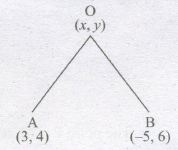
Let the point O be (x, y), A be (3, 4) and B be (-5, 6).
Distance = \(\sqrt { ({ x }_{ 2 }-{ x }_{ 1 })^{ 2 }+(y_{ 2 }-y_{ 1 })^{ 2 } } \)
Given OA = OB
\(\sqrt { (x-3)^{ 2 }+(y-4)^{ 2 } } =\sqrt { (x+5)^{ 2 }+(y-6)^{ 2 } } \)
Squaring on both sides
(x-3)2 + (y-4)2 = (x+5)2+(y-6)2
x2-6x+9+y2-8y+16 = x2+10x+25+y2-12y+36
x2+y2-6x-8y+25 = x2+y2+10x-12y+61
-6x-10x-8y+12y = 61-25
⇒ -4x + y = 9
The relation between x and y is y = 4x + 9
7.
Let the point A be (a, a), B is (1, 3)
Distance AB = 10 (Given)
By distance formula \(\sqrt { (a-1)^{ 2 }+(a-3)^{ 2 } } =10\)
Simplifying
2a2- 8a + 10 = 100
a2- 4a - 45 = 0
(a - 9)(a + 5) = 0
⇒ a = -5 ; A = (-5,-5)
a = 9 ; A = (9,9)
8.
Since B is on the x-axis, the y-coordinate of B is 0.
So, the coordinates of the point B is (11, 0)
By the distance formula the distance between the points A (7, 3), B (11, 0) is
\(d=\sqrt { \left( { x }_{ 2 }-{ x }_{ 1 } \right) ^{ 2 }+\left( y_{ 2 }-y_{ 1 } \right) ^{ 2 } } \)
\(AB=\sqrt { \left( 11-7 \right) ^{ 2 }+\left( 0-3 \right) ^{ 2 } } \)
\(=\sqrt { \left( 4 \right) ^{ 2 }+\left( -3 \right) ^{ 2 } } =\ \sqrt { 16+9 } =\sqrt { 25 } =5\)
9.
Let A(–4, –3), B(3, 1), C(3, 6), D(–4, 2) be the four vertices of any quadrilateral ABCD. Using the distance formula.
Let \(d=\sqrt { \left( { x }_{ 2 }-{ x }_{ 1 } \right) ^{ 2 }+\left( y_{ 2 }-y_{ 1 } \right) ^{ 2 } } \)
\(AB=\sqrt { \left( 3+4 \right) ^{ 2 }+\left( 1+3 \right) ^{ 2 } } =\sqrt { 49+16 } =\sqrt { 65 } \)
\(BC=\sqrt { \left( 3-3 \right) ^{ 2 }+\left( 6-1 \right) ^{ 2 } } =\sqrt { 0+25 } =\sqrt { 25 } =5\)
\(CD=\sqrt { \left( -4-3 \right) ^{ 2 }+\left( 2-6 \right) ^{ 2 } } =\sqrt { 49+16 } =\sqrt { 65 } \)
\(AD=\sqrt { \left( -4+4 \right) ^{ 2 }+\left( 2+3 \right) ^{ 2 } } =\sqrt { \left( { 0 }^{ 2 } \right) +\left( { 5 }^{ 2 } \right) } =\sqrt { 25 } =5\)
\(AB=CD=\sqrt { 65 } \) and BC = AD = 5
Here, the opposite sides are equal. Hence ABCD is a parallelogram.
10.
The distance between the points (-4, 3), (2, -3) is
\(d=\sqrt { \left( { x }_{ 2 }-{ x }_{ 1 } \right) ^{ 2 }+\left( y_{ 2 }-y_{ 1 } \right) ^{ 2 } } \)
\(=\sqrt { \left( 2+4 \right) ^{ 2 }+\left( -3-3 \right) ^{ 2 } } \)
\(=\sqrt { \left( { 6 }^{ 2 }+\left( -6 \right) ^{ 2 } \right) } =\sqrt { \left( 36+36 \right) } \)
\(=\sqrt { 36\times 2 } \)
\(=6\sqrt { 2 } \)

9th Standard Syllabus & Materials
9th Standard
TN 9th Tamil உள்ளத்தின் சீர் - திருக்குறள் Important Questions And Answers Study Material - QB365 Set A
NEW9th Standard
TN 9th Tamil உள்ளத்தின் சீர் - மணிமேகலை Important Questions And Answers Study Material - QB365 Set A
NEW9th Standard
TN 9th Tamil உள்ளத்தின் சீர் - ஏறு தழுவுதல் Important Questions And Answers Study Material - QB365 Set A
NEW9th Standard
TN 9th Tamil உயிருக்கு வேர் - தண்ணீர் Important Questions And Answers Study Material - QB365 Set A



Tamilnadu Stateboard 9th Standard Subjects
Tamilnadu Stateboard Standards