10th Standard CBSE Syllabus & Materials
10th Standard CBSE
CBSE 10th Social Science ECO - Globalisation and the Indian Economy - New Model Questions Papers Study Material - QB365 Set A
NEW10th Standard CBSE
CBSE 10th Social Science ECO - Money and Credit - New Model Questions Papers Study Material - QB365 Set A
NEW10th Standard CBSE
CBSE 10th Social Science ECO - Sectors of the Indian Economy - New Model Questions Papers Study Material - QB365 Set A
NEW10th Standard CBSE
CBSE 10th Social Science ECO - Development - New Model Questions Papers Study Material - QB365 Set A
NEW10th Standard CBSE
CBSE 10th Social Science PS - Outcomes of Democracy - New Model Questions Papers Study Material - QB365 Set A
NEW10th Standard CBSE
CBSE 10th Social Science PS - Gender, Religion and Caste - New Model Questions Papers Study Material - QB365 Set A

Published on: 11/08/2026
Download CBSE Class 10th Standard CBSE Maths question papers, sample papers, important questions, and previous year solved papers in PDF format. Get free study materials, NCERT solutions, and exam preparation resources for Class 10th Standard CBSE Maths
Questions + Answers key
Take MCQ Maths Test
1.
Find the zeroes of the following quadratic polynomials and verify the relationship between the zeroe and the coefficients.
6x2 – 3 – 7x
2.
Find the zeroes of the following quadratic polynomials and verify the relationship between the zeroe and the coefficients.
4s2 – 4s + 1
3.
Find the zeroes of the following quadratic polynomials and verify the relationship between the zeroes and the coefficients.
x2 – 2x – 8
4.
Find the zeroes of quadratic polynomial 5x2-4-8x and verify the relationship between the zeroes and the coefficients of the polynomial.
5.
Find a quadratic polynomial each with the given numbers as the sum and product of its zeroes respectively.
\(\sqrt{2}, \frac{1}{3}\)
6.
Find a quadratic polynomial each with the given numbers as the sum and product of its zeroes respectively.
\(\frac{1}{4},-1\)
7.
Find the zeroes of the quadratic polynomial x2 + 7x + 10, and verify the relationship between the zeroes and the coefficients.
8.
If p,q are zeroes of polynomial f(x) = 2x2 - 7x + 3, find the value of p2 + q2.
9.
A quadratic polynomial having zeroes \(-\sqrt{\frac{5}{2}} \text { and } \sqrt{\frac{5}{2}} \text { is }\)
\(x^2-5 \sqrt{2} x+1\)
8x2 - 20
15x2 - 6
\(x^2-2 \sqrt{5} x-1\)
10.
A quadratic polynomial whose zeroes are \(\frac{2}{5} \text { and } \frac{-1}{5}\) is
25x2 + 5x - 2
5x2 - 2x + 1
5x2 + 2x - 1
25x2 - 5x - 2
11.
If α and β are the zeroes of the polynomial x2 - 1, then the value of α + β is
2
1
-1
0
12.
If the zeroes of the quadratic polynomial x2 + (a + 1)x + b are 2 and -3, then
a = -7, b = -1
a = 5, b = -1
a = 2, b = -6
a = 0, b = -6
13.
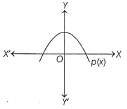
In the given graph, the polynomial p(x)is shown. Number of zeroes of p (x) is
3
2
1
4
14.
Zeroes of a quadratic polynomial x2 - 5x + 6 are
-5, 1
5, 1
2, 3
-2, –3
15.
The zeroes of the quadratic polynomial 16x2 - 9 are
\(\frac{3}{4}, \frac{3}{4}\)
\(-\frac{3}{4}, \frac{3}{4}\)
\(\frac{9}{16}, \frac{9}{16}\)
\(-\frac{3}{4},-\frac{3}{4}\)
16.
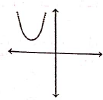
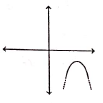
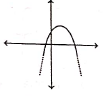
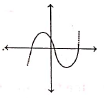
Which of the following is not the graph of a quadratic polynomial?
17.
If one zero of 2x2 – 3x + k is reciprocal to the other, then the value of k is :
-3
2
-3/2
-2/3
18.
The value of quadratic polynomial f (x)=2x2– 3x- 2 at x =-2 is
15
16
-12
12
19.
Find the zeroes of the quadratic polynomial x2 - 15 and verify the relationship between the zeroes and the coefficients of the polynomial.
20.
Find the zeroes of the following quadratic polynomials and verify the relationship between the zeroes and the coefficients
3x2 – x – 4
21.
Find the zeroes of the following quadratic polynomials and verify the relationship between the zeroe and the coefficients.
t2 – 15
22.
Find the zeroes of the following quadratic polynomials and verify the relationship between the zeroes and the coefficients.
4u2 + 8u
23.
While playing in garden, Sahiba saw a honeycomb and asked her mother what is that. She replied that it's a honeycomb made by honey bees to store honey. Also, she told her that the shape of the honeycomb formed is parabolic. The mathematical representation of the honeycomb structure is shown in the graph.
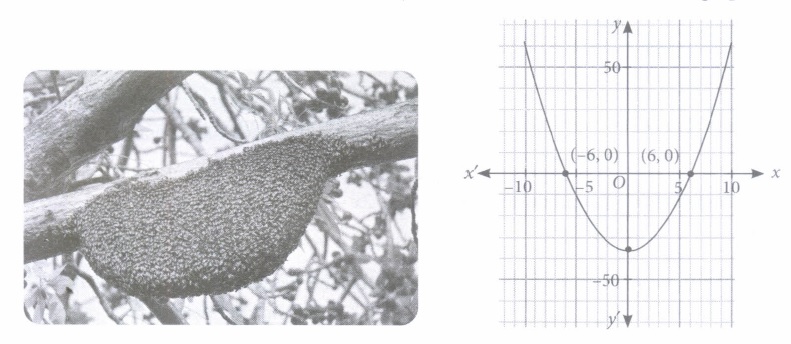
Based on the above information, answer the following questions.
(i) Graph of a quadratic polynomial is in___________shape.
| (a) straight line | (b) parabolic |
| (c) circular | (d) None of these |
(ii) The expression of the polynomial represented by the graph is
| (a) x2-49 | (b) x2-64 | (c) x2-36 | (d) x2-81 |
(iii) Find the value of the polynomial represented by the graph when x = 6.
| (a) -2 | (b) -1 | (c) 0 | (d) 1 |
(iv) The sum of zeroes of the polynomial x2 + 2x - 3 is
| (a) -1 | (b) -2 | (c) 2 | (d) 1 |
(v) If the sum of zeroes of polynomial at2 + 5t + 3a is equal to their product, then find the value of a.
| (a) -5 | (b) -3 | \(\text { (c) } \frac{5}{3}\) | \(\text { (d) } \frac{-5}{3}\) |
1.
6x2 - 3 - 7x = 6x2 - 7x - 3
=6x2 -9x + 2x -3
=3x(2x - 3) + 1(2x - 3)
=(2x - 3)(3x + 1)
\(=2\left(x-\frac{3}{2}\right) 3\left(x+\frac{1}{2}\right)\)
\(=6\left(x-\frac{3}{2}\right)\left(x+\frac{1}{3}\right)\)
The zeroes of the polynomial are {3/2, -1/3}
Relationship between the zeroes and the coeffieicients of the polynomial
Also sum of the zeroes = \(\frac{3}{2}-\frac{1}{3}=\frac{9-2}{6}=\frac{7}{6}\)
Also product of the zeroes = \(\frac{3}{2} \times-\frac{1}{3}=-\frac{1}{2}\)
Hence Verified.
2.
4s2 – 4s + 1 = 4s2 – 2s - 2s + 1
=2s(2s - 1) - 1(2s - 1)
=(2s - 1)(2s -1)
\(=2\left(s-\frac{1}{2}\right) 2\left(s-\frac{1}{2}\right)\)
Therefore the zeroes of the polynomial are 1/2, 1/2
Relationship between the zeroes and the coefficient of the polynomial:
Also sum of the zeroes = \(\frac{1}{2}+\frac{1}{2}=1\)
Also product of the zeroes = \(\frac{1}{2} \times \frac{1}{2}=\frac{1}{4}\)
hence verfied.
3.
Let p(x) = x2 - 2x - 8
= x2 - 4x + 2x - 8 [by splitting the middle term]
= x(x - 4) + 2(x - 4) = (x + 2) (x - 4)
To find zeroes, put p(x) = 0
\(\Rightarrow\) x - 4 = 0 or x + 2 = 0 \(\Rightarrow\) x = 4 or x = -2
Hence, zeroes of the given polynomial are -2 and 4.
Verification
Here, sum of the zeroes = -2 + 4 = 2 = -(-2/1)
\(=-\frac{Coefficient \quad of \quad x}{Coefficient \quad of \quad x^{2}}\)
and product of the zeroes = -2 \(\times\) 4 = -8 = -8/1
\(=\frac{Constant \quad term}{Coefficient \quad of \quad x^{2}}\)
So, the relationship between the zeroes and its coefficients is verified.
4.
\(2,-\frac { 2 }{ 5 } \)
5.
Let the polynomial be ax2 + bx + c, and its zeroes be α and ß
Given \(\alpha+\beta=\sqrt{2}=\frac{-b}{a}\)
\(\alpha \beta=\frac{1}{3}=\frac{c}{a}\)
If a = 3, then \(b=\sqrt{2}\) and c = 1/3
Therefore, the quadratic polynomial is \(3 x^{2}-3 \sqrt{2} x+1\).
6.
Given, sum of zeroes = 1/4 and product of zeroes = -1
Then, the quadratic polynomial
=x2 - (sum of zeroes)x + product of zeroes
\(=x^{2}-\left ( \frac{1}{4} \right )x-1=x^{2}-\frac{x}{4}-1=\frac{4x^{2}-x-4}{4}\)
We can consider 4x2 - x - 4 as required quadratic polynomial because it will also staisfy the given conditions.
7.
We have
x2 + 7x + 10 = (x + 2)(x + 5)
So, the value of x2 + 7x + 10 is zero when x + 2 = 0 or x + 5 = 0, i.e., when x = – 2 or x = –5. Therefore, the zeroes of x2 + 7x + 10 are – 2 and – 5. Now,
sum of zeroes = \(-2+(-5)=-(7)=\frac{-(7)}{1}=\frac{-(\text { Coefficient of } x)}{\text { Coefficient of } x^{2}}\)
product of zeroes = \((-2) \times(-5)=10=\frac{10}{1}=\frac{\text { Constant term }}{\text { Coefficient of } x^{2}}\)
8.
f(x) = 2x2 - 7x + 3
Sum of roots = p + q \(=-\frac { Coefficient\quad of\quad x }{ Coefficient\quad of\quad { x }^{ 2 } } \)
\(=-\left( \frac { -7 }{ 2 } \right) =\frac { 7 }{ 2 } \)
Product of roots = pq \(=-\frac { Constant\quad term }{ Coefficient\quad of\quad { x }^{ 2 } } =\frac{3}{2}\)
We know that
(p + q)2 = p2 + q2 + 2pq
\(\Rightarrow\) p2 + q2 = (p + q)2 - 2pq
\(=\left( \frac { 7 }{ 2 } \right) ^{ 2 }-3=\frac { 49 }{ 4 } -\frac { 3 }{ 1 } =\frac { 37 }{ 4 } \)
9.
Given zeroes of polynomial are \(-\sqrt{\frac{5}{2}} \text { and } \sqrt{\frac{5}{2}}\)
∴ Sum of zeroes = \(-\sqrt{\frac{5}{2}}+\sqrt{\frac{5}{2}}=0\) and product of zeroes = \(-\sqrt{\frac{5}{2}} \cdot \sqrt{\frac{5}{2}}=-\frac{5}{2}\)
A quadratic polynomial with two zeroes is given by k(x2 - (α + β)x + αβ).
\(\therefore k\left(x^2-(0) x+\left(\frac{-5}{2}\right)\right)=k\left(x^2-\frac{5}{2}\right)\)
For k = 8, the quadratic polynomial is \(8\left(x^2-\frac{5}{2}\right)=8 x^2-20\)
10.
Given zeroes of polynomial are \(\frac{2}{5} \text { and } \frac{-1}{5}\)
Let \(\alpha=\frac{2}{5} \text { and } \beta=-\frac{1}{5}\)
∴ Sum of zeroes = \(\alpha+\beta=\frac{2}{5}-\frac{1}{5}=\frac{1}{5}\)
Product of zeroes = \(\alpha \beta=\frac{2}{5} \times\left(-\frac{1}{5}\right)=-\frac{2}{25}\)
∴ Required quadratic polynomial
= x2 - (α + β)x + αβ
\(=x^2-\frac{1}{5} x+\left(-\frac{2}{25}\right)=\frac{25 x^2-5 x-2}{25}\)
We can consider 25x2 - 5x - 2 as required quadratic polynomial because it will also satisfy the given condition.
11.
Let p(x) = x2 - 1
Put p(x) = 0 ⇒ x2 - 1 = 0
⇒ x2 = 1 ⇒ \(x= \pm 1\)
So, the zeroes are 1 and - 1.
Let α = 1 and β = -1
⇒ (α + β) = 1 + (-1) = 0
12.
Let α = 2 and β = -3
Then, the quadratic polynomial will be
x2 - (α + β)x + αβ = x2 - (2 - 3)x + 2(-3)
= x2 - (-1)x - 6 = x2 + x - 6
On comparing this polynomial with x2 + (a + 1)x + b, we get
a + 1 = 1 and b = -6
⇒ a = 0 and b = -6
13.
In the given figure, the graph of a polynomial p(x) cuts X-axis at two distinct points. Hence, there are only two zeroes of the polynomial p(x).
14.
Let f(x) = x2 - 5x + 6
By splitting the middle term, we get
f(x) = x2 - 3x - 2x + 6 = x(x - 3) - 2(x - 3)
⇒ f(x) = (x - 3)(x - 2)
On putting f(x) = 0, we get
x - 3 = 0 or x - 2 = 0
⇒ x = 3 or x = 2
15.
Let p(x) = 16x2 - 9
To find zeroes of p(x), put p(x) = 0
∴ 16x2 - 9 = 0 ⇒ 16x2 = 9
⇒ \(x^2=\frac{9}{16} \Rightarrow x= \pm \frac{3}{4}\)
So, the zeroes are \(\frac{3}{4} \text { and } \frac{-3}{4}\).
16.
We know that for any quadratic polynomial ax2 + bx + c, a ≠ 0, the graph of the corresponding equation y = ax + bx + c has one of the two shapes either open upwards like \(\cup\) or open downwards like \(\cap\) depending on whether a > 0 or a < 0. So, option (d) cannot be possible. Also, the curve of a quadratic polynomial crosses the X axis atmost at two points, but in option (d) the curve crosses the X-axis at three points, so it does not represent the quadratic polynomial.
17.
(b)
2
18.
(d)
12
19.
Let f(x) = x2 - 15
\(\Rightarrow f(x)=(x-\sqrt{15})(x+\sqrt{15}) \quad\left[\because a^2-b^2=(a-b)(a+b)\right]\)
On putting f(x) = 0, we get
\(\begin{aligned}
& (x-\sqrt{15})(x+\sqrt{15})=0 \\
\end{aligned}\)
\(\begin{aligned}
& \Rightarrow x-\sqrt{15}=0 \text { or } x+\sqrt{15}=0 \\
\end{aligned}\)
\(\begin{aligned}
& \Rightarrow \quad x=\sqrt{15} \text { or } x=-\sqrt{15}
\end{aligned}\)
Thus, the zeros of given polynomial are \(\alpha=\sqrt{15}\) and \(\beta=-\sqrt{15}\)
Verification
Here, the sum of zeroes, \(\alpha+\beta=\sqrt{15}-\sqrt{15}=0\)
\(=-\frac{0}{1}=-\frac{\text { Coefficient of } x}{\text { Coefficient of } x^2}\)
and product of zeroes,
\(\begin{aligned}
\alpha \beta=\sqrt{15} \times(-\sqrt{15}) & =-15=\frac{-15}{1}
\end{aligned}\)
\(\begin{aligned}
& =\frac{\text { Constant term }}{\text { Coefficient of } x^2}
\end{aligned}\)
So, the relationship between the zeroes and the coefficients is verified.
20.
3x2 – x – 4 = 3x2 – 4x + 3x – 4
= x(3x - 4) +1(3x - 4)
=(3x - 4)(x +1)
The zeroes of the polynomial are {4/3, -1}
Relationship between the zeroes and the coefficient of the polynomial:
Also sum of the zeroes = \(\frac{4}{3}-1=\frac{4-3}{3}=\frac{1}{3}\)
Also product of the zeroes = \(\frac{4}{3} x-1=-\frac{4}{3}\)
Hence verified.
21.
Let p(t) = t2 - 15 = t2 - \(\left ( \sqrt{15} \right )^{2}\)
= (t - \(\sqrt{15}\))(t + \(\sqrt{15}\)) [\(\because\) a2 - b2 = (a - b) (a + b)]
To find zeroes, put p(t) = 0
\(\Rightarrow (t-\sqrt{15})(t+\sqrt{15})=0\)
\(\Rightarrow t-\sqrt{15}=0\) or t + \(\sqrt{15}\) = 0 \(\Rightarrow\) t = \(\sqrt{15}\) or t = -\(\sqrt{15}\)
Hence, zeroes of the given polynomial are -\(\sqrt{15}\) and \(\sqrt{15}\).
Verification
Hence, sum of zeroes = -\(\sqrt{15}\) + \(\sqrt{15}\) = 0 = -(0/1)
\(=-\frac{Coefficient \quad of \quad t}{Coefficient \quad of \quad t^{2}}\)
and product of zeroes = -\(\sqrt{15}\) \(\times\)\(\sqrt{15}\)= -15 = \(\frac{-15}{1}\)
\(=\frac{Constant \quad term}{Coefficient \quad of \quad t^{2}}\)
So, the relationship between the zeroes and its coefficients is verified.
22.
Let p(u) = 4u2 + 8u = 4u(u+2)
To find zeroes, put p(u) = 0
\(\Rightarrow\) 4u(u+2) = 0 \(\Rightarrow\) u = 0 or u + 2 = 0 [\(\because\) 4 \(\neq\)0]
\(\Rightarrow\) u = 0 or u = -2
Hence, zeroes of the given polynonial are 0 and -2.
Verification
Here, sum of zeroes = 0 - 2 = -2 = -(8/4)
=-\(\frac{Coefficient \quad of \quad u}{Coefficient \quad of \quad u^{2}}\)
and product of zeroes
=0 \(\times\)-2 = 0 = (0/4) = \(\frac{Constant \quad term}{Coefficient \quad of \quad u^{2}}\)
so, the relationship between the zeroes and its coefficients is verified.
23.
(i) (b): Graph of a quadratic polynomial is a parabolic in shape.
(ii) (c): Since the graph of the polynomial cuts the
x-axis at (-6,0) and (6, 0). So, the zeroes of polynomial are -6 and 6.
\(\therefore\) Required polynomial is p(x) = x2 - (-6 + 6)x + (-6)(6) = x2 - 36
(iii) (c) : We have, p(x) = x2 - 36
Now, p( 6) = 62 - 36 = 36 - 36 = 0
(iv) (b): Letf (x) = x2 + 2x - 3. Then,
\(\text { Sum of zeroes }=-\frac{\text { coefficient of } x}{\text { coefficient of } x^{2}}=-\frac{(2)}{1}=-2\)
(v) (d): The given polynomial is at2+ 5t + 3a Given, sum of zeroes = product of zeroes.
\(\Rightarrow \quad \frac{-5}{a}=\frac{3 a}{a} \Rightarrow a=\frac{-5}{3}\)

10th Standard CBSE Syllabus & Materials
10th Standard CBSE
CBSE 10th Social Science PS - Federalism - New Model Questions Papers Study Material - QB365 Set A
NEW10th Standard CBSE
CBSE 10th Social Science PS - Power Sharing - New Model Questions Papers Study Material - QB365 Set A
NEW10th Standard CBSE
CBSE 10th Social Science GEO - Manufacturing Industries - New Model Questions Papers Study Material - QB365 Set A
NEW10th Standard CBSE
CBSE 10th Social Science GEO - Minerals and Energy Resources - New Model Questions Papers Study Material - QB365 Set A



NCERT Books

Syllabus

Exam Pattern

Sample Question Papers

Previous year Question Papers

Important Notes

MCQ Practice test

NCERT Exemplers

Case study Questions

Image Based Questions

Passage based Questions

HOT Questions

Value Based Questions

Model Questions Papers
NCERT ( Book Back ) Questions

Assertion and Reason
Important Questions And Answers

CBSE 10th Standard CBSE Subjects
CBSE Standards