
 100% FREE ACCESS
10th Standard CBSE Syllabus & Materials
10th Standard CBSE
CBSE 10th Social Science ECO - Globalisation and the Indian Economy - New Model Questions Papers Study Material - QB365 Set A
NEW10th Standard CBSE
CBSE 10th Social Science ECO - Money and Credit - New Model Questions Papers Study Material - QB365 Set A
NEW10th Standard CBSE
CBSE 10th Social Science ECO - Sectors of the Indian Economy - New Model Questions Papers Study Material - QB365 Set A
NEW10th Standard CBSE
CBSE 10th Social Science ECO - Development - New Model Questions Papers Study Material - QB365 Set A
NEW10th Standard CBSE
CBSE 10th Social Science PS - Outcomes of Democracy - New Model Questions Papers Study Material - QB365 Set A
NEW10th Standard CBSE
CBSE 10th Social Science PS - Gender, Religion and Caste - New Model Questions Papers Study Material - QB365 Set A

Published on: 17/08/2026
Download CBSE Class 10th Standard CBSE Maths question papers, sample papers, important questions, and previous year solved papers in PDF format. Get free study materials, NCERT solutions, and exam preparation resources for Class 10th Standard CBSE Maths
Questions + Answers key
Take MCQ Maths Test
1.
If \(\sqrt { 2 } \sin { \theta } =1\), find the value of \(\sec ^{ 2 }{ \theta } -cosec^{ 2 }\theta \)
2.
Prove \((\tan { \theta } +2)(2\tan { \theta } +1)=5\tan { \theta } +2\sec ^{ 2 }{ \theta } .\)
3.
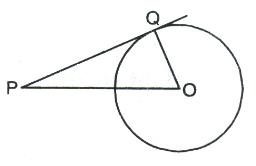
PQ is tangent to circle with centre O. Find the radius of the circle, if PO = 5 cm and PQ = 4 cm.
4.
If a pole 6 m high throws shadow of \(2\sqrt { 3 } \) m, then find the angle of elevation of the sun.
5.
The angle of elevation of the top of a tower from a point 20 meters away from the base is 45o . Find the height of the tower.
6.
Prove that the tangents drawn at the ends of a diameter of a circle are parallel.
7.
If \(\tan { \theta } +\sin { \theta } =m\) and \(\tan { \theta } -\sin { \theta } =n\) ,then show that (m2-n2)2 = 16 mn or (m2-n2) = \(4 \sqrt { mn } \).
8.
Prove that \(\frac { \sin { A } +\cos { A } }{ \sin { A } -\cos { A } } +\frac { \sin { A } -\cos { A } }{ \sin { A } +\cos { A } } =\frac { 2 }{ \sin ^{ 2 }{ A } -\cos ^{ 2 }{ A } } .\)
9.
If sec 5 A = cosec (A + 300), find A. where 5 A is an acute angle, then find the value of A.
10.
An observer 1.75m tall is at a distance of 24 m from a wall 25.75 m high. Find the angle of elevation of the top of the wall at the observer's eye
11.
Prove that in two concentric circles, the chord of the larger circle, which touches the smaller circle, is bisected at the point of contact.
12.
The lengths of tangents drawn from an external point to a circle are equal.
13.
The angle of elevation of the top of a tower from a point A on the ground is 30o. On moving a distance of 20 meters towards the foot of the tower to a point B, the angle of elevation increases to 60o . Find the height of the tower and distance of the tower from the point A. \((\sqrt { 3 } =1.732)\)
14.
Two ships are sailing in the sea on the either side of the lighthouse. The angles of depression of two ships as observed from the top of the lighthouse are 60° and 45°, respectively. If the distance between the ships is 100 \(\left(\frac{\sqrt{3}+1}{\sqrt{3}}\right) \mathrm{m}\)
(i) Find the height of the lighthouse.
(ii) Determine the distance between two ships.
15.
Prove that \(\frac { \sin { A } }{ 1+\cos { A } } +\frac { \sin { A } }{ 1-\cos { A } } =\sqrt { \frac { 1+\cos { A } }{ 1-\cos { A } } } +\sqrt { \frac { 1-\cos { A } }{ 1+\cos { A } } } \) = 2 cosec A
16.
Show that \(\frac { \sin { \theta } }{ 1+\cos { \theta } } +\frac { 1+\cos { \theta } }{ \sin { \theta } } =2cosec\theta \)
17.
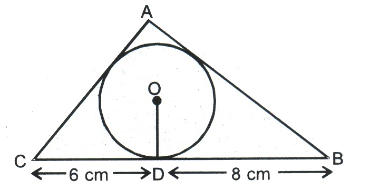
A triangle ABC is drawn to circumscribe a circle of radius 4 cm such that the segments BD and DC into which BC is divided by the point of contact D are of lengths 8 cm and 6 cm respectively (see Fig). Find the sides AB and AC.
18.
A round balloon of radius 'a' subtends an angle \(\theta\) at the eye of the observer while the angle of elevation of its centre is \(\phi \). Prove that the height of the centre of the balloon is a sin \(\phi \) cosec(\(\theta/2\)).
19.
If the height of the tower is equal to the length of its shadow, then the angle of elevation of the Sun is
30°
45°
60°
90°
20.
A line which intersects a circle in two distinct points, is called a
chord
tangent
secant
diameter
21.
If the height of the tower is equal to the length of its shadow, then the angle of elevation of the Sun is
30°
45°
60°
90°
22.
If cot θ = 1/√3, the value of sec2 θ + cosec² θ is
1
40/9
38/9
\(5\frac{1}{3}\)
23.
If tan θ = 5/12, then the value of \(\frac{\sin \theta+\cos \theta}{\sin \theta-\cos \theta} \) is
-17/7
17/7
17/13
-7/13
24.
From an external point P, tangents PA and PB are drawn to a circle with centre O. If CD is the tangent to the circle at a point E and PA = 14 cm, then perimeter of ∆PCD is
14 cm
21 cm
28 cm
35 cm
25.
From the top of a 7 m high building the angle of elevation of the top of a cable tower is 60° and the angle of depression of its foot is 45°, then the height of the tower is
14.124 m
17.124 m
19.124 m
15.124 m
26.
If sin\(\theta\) + sin2\(\theta\) + sin3\(\theta\) = 1,then cos 6\(\theta\) - 4 cos4\(\theta\) + 8 cos2\(\theta\) is equal to
1
2
3
4
27.
If cos A \(=\frac{4}{5}\) then the value of tan A is
3 / 5
3 / 4
4 / 3
5 / 3
28.
Using the formula cos 2θ =1-2 sin2 θthe value of sin15° is
\(\frac { \sqrt { 2-\sqrt { 3 } } }{ 2 } \)
0
1
3
29.
If angles C,B and A of a right angled triangle ABC, right angled at A, form an increasing A.P.. then, sinA x cosB =
3/4
1/2
3/5
5/4
30.
If the angle of the top of the 200 m high tower from a point C on the ground is 30°. The distance of the point C from the foot of the tower is (Take √3 = 1.732)
346.4 m
173.6 m
300.4 m
246.6 m
31.
Consider a ladder which makes an angle of 60° with a wall of height 10 m and its top just touches the top of the wall. If the ladder is now rotated in such a way that its top now touches the top of the opposite wall which has a height of 10/√3 m. What is the angle by which the ladder is rotated.
45°
60°
90°
30°
32.
A tree is broken by the wind. The top struck the ground at an angle of 30° and at a distance of 30 metres from the foot of the tree. The height of the tree in metres is
35√3
40√3
25√3
30√3
33.
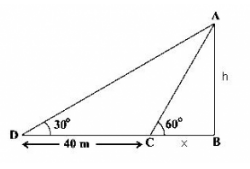
Find AB in the given figure
√3
30√3
20√3
10√3
34.
A circle can pass through
3 non- collinear points
3 collinear points
4 collinear points
2 collinear points
35.
Number of tangents, that can be drawn to a circle, parallel to a given chord is
3
zero
Infinite
2
36.
If radii of two concentric circles are 4 cm and 5 cm, then length of each chord of one circle which is tangent to the other circle, is
3 cm
6 cm
9 cm
1 cm
37.
Assertion : In the given figure, AP and AO are tangents to a circle such that AP = 11cm and \(\angle P A Q=60^{\circ}\), then length of PQ is 8 cm.
Reason : The centre of the circle lies on the bisector of the angle between the two tangents.
Codes :
(a) If both Assertion and Reason are correct and Reason is the correct explanation of Assertion.
(b) If both Assertion and Reason are correct, but Reason is not the correct explanation of Assertion.
(c) If Assertion is correct but Reason is incorrect.
(d) If Assertion is incorrect but Reason is correct.
38.
Assertion The equation \(\sec ^{2} \theta=\frac{4 x y}{(x+y)^{2}} \text { is }\) only possible, when x = y.
Reason \(\sec ^{2} \theta \geq 1\) and therefore \((x-y)^{2} \leq 0\)
Codes:
(a) If both Assertion and Reason are correct and Reason is the correct explanation of Assertion.
(b) If both Assertion and Reason are correct, but Reason is not the correct explanation of Assertion.
(c) If Assertion is correct but Reason is Incorrect.
(d) If Assertion is incorrect but Reason is correct.
39.
In an international school in Hyderabad organised an Interschool Throwball Tournament for girls just after the pre-board exam. The throw ball team was very excited. The team captain Anjali directed the team to assemble in the ground for practices. Only three girls Priyanshi, Swetha and Aditi showed up. The rest did not come on the pretext of preparing for pre-board exam. Anjali drew a circle of radius 5 m on the ground. The centre A was the position of Priyanshi. Anjali marked a point N, 13 m away from centre A as her own position. From the point N, she drew two tangential lines NS and NR and gave positions S and R to Swetha and Aditi. Anjali throws the ball to Priyanshi, Priyanshi throws it to Swetha, Swetha throws it to Anjali, Anjali throws it to Aditi, Aditi throws it to Priyanshi, Priyanshi throws it to Swetha and so on.
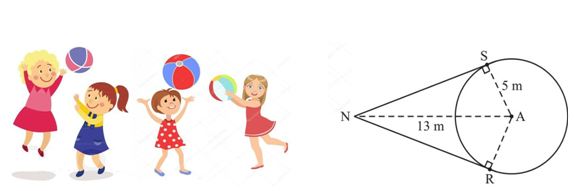
(a) What is the measure of \(\angle \mathrm{NSA} ?\)
| (i) 30o | (ii) 45o | (iii) 60o | (iv) 90o |
(b) Find the distance between Swetha and Anjali
| (i) 8m | (ii) ) 12 m | (iii) 15m | (iv) 18m |
(c) How far does Anjali have to throw the ball towards Aditi
| (i) 18m | (ii) 15m | (iii) 12m | (iv) 8m |
(d) If \(\angle \mathrm{SNR}\) is equal to θ, then which of the following is true?
| (i) \(\angle \mathrm{ANS}=90^{\circ}-\theta\) | (ii) \(\angle \mathrm{SAN}=90^{\circ}-\theta\) | (iii) \(\angle \operatorname{RAN}=\theta\) | (iv) \(\angle \operatorname{RAS}=180^{\circ}-\theta\) |
(e) If \(\angle \mathrm{SNR}\) SNR is equal to \(\theta\) ,then \(\angle \mathrm{NAS}\) is equal
| (i) \(90^{\circ}-(\theta / 2)\) | (ii) \(1180^{\circ}-2 \theta\) | (iii) \(90^{\circ}-\theta\) | (iv) \(90^{\circ}+\theta\) |
40.
A boy is standing on the top of light house. He observed that boat P and boat Q are approaching to light house from opposite directions. He finds that angle of depression of boat P is 45° and angle of depression of boat Q is 30°. He also knows that height of the light house is 100 m.
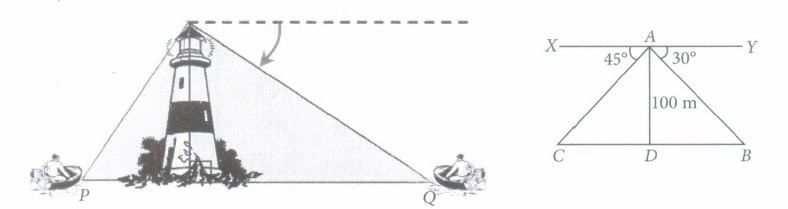
Based on the above information, answer the following questions.
(i) Measure of \(\angle\)ACD is equal to
| (a) 30° | (b) 45° | (c) 60° | (d) 90° |
(ii) If \(\angle\)YAB = 30°, then \(\angle\)ABD is also 30°, Why?
| (a) vertically opposite angles | (b) alternate interior angles |
| (c) alternate exterior angles | (d) corresponding angles |
(iii) Length of CD is equal to
| (a) 90 m | (b) 60 m | (c) 100 m | (d) 80 m |
(iv) Length of BD is equal to
| (a) 50 m | (b) 100 m | (c) 100\(\sqrt{2}\) m | (d) 100\(\sqrt{3}\) m |
(v) Length of AC is equal to
| (a)100\(\sqrt{2}\) m | (b) 100\(\sqrt{3}\) m | (c) 50 m | (d) 100 m |
41.
There are two windows in a house. First window is at the height of 2 m above the ground and other window is 4 m vertically above the lower window. Ankit and Radha are sitting inside the two windows at points G and F respectively. At an instant, the angles of elevation of a balloon from these windows are observed to be 60° and 30° as shown below
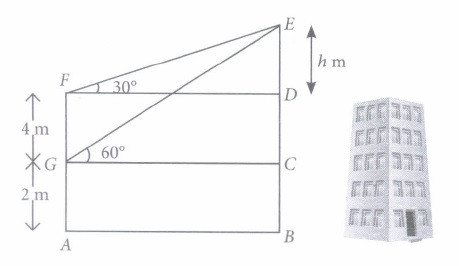
Based on the above information, answer the following questions.
(i) Who is more closer to the balloon?
| (a) Ankit | (b) Radha |
| (c) Both are at equal distance | (d) Can't be determined |
(ii) Value of DF is equal to
| \((a) \frac{h}{\sqrt{3}} \mathrm{~m}\) | \((b) h \sqrt{3} \mathrm{~m}\) | \((c) \frac{h}{2} \mathrm{~m}\) | \((d) 2 h \mathrm{~m}\) |
(iii) Value of h is
| (a) 2 | (b) 3 | (c) 4 | (d) 5 |
(iv) Height of the balloon from the ground is
| (a) 4 m | (b) 6 m | (c) 8 m | (d) 10 m |
(v) If the balloon is moving towards the building, then both angle of elevation will
| (a) remain same | (b) increases | (c) decreases | (d) can't be determined |
1.
Given, \(\sqrt { 2 } \sin { \theta } =1\)
\(\sin { \theta } =\frac { 1 }{ \sqrt { 2 } } =\sin { { 45 }^{ ° } } \)
\(\therefore \quad \theta ={ 45 }^{ ° }\)
Now \(\sec ^{ 2 }{ \theta } -cosec^{ 2 }\theta \) = \(\sec ^{ 2 }{ { 45 }^{ ° } } -cosec^{ 2 }{ 45 }^{ ° }\)
\(={ \left( \sqrt { 2 } \right) }^{ 2 }-{ \left( \sqrt { 2 } \right) }^{ 2 }\)
= 2 - 2
= 0
2.
LHS=\((\tan { \theta } +2)(2\tan { \theta } +1)\)
\(=2\tan ^{ 2 }{ \theta } +4\tan { \theta } +\tan { \theta } +2\)
\(=2\tan ^{ 2 }{ \theta } +2+5\tan { \theta } \)
\(=2(\tan ^{ 2 }{ \theta } +1)+5\tan { \theta } \)
\(=2\sec ^{ 2 }{ \theta } +5\tan { \theta } \quad \left[ \because 1+\tan ^{ 2 }{ \theta } =\sec ^{ 2 }{ \theta } \right] \)
\(=5\tan { \theta } +2\sec ^{ 2 }{ \theta } \)=RHS
Hence proved.
3.
3 cm
4.
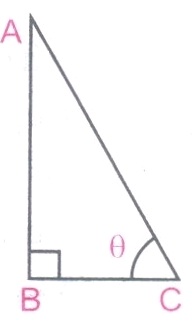
Let AB is pole and BC is its shadow
∴ AB = 6m, BC = 2\(\\ \\ \\ \\ \sqrt { 3 } \) m
In right ΔABC, \(\frac { AB }{ BC } \)=tanፀ
⇒ tanፀ = \(\frac { 6 }{ 2\sqrt { 3 } } \)
⇒ tanፀ = \(\sqrt { 3 } \)
⇒ ፀ = 60o
5.
Let AB is the tower and C is the point 20 m away from the base of the tower
∴ BC = 20m, ∠ACB = 45o
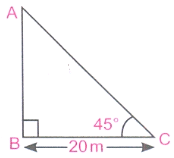
In right ΔABC, tan 45o = \(\frac{AB}{BC}\)
⇒ I = \(\frac{AB}{20}\) ∴ AB = 20 m
6.
Let AB be a diameter of a given circle and LM and PQ be the tangent lines drawn to the circle at points A and B, respectively.
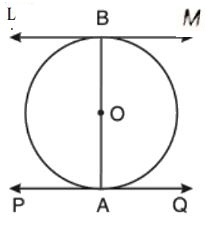
To prove LM || PQ
Proof We know that the tangent at any point of a circle is perpendicular to the radius through the point of contact.
\(\therefore\) OA \(\perp\) PQ and OB \(\perp\) LM
\(\Rightarrow\) AB \(\perp\) PQ
and AB \(\perp\) LM
\(\Rightarrow\) \(\angle\)PAB = 90°
and \(\angle\)ABM = 90°
\(\Rightarrow\) \(\angle\)PAB = \(\angle\)ABM
[each = 90°]
But these are alternate angles.
\(\therefore\) PQ || LM
Hence, the tangents drawn at the ends of a diameter of a circle are parallel.
Hence proved.
7.
Given, \(\tan { \theta } +\sin { \theta } =m\quad \quad \quad ...(i)\)
and \(\tan { \theta } -\sin { \theta } =n\quad \quad ...(ii)\)
On adding Eqs. (i) and (ii), we get
\(2\tan { \theta } =m+n\quad \Rightarrow \tan { \theta } =\frac { m+n }{ 2 } \)
\(\therefore \quad \cot { \theta } =\frac { 1 }{ \tan { \theta } } =\frac { 2 }{ m+n } \quad \quad ...(iii)\)
On subtracting Eq. (ii) from Eq. (i), we get, \(2\sin { \theta } =m-n\)
\(\Rightarrow \sin { \theta } =\frac { m-n }{ 2 } \quad \quad \quad \quad .....(iv)\)
\(\therefore \quad cosec\theta =\frac { 1 }{ \sin { \theta } } =\frac { 2 }{ m-n } \)
We know that, \({ cosec }^{ 2 }\theta -\cot ^{ 2 }{ \theta } =1\)
\({ \left( \frac { 2 }{ m-n } \right) }^{ 2 }-{ \left( \frac { 2 }{ m+n } \right) }^{ 2 }=1\) [from Eqs. (ii) and (iv)]
\(\Rightarrow \frac { 4 }{ { \left( m-n \right) }^{ 2 } } -\frac { 4 }{ { \left( m+n \right) }^{ 2 } } =1\)
\(\Rightarrow 4\left[ \frac { 1 }{ { \left( m-n \right) }^{ 2 } } -\frac { 1 }{ { \left( m+n \right) }^{ 2 } } \right] =1\)
\(\Rightarrow 4\left[ \frac { { \left( m+n \right) }^{ 2 }-{ \left( m-n \right) }^{ 2 } }{ { \left( m-n \right) }^{ 2 }{ \left( m+n \right) }^{ 2 } } \right] =1\)
\(\Rightarrow 4\left[ \frac { ({ m }^{ 2 }+{ n }^{ 2 }+2mn)-({ m }^{ 2 }+{ n }^{ 2 }-2mn) }{ { \left( m-n \right) }^{ 2 }{ \left( m+n \right) }^{ 2 } } \right] =1\)
\(\Rightarrow 4\left[ \frac { 2mn+2mn) }{ { \left( m-n \right) }^{ 2 }{ \left( m+n \right) }^{ 2 } } \right] =1\)
\(\Rightarrow \frac { 16mn }{ { \left( m-n \right) }^{ 2 }{ \left( m+n \right) }^{ 2 } } =1\)
\(\Rightarrow \frac { 16mn }{ { \left( { m }^{ 2 }-{ n }^{ 2 } \right) }^{ 2 } } =1\)
\(\Rightarrow { \left( { m }^{ 2 }-{ n }^{ 2 } \right) }^{ 2 }=16mn\)
\(\therefore \quad { \left( { m }^{ 2 }-{ n }^{ 2 } \right) }=4\sqrt { mn } \) [taking positive square roor]
Hence proved.
8.
LHS = \(\frac { \sin { A } +\cos { A } }{ \sin { A } -\cos { A } } +\frac { \sin { A } -\cos { A } }{ \sin { A } +\cos { A } } \)
\(=\frac { { \left( \sin { A } +\cos { A } \right) }^{ 2 }+{ \left( \sin { A } -\cos { A } \right) }^{ 2 } }{ \left( \sin { A } -\cos { A } \right) \left( \sin { A } +\cos { A } \right) } \)
\(=\frac { \left[ \sin ^{ 2 }{ A } +2\cos { A } \sin { A } +\cos ^{ 2 }{ A } +\sin ^{ 2 }{ A } -2\cos { A } \sin { A } +\cos ^{ 2 }{ A } \right] }{ \sin ^{ 2 }{ A } -\cos ^{ 2 }{ A } } \)
\(=\frac { 2\sin ^{ 2 }{ A } +2\cos ^{ 2 }{ A } }{ \sin ^{ 2 }{ A } -\cos ^{ 2 }{ A } } =\frac { 2(\sin ^{ 2 }{ A } +\cos ^{ 2 }{ A } ) }{ \sin ^{ 2 }{ A } -\cos ^{ 2 }{ A } } \)
\(=\frac { 2 }{ \sin ^{ 2 }{ A } -\cos ^{ 2 }{ A } } \left[ \because \sin ^{ 2 }{ A } +\cos ^{ 2 }{ A } =1 \right] \)
= RHS
Hence proved.
9.
We have, sec 5A = cosec (A + 300)
\(\Rightarrow\) sec 5A = sec[900- (A + 300)] \([\because sec({ 90 }^{ 0 }-\theta )=cosec\theta ]\)
\(\Rightarrow\) sec 5A = sec(600 - A)
\(\Rightarrow\) 5A = 600 - A [\(\therefore\) 5A and (600- A) are acute angles]
\(\Rightarrow\) 6A = 600
\(\therefore\) A = 100
10.
45°
11.
We are given two concentric circles C1 and C2 with centre O and a chord AB of the larger circle C1 which touches the smaller circle C2 at the point P (see Fig). We need to prove that AP = BP.
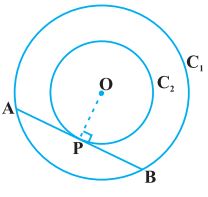
Let us join OP. Then, AB is a tangent to C2 at P and OP is its radius. Therefore, by Theorem.
OP \(\perp\) AB
Now AB is a chord of the circle C1 and OP \(\perp\) AB. Therefore, OP is the bisector of the chord AB, as the perpendicular from the centre bisects the chord,
i.e., AP = BP
12.
We are given a circle with centre O, a point P lying outside the circle and two tangents PQ, PR on the circle from P see fig. We are required to prove that PQ = PR.
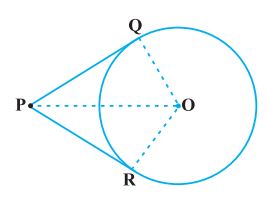
For this, we join OP, OQ and OR. Then \(\angle\)OQP and \(\angle\)ORP are right angles, because these are angles between the radii and tangents, and according to Theorem 10.1 they are right angles. Now in right triangles OQP and ORP,
OQ = OR (Radii of the same circle)
OP = OP (Common)
Therefore, \(\Delta\)OQP \(\cong\)\(\Delta\) ORP (RHS)
This gives PQ = PR (CPCT)
13.
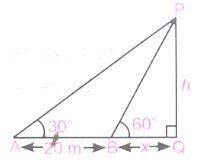
Let 'h' m be height of the tower PQ
AB=20 m. Let BQ=x m
In rt. ΔPQB
\(\frac { PQ }{ BQ } \)=tan 60o ⇒ \(\frac { h }{ x } =\sqrt { 3 } \Rightarrow \sqrt { 3 } x\) .........(i)
In rt. ΔPQA,
\(\frac { PQ }{ AQ } \)=tan 30o ⇒ \(\frac { h }{ 20+x } =\frac { 1 }{ \sqrt { 3 } } \Rightarrow \sqrt { 3 } \)h=20+x ....(ii)
From (i) and (ii)
\(\sqrt { 3 } .\sqrt { 3 } \)x=20+x ⇒ x=10
∴ Distance of tower fro A is 20 m+10 m=30 m
Put x=10 in (i), we get
h=\(\sqrt { 3 } \) x 10=1.732 x 10=1.732 m
14.
Let CD = h m be the height of the lighthouse and A, B be two ships on either side of lighthouse, such that their angles of depression are 60° and 45°, respectively.
i.e. ∠XCB = ∠CBD = 45° [alternate angles] and ∠YCA = ∠CAD = 60° [alternate angles]
Given, the distance between the ships A and B is
\(A B=\frac{100(\sqrt{3}+1)}{\sqrt{3}} \mathrm{~m}\)
In right angled ΔBDC,
\(\tan 45^{\circ}=\frac{C D}{B D} \left[\because \tan \theta=\frac{P}{B}\right]\)
\(\Rightarrow 1=\frac{C D}{B D} \left[\because \tan 45^{\circ}=1\right]\)
⇒ BD = CD ......(i)
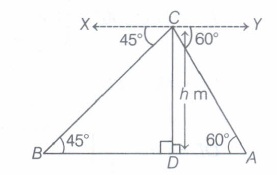
and in right angled ΔADC,
\(\tan 60^{\circ}=\frac{C D}{A D}\)
\(\Rightarrow \sqrt{3}=\frac{C D}{A D} \left[\because \tan 60^{\circ}=\sqrt{3}\right]\)
\(\Rightarrow C D=\sqrt{3} A D \Rightarrow A D=\frac{C D}{\sqrt{3}}\)
(i) 100 m,
(ii) \(100\left(1+\frac{1}{\sqrt{3}}\right) \mathrm{m}\)
15.
First term
\(=\sin { A } \left( \frac { 1-\cos { A } +1+\cos { A } }{ 1-\sin ^{ 2 }{ A } } \right) =\sin { A } .\frac { 2 }{ \sin ^{ 2 }{ A } } \)
\(=\frac { 2 }{ \sin { A } } =cosecA\quad \quad \left[ \therefore \frac { 1 }{ \sin { A } } =cosecA \right] \)
= Third term
Second term =\(\sqrt { \frac { 1+\cos { A } }{ 1-\cos { A } } } +\sqrt { \frac { 1-\cos { A } }{ 1+\cos { A } } } \)
\(=\sqrt { \frac { 1+\cos { A } }{ 1-\cos { A } } \times \frac { 1+\cos { A } }{ 1+\cos { A } } } +\sqrt { \frac { 1-\cos { A } }{ 1+\cos { A } } \times \frac { 1-\cos { A } }{ 1-\cos { A } } } \)
\(=\frac { 1+\cos { A } }{ \sqrt { \sin ^{ 2 }{ A } } } +\frac { 1-\cos { A } }{ \sqrt { \sin ^{ 2 }{ A } } } \quad [\because \sin ^{ 2 }{ A } +\cos ^{ 2 }{ A } =1]\)
\(=\frac { 1+\cos { A } +1-\cos { A } }{ \sin { A } } \)
= Third term \([\because \frac { 1 }{ \sin { A } } =cosecA]\)
Hence proved.
16.
LHS = \(\frac { \sin ^{ 2 }{ \theta } +\cos ^{ 2 }{ \theta } ++1 }{ (1+\cos { \theta } )\sin { \theta } } \)
\(=\frac { 1+2\cos { \theta } +1 }{ (1+\cos { \theta } )\sin { \theta } } =\frac { 2(\cos { \theta } +1) }{ (1+\cos { \theta } )\sin { \theta } } =2cosec\theta \)
17.
Given, CD = 6 cm, BD = 8 cm and radius = 4 cm
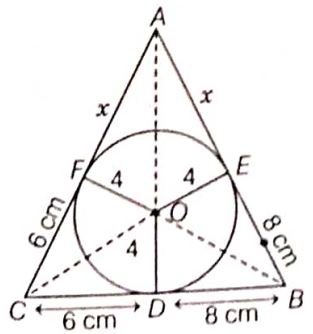
Join OC, OA and OB.
Let the circle touches the other sides AB and AC at points E and F, respectively.
We know that tangents drawn from an external point to the circle are equal in length.
\(\therefore\) CD = CF = 6 cm [\(\because\) C is an external point]
BD = BE = 8 cm [\(\because\) B is an external point]
and AF = AE = x cm (say [\(\because\) A is an external point]
Area of \(\Delta\)OCB, \(A_1=\frac{1}{2} \times \text { Base } \times \text { Height }\)
\(\begin{aligned} & =\frac{1}{2} \times C B \times O D \\ \end{aligned}\)
\(\begin{aligned} & =\frac{1}{2} \times 14 \times 4=28 \mathrm{~cm}^2 \\ \end{aligned}\)
\(\begin{aligned} & \quad[\because C B=C D+B D=6+8=14] \end{aligned}\)
Area of \(\Delta\)OCA,
\(\begin{aligned} A_2 & =\frac{1}{2} \times A C \times O F \end{aligned}\)
\(\begin{aligned} =\frac{1}{2}(6+x) \times 4=(12+2 x) \mathrm{cm}^2 \end{aligned}\)
and area of \(\Delta\)OBA,
\(A_3=\frac{1}{2} \times A B \times O E=\frac{1}{2}(8+x) \times 4=(16+2 x) \mathrm{cm}^2\)
Thus, area of \(\Delta\)ABC
= A1 + A2 + A3 = [28 + (12 + 2x) + (16+ 2x)]
= (56 + 4x) cm2 ...(i)
Now, semi-perimeter of \(\Delta\)ABC=\(\frac{1}{2}\)(AB + BC + CA)
\(\Rightarrow \quad s=\frac{1}{2}(x+8+14+6+x)\)
\(\Rightarrow\) s = (14 + x) cm
Using Heron's formula,
area of \(\Delta\)ABC = \(\begin{aligned} & =\sqrt{s(s-a)(s-b)(s-c)} \end{aligned}\)
\(\begin{aligned} =\sqrt{(14+x)(14+x-14)(14+x-x-6)(14+x-x-8)} \end{aligned}\)
\(\begin{aligned} & =\sqrt{(14+x) \times x \times 8 \times 6} \end{aligned}\)
\(\begin{aligned} =\sqrt{(14+x) 48 x} \end{aligned}\) ...(ii)
From Eqs. (i) and (ii), we get
\(\sqrt{(14+x) 48 x}=56+4 x=4(14+x)\)
On squaring both sides, we get
(14 + x) 48 x = 42 (14 + x)2
\(\Rightarrow\) 3x = 14 + x
\(\Rightarrow\) 2x = 14
\(\Rightarrow\) x = 7
\(\therefore\) Length of AC = 6 + x = 6 + 7 = 13 cm
and length of AB = 8 + x = 8 + 7 = 15 cm
18.
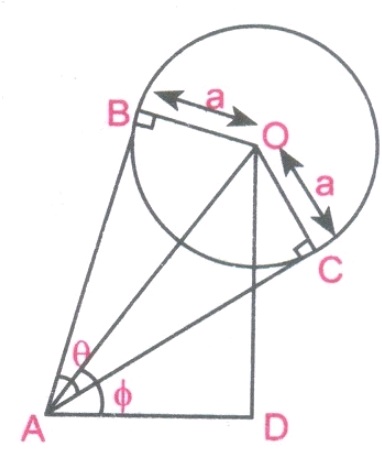
In ΔAOB and ΔAOC,
AB=AC, AO=AO and OB=OC
∴ ΔAOB≌∆AOC
∴ ㄥBAO=ㄥCAO
⇒ ㄥCAO=1/2ፀ
In right ΔACO,
\(\frac { AO }{ OC } =cosec\left( \frac { \theta }{ 2 } \right) \)
⇒ \(\frac { AO }{ a } =cosec\left( \frac { \theta }{ 2 } \right) \)
⇒ AO=a.cosec\(\left( \frac { \theta }{ 2 } \right) \).sin¢
∴ Height of centre of balloon is a sin¢.cosec\(\left( \frac { \theta }{ 2 } \right) \).
19.
Let AB be the tower and BC be its shadow.
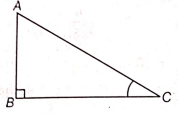
Given, AB = BC
In right angled △ABC,
\(\tan C=\frac{\text { Perpendicular }}{\text { Base }}=\frac{A B}{B C}=1\)
⇒ tan C = tan45° [∵ tan45° = 1]
∴ C = 45°
20.
A line which intersects circle at two distinct points is known as secant.
21.
(b)
45°
22.
(d)
\(5\frac{1}{3}\)
23.
(a)
-17/7
24.
(c)
28 cm
25.
(c)
19.124 m
26.
(d)
4
27.
(b)
3 / 4
28.
(a)
\(\frac { \sqrt { 2-\sqrt { 3 } } }{ 2 } \)
29.
(b)
1/2
30.
(a)
346.4 m
31.
(c)
90°
32.
(d)
30√3
33.
(c)
20√3
34.
(a)
3 non- collinear points
35.
(d)
2
36.
Let C1 and C2 be the two concentric circles, with centre at O and respective radii being r1 = 4cm and r2 = 5cm.
Draw a chord AC of circle C2, to touch circle C1 at B.
Join OB.
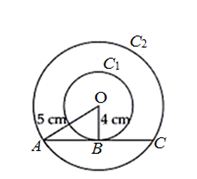
Here OB 丄 AC [As, tangent at any point of circle is perpendicular to radius through the point of contact]
Thus, in right angled OAB ,we have:
OA2 = AB2 + OB2 [By using phythagoras theorem]
⇒ 52 = AB2 + 42
⇒ AB2 = 25 - 16 = 9
∴ Length of chord AC = 2 AB = 2 x 3 = 6 cm
37.
If Assertion is incorrect but Reason is correct.
38.
(a) If both Assertion and Reason are correct and Reason is the correct explanation of Assertion.
39.
(a) (iv) NS and NR are both tangent to the circle
So, \(N S \perp S A\) and \(N R \perp R A\)
[ \(\therefore\) Tangent to a circle is perpendicular to the radius through the point of contact ]
\(\therefore \angle N S A=90^{\circ}\)
(b) (ii)
\(\angle N S A=90^{\circ} \quad \Rightarrow N A^{2}=N S^{2}+S A^{2}\) [ By Pythagora's Theorem]
\(\Rightarrow N S=\sqrt{N A^{2}-S A^{2}}=\sqrt{13^{2}-5^{2}}=\sqrt{169-25}\)
\(=\sqrt{144}=12 \mathrm{~m}\)
(c) (iiii)
NR = NS = 12m
Tangents drawn from an external point are equal
\(\therefore N R=12 \mathrm{~m}\)
(d) (iv)
\(\angle S N R+\angle R A S=180^{\circ} \Rightarrow \angle R A S=180^{\circ}-\angle S N R\)
[\(\because\) The angle between the two tangents drawn from an external point to a circle is supplementary to the angle subtended by the line segments joining the points of contact to the centre]
\(\Rightarrow \angle R A S=180^{\circ}-\theta\)
(e) (i)
\(\angle R A S=180^{\circ}-\theta\) [ Calulated bove]
Now, \(\angle N A S=\angle N A R=\frac{1}{2} \angle R A S\)
[\(\because\) If two tangents are drawn from an external point, then they extend equal angles at the centre]
\(\Rightarrow \angle N A S=\frac{1}{2}\left(180^{\circ}-\theta\right)=90^{\circ}-\frac{\theta}{2}\)
40.
(i) (b): \(\angle X A C=45^{\circ}\)
\(\therefore \quad \angle A C D=45^{\circ}\) [Alternate interior angles]
(ii) (b)
(iii) (c) : \(\text { In } \Delta A C D\)
\(\frac{A D}{D C}=\tan 45^{\circ} \)
\(\Rightarrow \frac{100}{D C}=1 \Rightarrow D C=100 \mathrm{~m}\)
(iv) (d): \(\text { In } \Delta A B D, \frac{A D}{B D}=\tan 30^{\circ}\)
\(\Rightarrow \quad \frac{100}{B D}=\frac{1}{\sqrt{3}} \)
\(\Rightarrow \quad B D=100 \sqrt{3} \mathrm{~m}\)
(v) (a): \(\text { In } \Delta A D C\)
\(\frac{A D}{A C}=\sin 45^{\circ} \Rightarrow \frac{100}{A C}=\frac{1}{\sqrt{2}} \Rightarrow A C=100 \sqrt{2} \mathrm{~m}\)
41.
(i) (b): The person who makes small angle of elevation is more closer to the balloon.
\(\therefore\) Radlra is more closer to the balloon.
(ii) (b): \(\text { In } \Delta E F D, \tan 30^{\circ}=\frac{E D}{D F}\)
\(\Rightarrow \quad \frac{1}{\sqrt{3}}=\frac{h}{D F} \)
\(\Rightarrow \quad D F=h \sqrt{3} \mathrm{~m}\)
(iii) (a): In \(\Delta\)GCE,
\(\begin{array}{l}
\tan 60^{\circ}=\frac{E C}{G C}=\frac{h+4}{D F} \\
\Rightarrow \quad \sqrt{3}=\frac{h+4}{\sqrt{3} h} \Rightarrow 3 h=h+4 \Rightarrow h=2
\end{array}\)
(iv) (c): Height of the balloon from the ground = BE = BC + CD + DE = 2 + 4 + 2 = 8 m
(v) (b)

10th Standard CBSE Syllabus & Materials
10th Standard CBSE
CBSE 10th Social Science PS - Federalism - New Model Questions Papers Study Material - QB365 Set A
NEW10th Standard CBSE
CBSE 10th Social Science PS - Power Sharing - New Model Questions Papers Study Material - QB365 Set A
NEW10th Standard CBSE
CBSE 10th Social Science GEO - Manufacturing Industries - New Model Questions Papers Study Material - QB365 Set A
NEW10th Standard CBSE
CBSE 10th Social Science GEO - Minerals and Energy Resources - New Model Questions Papers Study Material - QB365 Set A



NCERT Books

Syllabus

Exam Pattern

Sample Question Papers

Previous year Question Papers

Important Notes

MCQ Practice test

NCERT Exemplers

Case study Questions

Image Based Questions

Passage based Questions

HOT Questions

Value Based Questions

Model Questions Papers
NCERT ( Book Back ) Questions

Assertion and Reason
Important Questions And Answers

CBSE 10th Standard CBSE Subjects
CBSE Standards