
 100% FREE ACCESS
10th Standard CBSE Syllabus & Materials
10th Standard CBSE
CBSE 10th Social Science ECO - Globalisation and the Indian Economy - New Model Questions Papers Study Material - QB365 Set A
NEW10th Standard CBSE
CBSE 10th Social Science ECO - Money and Credit - New Model Questions Papers Study Material - QB365 Set A
NEW10th Standard CBSE
CBSE 10th Social Science ECO - Sectors of the Indian Economy - New Model Questions Papers Study Material - QB365 Set A
NEW10th Standard CBSE
CBSE 10th Social Science ECO - Development - New Model Questions Papers Study Material - QB365 Set A
NEW10th Standard CBSE
CBSE 10th Social Science PS - Outcomes of Democracy - New Model Questions Papers Study Material - QB365 Set A
NEW10th Standard CBSE
CBSE 10th Social Science PS - Gender, Religion and Caste - New Model Questions Papers Study Material - QB365 Set A

Published on: 17/08/2026
Download CBSE Class 10th Standard CBSE Maths question papers, sample papers, important questions, and previous year solved papers in PDF format. Get free study materials, NCERT solutions, and exam preparation resources for Class 10th Standard CBSE Maths
Questions + Answers key
Take MCQ Maths Test
1.
A middle school decided to run the following spinner game as a fund-raiser on Christmas Carnival.
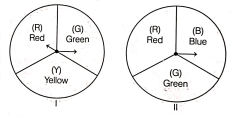
Making Purple: Spin each spinner once, blue and red make purple. So, if one spinner shows Red (R) and another Blue (B), then you 'win'. One such outcome is written as 'RB'
Based on the above, answer the following questions
(i) List all possible outcomes of the game
(ii) Find the probability of 'Making Purple'.
(iii) For each win, a participant gets ₹10, but if he/she loses, he/she has to pay ₹5 to the school.
If 99 participants played, calculate how much fund Could the school have collected.
Or
If the same amount of ₹5 has been decided for winnings or losing the game, then how much fund had been collected by school?
(Number of participants = 99)
2.
Gurpreet is very fond of doing research on plants. She collected some leaves from different plants and measured their lengths in mm.
The data obtained is represented in the following table.
Length (in mm) | Number of leaves |
|---|---|
70-80 | 3 |
80-90 | 5 |
90-100 | 9 |
100-110 | 12 |
110-120 | 5 |
120-130 | 4 |
130-140 | 2 |
Based on the above information, answer the following questions.
(i) Write the median class of the data.
(ii) How many leaves are of length equal to or more than 10 cm?
(iii) (a) Find median of the data.
Or
(b) Write the modal class and find the mode of the data.
3.
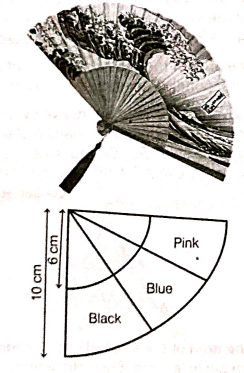
Heena hold a Japanese fan in her hand as shown in the figure. It is shaped like a sector of a circle and made of a thin material such as paper or feather. The inner and outer radii are 6 cm and 10 cm, respectively. The fan has three colours i.e. pink, blue and black.
Based on the above information, answer the following questions.
(i) (a) If the region containing blue colour makes an angle of 80° at the centre, then find the area of the region having blue colour.
Or
(b) If the region containing black colour makes an angle of 40° at the centre, then find the area of the region having black colour.
(ii) If the region containing pink colour makes an angle of 30° at the centre, then find the perimeter of the region containing pink colour.
(iii) Find the area of the region having radius 6 cm
4.
Some students were asked to list theirs favourite colour. The measure of each colour is shown by the central angle of a pie-chart given below :
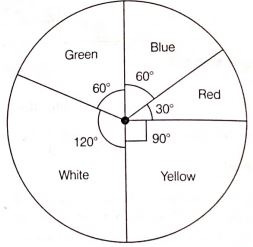
Study the pie-chart and answer the following questions :
(i) If a student is chosen at random, then find the probability of his/her favourite colour being white?
(ii) What is the probability of his/her favourite colour being blue or green?
(iii) If 15 students liked the colour yellow, how many students participated in the survey?
Or
What is the probability of the favourite colour being red or blue?
1.
(i) Possible outcomes= RR,RB,RG, GR,GB,GG,YR,YB.YG
(ii) Total number of outcomes=9
Favourable outcomes = RB
∴ Probability \(=\frac{1}{9}\)
(ii)Since, probability of wining the game \(=\frac{1}{9}\)
and probability of lossing the game = \(=\frac{8}{9}\)
Given, number of participants=99
∴ Number of winner students = \(99 \times \frac{1}{9}=11\)
and number of students that losses the game \(=\frac{99 \times 8}{9}=88\)
∴ Fund collected by school= 88×5-11x10
= 440 - 110 =₹ 330
Or
If the same amount of ₹ 5 has been decided for winning or loosing the game.
∴ Fund collected by school = 88 × 5 -11 x 5
=77×5 = ₹ 385
2.
Table for the given data
Length (in mm) | Frequency (f) | Cumulative frequency (cf) |
70-80 | 3 | 3 |
80-90 | 5 | 8 |
90-100 | 9 | 17 |
100-110 | 12 | 29 |
110-120 | 5 | 34 |
120-130 | 4 | 38 |
130-140 | 2 | 40 |
(i) We have, N = 40
\(\frac{N}{2}=20\)
So, median class is 90 - 100.
(ii) We know that 10 cm = 100 mm
Number of leaves greater than 100 mm
= 12 + 5 + 4 + 2 = 23
(iii) (a) Median of class is 100 – 110.
So, I = 100, f = 12, cf = 17 and h = 10
\(\text { ∵ Median }=l+\frac{\left(\frac{N}{2}-c f\right)}{f} \times h\)
\(\text { ⇒ Median }=100+\left(\frac{20-17}{12}\right) \times 10\)
\(=100+\frac{30}{12}=100+2.5\)
⇒ Median = 102.5
(b) We have, modal class as 100 - 110.
So, l = 100, f1 = 12, f0 = 9, f2 = 5 and h = 10
We know that mode = \(l+\frac{f_1-f_0}{2 f_1-f_0-f_2} \times h\)
Mode = \(100+\frac{12-9}{24-9-5} \times 10\)
= 100 + 3 = 103
3.
(i) (a) Area of region having blue colour \(=\frac{80^{\circ}}{360^{\circ}} \pi\left[(10)^2-\left(6^2\right)\right] \text { Ans. } 44.69 \mathrm{~cm}^2\)
Or
(b) Area of region having black colour
\(\begin{aligned} &=\frac{40^{\circ}}{360^{\circ}} \pi\left[(10)^2-(6)^2\right]\\ &\text { Ans. } 22.34 \mathrm{~cm}^2 \end{aligned}\)
(ii) Perimeter of the region having pink colour
= 2(10-6) + Length of arc having radius 6 cm
+ Length of arc having radius 10 cm
Ans. 16.38 cm
(iii) Area of region \(=\frac{150^{\circ}}{360^{\circ}} \times \pi r^2\)
Ans. 47.14 cm2
4.
(i) Total angle = 360°
Angle of white = 120°
\(\therefore \text { Probability }=\frac{120^{\circ}}{360^{\circ}}=\frac{1}{3}\)
(ii) Total angle = 360°
Angle of blue = 60°
Angle of green = 60°
\(\therefore \text { Probability }=\frac{60^{\circ}+60^{\circ}}{360^{\circ}}=\frac{120^{\circ}}{360^{\circ}}=\frac{1}{3}\)
(iii) Let n students participated in the survey
\(\Rightarrow \frac{90^{\circ}}{360^{\circ}} \times n=15 \Rightarrow n=15 \times 4=60\)
\(\therefore\) 60 students participated in the survey.
Or
Total angle = 360°
Angle of red = 30°
Angle of blue = 60°
\(\therefore \text { Probability }=\frac{60^{\circ}+30^{\circ}}{360^{\circ}}=\frac{90^{\circ}}{360^{\circ}}=\frac{1}{4}\)
10th Standard CBSE Syllabus & Materials
10th Standard CBSE
CBSE 10th Social Science PS - Federalism - New Model Questions Papers Study Material - QB365 Set A
NEW10th Standard CBSE
CBSE 10th Social Science PS - Power Sharing - New Model Questions Papers Study Material - QB365 Set A
NEW10th Standard CBSE
CBSE 10th Social Science GEO - Manufacturing Industries - New Model Questions Papers Study Material - QB365 Set A
NEW10th Standard CBSE
CBSE 10th Social Science GEO - Minerals and Energy Resources - New Model Questions Papers Study Material - QB365 Set A

NCERT Books

Syllabus

Exam Pattern

Sample Question Papers

Previous year Question Papers

Important Notes

MCQ Practice test

NCERT Exemplers

Case study Questions

Image Based Questions

Passage based Questions

HOT Questions

Value Based Questions

Model Questions Papers
NCERT ( Book Back ) Questions

Assertion and Reason
Important Questions And Answers

CBSE 10th Standard CBSE Subjects
CBSE Standards