
 100% FREE ACCESS
10th Standard CBSE Syllabus & Materials
10th Standard CBSE
CBSE 10th Social Science ECO - Globalisation and the Indian Economy - New Model Questions Papers Study Material - QB365 Set A
NEW10th Standard CBSE
CBSE 10th Social Science ECO - Money and Credit - New Model Questions Papers Study Material - QB365 Set A
NEW10th Standard CBSE
CBSE 10th Social Science ECO - Sectors of the Indian Economy - New Model Questions Papers Study Material - QB365 Set A
NEW10th Standard CBSE
CBSE 10th Social Science ECO - Development - New Model Questions Papers Study Material - QB365 Set A
NEW10th Standard CBSE
CBSE 10th Social Science PS - Outcomes of Democracy - New Model Questions Papers Study Material - QB365 Set A
NEW10th Standard CBSE
CBSE 10th Social Science PS - Gender, Religion and Caste - New Model Questions Papers Study Material - QB365 Set A

Published on: 29/05/2021
QB365 Provides the HOT Question Papers for Class 10 Maths, and also provide the detail solution for each and every HOT Questions. HOT Questions will help to get more idea about question pattern in every exams and also will help to get more marks in Exams
Download CBSE Class 10th Standard CBSE Maths question papers, sample papers, important questions, and previous year solved papers in PDF format. Get free study materials, NCERT solutions, and exam preparation resources for Class 10th Standard CBSE Maths
Questions + Answers key
Take MCQ Maths Test1.
From a group of 3 Girls and 2 Boys, two children are selected at random.Find the probability such that at least one boy is selected.
2.
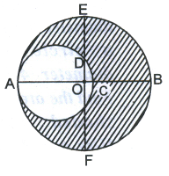
In the figure alongside, crescent is formed by two circles which touch at the point A, O is the centre of the point A, O is the centre of the bigger circle.If CB=9cm and ED=5cm, find the area of the shaded region.[Take \(\pi\)=3.14]
3.
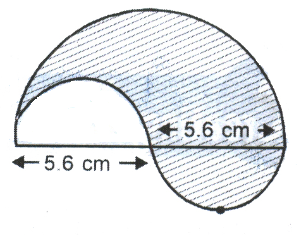
Calculate the area of the shaded portion of the figure alongside.
4.
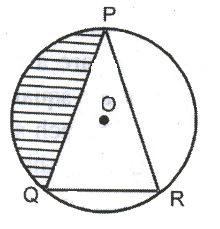
In the adjoining figure, PQR is an equilateral triangle inscribed in a circle of radius 7 cm. Find the area of the shaded region.
5.
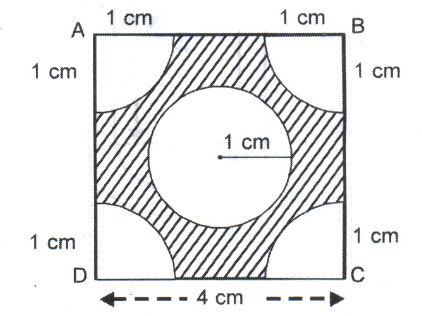
In the given figure, from each corner of a square ABCD, of side 4 cm, quadrant of a circle of radius 1 cm each is cut and a circle of radius 1 cm is cut from the centre. Find the area of the shaded region.
6.
Construct a triangle whose perimeter is 13.5 cm and the ratio of the three sides is 2 : 3 : 4.
7.
Draw a triangle PQR, with PQ = 4 cm, angle \(\angle\) Q = 60o and the median PL = 3.6 cm. Draw another triangle PQ'R' similar to given triangle \(\Delta\)PQR, such that PQ' = \(\frac { 4 }{ 3 } \) PQ.
8.
The angles of depression of top and bottom of tower as seen from the top of a 100m high cliff are 300 and 600 respectively.Find the height of the tower.
9.
If a1, a2, a3, ....., be an A.P. of non-zero terms, prove that: \(\frac { 1 }{ { a }_{ 1 }{ a }_{ 2 } } +\frac { 1 }{ { a }_{ 2 }{ a }_{ 3 } } +......+\frac { 1 }{ { a }_{ n-1 }{ a }_{ n } } =\frac { n-1 }{ { a }_{ 1 }{ a }_{ n } } .\)
10.
A vessel is in form of an inverted cone.Its height is 8cm and the radius of its top, which is open, is 5cm.It is filled with water up to the brim.When lead shots, each of which is a sphere of radius 0.5cm are dropped into the vessel, one-fourth of the water flows out.Find the number of lead shots dropped in the vessel.
1.
Let G1, G2, G3 and B1, B2 be three girls and two boys respectively.
Since two children are selected at random, therefore the following are the possible groups:
B1B2, B1G1, B1G2, B1G3, B2G1, B2G2, B2G3, G1G2, G1G3, G2G3
Total number of cases = 10
Now, at least one boy is selected in the following ways:
B1B2, B1G1, B1G2, B1G3, B2G1, B2G2, B2G3
Total number of favourable cases = 7
\(\therefore\) Required probability = \(\frac {7} {10}\)
2.
Suppose R and r be the radii of bigger and smaller circles, respectively
⇒ AB - AC = CB
⇒ 2R-2r=9
⇒ R-r=\(9\over 2\)= 4.5 cm ...(i)
-S.png)
Join AD and CD
ΔAOD ~ ΔDOC
\(⇒\ {OD\over OA}={OC\over OD}\)
⇒ OD2 = OA x OC
⇒ (R-5)2=R x (R-9)
⇒R2+25-10R=R2-9R
⇒ R=25cm
From (i), we have R-r = 4.5
=25 - 4.5 = 20.5cm
Now, area of the shaded portion = πR2-πr2
=π(R2-r2)
=π(R+r)(R-r)
=3.14 x (25+20.5)(25-20.5)
=3.14 x 45.5 x 4.5
= 642.915 cm2
Hence, the required area of the shaded portion is 642.915cm2
3.
49.28 cm2
4.
30.38 cm2
5.
9.72 cm2
6.
Steps of Construction :
1. Draw a line segment AB = 13.5 cm.
2. Through A, construct an acute angle ㄥBAX ( < 90o).
3. Mark nine points (2 + 3 + 4 = 9) at equal distances on AX Such that AA1= A1A2 = A2A3 = A3A4 = A4A5 = A5A6 = A6A7 = A7A8 = A8A9.
4. Join A9B.
5. Through A2 and A5 draw A5R || A9B and A2Q || A9B, intersecting AB in Q and R.
6. With Q as centre draw an arc of radius AQ.
7. With R as centre draw another arc of radius RB, intersecting previous arc in P.
8. Join PQ and PR
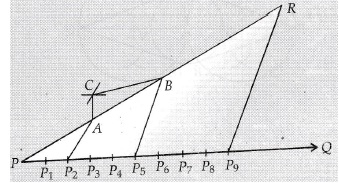
Thus, ΔPQR is the required triangle.
7.
Steps of Construction :
1. Draw a line segment PQ = 4 cm.
2. At Q, construct an ㄥPQY = 60o.
3. Through P, draw an arc of radius 3.6 cm, intersecting QY in S.
4. With S as centre and radius equal to SQ, draw an arc to intersect QY in R.
5. Join PR to get ΔPQR.
6. At P, construct an acute angle ㄥQPX ( < 90o).
7. Mark four points on PX such that PP1 = P1P2 = P2P3 = P3P4.
8. Join P3Q.
9. Through P4, draw P4Q' || P3Q, intersecting PQ in Q', when produced.
10. Through Q', draw Q'R' || QR intersecting PR in PR', when produced.
Thus, ΔPO'R' is the required triangle.
8.
66.67m
9.
Here, a1, a2, a3, ....., an be the given A.P. with a1 as first term and d as the common difference
\(\therefore\) a2 = a1 + d
a3 = a1 + 2d
and an = a1 + ( n - 1 )d
Now, L.H.S = \(\frac{1}{{a}_{1}{a}_{2}}+\frac{1}{{a}_{2}{a}_{3}}+...+\frac{1}{{a}_{n-1}{a}_{n}}\)
\(=\frac{1}{{a}_{1}({a}_{1}+d)}+\frac{1}{({a}_{1}+d)({a}_{1}+2d)}+...+\frac{1}{[{a}_{1}+(n-2)d][{a}_{1}+(n-1)d]}\)
\(\frac{1}{d}\left[ \frac{1}{{a}_{1}}-\frac{1}{{a}_{1}+d} \right]+\frac{1}{d}\left[ \frac{1}{{a}_{1}+d} -\frac{1}{{a}_{1}+2d}\right]+....+\frac{1}{d}\left[ \frac{1}{{a}_{1}+(n-2)s}-\frac{1}{{a}_{1}+(n-1)d} \right]\)
\(-=\frac{1}{d}\left[ \frac{1}{{a}_{1}}-\frac{1}{{a}_{1}+d}+\frac{1}{{a}_{1}+d}-\frac{1}{{a}_{1}+2d} +....+\frac{1}{{a}_{1}+(n-2)d} -\frac{1}{{a}_{1}+(n-1)d}\right]\)
\(=\frac{1}{d}\left[ \frac{1}{{a}_{1}}-\frac{1}{{a}_{1}+(n-1)d} \right]\)
\(=\frac{1}{d}\left[ \frac{{a}_{1}+(n-1)d-{a}_{1}}{{a}_{1}({a}_{1}+(n-1)d)} \right]\)
\(=\left[ \frac{(n-1)d}{{a}_{1}{a}_{n}} \right]\)
\(=\frac{n-1}{{a}_{1}{a}_{n}}\) = R.H.S.
10.
Given, height of the cone=8 cm and radius of the cone = 5 cm
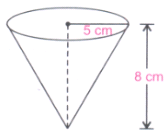
Volume of cone=\(\frac{1}{3}\)πr2h
=\(\frac{1}{3}\)π(5)28 cm3=\(\frac{200}{3}\)π cm3
Radius of one spherical lead shot=0.5 cm
Volume of one spherical lead shot=\(\frac{4}{3}\)πr 3=\(\frac{4}{3}\)π(0.5)3 cm3
=\(\frac{4\times{0.125}}{3}\)π cm3=\(\frac{0.5}{3}\)π cm3
When spherical lead are dropped in the vessel, one fourth of water flows out
Let number of lead shots be n
Volume of n spherical shots = \(\frac{1}{4}\) volume of conical vessel
n\(\left(\frac{0.5}{3}\pi\right)\)=\(\frac{1}{4}\left(\frac{200}{3}\pi\right)\)⇒n(0.5)=50⇒ n=\(\frac{50\times{10}}{5}\)=100

10th Standard CBSE Syllabus & Materials
10th Standard CBSE
CBSE 10th Social Science PS - Federalism - New Model Questions Papers Study Material - QB365 Set A
NEW10th Standard CBSE
CBSE 10th Social Science PS - Power Sharing - New Model Questions Papers Study Material - QB365 Set A
NEW10th Standard CBSE
CBSE 10th Social Science GEO - Manufacturing Industries - New Model Questions Papers Study Material - QB365 Set A
NEW10th Standard CBSE
CBSE 10th Social Science GEO - Minerals and Energy Resources - New Model Questions Papers Study Material - QB365 Set A



NCERT Books

Syllabus

Exam Pattern

Sample Question Papers

Previous year Question Papers

Important Notes

MCQ Practice test

NCERT Exemplers

Case study Questions

Image Based Questions

Passage based Questions

HOT Questions

Value Based Questions

Model Questions Papers
NCERT ( Book Back ) Questions

Assertion and Reason
Important Questions And Answers

CBSE 10th Standard CBSE Subjects
CBSE Standards