 100% FREE ACCESS
11th Standard CBSE Syllabus & Materials
11th Standard CBSE
CBSE 11th Economics PART-A - Presentation of Data - New Sample Question Papers Study Material - QB365 Set A
NEW11th Standard CBSE
CBSE 11th Economics PART-A - Organisation of Data - New Sample Question Papers Study Material - QB365 Set A
NEW11th Standard CBSE
CBSE 11th Economics PART-A - Collection of Data - New Sample Question Papers Study Material - QB365 Set A
NEW11th Standard CBSE
CBSE 11th Economics PART-A - Introduction to Economics and Statistics - New Sample Question Papers Study Material - QB365 Set A
NEW11th Standard CBSE
CBSE 11th Business Studies International Trade Sample Question Papers Study Material - QB365 Set A
NEW11th Standard CBSE
CBSE 11th Business Studies Evolution and Fundamentals of Business Sample Question Papers Study Material - QB365 Set A

Published on: 18/08/2026
Download CBSE Class 11th Standard CBSE Chemistry question papers, sample papers, important questions, and previous year solved papers in PDF format. Get free study materials, NCERT solutions, and exam preparation resources for Class 11th Standard CBSE Chemistry
Questions + Answers key
Take MCQ Chemistry Test
1.
Select from each, group of species which has the smallest radius stating the appropriate reason:
O, O-, O2-
2.
List two main differences between orbit and orbital.
3.
Define principal quantum number(n).
4.
What is screening or shielding effect? How does it influence the ionization enthalpy?
5.
Define the term ionization enthalpy? How does it vary along a period and along a group?
6.
How many protons and neutrons are present in the following nuclei?
(i) \(_{ 6 }^{ 13 }{ c }\)
(ii) \(_{ 8 }^{ 16 }{ o }\)
(iii) \(_{ 12 }^{ 24 }{ Mg }\)
(iv) \(_{ 12 }^{ 56 }{ Fe }\)
(v) \(_{ 38 }^{ 88 }{ Sr }\)
7.
Among the second period elements the actual ionization enthalpies are in the order Li < B < Be < C < O < N < F < Ne. Explain why
(i) Be has higher ∆i H than B
(ii) O has lower ∆i H than N and F?
8.
According to Rutherford's model of the atom, where is the positive charge concentrated? What does it predict about the relative size of the nucleus and the radius of the atom? What is the nucleus composed of according to his model?
9.
Explain, giving reasons, which of the following sets of quantum numbers are not possible.
(a) n = 0, l = 0, ml = 0, ms = + ½
(b) n = 1, l = 0, ml = 0, ms = – ½
(c) n = 1, l = 1, ml = 0, ms = + ½
(d) n = 2, l = 1, ml = 0, ms = – ½
(e) n = 3, l = 3, ml = –3, ms = + ½
(f) n = 3, l = 1, ml = 0, ms = + ½
10.
What is the total number of orbitals associated with the principal quantum number n = 3 ?
11.
Which of the following are isoelectronic species i.e., those having the same number of electrons?
Na+,K+,Mg2+,Ca2+,S2-,Ar
12.
What are the various factors due to which the ionization enthalpy of the main group elements tends to decrease down a group?
13.
What is the basic difference in approach between the Mendeleev’s Periodic Law and the Modern Periodic Law?
14.
Using s, p, d notations, describe the orbital with the following quantum numbers.
(a) n=1, l=0;
(b) n = 3; l=1
(c) n = 4; l =2;
(d) n=4; l=3.
15.
Indicate the number of unpaired electrons in : (a) P, (b) Si, (c) Cr, (d) Fe and (e) Kr.
16.
What is the lowest value of n that allows g orbitals to exist?
17.
Calculate the number of protons, neutrons and electrons in \(\overset { 80 }{ 35 } \) Br.
18.
What will be the wavelength of a ball of mass 0.1 kg moving with a velocity of 10 m s–1 ?
19.
Write outer electronic configuration of Cr atom. Why are half filled orbitals more stable?
20.
Give the number of radial nodes for 3s and 2p orbitals.
21.
State and explain the following:
(i) Aufbau principle
(ii) Pauli exclusion principle.
(iii) Hund's rule of maximum multiplicity.
22.
Define electron gain enthalpy. What are its units? Discuss the factors which influence the electron gain enthalpy.
23.
What is the basic difference between the terms electron gain enthalpy and electronegativity?
24.
If the velocity of the electron in Bohr's first orbit is 2.19 x 10⁶ ms-1 , calculate the de-Broglie wavelength associated with it.
25.
Anything that influences the valence electrons will affect the chemistry of the element. Which one of the following factors does not affect the valence shell?
Valence principal quantum number (n)
Nuclear charge (Z)
Nuclear mass
Number of core electrons
26.
In the modern periodic table, the period indicates the value of :
atomic number
atomic mass
principal quantum number
azimuthal quantum number
27.
The ionisation energy of nitrogen is more than oxygen because of ______.
more attraction of electrons by the nucleus
the extra stability of half-filled p-orbitals
the ionic radius of nitrogen atom is smaller
All of the above are correct
28.
If the bond distance in chlorine molecule (Cl2 ) is 198 pm, then the radius of chlorine is ______.
198 pm
49.5 pm
99 pm
24.75 pm
29.
General outer electronic configuration of d-block elements is _____.
\((n-1) d^{1-10} n s^{3}\)
\((n+1) d^{1-10} n s^{0-2}\)
\((n-1) d^{1-10} n s^{0-2}\)
\((n-1) d^{0} n s^{0-2}\)
30.
The symbol and name according to the IUPAC system for the element with atomic number = 120,respectively are _____.
Ubn and unbinilium
Ubn and unbiunium
Ubn and unnilbium
Ubn and unnilium
31.
The horizontal rows and the vertical columns in the periodic table are termed as respectively?
periods, groups
groups, periods
series, periods
family, periods
32.
The outermost electronic configuration of manganese (at. no. = 25) is _______.
3d54s2
3d64s1
3d74so
3d6 4s2
33.
The orbital with n = 3 and 1 = 2 is _______.
3s
3p
3d
3j
34.
de Broglie equation is _______.
\(\lambda =\frac { h }{ mv } \)
\(\lambda =\frac { hv }{ m } \)
\(\lambda =\frac { mv }{ h } \)
\(\lambda =hmv\)
35.
The Balmer series in the spectrum of hydrogen atom falls in _______.
ultraviolet region
visible region
infrared region
none of these
36.
In a sodium atom (atomic number = 11 and mass number = 23) and the number of neutrons is _______.
equal to the number of protons
less than the number of protons
greater than the number of protons
none of these
37.
Diagonal relationships are shown by _____.
Be and Al
Mg and Al
Li and Mg
Band P
38.
What is the electronic configuration of the elements of group 14?
ns2 np4
ns2 np6
ns2 np2
ns2
39.
40.
Assertion: It is impossible to determine the exact position and exact momentum of an electron simultaneously.
Reason: The path of an electron in an atom is clearly defined.
Codes:
(a) Both Assertion and Reason are true and Reason is the correct explanation of Assertion.
(b) Both Assertion and Reason are true but Reason is not the correct explanation of Assertion.
(c) Assertion is true but Reason is false.
(d) Both Assertion and Reason are false.
41.
42.
43.
Orbitals are region or space wher.e there is maximum probability of finding electrons. Qualitatively, these orbitals can be distinguished by their size, shape and orientation. An orbital of small size means there is more chance of finding the electron near the nucleus. Shape and orientation means the direction in which probability of finding electron is maximum. Atomic orbitals can be distinguished by quantum numbers. Each orbital is designated by three quantum numbers n, I and m1 (magnetic quantum number) which define energy, shape and orientation but these are not sufficient to explain spectra of multi-electrons atoms. Spin quantum number (ms ) determines the spin of electron. Spin angular momentum of electron has two orientations relative to chosen axis which are distinguished by spin quantum numbers ms which can take values +1/2 and -1/2.
| Value of 'l' | 0 | 1 | 2 | 3 | 4 |
| Notation for subshell | s | p | d | f | g |
(a) How many orbitals are associated with n = 3?
(b) Describe the orbitals represented by (i) n = 2, l = 1 (ii) n = 4, l = 0.
(c) How many electron are possible in an orbital? Why?
(d) What is shape of 's' and 'p' orbitals?
(e) Name two d-orbitals which are on axis.
1.
O has smallest radius because it has highest effective nuclear charge because 8 protons attract 8 electrons.
In O-, 8 protons attract 9 electrons less srongly.
In O2-, 8 protons attract 10 electrons with least force of atraction among these.
2.
| Orbit | Orbital |
| 1. Orbit is a well-defined 2-D circular path around the nucleus in which the electrons revolve |
1. Orbital is a 3-D space around the nucleus within which the probability of finding the electrons is maximum. |
| 2. Concept of orbit is not in accor-dance with the wave natureof electrons. | 2. It is in accordance with the wave nature of electrons. |
| 3. Orbits do not have directional characteristics. | 3. All orbitals except s-orbitals have directional characteristics. |
3.
Principal quantum number tells the principal energy level or shell to which the electron belongs. It gives the information about the distance and the energy of the electron.
4.
In a multielectron atom, the electrons present in the inner shells shield the electrons in the valence shell from the attraction of the nucleus or they act as a screen between the nucleus and these electrons. This is known as Sheil ding effect or screening effect. As the screening effect increases, the effective nuclear charge decreases. Consequently, the force of attraction by the nucleus for the valence shell electrons decreases and hence the ionization enthalpy decreases.
5.
Ionization Enthalpy. The minimum amount of energy required to remove the most loosely bound electron from an isolated gaseous atom so as to convert it into a gaseous cation is called its ionization enthalpy or energy. It is represented by\(\triangle
\)i H. This process may be represented as
M(g) +\(\triangle
\)i H⟶M+(g) + e- (g)
where M (g) is isolated gaseous atom. M+ (g) is the resultant cation (a position ion) Variation along a period. Moving from left to right in a period, the ionization enthalpy increases with atomic number.
6.
(i) \(_{ 6 }^{ 13 }{ c }\) ; Atomic no. (Z) = 6 Mass no. (A) = 13
No. of protons (P) = 6 No. of neutrons (n) = 13 - 6 = 7
(ii) \(_{ 8 }^{ 16 }{ O }\) ; Atomic no. (Z) = 8 Mass no. (A) 16
No. of protons (P) = 8 No. of neutrons (n) = 16 - 8 = 8
(iii) \(_{ 12 }^{ 24 }{ Mg }\) Atomic no. (Z) = 12 Mass no. (A) = 24
No. of protons (P) = 12 No. of neutrons (n) = 24 -12 = 12
(iv) \(_{ 26 }^{ 56 }{ Fe }\) ;Atomic no (Z) = 26 Mass no. (A) = 56
No. of protons (P) = 26 No. of neutrons (n) = 56 - 26 = 30
(v) \(_{ 38 }^{ 88 }{ Sr }\) ;Atomic no (Z) = 38 Mass no. (A) = 88
No. of protons (P) = 38 No. of neutrons (n) = 50.
7.
(i) During the process of ionization, the electron to be removed from beryllium atom is a 2s-electron, whereas the electron to be removed from boron atom is a 2p-electron. Now, 2s-electrons are more strongly attached to the nucleus than 2p-electrons. Therefore, more energy is required to remove a 2s-electron of beryllium than that required to remove a 2p-electron of boron. Hence, beryllium has higher ΔiH than boron.
(ii) In nitrogen, the three 2p-electrons of nitrogen occupy three different atomic orbitals. However, in oxygen, two of the four 2p-electrons of oxygen occupy the same 2p-orbital. This results in increased electron-electron repulsion in oxygen atom. As a result, the energy required to remove the fourth 2p-electron from oxygen is less as compared to the energy required to remove one of the three 2p-electrons from nitrogen. Hence, oxygen has lower ΔiH than nitrogen.
Fluorine contains one electron and one proton more than oxygen. As the electron is being added to the same shell, the increase in nuclear attraction (due to the addition of a proton) is more than the increase in electronic repulsion (due to the addition of an electron). Therefore, the valence electrons in fluorine atom experience a more effective nuclear charge than that experienced by the electrons present in oxygen. As a result, more energy is required to remove an electron from fluorine atom than that required to remove an electron from oxygen atom. Hence, oxygen has lower ΔiH than fluorine.
8.
According to Rutherford's model of atom, the positive charge is concentrated at the centre, that is, at the nucleus. Since, a small fraction of -particles were deflected through small angle and also a few of them bounced back, it proved that the nucleus occupies a very small volume in the atom. The radius of the atom is about 10-10m while of nucleus is 10-15 m. The nucleus is composed of protons and neutrons and is surrounded by revolving electrons.
9.
(a) The given set of quantum numbers is not possible because the value of the principal quantum number (n) cannot be zero.
(b) The given set of quantum numbers is possible.
(c) The given set of quantum numbers is not possible. For a given value of n, ‘l’ can have values from zero to (n – 1). For n = 1, l = 0 and not 1.
(d) The given set of quantum numbers is possible.
(e) The given set of quantum numbers is not possible. For n = 3, l = 0 to (3 – 1) l = 0 to 2 i.e., 0, 1, 2
(f) The given set of quantum numbers is possible.
10.
For n = 3, the possible values of l are 0, 1 and 2. Thus there is one 3s orbital (n = 3, l = 0 and ml = 0); there are three 3p orbitals (n = 3, l = 1 and ml = –1, 0, +1); there are five 3d orbitals (n = 3, l = 2 and ml = –2, –1, 0, +1+, +2).
Therefore, the total number of orbitals is 1+3+5 = 9
The same value can also be obtained by using the relation; number of orbitals = n2, i.e. 32 = 9
11.
Isoelectronic species have the same number of electrons but different atomic numbers. Number of positive charge shows the number of electrons lost and number of negative charges shows the number of electrons gained by an atom. Calculation of number of electrons have been shown below.
\(_{ 11 }Na^{ + }=11-1=10{ e }^{ - }, \ _{ 19 }K^{ + }=19-1=18{ e }^{ - },\)
\(_{ 12 }Na^{ 2+ }=12-2=10{ e }^{ - }, \ _{ 20 }Na^{ 2+ }=20-2=18{ e }^{ - },\)
\(_{ 16 }S^{ 2- }=16+2=18{ e }^{ - }, \ _{ 18 }Ar=18{ e }^{ - }\)
Hence, isoelectronic species are
\(Na^{ + }and \ Mg^{ 2+ } \ { k }^{ + },{ Ca }^{ 2+ },{ s }^{ 2- } \ and \ Ar\)
12.
The ionisation enthalpy of the main group elements decreases regularly on moving down the group due to the following two factors.
(i) Atomic size On moving down the group,atomic size increases due to the addition of new higher energy shell.As a result of this, forces of attraction of nucleus for valence electrons decrease and ionisation enthalpy also decreases.
(ii) Screening effect On moving down the group, screening effect or shielding effect increases, so ionisation enthalpy decreases (because forces of attraction between nucleus and electron secreases).
13.
Mendeleev's periodic law : It states that the properties of the elements are a periodic function of their atomic weights
Modern periodic law : It states that the properties of the elements are a periodic function of their atomic numbers. Thus, change in the base of classification of elements from atomic weight to atomic number is the basic difference between Mendeleev's periodic law and the modern periodic law.
14.
(a) n = 1, l = 0 (Given)
The orbital is 1s.
(b) For n = 3 and l = 1
The orbital is 3p.
(c) For n = 4 and l = 2
The orbital is 4d.
(d) For n = 4 and l = 3
The orbital is 4f.
15.
(a) 15P = 1s2, 2s2, 2p6, 3s2, 3p3. 3 unpaired electrons.
(b) 14Si = 1s2, 2s2, 2p6, 3s2, 3p2. 2 unpaired electrons.
(c) 14Cr = 1s2, 2s2, 2p6, 3s2, 3p6, 3d5, 4s1. 6 unpaired electrons.
(d) 26Fe = 1s2, 2s2, 2p6, 3s2, 3p6, 3d6, 4s2. 4 unpaired electrons
(e) 36Kr = 1s2, 2s2, 2p6, 3s2, 3p6, 3d10, 4s2, 4p6. No unpaired electrons.
16.
For g-orbitals, l = 4.
As for any value ‘n’ of principal quantum number, the Azimuthal quantum number (l) can have a value from zero to (n – 1).
∴For l = 4, minimum value of n = 5
17.
In this case, \(\overset { 80 }{ 35 } \) Br, Z = 35, A = 80, species is neutral Number of protons = number of electrons = Z = 35 Number of neutrons = 80 – 35 = 45, (mass number (A) = number of protons (Z ) + number of neutrons (n))
18.
According to de Brogile equation \(λ=\frac{h}{mv}= \frac{h}{p}\)
\(λ=\frac{h}{mv}=\frac{6.626×10^{−34}Js}{(0.1 kg)(10 ms^{−1})}\) = 6.626×10⁻³⁴m
[∵ J=Kgm2s−2]
19.
\(\mathrm{Cr}(24): 1 s^{2} 2 s^{2} 2 p^{6} 3 s^{2} 3 p^{6} 4 s^{1} 3 d^{5}\)
Half filled orbitals are more stable because of symmetrical distribution of electrons and exchange energy is maximum.
20.
Number of radial nodes = (n - l - 1)
For 3s orbital, n = 3, l = 0
When 'n' is principal quantum
number, 'l' is azimuthal quantum number
l = 0 for s-orbital
l = 1 for p-orbltal
Hence number of radial nodes = (3 - 0 - 1) = 2
For 2p orbital, n = 2, l = 1
∴ Number of radial nodes = (2 - 1- 1) = 0
21.
(i) Aufbau Principle: In the ground state of the atoms, the orbitals are filled in the order of their increasing energies. In other words, electrons first occupy the lowest-energy orbital available to them and enter into higher energy orbitals only after the lower energy orbitals are filled.
The order in which the energies of the orbitals increase and hence the order in which the orbitals are filled is as follows:
15, 25, 2p, 3s, 3p, 4s, 3d, 4p, 55, 4d, 5p, 6s, 4f, 5d, 6p, 75, Sf, 6d, 7p .......
(ii) Pauli Exclusion Principle: An orbital can have maximum of two electrons and
these must have opposite signs.
For example: Two electrons in an orbital can be represented by
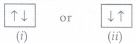
The two electrons have opposite spin, if one is revolving clockwise, the other is revolving anticlockwise or vice versa.
(iii) Hund's Rule of Maximum Multiplicity: Electron pairing in p, d and f orbitals cannot occur until each orbital of a given subshell contains one electron each or is single occupied.
For example: For the element nitrogen which contains 7 electrons, the following configuration can be written.
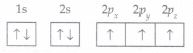
Total spin of unpaired electrons \(=\frac { 1 }{ 2 } +\frac { 1 }{ 2 } +\frac { 1 }{ 2 } =1\frac { 1 }{ 2 } \)
22.
Electron gain enthalpy is the energy released when an isolated gaseous atom is converted into a negative ion by adding an extra electron. Electron gain enthalpy is denoted by the sign \(\triangle\)eg H.
The process may be represented by
M(g) + e- ⟶ M- (g)
neutral gaseous anion atom
\(\triangle\) H = \(\triangle\)eg H
electron gain enthalpy is negative or positive it depends upon the nature of the element. For example. For halogens it is highly negative, because they can acquire the noble gas configuration by accepting an extra electron. In contrast. For noble gases have positive electron gain enthalpy because energy has to be supplied to the element.
Factors on which electron gain enthalpy depends:
(i) Atomic size. As the size of an atom increases, the distance between its nucleus and the incoming electron also increases. Therefore, the force of attraction between the nucleus and the incoming electron decreases and hence the electron gain enthalpy becomes less negative.
(ii) Nuclear charge. As the nuclear charge increases force of attraction for the incoming electron increases and thus electron gain enthalpy becomes more negative.
(iii) Symmetry of electronic configuration. Elements having symmetrical configuration (Either half filled or fully filled orbitals in the same subshell) having no attraction for electron because by accepting electron their configuration becomes less stable. In that case energy has to be supplied to accept electron. Thus electron gain enthalpy will be positive.
23.
Electronegativity:
1. The tendency of an atom in a molecule to attract the shared pair of electrons towards itself is known as electronegativity.
2. There is no specific unit for electronegativity. In the modern periodic table:
3. In the modern periodic table: as we move left to right, across a period the nuclear charge increases, atomic size decreases, and electronegativity value increases.
4. As we move down the group there is an increase in the atomic number also nuclear charge and a decrease in the electronegativity value.
5. In general, metal shows a lower electronegativity value compared to on-metals.
| Electronegativity: | Electron gain enthalpy |
| 1. An atom in a molecule tends to attract the shared pair of electrons towards itself known as electronegativity. | 1. Electron gain enthalpy is defined as the amount of energy released when an electron is added to an isolated gaseous atom. |
| 2. It is the property of a bonded atom. | 2. It is the property of an isolated atom. |
| 3. It has no unit. | 3. Its unit is KJ/ mol. |
| 4. The values of electronegativity cannot be determined experimentally. | 4. An element has a constant value of the electron gain enthalpy that can be calculated experimentally. |
24.
We know that, mass of electron = 9.11 x 10⁻³¹ kg
h = 6.626 x 10⁻³⁴ Js
Wavelength,
\(\lambda =\frac { h }{ mv } =\frac { 6.626\times{ 10 }^{ -34 }kg \ { m }^{ 2 }{ s }^{ -1 } }{ 9.11\times{ 10 }^{ -31 }kg\times2.19\times{ 10 }^{ 6 }\times m{ s }^{ -1 } }\)
\( \lambda =3.32\times{ 10 }^{ -10 }m=332pm\)
25.
(c)
Nuclear mass
26.
In the modern periodic table, each period begins with the filling of a new shell. Therefore, the period indicates the value of principal quantum number. Thus, option (c) is correct.
27.
(b)
the extra stability of half-filled p-orbitals
28.
(a)
198 pm
29.
(c)
\((n-1) d^{1-10} n s^{0-2}\)
30.
(a)
Ubn and unbinilium
31.
(a)
periods, groups
32.
(a)
3d54s2
33.
(c)
3d
34.
(a)
\(\lambda =\frac { h }{ mv } \)
35.
(b)
visible region
36.
(c)
greater than the number of protons
37.
(c)
Li and Mg
38.
(c)
ns2 np2
39.
40.
(c) Assertion is true but Reason is false.
41.
42.
43.
(a) Number of orbitals = n 2 = 3 2 = 9 orbitals, 3s, 3 px, 3 py , 3 pz, 3 d x2 - y2, 3 dz2, 3 dxy, 3 dyz and 3 dzx.
(b) (i) 2p (ii) 4s
(c) Orbital can have maximum two electron which must be of opposite spin.
(d) 's' orbitals are spherical and 'p' orbitals have dumb-bell shaped.
(e) d x2 - y2 , dz2.

11th Standard CBSE Syllabus & Materials
11th Standard CBSE
CBSE 11th Business Studies Forms of Business Organisation Sample Question Papers Study Material - QB365 Set A
NEW11th Standard CBSE
CBSE 11th Business Studies Business, Trade and Commerce Sample Question Papers Study Material - QB365 Set A
NEW11th Standard CBSE
CBSE 11th Physics Waves Sample Question Papers Study Material - QB365 Set A
NEW11th Standard CBSE
CBSE 11th Physics Kinetic Theory Sample Question Papers Study Material - QB365 Set A



NCERT Books

Syllabus

Exam Pattern

Sample Question Papers

Previous year Question Papers

Important Notes

MCQ Practice test

NCERT Exemplers

Case study Questions

Image Based Questions

Passage based Questions

HOT Questions

Value Based Questions

Model Questions Papers
NCERT ( Book Back ) Questions

Assertion and Reason
Important Questions And Answers

CBSE 11th Standard CBSE Subjects
CBSE Standards