
 100% FREE ACCESS
11th Standard CBSE Syllabus & Materials
11th Standard CBSE
CBSE 11th Economics PART-A - Presentation of Data - New Sample Question Papers Study Material - QB365 Set A
NEW11th Standard CBSE
CBSE 11th Economics PART-A - Organisation of Data - New Sample Question Papers Study Material - QB365 Set A
NEW11th Standard CBSE
CBSE 11th Economics PART-A - Collection of Data - New Sample Question Papers Study Material - QB365 Set A
NEW11th Standard CBSE
CBSE 11th Economics PART-A - Introduction to Economics and Statistics - New Sample Question Papers Study Material - QB365 Set A
NEW11th Standard CBSE
CBSE 11th Business Studies International Trade Sample Question Papers Study Material - QB365 Set A
NEW11th Standard CBSE
CBSE 11th Business Studies Evolution and Fundamentals of Business Sample Question Papers Study Material - QB365 Set A

Published on: 27/05/2021
QB365 Provides the updated NCERT Exemplar Questions for Class
11, and also provide the detail solution for each and every NCERT Exemplar questions. NCERT Exemplar questions are latest updated question pattern from NCERT, QB365 will helps to get more marks in Exams
Download CBSE Class 11th Standard CBSE Chemistry question papers, sample papers, important questions, and previous year solved papers in PDF format. Get free study materials, NCERT solutions, and exam preparation resources for Class 11th Standard CBSE Chemistry
Questions + Answers key
Take MCQ Chemistry Test
1.
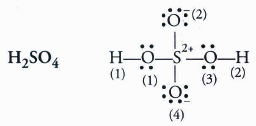
Write lewis structure of the following compounds and show formal charge each atom.
2.
Which of these compounds has the highest dipole moment?
3.
Give reasons for the following. Ethyne molecule is linear.
4.
Give reasons for the following. Covalent bonds are directional bond while ionic bonds are non-directional.
5.
Explain the non-linear shape of H2S and non-planar shape of pcl3 using valence shell electron pair repulsion theory.
1.
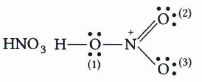
Formal charge on an atom in a Lewis structure
= [total number of valence electrons in free atom]
- [total number of non-bonding (lone pairs) electrons]
- \(\frac { 1 }{ 2 } \)[total number of bonding or shared electron]
Formal charge on H = 1 - 0 x 2 = 0
Formal charge on N = 5 - 0 x 8 = 1
Formal charge on O (1) = 6 - 4 - x 4 = 0
Formal charge on O (2) = 6 - 4 - x 4 = 0
Formal charge on O (3) = 6 - 6 - x 2 = -1
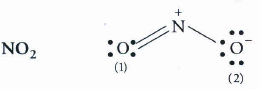
On solving we get, formal charges on O(1), N and O(2) as 0, +1 and -1 respectively.
Similarly, on solving we get formal charge on H(1), H(2), O(2), O(3), O(4) ans S, as 0, 0, 0, -1 , 0, -1 and +2 respectively.
2.
Z has seven electrons in its valence shell. It is the most electronegative element. Therefore, HZ will have the highest dipole moment.
3.
In ethyne molecule, both the carbon atoms are sp hybridised having two unhybridised orbitals, i.e. 2Px and 2Py. The two sp hybrid orbitals of both the carbon atoms are oriented in opposite direction forming an angle of 180o.
\(H-C\overset { \sigma }{ \underset { 2\pi -bond }{ \equiv } C } -H\)
That's why ethyne molecule is linear.
4.
A covalent bond is formed by the overlapping of atomic orbitals. The direction of overlapping gives the direction of bond. In ionic bond, the electrostatic field of an ion is non-directional. Each positive ion is surrounded by a number of anions in any direction depending upon its size and vice-versa.
That's why covalent bonds are directional bonds while ionic bonds are non-directional.
5.
H2S-In the central atom is sulphur. There are 6 electrons in its valence shell (16S = 2,8,6).Two electrons are shared with two H-atoms and the remaining four electrons are present as two one pair. Hence, total pairs of electrons are four(2 bond pairs and 2 lone pairs).
Due to the presence of 2 lone pairs the shape becomes distorted tetrahedral or angular or bent (non-linear).
PCl3-In the central atom is phosphorus. There are 5 electrons in its valence shell (16P = 2,8,5).Three electrons are shared with three Cl-atoms and the remaining two electrons are present as one long pair. Hence, total pairs of electrons are four(1 lone pairs and 3 bond pairs). Due to the presence of one lone pair, the shape becomes pyramidal (non-planar).

11th Standard CBSE Syllabus & Materials
11th Standard CBSE
CBSE 11th Business Studies Forms of Business Organisation Sample Question Papers Study Material - QB365 Set A
NEW11th Standard CBSE
CBSE 11th Business Studies Business, Trade and Commerce Sample Question Papers Study Material - QB365 Set A
NEW11th Standard CBSE
CBSE 11th Physics Waves Sample Question Papers Study Material - QB365 Set A
NEW11th Standard CBSE
CBSE 11th Physics Kinetic Theory Sample Question Papers Study Material - QB365 Set A

NCERT Books

Syllabus

Exam Pattern

Sample Question Papers

Previous year Question Papers

Important Notes

MCQ Practice test

NCERT Exemplers

Case study Questions

Image Based Questions

Passage based Questions

HOT Questions

Value Based Questions

Model Questions Papers
NCERT ( Book Back ) Questions

Assertion and Reason
Important Questions And Answers

CBSE 11th Standard CBSE Subjects
CBSE Standards