 100% FREE ACCESS
11th Standard CBSE Syllabus & Materials
11th Standard CBSE
CBSE 11th Economics PART-A - Presentation of Data - New Sample Question Papers Study Material - QB365 Set A
NEW11th Standard CBSE
CBSE 11th Economics PART-A - Organisation of Data - New Sample Question Papers Study Material - QB365 Set A
NEW11th Standard CBSE
CBSE 11th Economics PART-A - Collection of Data - New Sample Question Papers Study Material - QB365 Set A
NEW11th Standard CBSE
CBSE 11th Economics PART-A - Introduction to Economics and Statistics - New Sample Question Papers Study Material - QB365 Set A
NEW11th Standard CBSE
CBSE 11th Business Studies International Trade Sample Question Papers Study Material - QB365 Set A
NEW11th Standard CBSE
CBSE 11th Business Studies Evolution and Fundamentals of Business Sample Question Papers Study Material - QB365 Set A

Published on: 28/05/2021
QB365 Provides the HOT Question Papers for Class 11 Chemistry, and also provide the detail solution for each and every HOT Questions. HOT Questions will help to get more idea about question pattern in every exams and also will help to get more marks in Exams
Download CBSE Class 11th Standard CBSE Chemistry question papers, sample papers, important questions, and previous year solved papers in PDF format. Get free study materials, NCERT solutions, and exam preparation resources for Class 11th Standard CBSE Chemistry
Questions + Answers key
Take MCQ Chemistry Test1.
Give reasons.
A mixture of dilute NaOH and aluminium pieces is used to open drain.
2.
Give reasons.
Conc.HNO3 can be transported in aluminium container.
3.
Calculate the free energy change when 1 mole of NaCl is dissolved in water at 298 K. (Given, lattice energy of NACl = -777.8 kJ mol-1 , hydration energy = -774.1 kJ mol-1 and \(\Delta S=0.043kJ \ K^{ -1 }mol^{ -1 }\) at 298 K).
4.
Starting with the thermodynamic relationship G = H - TS, derive the following relationship
\(\Delta G=-T\Delta S_{ total }\)
5.
Why standard entropy of an elementary substance is not zero whereas standard enthalpy of formation is taken as zero?
6.
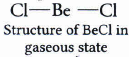
Discuss the hybridisation of Be in gaseous state and solid state.
7.
Explain why HF is less viscous than H2O
8.
Aluminium forms the ion Al3+ , but not Al 4+ why?
9.
Calculate the approximate charge in coulomb and approximate mass in kilogram of the nucleus of lithium 7 isotope.
10.
In Rutherford’s experiment, generally the thin foil of heavy atoms, like gold, platinum etc. have been used to be bombarded by the α-particles. If the thin foil of light atoms like aluminium etc. is used, what difference would be observed from the above results ?
1.
NaOH reacts with Al to evolve dihydrogen gas. The pressure of the hydrogen gas can be used to open drains.
2Al(s) + 2NaOH(aq) + 2H2O(l) \(\rightarrow \) 2NaAlO2(aq) + 2H2(g)
2.
Al reacts with conc. HNO3 to form a protective layer of aluminium oxide on its surface which prevents it from further reaction.
\(2Al(s)+6HNO_{ 3 }(conc.)\rightarrow Al_{ 2 }O_{ 3 }(s)+6NO_{ 2 }(g)+3H_{ 2 }O(l)\)
Alumina (a passive protective layer)
Therefore, Al becomes passive that's why aluminium containers can be used to transport conc.HNO3.
3.
\(\Delta H=hydration \ energy-lattice \ energy\)
\(\Delta H=-774.1kJmol^{ -1 }-(-777.8kJmol^{ -1 })=3.7kJmol^{ -1 }\)
\(\Delta G=-9.11kJmol^{ -1 }\)
4.
\(G=H-TS,\quad G_{ 1 }=H_{ 1 }-TS_{ 1 },{ G }_{ 2 }=H_{ 2 }-TS_{ 2 }\)
\( G_{ 2 }-G_{ 1 }=H_{ 2 }-H_{ 1 }-T({ S }_{ 2 }-S_{ 1 })\)
\( \Delta G=\Delta H-T\Delta S\)
\( \Delta S_{ total }=\Delta S_{ sys }+\Delta S_{ sure }\)
\( \Rightarrow \Delta S_{ total }=\Delta S_{ sys }-\frac { q }{ T } \)
\( \Rightarrow T\Delta S_{ total }=T\Delta S_{ sys }-q=T\Delta S_{ sys }-\Delta H\)
\(T\Delta S_{ total }=-\Delta G\Rightarrow \Delta G=-T\Delta S_{ total }\)
5.
A substance has a perfectly ordered arrangement of its constituent particles only at absolute zero. Hence, entropy is zero only at absolute zero. Enthalpy of formation is the heat change involved in the formation of one mole of the substance from its elements. An element formed from itself means no heat change, i.e \(\Delta _{ f }H^{ \circ }=0\) .
6.
In gaseous state at high temperature, BeCl2 exists as linear molecule Cl-Be-Cl, thus the hybridisation of the central atoms is sp
In solid state,it has a polymeric structure with chlorine bridges as follows

Two Cl-atoms are listed to be atom by two coordination bonus and two by covalent bonds. For these bonds to be formed, Be in the excited state with the configuration undergoes Sp3 hybridization. Two half-filled hybrid orbitals will form normal covalent bonds with two Cl-atoms. The other two Cl-atoms are coordinated to Be-atom. The other two Cl-atoms are coordinated be Be-atom by donating electron pairs into the empty hybrid orbitals.
7.
There is greater intermolecular hydrogen bonding in H2 O than that in HF as each H2 O molecule forms four H-bonds with water molecules,, whereas HF forms only H-bonds with other HF molecules. Greater the intermolecular H-bonding, greater is the viscosity. Hence, HF is less viscous than H2 O
8.
Aluminium \(([Ne]^{ 3{ s }^{ 2 } } \ 3p'\) can achien the electronic configuration of the nearest noble gas (Ne) by losing only three electrons, Al3+ = 1s22s22p6 . Aluminium with not form the Al4+ ion because an extremely high amount of energy would be required to remove an electron from the stable noble gas configuration.
9.
Nucleus of Li atom has 3 protons and 4 neutrons.
Charge on one proton =1.60 x 10⁻¹⁹ coulombs
Charge on 3 protons (i.e. charge on nucleus)
= \(3\times 1.60\times 10^{ -19 }C=4.80\times 10^{ -19 }C\)
Mass of proton mass of neutron \(\simeq 1.67\times 10^{ -27 }kg\)
Mass of nucleus = \(7\times 1.67\times 10^{ -27 }kg\)
= \(11.69\times 10^{ -27 }kg\)
10.
Heavy atoms such as gold, platinum have nucleus. Heavy nucleus contains large amount of positive charge. When a beam of \(\alpha \)-particles is shot at a thin gold foil, most of them pass through without much effect.
Some however, are deflected back or by small angles due to enormous repulsive force of heavy nucleus. If light aluminium foil is used, the number of \(\alpha \) -particles deflected back or those deflected by small angles will be negligible.

11th Standard CBSE Syllabus & Materials
11th Standard CBSE
CBSE 11th Business Studies Forms of Business Organisation Sample Question Papers Study Material - QB365 Set A
NEW11th Standard CBSE
CBSE 11th Business Studies Business, Trade and Commerce Sample Question Papers Study Material - QB365 Set A
NEW11th Standard CBSE
CBSE 11th Physics Waves Sample Question Papers Study Material - QB365 Set A
NEW11th Standard CBSE
CBSE 11th Physics Kinetic Theory Sample Question Papers Study Material - QB365 Set A



NCERT Books

Syllabus

Exam Pattern

Sample Question Papers

Previous year Question Papers

Important Notes

MCQ Practice test

NCERT Exemplers

Case study Questions

Image Based Questions

Passage based Questions

HOT Questions

Value Based Questions

Model Questions Papers
NCERT ( Book Back ) Questions

Assertion and Reason
Important Questions And Answers

CBSE 11th Standard CBSE Subjects
CBSE Standards