
 100% FREE ACCESS
11th Standard CBSE Syllabus & Materials
11th Standard CBSE
CBSE 11th Economics PART-A - Presentation of Data - New Sample Question Papers Study Material - QB365 Set A
NEW11th Standard CBSE
CBSE 11th Economics PART-A - Organisation of Data - New Sample Question Papers Study Material - QB365 Set A
NEW11th Standard CBSE
CBSE 11th Economics PART-A - Collection of Data - New Sample Question Papers Study Material - QB365 Set A
NEW11th Standard CBSE
CBSE 11th Economics PART-A - Introduction to Economics and Statistics - New Sample Question Papers Study Material - QB365 Set A
NEW11th Standard CBSE
CBSE 11th Business Studies International Trade Sample Question Papers Study Material - QB365 Set A
NEW11th Standard CBSE
CBSE 11th Business Studies Evolution and Fundamentals of Business Sample Question Papers Study Material - QB365 Set A

Published on: 28/05/2021
QB365 Provides the HOT Question Papers for Class 11 Chemistry, and also provide the detail solution for each and every HOT Questions. HOT Questions will help to get more idea about question pattern in every exams and also will help to get more marks in Exams
Download CBSE Class 11th Standard CBSE Chemistry question papers, sample papers, important questions, and previous year solved papers in PDF format. Get free study materials, NCERT solutions, and exam preparation resources for Class 11th Standard CBSE Chemistry
Questions + Answers key
Take MCQ Chemistry Test1.
An alkane has a molecule mass of 72. Give all the possible structural isomers along with their IUPAC names.
2.
A tetravalent element forms monoxide and dioxide withoxygen. When air is passed over heated element(1273 K), Producer gas is obtained. Monoxide of the element is powerful reducing agent and reduces ferric oxide to iron. Identify the element and write formulas of its monoxide and dioxide.
Write chemical equations for the formation of prodecur gas and reduction of ferric oxide with the monoxide.
3.
Due to this property hydrogen is used for the manufacture of vanaspati ghee from edible oils such as cotton-seed oil, soyabean oil, corn oil etc.
4.
Describe the industrial applications of hydrogen dependent on the heat liberated when its atoms are made to combine on the surface of a metal.
5.
What is the minimum volume of water required to dissolve 1g of calcium sulphate at 298 K? (For calcium sulphate, Ksp is 9.1 x 10⁻⁶).
6.
A man takes a diet equivalent to 10000 kJ per day and does work, in expending his energy in all forms equivalent to 12500 kJ per day. What is change in internal energy per day?If the energy lost was stored as sucrose (1632 kJ pre 100g), how many days should it take to lose 2kg of his weight?(Ignore water loss)
7.
Indicate the type of bonds present in NH4No3 and state the mode of hybridisation of two N-atoms in it.
8.
What is meant by the term bond order? Calculate the bond order of : N2, O2, O2 +, \({ O }_{ 2 }^{ - }\)
9.
Prove that density of the nucleus is constant.
1.
The general formula of alkanes is CnH2n+2=12xn+1x(2n+2)=72 or 12n+2n+2=72 or n=5
Thus, the molecular formula of the alkane is C5H12. For structural isomers and their IUPAC names.
2.
Producer gas is a mixture of CO and N2, therefore, the tetravalent element is carbon and its monoxide and dioxide are CO and CO2 respectively.
\(2C(s)+\underbrace { O_{ 2 }(s)+4N_{ 2 }(g) }_{ Air } \overset { 1273k }{ \rightarrow } \underbrace { 2CO(g)+4N_{ 2 }(g) }_{ Producer \ gas } \)
The carbon monoxide is a strong reducing agent and reduces ferric oxide to iron.
\(Fe_{ 2 }O_{ 3 }(s)+3CO(g)\overset { \Delta }{ \rightarrow } 2Fe(s)+3CO_{ 2 }(g)\)
3.
Due to this property dihydrogen is used for the manufacture of ammonia (Haber's process)
\(N_{ 2 }(g)+3H_{ 2 }(g)\overset { 673K, \ 200 \ atm }{ \underset { Fe,Mo }{ \rightleftharpoons } } 2NH_{ 3 }(g)\)
4.
Due to this property hydrogen is used in atomic hydrogen welding/cutting torch.
5.
\({ CaSO }_{ 4 }\rightleftharpoons { Ca }^{ 2+ }+{ SO }_{ 4 }^{ 2- };{ K }_{ sp }=9.1\times { 10 }^{ -6 }\)
S S S
Where s is the solubility of CaSO4
\({ K }_{ sp }=\left[ { Ca }^{ 2+ } \right] \left[ { SO }_{ 4 }^{ 2- } \right] =S.S={ S }^{ 2 }\)
\(S=\sqrt { { K }_{ sp } } =\sqrt { 9.1\times { 10 }^{ -6 } } \Rightarrow S=3.017\times { 10 }^{ -3 }M\)
Solubility of CaSO4 = 3.017 x 10⁻³ mol-1
= 3.017 x 10-3 x 136 gL-1
(Molar mass of CaSO4 =136 g mol-1)
= 410.3 x 10⁻³ gL-1
410.3x10⁻³ g CaSO4 is dissolved in = 1L
1g CaSO4 is dissolved in = \(\frac { 1\times 1 }{ 410.3\times { 10 }^{ -3 } } \) = 2.437 L
6.
Energy taken by a man = 10000 kJ
Change in internal energy per day = 12500 - 10000 = 2500 kJ
The energy is lost by the man as he expends more energy than he takes.Now 100g of sugar corresponds to energy = 1632 kJ loss in energy.
2000g of sugar corresponds to energy = \(\frac { 1632\times 2000 }{ 100 } \)
= 32640 kJ
Number of days required to lose 2000g of weight or 32640 kJ of energy = \(\frac { 32640 }{ 2500 } \) = 13days
7.
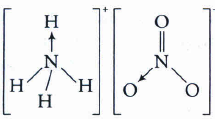
\({ NH }_{ 4 }^{ + }\) ion contains covalent and dative bonds. (It is formed by donation of lone pair of electrons on N in NH3 to H+ ion). \({ NO }_{ 3 }^{ - }\) ion also contains covalent and davite bonds.
Bond between \({ NH }_{ 4 }^{ + }\) and \({ NO }_{ 3 }^{ - }\) ions is ionis.
N of \({ NH }_{ 4 }^{ + }\) ion is sp3 hydridised and is tetrahedral.
N of \({ NO }_{ 3 }^{ - }\) ion is sp2 hybridised and is planar.
8.
Bond order is defined as one half the difference between the number of electron present in the bonding and anti-bonding orbitals, i.e
Bond order (BO) \(=\frac { 1 }{ 2 } ({ N }_{ b }-{ N }_{ a })\)
A positive bond order means a stable molecule while a negative or zero bond order means an unstable molecule.
Stability of a molecule \(\propto \) bond order
Bond length \(\propto \) \(\frac { 1 }{ bond \ order } \)
Bond order values 1,2 or 3 corresponding to single, double or triple bonds respectively.
9.
Radius of the nucleus = \(1.33\times { 10 }^{ -11 }\times A^{ 1/3 }m\)
Density of nucleus \(=\frac { mass }{ volume } \)
\(=\frac { A\times 1.66\times 10^{ -27 }kg }{ \frac { 4 }{ 3 } \times \pi \times (1.33\times 10^{ -11 }\times { A }^{ 1/3 })^{ 3 } } \)
= constant
Thus, density of nucleus is constant, independent of the element under consideration.

11th Standard CBSE Syllabus & Materials
11th Standard CBSE
CBSE 11th Business Studies Forms of Business Organisation Sample Question Papers Study Material - QB365 Set A
NEW11th Standard CBSE
CBSE 11th Business Studies Business, Trade and Commerce Sample Question Papers Study Material - QB365 Set A
NEW11th Standard CBSE
CBSE 11th Physics Waves Sample Question Papers Study Material - QB365 Set A
NEW11th Standard CBSE
CBSE 11th Physics Kinetic Theory Sample Question Papers Study Material - QB365 Set A



NCERT Books

Syllabus

Exam Pattern

Sample Question Papers

Previous year Question Papers

Important Notes

MCQ Practice test

NCERT Exemplers

Case study Questions

Image Based Questions

Passage based Questions

HOT Questions

Value Based Questions

Model Questions Papers
NCERT ( Book Back ) Questions

Assertion and Reason
Important Questions And Answers

CBSE 11th Standard CBSE Subjects
CBSE Standards