 100% FREE ACCESS
11th Standard CBSE Syllabus & Materials
11th Standard CBSE
CBSE 11th Economics PART-A - Presentation of Data - New Sample Question Papers Study Material - QB365 Set A
NEW11th Standard CBSE
CBSE 11th Economics PART-A - Organisation of Data - New Sample Question Papers Study Material - QB365 Set A
NEW11th Standard CBSE
CBSE 11th Economics PART-A - Collection of Data - New Sample Question Papers Study Material - QB365 Set A
NEW11th Standard CBSE
CBSE 11th Economics PART-A - Introduction to Economics and Statistics - New Sample Question Papers Study Material - QB365 Set A
NEW11th Standard CBSE
CBSE 11th Business Studies International Trade Sample Question Papers Study Material - QB365 Set A
NEW11th Standard CBSE
CBSE 11th Business Studies Evolution and Fundamentals of Business Sample Question Papers Study Material - QB365 Set A

Published on: 28/05/2021
QB365 Provides the HOT Question Papers for Class 11 Chemistry, and also provide the detail solution for each and every HOT Questions. HOT Questions will help to get more idea about question pattern in every exams and also will help to get more marks in Exams
Download CBSE Class 11th Standard CBSE Chemistry question papers, sample papers, important questions, and previous year solved papers in PDF format. Get free study materials, NCERT solutions, and exam preparation resources for Class 11th Standard CBSE Chemistry
Questions + Answers key
Take MCQ Chemistry Test1.
When the first element of the periodic table is treated with dioxygen, it gives a compound whose solid state floats on its liquid state. This compound has an ability to act as an acid as well as a base. What products will be formed when this compound undergoes auto ionisation?
2.
An ionic hydride of an alkali metal has significant covalent character and is almost unreactive towards oxygen and chlorine. This is used in the synthesis of other useful hydrides. Write its reaction with \({ Al }_{ 2 }{ Cl }_{ 6 }\)
3.
Calculate the pH of 10-8M HCl
4.
Iron pieces are attracted towards a magnet but zinc pieces are not. Why?
5.
If uncertainties in the measurement of position and momentum of an electron are found to be equal in magnitude, what is the uncertainty in the measurement of velocity of the electron? Comment on the result obtained?
1.
The first element of the periodic table is H and its molecular form is dihydrogen (H 2). When dihydrogen reacts with dioxygen, water is formed.
Water is a liquid at room temperature. When liquid water freezes, it expands to form ice. In other words, the density of ice is lower than that of liquid water and hence, ice floats over water.
Water is amphoteric in nature, i.e. it acts as an acid in presence of strong bases and as a base in the presence of strong acids.
\(\begin{matrix} { H }_{ 2 }O\left( l \right) \\ { Acid }_{ 1 } \end{matrix}+\begin{matrix} { NH }_{ 3 }\left( aq \right) \\ Base_{ 2 } \end{matrix}\longrightarrow \begin{matrix} { NH }_{ 4 }^{ + }\left( aq \right) \\ { Acid }_{ 2 } \end{matrix}+\begin{matrix} { OH }^{ - }\left( aq \right) \\ Base_{ 1 } \end{matrix}\\ \begin{matrix} { H }_{ 2 }O\left( l \right) \\ Base_{ 1 } \end{matrix}+\begin{matrix} { H }_{ 2 }S\left( aq \right) \\ { Acid }_{ 2 } \end{matrix}\longrightarrow \begin{matrix} { H }_{ 3 }{ O }^{ + }\left( aq \right) \\ { Acid }_{ 1 } \end{matrix}+\begin{matrix} { HS }^{ - }\left( aq \right) \\ Base_{ 2 } \end{matrix}\)
Due to amphoteric character, water undergoes self-ionisation as shown below.
\(\begin{matrix} { H }_{ 2 }O\left( l \right) \\ { Acid }_{ 1 } \end{matrix}+\begin{matrix} { H }_{ 2 }O\left( base \right) \\ Base_{ 2 } \end{matrix}\rightleftharpoons \begin{matrix} { H }_{ 3 }{ O }^{ + }\left( aq \right) \\ { Acid }_{ 1 } \\ \left( Conjugate \ acid \right) \end{matrix}+\begin{matrix} { OH }^{ - }\left( aq \right) \\ Base_{ 2 } \\ \left( Conjugate \ Base \right) \end{matrix}\)
The self-ionisation of water is called autoprotolysis.
2.
It is LiH because it has significant covalent character due to the smallest alkali metal Li. LiH is very stable. It is almost unreactive towards oxygen and chlorine.
It reacts with \({ Al }_{ 2 }{ Cl }_{ 6 }\) to form lithium aluminium hydride.
\(8LiH+{ Al }_{ 2 }{ Cl }_{ 6 }\longrightarrow 2LiAl{ H }_{ 4 }+6LiCl\)
3.
\(\because \) pH = -log[H+] =-log 10-8 = 8
But this is not true because an acidic solution cannot have pH greater than 7. In this condition,[H+] of water cannot be neglected.
Therefore,[H+]total = [H+]HCl+[H+]\({ H }_{ 2 }O\)= 10-8+10-7
= 10-8(1 + 10) = 11\(\times \)10-8
Now from, pH = -log[H+] = -log(11\(\times \)10-8)
= -log 11-log 10-8 = 6.958
4.
Electronic configuration of iron suggests that it contains unpaired electrons (\(_{ 26 }Fe=\left[ Ar \right] 3d^{ 6 }{ 4s }^{ 2 }\)
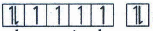
and hence it is paramagnetic whereas zinc has no unpaired electron
\((_{ 30 }Zn=\left[ Ar \right] ^{ 18 }3d^{ 10 }{ 4s }^{ 2 }) \) and hence, it is diamagnetic. It is rather repelled by the magnet.
5.
\(\triangle x\times \triangle P=\frac { h }{ 4\pi } ,\ As \ \triangle x=\triangle P\)
\( \therefore { \left( \triangle P \right) }^{ 2 }=\frac { h }{ 4\pi } or\quad \triangle P=\sqrt { \frac { h }{ 4\pi } } or \ m\times \triangle v=\sqrt { \frac { h }{ 4\pi } } \)
\( or \ \triangle v=\frac { 1 }{ m } \sqrt { \frac { h }{ 4\pi } } =\frac { 1 }{ 9.11\times { 10 }^{ -31 } } \times \sqrt { \frac { 6.626\times { 10 }^{ -34 } }{ 4\times 3.14 } }\)
\( =\frac { 0.726\times { 10 }^{ -17 } }{ 9.11\times { 10 }^{ -31 } } =7.89\times { 10 }^{ 12 }{ ms }^{ -1 }\)
Thus, uncertainty in velocity is greater than the velocity of light which is impossible. Thus, the two uncertainties cannot be equal in magnitude.
11th Standard CBSE Syllabus & Materials
11th Standard CBSE
CBSE 11th Business Studies Forms of Business Organisation Sample Question Papers Study Material - QB365 Set A
NEW11th Standard CBSE
CBSE 11th Business Studies Business, Trade and Commerce Sample Question Papers Study Material - QB365 Set A
NEW11th Standard CBSE
CBSE 11th Physics Waves Sample Question Papers Study Material - QB365 Set A
NEW11th Standard CBSE
CBSE 11th Physics Kinetic Theory Sample Question Papers Study Material - QB365 Set A

NCERT Books

Syllabus

Exam Pattern

Sample Question Papers

Previous year Question Papers

Important Notes

MCQ Practice test

NCERT Exemplers

Case study Questions

Image Based Questions

Passage based Questions

HOT Questions

Value Based Questions

Model Questions Papers
NCERT ( Book Back ) Questions

Assertion and Reason
Important Questions And Answers

CBSE 11th Standard CBSE Subjects
CBSE Standards