
 100% FREE ACCESS
11th Standard CBSE Syllabus & Materials
11th Standard CBSE
CBSE 11th Economics PART-A - Presentation of Data - New Sample Question Papers Study Material - QB365 Set A
NEW11th Standard CBSE
CBSE 11th Economics PART-A - Organisation of Data - New Sample Question Papers Study Material - QB365 Set A
NEW11th Standard CBSE
CBSE 11th Economics PART-A - Collection of Data - New Sample Question Papers Study Material - QB365 Set A
NEW11th Standard CBSE
CBSE 11th Economics PART-A - Introduction to Economics and Statistics - New Sample Question Papers Study Material - QB365 Set A
NEW11th Standard CBSE
CBSE 11th Business Studies International Trade Sample Question Papers Study Material - QB365 Set A
NEW11th Standard CBSE
CBSE 11th Business Studies Evolution and Fundamentals of Business Sample Question Papers Study Material - QB365 Set A

Published on: 26/05/2021
QB365 Provides the updated NCERT Exemplar Questions for Class
11, and also provide the detail solution for each and every NCERT Exemplar questions. NCERT Exemplar questions are latest updated question pattern from NCERT, QB365 will helps to get more marks in Exams
Download CBSE Class 11th Standard CBSE Physics question papers, sample papers, important questions, and previous year solved papers in PDF format. Get free study materials, NCERT solutions, and exam preparation resources for Class 11th Standard CBSE Physics
Questions + Answers key
Take MCQ Physics Test1.
The oxygen molecule has a mass of 5.30 × 10⁻²⁶ kg and a moment of inertia of 1.94 × 10-46 kg m2 about an axis through its centre perpendicular to the lines joining the two atoms. Suppose the mean speed of such a molecule in a gas is 500 m/s and that its kinetic energy of rotation is two thirds of its kinetic energy of translation. Find the average angular velocity of the molecule.
2.
A solid sphere rolls down two different inclined planes of the same heights but different angles of inclination.
(a) Will it reach the bottom with the same speed in each case?
(b) Will it take longer to roll down one plane than the other?
(c) If so, which one and why?
3.
A disc of radius R is rotating with an angular speed \(\omega \), about a horizontal axis. It is placed on a horizontal table. The coefficient of kinetic friction is \({ \mu }_{ k }\).
(i) What was the velocity of its centre of mass before being brought in contact with the table?
(ii) What happens to the linear velocity of a point on its rim when placed in contact with the table?
(iii) What happens to the linear speed of the centre of mass when disc is placed in contact with the table?
(iv) Which force is responsible for the effect in (ii) and (iii)?
(v) What condition should be satisfied for rolling to begin?
(vi) Calculate the time taken for the rolling to begin.
4.
(a) A child stands at the centre of a turntable with his two arms outstretched. The turntable is set rotating with an angular speed of 40 rev/min. How much is the angular speed of the child if he folds his hands back and thereby reduces his moment of inertia to 2/5 times the initial value ? Assume that the turntable rotates without friction.
(b) Show that the child’s new kinetic energy of rotation is more than the initial kinetic energy of rotation. How do you account for this increase in kinetic energy?
1.
Here, m = 5.30\(\times\)10-26 kg
I = 1.94\(\times\)10-46kg m2
v =500 m/s
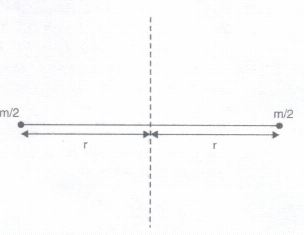
If \(\frac { m }{ 2 } \)is mass of each atom of oxygen and 2r is distance between the two atoms as shown in Fig.then
\(I=\frac { m }{ 2 } { r }^{ 2 }+\frac { m }{ 2 } { r }^{ 2 }={ mr }^{ 2 }\)
\(r=\sqrt { \frac { 1 }{ m } } =\sqrt { \frac { 1.94\times { 10 }^{ -46 } }{ 5.30\times { 10 }^{ -26 } } } \)
= 0.61\(\times\)10-10 m
As K.E. of rotation= \(\frac { 2 }{ 3 } \)K.E of translation
∴ \(\frac { 1 }{ 2 } I{ \omega }^{ 2 }=\frac { 2 }{ 3 } \times \frac { 1 }{ 2 } { m\omega }^{ 2 }\)
\(\frac { 1 }{ 2 } ({ mr }^{ 2 }){ \omega }^{ 2 }=\frac { 1 }{ 2 } { mv }^{ 2 }\)
\(\omega =\sqrt { \frac { 2 }{ 3 } } \frac { \upsilon }{ r } =\sqrt { \frac { 2 }{ 3 } } \times \frac { 500 }{ 0.61\times { 10 }^{ -10 } } \) = 6.7 1012 rad/s
2.
(a) Using law of conservation of energy
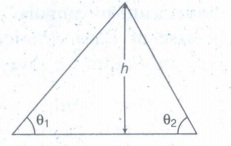
\(\frac { 1 }{ 2 } mv^{ 2 }+\frac { 1 }{ 2 } I{ \omega }^{ 2 }\)=mgh
or \(\frac { 1 }{ 2 } mv^{ 2 }+\frac { 1 }{ 2 } \left( \frac { 2 }{ 5 } m{ R }^{ 2 } \right) \frac { { v }^{ 2 } }{ { R }^{ 2 } } =mgh\)
or \(\frac { 7 }{ 10 } v^{ 2 }=gh\) or v =\(\sqrt { \frac { 10gh }{ 7 } } \)
Since h is same for both the inclined planes therefore v is the same
(b)
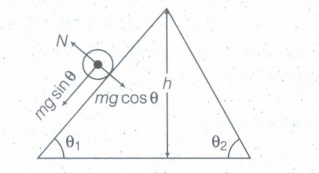
\(l=\frac { 1 }{ 2 } \left( \frac { g\quad sin\quad \theta }{ 1+\frac { { K }^{ 2 } }{ { R }^{ 2 } } } \right) { t }^{ 2 }=\frac { g\quad sin\theta }{ 2\left( 1+\frac { 2 }{ 5 } \right) } { t }^{ 2 }=\frac { 5gsin\theta }{ 14 } { t }^{ 2 }\)
or \(t=\sqrt { \frac { 14l }{ 5g\quad sin\quad \theta } } \)
Now, sin \(\theta\)=\(\frac { h }{ l } \) or l =\(\frac { h }{ sin\theta } \)
∴ \(t=\frac { 1 }{ sin\quad \theta } \sqrt { \frac { 14h }{ 5g } } \)
Lesser the value of,\(\theta\) more will be t.
(c) Clearly, the solid sphere will take longer to roll down the plane with smaller inclination.
3.
(i) Before the disc is brought in contact with table, it is only rotating about its horizontal axis. So, its centre of mass is at rest, i.e. \({ v }_{ CM }=0\).
(ii) When rim is placed in contact with the table, then its linear velocity at any point on the rim of disc will reduce due to kinetic friction.
(iii) If rotating disc is placed in contact with the table, its centre of mass acquires some velocity (which was zero before contact) due to kinetic friction. So, linear velocity of CM will increase.
(iv) kinetic friction.
(v) Rolling will begin when \({ v }_{ CM }=R\omega \).
(vi) Acceleration produced in the centre of mass due to friction \({ a }_{ CM }=\frac { F }{ m } =\frac { { \mu }_{ k }mg }{ m } ={ \mu }_{ k }g\)
Angular acceleration produced by the torque due to friction. \(\alpha =\frac { \tau }{ I } =\frac { { \mu }_{ k }mgR }{ I } \)
\(\therefore \ { v }_{ CM }={ u }_{ CM }+{ a }_{ CM }t\)
\(\Rightarrow { v }_{ CM }={ \mu }_{ k }gt\)
and \(\omega ={ \omega }_{ 0 }+\alpha t\Rightarrow \omega ={ \omega }_{ 0 }-\frac { { \mu }_{ k }{ mg }R }{ I } t\)
For rolling without slipping,
\(\frac { { v }_{ CM } }{ R } ={ \omega }_{ 0 }-\frac { { \mu }_{ k }{ mg }R }{ I } t\)
\(\Rightarrow \ \frac { { \mu }_{ k }{ gt } }{ R } ={ \omega }_{ 0 }-\frac { { \mu }_{ k }{ mg }R }{ I } \)
\(t=\frac { { R\omega }_{ 0 } }{ { { \mu }_{ k }{ g } }\left( 1+\frac { { { mR }^{ 2 } } }{ I } \right) } \).
4.
(a) As no external torque is involved with child + turntable system, so angular momentum of system remains constant.
or \({ I }_{ i }{ \omega }_{ i }={ I }_{ f }{ \omega }_{ f }\)
\({ I }_{ i }{ \omega }_{ i }\) = initial angular momentum, \({ I }_{ f }{ \omega }_{ f }\) = final angular momentum
Here, \({ \omega }_{ i }=40\quad rpm\Rightarrow { I }_{ f }=\frac { 2 }{ 5 } { I }_{ i }\)
Substituting, we get
\({ I }_{ i }\times40=\frac { 2 }{ 5 } { I }_{ i }\times{ \omega }_{ f }\)
or \({ \omega }_{ f }=\frac { 5\times40 }{ 2 } =100\quad rpm\)
(b) \(\frac{\text { Final Kinetic Energy of rotation }}{\text { Initial Kinetic Energy of rotation }}=\frac{\frac{1}{2} I_{2} \omega_{2}^{2}}{\frac{1}{2} I_{1} \omega_{1}^{2}}=\frac{\frac{1}{2} I_{2}\left(2 \pi v_{2}\right)^{2}}{\frac{1}{2} I_{1}\left(2 \pi v_{1}\right)^{2}}\)
\(=\frac{I_{2} v_{2}^{2}}{I_{1} v_{1}^{2}}=\frac{\frac{2}{5} I_{1} \times(100)^{2}}{\frac{2}{5} I_{1} \times(40)^{2}}\)
= 2.5
Clearly, final (K.E) becomes more because the child used his internal energy when he folds his hands to increase the kinetic energy.

11th Standard CBSE Syllabus & Materials
11th Standard CBSE
CBSE 11th Business Studies Forms of Business Organisation Sample Question Papers Study Material - QB365 Set A
NEW11th Standard CBSE
CBSE 11th Business Studies Business, Trade and Commerce Sample Question Papers Study Material - QB365 Set A
NEW11th Standard CBSE
CBSE 11th Physics Waves Sample Question Papers Study Material - QB365 Set A
NEW11th Standard CBSE
CBSE 11th Physics Kinetic Theory Sample Question Papers Study Material - QB365 Set A



NCERT Books

Syllabus

Exam Pattern

Sample Question Papers

Previous year Question Papers

Important Notes

MCQ Practice test

NCERT Exemplers

Case study Questions

Image Based Questions

Passage based Questions

HOT Questions

Value Based Questions

Model Questions Papers
NCERT ( Book Back ) Questions

Assertion and Reason
Important Questions And Answers

CBSE 11th Standard CBSE Subjects
CBSE Standards