 100% FREE ACCESS
12th Standard CBSE Syllabus & Materials
12th Standard CBSE
CBSE 12th Economics Government Budget and the Economy Previous year Question Papers Study Material - QB365 Set A
NEW12th Standard CBSE
CBSE 12th Computer Science Interface Python with MySQL - New Previous year Question Papers Study Material - QB365 Set A
NEW12th Standard CBSE
CBSE 12th Computer Science Database Concept - New Previous year Question Papers Study Material - QB365 Set A
NEW12th Standard CBSE
CBSE 12th Computer Science Data Communication - New Previous year Question Papers Study Material - QB365 Set A
NEW12th Standard CBSE
CBSE 12th Computer Science Data Structures - New Previous year Question Papers Study Material - QB365 Set A
NEW12th Standard CBSE
CBSE 12th Computer Science Functions - New Previous year Question Papers Study Material - QB365 Set A

Published on: 02/11/2025
Download CBSE Class 12th Standard CBSE Biology question papers, sample papers, important questions, and previous year solved papers in PDF format. Get free study materials, NCERT solutions, and exam preparation resources for Class 12th Standard CBSE Biology
Questions + Answers key
Take MCQ Biology Test
1.
Eichhornia crassipes is an alien hydrophyte introduced in India. Mention the problems posed by this plant.
2.
What is eutrophication?
3.
What is advantage of genetically uniform crop plants?
4.
Name any two conventional methods of ex situ conservation.
5.
Explain the cause of algal bloom in a water body. How does it affect an ecosystem?
6.
What are index species?
7.
Describe ecological role of biodiversity.
8.
Name any four regions in India, where sacred groves are found.
9.
Name the two measures of species diversity
10.
How have human activities caused desertification? Explain
11.
Create an aquatic food chain in a water body into which effluents flow from a pesticide factory. Diagrammatically represent and answer the following questions:
What is the phenomenon called?
12.
What is photochemical smog? How does smog affect the biological world?
13.
When and where was the world summit on sustainable development held? How many countries signed the convention? What was the objective?
14.
Explain giving one example,how co-extinction is one of the causes of loss of biodiversity.List the three other causes also ( without description).
15.
List the uses of biodiversity.
16.
Describe in detail the species-area relationship of biodiversity
17.
If a water body is contaminated with a toxicant, its biomagnification will be more marked in
water
planktons
small fishes
birds
18.
In gobar gas, the maximum amount is that of
butane
methane
propane
carbon dioxide
19.
The domestic sewage in large cities
has a high BOD as it contains both aerobic and anaerobic bacteria.
is processed by aerobic and then anaerobic bacteria in the secondary treatment in Sewage Treatment Plants(STPs).
when treated in STPs does not really require the aeration step as the sewage contains adequate oxygen.
has very high amount of suspended solid and dissolved salts.
20.
Which one of the following pairs of gases are the major cause of 'green house effect'?
CO2 and O3
CO2 and CO
CFCs and SO2
CO2 and N2O
21.
Montreal Protocol aims at
Control of CO2 emission
Reduction in ozone depleting substances
Biodiversity conservation
Control of water pollution
22.
Which of the following is not a green house gas?
methane
oxygen
water vapour
carbon monoxide
23.
It is estimated that out of the total global warming the relative contribution of CO2, CH4, CFCs and N2O are
60%, 20% 14% and 6%
6%, 14%, 20% and 60%
20%, 60%, 14% and 6%
20%, 14%, 60% and 6%
14%, 6%, 20% and 60%
24.
Which one of the following is not used for disinfection of drinking water?
chlorine
ozone
chloramine
phenyl
25.
Minamata disease was caused due to the consumption of
Sea food containing lot of cadmium
Fish contaminated with mercury
Oysters with lots of pesticide
Sea food contaminated with selenium
26.
In 1984, the Bhopal gas tragedy took place because methyl isocyanate
Reacted with ammonia
Reacted with CO2
Reacted with water
Reacted with DDT
1.
()
When alien species are introduced unintentionally, they turn invasive and cause decline or extinction of indigenous species. For example, the environment damage caused and threat posed to our native species by invasive weed species like water hyacinth (Eichhornia crassipes) is well known.
2.
()
Increased productivity due to nutrient abundance.
3.
()
Monoculture of crop plants will give high yield.
4.
()
Botanical gardens and zoos are the conventional ex situ strategies.
5.
Increased concentrations of phosphates and nitrates from industries, residential wastes as well as from agricultural run off water into the water bodies result in excessive growth of algae which form a mat on the surface of water. This phenomenon is called algal bloom or eutrophication.
It affects the ecosystem in following ways:
(i) It decreases light penetration thus affecting photosynthesis.
(ii) It result in depletion of dissolved oxygen resulting in death of aquatic life.
(iii) Nitrates contaminate drinking water leading to decrease in oxygen capacity of haemoglobin in human beings.
6.
The species that inhabit polluted water in highest concentration
7.
Ecological role of biodiversity:
1. Biodiversity provides plant pollinators, predators, decomposers and contributed to soil fertility.
2. It helps in the purification of air and water, management of flood, drought and other environmental disasters.
3. Ecosystems with more diversity can withstand the environmental challenges better because genetically diverse species present in the ecosystem will have different tolerance ranges for a given environmental stress, hence they cannot be easily eliminated by any single stress at a time. However, if the ecosystem contains only few species, it will become a fragile or unstable ecosystem.
4. The species with high genetic diversity and the ecosystem with high biodiversity have greater capacity for adaptation against environmental perturbations.
8.
Sacred groves are found in
(i) Khasi and Jaintia Hills in Meghalaya
(ii) Aravalli Hills of Rajasthan.
(iii) Western Ghat regions in Karnataka and Maharashtra
(iv) Sarguja, chanda and bastar areas of mathaya pradesh.
9.
(i) Species richness
(ii) Species eveness ( in distribution) are the two measures of species diversity.
10.
The human activities like deforestation, over-cultivation, unrestricted grazing, poor irrigation practices, result in arid patches of land (deforestation). When these large barren patches extend and remain unattended for long, a desert is created. Because the formation of fertile top layer of soil takes millions of years, desertification easily takes over.
11.
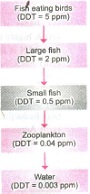
Biomagnification or biological magnification.
12.
Photochemical smog is grey or yellowish brown, opaque smog formed at high temperature over cities and towns due to still air, emission of nitrogen oxides and volatile hydrocarbons from automobile exhausts and solar energy.It contains secondary pollutants. It is having oxidizing environment.
13.
1. The world summit on sustainable development was held in 2002, in Johannesburg, south Africa.
2. 190 countries signed the convention.
3. Its objective was achive by 2010, a significant reduction in the current rate of biodiversity loss at global, regional and local levels.
14.
Co-extinction is a phenomenon in which when a species becomes extinct, the plant and animal species associated with it, in an obligatory manner, also become extinct.
e.g. (i) In case of a co-evolved plant and its pollinator, if one of them becomes extinct, invariably the other one becomes extinct.
(ii) If a host fish becomes extinct, the unique parasites depending on it would also become extinct.
The three other causes are:
(i) Habitat loss and fragmentation
(ii) Over-exploitation and
(iii) Invasion of alien species
15.
Uses of biodiversity.
1. As source of food and improved varieties.
2. As source of drugs and medicines.
3. Aesthetic and cultural benefits.
Examples of aesthetic rewards include ecotourism, bird watching, wildlife, pet keeping, gardening, etc. Throughout human history, people have related biodiversity to the very existence of human race through cultural and religious beliefs.
4. Biodiversity is essential for the maintenance and sustainable utilization of goods and services from ecological system as well as from individual species.
16.
Species-Area Relationship
1. Alexander Von Humboldt has observed that within a region, species richness increases with increased explored area, but only upto a limit.
2. The relationship between species richness and area for a number of taxa like angiospermic plants, freshwater fishes and birds is found to be a rectangular hyperbola.
3. On a log scale, the relationship becomes linear (straight line) and is described by the equation:
log S = log C + Z log A, where
S = Species Richness
Z = Slope of the line (regression coefficient)
A = Area and C = Y - intercept
4. Ecologists have found that the value of Z-line ranges between 0.1 and 0.2 irrespective of the taxonomic group of the region.
5. But in very large areas, like a continent, the Z value ranges between 0.6 and 1.2 and indicate species richness.
17.
(d)
birds
18.
(b)
methane
19.
(b)
is processed by aerobic and then anaerobic bacteria in the secondary treatment in Sewage Treatment Plants(STPs).
20.
(d)
CO2 and N2O
21.
(b)
Reduction in ozone depleting substances
22.
(b)
oxygen
23.
(a)
60%, 20% 14% and 6%
24.
(d)
phenyl
25.
(b)
Fish contaminated with mercury
26.
(c)
Reacted with water

12th Standard CBSE Syllabus & Materials
12th Standard CBSE
CBSE 12th Computer Science Python Revision Tour I - New Previous year Question Papers Study Material - QB365 Set A
NEW12th Standard CBSE
CBSE 12th Business Studies Planning Important Questions And Answers Study Material - QB365 Set A
NEW12th Standard CBSE
CBSE 12th Business Studies Business Environment Important Questions And Answers Study Material - QB365 Set A
NEW12th Standard CBSE
CBSE 12th Business Studies Principles of Management Important Questions And Answers Study Material - QB365 Set A



NCERT Books

Syllabus

Exam Pattern

Sample Question Papers

Previous year Question Papers

Important Notes

MCQ Practice test

NCERT Exemplers

Case study Questions

Image Based Questions

Passage based Questions

HOT Questions

Value Based Questions

Model Questions Papers
NCERT ( Book Back ) Questions

Assertion and Reason
Important Questions And Answers

CBSE 12th Standard CBSE Subjects
CBSE Standards