100% FREE ACCESS
12th Standard CBSE Syllabus & Materials
12th Standard CBSE
CBSE 12th Economics Government Budget and the Economy Previous year Question Papers Study Material - QB365 Set A
NEW12th Standard CBSE
CBSE 12th Computer Science Interface Python with MySQL - New Previous year Question Papers Study Material - QB365 Set A
NEW12th Standard CBSE
CBSE 12th Computer Science Database Concept - New Previous year Question Papers Study Material - QB365 Set A
NEW12th Standard CBSE
CBSE 12th Computer Science Data Communication - New Previous year Question Papers Study Material - QB365 Set A
NEW12th Standard CBSE
CBSE 12th Computer Science Data Structures - New Previous year Question Papers Study Material - QB365 Set A
NEW12th Standard CBSE
CBSE 12th Computer Science Functions - New Previous year Question Papers Study Material - QB365 Set A

Published on: 20/08/2026
Download CBSE Class 12th Standard CBSE Biology question papers, sample papers, important questions, and previous year solved papers in PDF format. Get free study materials, NCERT solutions, and exam preparation resources for Class 12th Standard CBSE Biology
Questions + Answers key
Take MCQ Biology Test
1.
Can you think of a situation where we deliberately want to make a species extinct? How would you justify it?
2.
The species diversity of plants (22 per cent) is much less than that of animals (72 per cent). What could be the explanations to how animals achieved greater diversification?
3.
Among the ecosystem services are control of floods and soil erosion. How is this achieved by the biotic components of the ecosystem?
4.
What are sacred groves? What is their role conservation?
5.
What are the major causes of species losses in a geographical region?
6.
What is the significance of the slope of regression in a species-area relationship?
7.
Name the three important components of biodiversity.
8.
In situ conservation can help endangered / threatened species. Justify the statement.
9.
The diagram given below shows a river and the types of land uses on two sides of the river in a countryside.
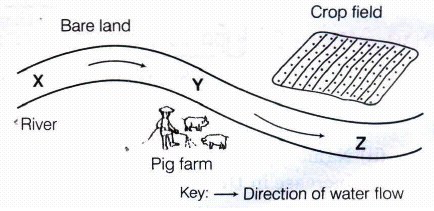
The water quality of the river was studied by measuring the amount of dissolved oxygen and ammonia in the water, collected at sites X, Y and Z. The result is presented in the table below:
| Site | Dissolved oxygen cm3/liter | Ammonia(ppm) |
| X | 8.9 | 0.02 |
| Y | 0.3 | 0.62 |
| Z | 1.6 | 5.30 |
(i) Explain why site Y has the lowest content of dissolved oxygen
(ii) Why are very few fishes found at site 'Z'?
(iii) Which organism will thrive just after site Z?
10.
How have human activities caused desertification? Explain
11.
Create an aquatic food chain in a water body into which effluents flow from a pesticide factory. Diagrammatically represent and answer the following questions:
What is the phenomenon called?
12.
(a) A decade back, the enormous vehicular traffic in Delhi had made Delhi rank 4th among most polluted cities of the world.Two measures taken by the Delhi government brought marked improvement in air quality by 2005.What were these two measures and how did they reduce air pollution?
(b) What is the norm set by Euro-II for petrol and diesel vehicles?
13.
What are flocs? State their role in effluent treatment and their ultimate fate in sewage treatment tank.
14.
How is biodiversity important for ecosystem functioning?
15.
Give three hypotheses for explaining why tropics show greatest levels of species richness.
16.
How do ecologists estimate the total number of species present in the world?
1.
A harmful organism, that is harmful for one/more populations/species, can be made extinct; the food chain should not be affected. For example, the virus causing small pox has been controlled world over.
2.
Since plants cannot move away from their predators (herbivores) and harsh environmental conditions, many of them have become extinct. But animals can move away from the harmful/unfavourable environments or their predators and evolution of favourable characters has thus taken place in them.
3.
Control of foods and droughts:
1. Forests control flood by trapping and absorbing the rain water and slowly releasing it later.
2. The roots of plants hold the soil particles firmly and prevent soil erosion.
3. The forest cover prevents water directly falling on open soil.
4.
Sacred Groves are the tracts of forests where all the trees and wildlife within were venerated and given total protection.
1. These are the last refuges for a large number of rare and threatened plants.
5.
(i) Habitat loss and fragmentation
(ii) Over-exploitation by man for natural resources
(iii) Invasion of alien species, which complete with the native species and cause their extinction.
(iv) Co-extinction of related plants and animals.
6.
Slope of regression represents the changes in the species richness with the area. Species richness decreases with the decrease in area. The value of 'Z' (regression coefficient) lies in between 0.1-0.2, regardless of the taxonomic groups in the region. For very larger areas like continents, the slope of the line becomes much steep with the Z values in the range of 0.6-1.
7.
Genetic diversity, species diversity, ecosystem diversity.
8.
In situ conservation involves the protection of species in their natural habitats. It helps in the conservation of threatened/endangered species via following means
(i) Biodiversity hotspots are regions with high levels of species richness and high degree of endemism (i.e. species confined to that region are not found anywhere else). These hotspots can reduce the ongoing mass extinctions by almost 30%.
(ii) Protected areas are ecologically unique and biodiversityrich regions.These are legallyprotected as biospherereserves.nationalparks and sanctuaries. Hence, can help in conservation of endangered species.
(iii) Sacred groves are forest areas set aside,all the trees and wildlife within it are venerated and given total protection. These are religious and cultural places, which are protected for conservation of endangered species.
9.
(i) Site Y has the lowest content of dissolved oxygen due to increased bacterial population. It is caused by sewage run-off from a pig farm.
(ii) There are very few fisher at size Z due to low oxygen Concentration and choked lake (by algae and weeds)
(iii) Algae and weeds will thrive after site Z.
10.
The human activities like deforestation, over-cultivation, unrestricted grazing, poor irrigation practices, result in arid patches of land (deforestation). When these large barren patches extend and remain unattended for long, a desert is created. Because the formation of fertile top layer of soil takes millions of years, desertification easily takes over.
11.
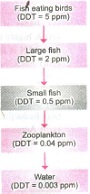
Biomagnification or biological magnification.
12.
(a) Government, through a new auto fuel policy, has laid out a road map to cut down vehicular pollution in Indian cities including Delhi.
(i) Switching over the entire public transport (i.e., buses autorickshaws, taxis) from diesel to CNG. CNG burns more efficiently and little is left unburnt
(ii) CNG is cheaper than petrol/diesel and cannot be siphoned off by thiefs or adultered like petrol or diesel.
(b) Government has introduced Euro II norms.This norm stipulates that sulphur be controlled at 350 ppm in diesel and 150 ppm in petrol.
Aromatic hydrocarbons are to be contained at 42% of the concerned fuel.It has significantly improved the air quality.
13.
Flocs are the masses of bacteria associated with fungal filaments to form mesh-like structure.
14.
Biodiversity is very important for ecosystem functioning. More diverse ecosystems are considered more stable. Stable communities are resilient and resistant to change.
Hence, diversity stabilises the community and also helps in increasing the productivity. Higher the biodiversity of an ecosystem, higher the number of species and therefore, lower is the rate of extinction. While, in case of low biodiversity, there are higher chances of extinction.
Extinction of even one or two key species has negative impacts on the entire ecosystem.
Thus, the diversity ensures the stability and proper functioning of the entire ecosystem as explained via the 'Rivet popper hypothesis'.
Biodiversity is important for ecosystem functioning.
(i) Ecologists believe that communities with more species diversity tend to be more stable than those with less species diversity.
(ii) Plots with increased species diversity show, higher productivity.
(iii) The ecosystem with more diversity becomes resistant to seasonal disturbances.
(iv) They also show resistant to invasion by alien species.
15.
(i) Speciation is a function of time: the temperate regions were subjected to frequent glaciation in the past, while the tropics have remained undisturbed and hence had longer time to evolve more species diversity.
(ii) The tropical environments are less seasonal and relatively more constant and more predictable than temperate regions; speciation has been promoted/favoured by such constant environments and hence there is greater species diversity.
(iii) There is more solar radiation available in the tropical region; this contributes directly to more productivity and indirectly to greater species diversity.
16.
Ecologists make a statistical comparison of the species richness of systematically studied groups of insects of the temperate and tropical regions and extrapolate this ratio to the other groups of animals and plants. This is how they calculate the gross estimate of the total number of species existing on this planet.

12th Standard CBSE Syllabus & Materials
12th Standard CBSE
CBSE 12th Computer Science Python Revision Tour I - New Previous year Question Papers Study Material - QB365 Set A
NEW12th Standard CBSE
CBSE 12th Business Studies Planning Important Questions And Answers Study Material - QB365 Set A
NEW12th Standard CBSE
CBSE 12th Business Studies Business Environment Important Questions And Answers Study Material - QB365 Set A
NEW12th Standard CBSE
CBSE 12th Business Studies Principles of Management Important Questions And Answers Study Material - QB365 Set A



NCERT Books

Syllabus

Exam Pattern

Sample Question Papers

Previous year Question Papers

Important Notes

MCQ Practice test

NCERT Exemplers

Case study Questions

Image Based Questions

Passage based Questions

HOT Questions

Value Based Questions

Model Questions Papers
NCERT ( Book Back ) Questions

Assertion and Reason
Important Questions And Answers

CBSE 12th Standard CBSE Subjects
CBSE Standards