 100% FREE ACCESS
12th Standard CBSE Syllabus & Materials
12th Standard CBSE
CBSE 12th Economics Government Budget and the Economy Previous year Question Papers Study Material - QB365 Set A
NEW12th Standard CBSE
CBSE 12th Computer Science Interface Python with MySQL - New Previous year Question Papers Study Material - QB365 Set A
NEW12th Standard CBSE
CBSE 12th Computer Science Database Concept - New Previous year Question Papers Study Material - QB365 Set A
NEW12th Standard CBSE
CBSE 12th Computer Science Data Communication - New Previous year Question Papers Study Material - QB365 Set A
NEW12th Standard CBSE
CBSE 12th Computer Science Data Structures - New Previous year Question Papers Study Material - QB365 Set A
NEW12th Standard CBSE
CBSE 12th Computer Science Functions - New Previous year Question Papers Study Material - QB365 Set A

Published on: 20/08/2026
Download CBSE Class 12th Standard CBSE Biology question papers, sample papers, important questions, and previous year solved papers in PDF format. Get free study materials, NCERT solutions, and exam preparation resources for Class 12th Standard CBSE Biology
Questions + Answers key
Take MCQ Biology Test
1.
Find out what the various components of the medium used for propagation of an explant in vitro are?
2.
What is the major advantage of producing plants by micropropagation?
3.
Which part of the plant is best suited for making virus-free plants and why?
4.
Mention the chemical change that proinsulin undergoes, to be able to act as mature insulin.
5.
Explain how Eli Lily an American company produced insulin by recombinant DNA technology.
6.
Explain the term 'pathophysiology'.
7.
What are the areas which have been responsible for the recent advances in biotechnology?
8.
Can you suggest a method remove oil (hydrocarbon) from seeds based on your understanding of rDNA technology and chemistry of oil?
9.
How did Eli Lilly Company go about preparing the human insulin? How is the insulin thus produced different from that produced by the functional human gene?
10.
Find out from the internet what is golden rice?
11.
Does our blood have proteases and nucleases?
12.
(i) What are transgenic animals?
(ii) Name the first transgenic cow and state its importance.
13.
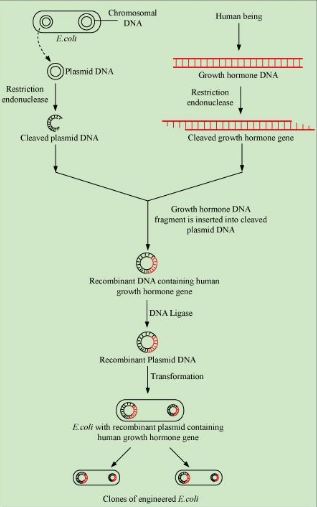
Digrammatically represent the experimental steps in cloning and expressing an human gene (say the gene for growth hormone) into a bacterium like E. coli ?
14.
How has the use of Agrobacterium tumefaciens as vector helped in controlling Meloidegyne incognitia infestation in tobacco plants? Explain in correct sequence.
15.
Why do lepidopterans die when they feed on Bt cotton plant? Explain how does it happen.
16.
Consult internet and find out how to make orally active protein pharmaceutical. What is the major problem to be encountered?
17.
What are genetically modified organisms?
18.
What are cry proteins ? Name an organism that produce it. How has man exploited this protein to his benefit?
19.
What are transgenic bacteria ? Illustrate using any one example.
20.
A group of scientists are working on creating transgenic cows to produce milk with medicinal properties.
But there are adverse side effects seen on the cows due to this procedure. Their life span shortened; they became prone to diseases and died very early.
(i) What do you mean by transgenic animals?
(ii) Should the scientists continue with the production of transgenic cows? Give reason.
(iii) Is there any law to regulate such acts?
(iv) What values did scientists lack?
21.
Briefly explain why are Transgenic animals produced?
22.
What is gene therapy? Illustrate using the example of adenosine deaminase (ADA?) deficiency.
23.
Compare and contrast the advantages and disadvantages of production of genetically modified crops.
24.
Study the diagram given below that shows the steps involved in the procedure of selecting transformed bacteria and answer the questions that follow
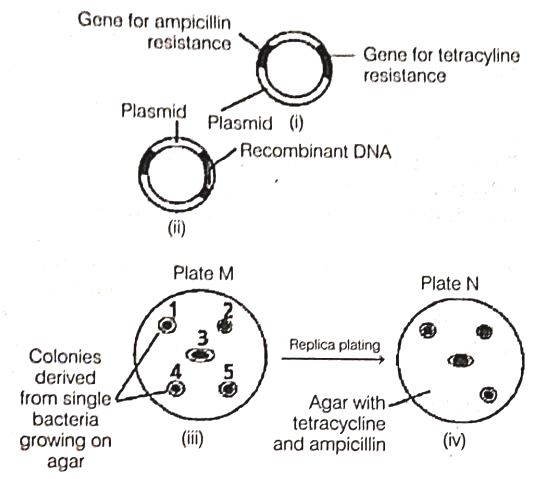
(a) Identify the colony that has got transformed. Justify your answer.
(b) What are the sites in a plasmid called where ampicillin and tetracycline resistance genes are inserted? State their role in genetic engineering.
(c) Name two enzymes playing an important role in genetic engineering.
Or
(c) State the role of \(\beta\)-galactosidase in insertional inactivation.
25.
The graph given below represents the production of genetically modified plants (in millions) starting from 1996 to 2016, i.e. a time span of 40 years. Study the given graph and answer the following questions.
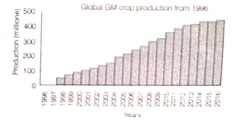
(i) State the relationship between increased production of genetically modified crops with time. How for do you agree with the current circumstances?
(ii) Do genetically modified crops favour post harvest losses?
(iii) State any two advantages of genetically modified crops.
or
(iii) Are there any adverse effects of transgenic crops on humans?
1.
The various components are water, agar, a source of carbon (e.g. sucrose), inorganic salts, vitamins, amino acid and growth hormones (e.g. auxins, cytokinin, etc).
2.
Micropropagation is used to produce thousands of plants in very short durations of time.
3.
The meristem is the plant part that is best suited for making virus-free plants. This is because even when the plant is infected with a virus, the meristem (apical and axillary) remains infection free; it can be removed, grown in vitro to obtain virus-free plants.
4.
1. The C-peptide is removed.
2. The peptides A and Bare joined.by disulphide bridges.
5.
In 1983, Eli Lily and American company prepared two DNA sequences corresponding to A and B, chains of human insulin, introduced them in plasmids of E. coli to produce insulin chains. Chains A and B were produced separately, extracted and combined by creating disulfide bonds to form human insulin.
6.
Pathophysiology is the study of functional chenges in the body of the host that occur in response to any disease or injury, e.g. if someone ingests a toxin, it may result into a variety of physical changes, such as inflammation in the stomach lining.
7.
The areas in recent advances in biochenology are
(i) Agriculture
(ii) Medicine
(iii) Food industry
(iv) Fermentation technology
(v) Environmental engineering, and
(vi) Genetic engineering.
8.
It involves metabolic engineering to transform an oil (hydrocarbon) producing seed into an oil-less seed.This can be done by identifying the specific enzyme involved in the biosynthesis of oil and then repressing the gene responsible for synthesizing that particular enzyme.
9.
Eli Lilly prepared two DNA sequences corresponding to A and B chains of human insulin and introduced them in plasmids ofE. cold to produce insulin chains. Chains A and B were produced separately,
extracted and combined by creating disulfide bonds to form human insulin. Insulin in human pancreas is synthesised as a pro-hormone containing the C peptide, which is removed in mature hormone. The synthesised insulin did not contain C peptide and was prepared in m form.
10.
Golden rice is a genetically modified rice with high levels of β-carotene and other carotenoids. This rice is modified in order to enhance the quantity of vitamin-A in it. It is called golden due to the gold-like colour it gets from β -carotene.
11.
No; blood has no proteases and nucleases.
12.
(i) Trangenic animals are the animals with the modified genome. A foreign gene is inserted into the genome of the animal to alter its DNA. This method is done to improve the genetic traits of the target animal. Initially, the improvement of genetic traits was done by selective breeding methods.
(ii) The first transgenic cow was named 'Rosie'. which was invented in 1997. It is helpful in the production of human protein-enriched milk. The protein in milk was about 2.4 grams per litre. The milk has alpha-lactalbumin and it is a balanced food for human babies.
13.
Cloning is the process of introducing a desired gene into a host like E.coli. The desired gene is inserted into a vector (plasmid) which basically acts as a vehicle to carry the desired gene into an organism in which we intend to express the gene of our interest.
14.
1. RNA interference (RNAi) occurs as a method of cellular defence in all eukaryotic organisms.
2. It involves the silencing of a specific mRNA by a complementary dsRNA.
3. The complementary RNA for making the doublestranded RNA comes either from an infection by RNA viruses or mobile genetic elements, called transposons, which replicate through an RNA intermediate.
4. The nematode-specific genes are introduced into the host plant, using Agrobacterium tumefaciens as vector, in such a way that it produced both sense and anti-sense RNA in the host. 5. The sense and antisense RNAs are complementary to each other and form dsRNA.
6. The dsRNA binds to and prevent the translation of a specific mRNA.
7. Consequently, the parasite is not able to live in the transgenic tobacco plant and hence the plant is protected.
15.
Bt cotton plants are the transgenic plants that express a Bacillus thuringiensis gene called cry gene. This gene, encodes for protein crystals having insecticidal properties against insects of group Lepidoptera, Diptera and Coleoptera. Inside the bacterium, these proteins remain inactive and do not harm the bacteria. However, these inactive crystals can get activated in the alkaline pH of the gut of insects upon ingestion.
After activation, these crystals can bind to the receptors present on the membranes of gut epithelial cells. Due to this binding, the membrane swells and pores are created on them. These pores lead to bursting of cell. Hence, soon the lepidopteran dies due to starvation.
16.
The major problem here is that the proteins with a short half lives are not orally active and are not absorbed properly.
An orally active protein should be metabolically stable and have a longer half life, so that it is not degraded fast and absorbed efficiently.
To make orally active protein drug, the site directed mutagenesis can be used to redesign their genes for the expression of a modified peptide.
17.
Genetically modified organisms are the living organisms (plants, animals, or bacteria) which have been genetically 'engineered' by the insertion of a foreign gene (a transgene).
18.
Cry proteins are the crystal proteins that are toxic to certain insect pests (Dipterans, Coleopterans and Lepidopterans).
They are produced by the bacterium Bacillus thuringiensis .
Man has isolated the genes encoding these proteins from this bacterium and incorporated into some crop plants; such crop plants produce the proteins in their cells and are resistant to the attack by these insect pests.
19.
Bacteria that have had their DNA manipulated to possess and express an extra (foreign) gene are known as transgenic bacteria, eg. DNA sequences introduced in plasmid of E. coli to produce insulin chains.
20.
(i) Animals that have had their DNA manipulated to possess and express an extra foreign gene are known as transgenic animals.
(ii) No, each cow would produce only a limited amount of medicinal milk before it dies. This means lives of many cows would be compromised for the production of substantial amount of medicinal milk, for the advantage of humans.
(iii) Some laws have been passed by the Government and agencies monitoring the genetic engineering researches to maintain ethics of life, and to regulate such acts.
(iv) Sympathy towards animals, ethics, respect for living organisms.
21.
Transgenic animals: Transgenic animals are produced for the following purposes:
(i) Transgenic animals are designed to allow the study of how genes are regulated and how they affect the normal functions of the body and its developments e.g. Information is obtained as to how insulin has a role as growth factor.
(ii) Transgenic animals are designed to increase our understanding as to how genes control the development of diseases; they serve as models for human diseases.
(iii) Transgenic animals that produce useful biological compounds are created by introducing a portion of the DNA that codes for that product, e.g.
\(\alpha \) -L antitrypsin is produced for curing emphysema.
(iv) Transgenic mice are being developed to test the safety of vaccines, e.g., polio vaccine has been tested on mice.
(v) Transgenic animals with more sensitivity to toxic substances are being developed to test the toxicity of drugs.
22.
Gene therapy is a collection of methods, that allows correction or replacement of a defective gene.
Correction of a genetic defect involves delivery of a normal gene into the individual's embryo to take over the function of the non-functional gene.
ADA (Adenosine deaminase) deficiency was treated in a 4 year old girl.
This disorder is caused by the deletion of the gene for the enzyme.
The lymphocytes from the blood of the patient are grown in a culture in vitro.
A functional ADA cDNA (using retroviral vector) is introduced into lymphocytes; such lymphocytes are introduced back into the blood of the patient.
But the patient requires periodic infusion of such genetically-engineered lymphocytes.
If the gene isolated from marrow cells is introduced in cells in the early stage, it could be a permanent cure.
23.
Advantages:
(i) Genetic modification has made the crops more tolerant to abiotic stresses like cold, heat, drought, salinity, etc.
(ii) It has reduced the dependence of crops on chemical pesticides as they are made pest-resistant.
(iii) Post-harvest losses are much reduced.
(iv) As the plants have increased efficiency of mineral usage by plants, the early exhaustion of fertility of soil is prevented.
(v) Food produced from GM (Genetically Modified) crops has enhanced nutritional value.
(vi Genetic modification has been used to create tailor-made plants to supply resources to industries such as starch, fuels, pharmaceuticals, etc.
Disadvantages:
The proteins produced by the GMO may cause allergy and other problems.
The genes present in the transgenic organisms may transform our intestinal bacteria also resistant to certain antibiotics.
When the resistant gene is transferred through pollen to the weeds, they may also become resistant to such pests and start flourishing.
24.
(a) Colony 4 got transformed as it failed to grow on agar containing ampicillin and tetracycline. Since, it is transformed, its gene for tetracycline and ampicillin resistance became inactive, thus it lost its ability to grow in both of them (ampicillin and tetracycline).
(b) Selectable markers are sites where ampicillin and tetracycline resistance genes are inserted. They are very important in genetic engineering as they help in the selection of the transformants from those of the non- transformants.
(c) EcoRI, Hind III
Or
(c) \(\beta\)- galactosidase acts as a reporter enzyme. It is produced by lac z, a reporter gene. In insertional inactivation, when there is inactivation of lac z gene due to insert , no B- galactosidase is formed and thus no blue colour in formed. Thus, giving a white coloured colonies of transformants.
25.
(i) The production of genetically modified crops has increased with increasing timespan due to the benefits that the GM crops give.Therefore, this scenario is completely justified. GM plants have benefitted us in increased yield and qualities like stress tolerance, etc., therefore, growing GM crops has become favourable for the farmers as they bring much benefits.
(ii) No, genetically engineered crops do not favour/offer post-harvest losses. They help farmers in minimising crop losses which occur due to insects and/or diseases.
(iii) Two advantages are
(a) Production of disease and drought resistant plants.
(b) Increased production of food with longer self life.
or
(iii) Transgenic plants/crops have certain adverse effects on humans. These include
(i) They may be allergic to humans.
(ii) They may transfer antibiotic resistance to humans.

12th Standard CBSE Syllabus & Materials
12th Standard CBSE
CBSE 12th Computer Science Python Revision Tour I - New Previous year Question Papers Study Material - QB365 Set A
NEW12th Standard CBSE
CBSE 12th Business Studies Planning Important Questions And Answers Study Material - QB365 Set A
NEW12th Standard CBSE
CBSE 12th Business Studies Business Environment Important Questions And Answers Study Material - QB365 Set A
NEW12th Standard CBSE
CBSE 12th Business Studies Principles of Management Important Questions And Answers Study Material - QB365 Set A



NCERT Books

Syllabus

Exam Pattern

Sample Question Papers

Previous year Question Papers

Important Notes

MCQ Practice test

NCERT Exemplers

Case study Questions

Image Based Questions

Passage based Questions

HOT Questions

Value Based Questions

Model Questions Papers
NCERT ( Book Back ) Questions

Assertion and Reason
Important Questions And Answers

CBSE 12th Standard CBSE Subjects
CBSE Standards