
 100% FREE ACCESS
12th Standard CBSE Syllabus & Materials
12th Standard CBSE
CBSE 12th Economics Government Budget and the Economy Previous year Question Papers Study Material - QB365 Set A
NEW12th Standard CBSE
CBSE 12th Computer Science Interface Python with MySQL - New Previous year Question Papers Study Material - QB365 Set A
NEW12th Standard CBSE
CBSE 12th Computer Science Database Concept - New Previous year Question Papers Study Material - QB365 Set A
NEW12th Standard CBSE
CBSE 12th Computer Science Data Communication - New Previous year Question Papers Study Material - QB365 Set A
NEW12th Standard CBSE
CBSE 12th Computer Science Data Structures - New Previous year Question Papers Study Material - QB365 Set A
NEW12th Standard CBSE
CBSE 12th Computer Science Functions - New Previous year Question Papers Study Material - QB365 Set A

Published on: 02/11/2025
Download CBSE Class 12th Standard CBSE Biology question papers, sample papers, important questions, and previous year solved papers in PDF format. Get free study materials, NCERT solutions, and exam preparation resources for Class 12th Standard CBSE Biology
Questions + Answers key
Take MCQ Biology Test
1.
The zone at the edge of lake or ocean which is alternatively exposed to air and immersed in water is called.
Pelagic zone
Benthic zone
Lentic one
Littoral zone
2.
The upright pyramid of numbers is about in
Pond
Forest
Lake
Grassland
3.
Nitrifying bacteria
oxidize ammonia to nitrates
convert free nitrogen to nitrogen compounds
convert proteins into ammonia
reduce nitrates to free nitrogen
4.
Maximum absorption of rainfall water is done by
tropical deciduous forest
tropical evergreen forest
tropical savannah
scrub forest
5.
Photosynthetic active radiation (PAR) has the following range of wavelengths
340-450 nm
400-700 nm
500-600 nm
450-950 nm
6.
Which of the following process helps in nutrient conservation?
Mineralisation
Immobilisation
Leaching
Nitrification
7.
The second trophic level in a lake is
Phytoplankton
Zooplankton
Benthos
Fishes
8.
Which one of the following has the largest population in a food chain?
Producers
Primary consumers
Secondary consumers
Decomposers
9.
Primary productivity varies from ecosystem to ecosystem. Explain.
10.
What could be the reason for the fast rate of decomposition in the tropics?
11.
State the function of a reservoir in a nutrient cycle. Explain the simplified model of carbon cycle in nature.
12.
In a botanical garden of a city there is a huge banyan tree growing on which hundreds of birds and thousands of insects live. Draw the pyramids of numbers and also biomass represented by this community. Comment giving reasons on the two different pyramids drawn.
13.
Describe the different classes of consumers.
14.
Describe a pond as an ecosystem.
15.
What does nature's carrying capacity for a species indicate?
16.
Oxygen content of the air is not affected by human activities. Why?
17.
Write two examples where man has interfered in ecosystem.
1.
(d)
Littoral zone
2.
(b)
Forest
3.
(a)
oxidize ammonia to nitrates
4.
(b)
tropical evergreen forest
5.
(b)
400-700 nm
6.
(b)
Immobilisation
7.
(b)
Zooplankton
8.
(a)
Producers
9.
Primary productivity depends upon the producers (plants species) their photosynthetic potential, soil, climate and other environmental factors of an ecosystem. They are seldom similar in different ecosystem. Therefore, primary productivity varies from ecosystem to ecosystem.
10.
1. The rate of decomposition is regulated by temperature and soil moisture, as they influence the activities of decomposers.
2. The trophic have a warm/hot and humid condition; such a condition is favourable for the decomposers and hence they speed up the process of decomposition.
11.
Function: To meet the deficit which occurs due to imbalance in the rate of influx and efflux.
.jpg)
12.
(i) Structure of a pyramid of number is given below:
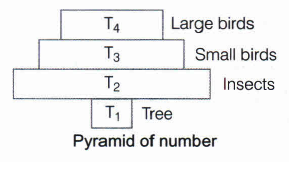
(ii) Differences between pyramid of number and biomass in a tree ecosystem are:
| Pyramid of biomass in a tree ecosystem | Pyramid of number in a tree ecosystem |
| The biomass of the single tree is much more than the biomass of insects | The base is much smaller with a single tree compared to the thousands of insects. |
| The pyramid looks upright with these two levels | The pyramid looks inverted with these two levels |
| The biomass of birds is much more than those of insects. | The numbers of birds feeding on the insects is less than that of insects |
13.
All organisms/animals which depend directly or indirectly on plants for their food are called consumers.
Consumers are of the following types:
(i) Primary consumers
They are the organisms/animals which depend directly on producers for their food;they are also called as herbivores,e.g. deer, rabbit, zooplanktons.
(ii)Secondary consumers
Secondary consumers are those animals which depend on the primary consumers for their food; they are primary carnivores, e.g frogs,hyena.
(iii)Tertiary consumers
Tertiary consumers are those animals which depend on the secondary consumers for their food;they are the secondary carnivores, e.g. lion, eagle, kite, etc.
14.
Pond - an Ecosystem
1. Pond is a fairly self-sustainable unit that shows even complex interactions of an aquatic ecosystem.
2. It is a shallow water body in which all the major/basic components of an ecosystem are well exhibited.
3. The abiotic components ar:
(i) Water with all the dissolved inorganic substance.
(ii) The rich soil deposit at the bottom.
(iii) The solar input.
(iv) The cycle of temperature.
(v) day length.
(vi) Climatic factor.
1. The producers or autotrophic components include phytoplanktons, some algae, floating and submerged and marginal plants.
2. The consumers are represented by
(i) zooplanktons,
(ii) f ree-swimming animals,
(iii) bottom dwelling animals.
1. The decomposers are the bacteria and fungi that are found at the bottom.
2. This system performs all the function of an ecosystem.
(i) Conversion of inorganic materials into organic compounds with the help of radiant energy of sun.
(ii) Consumption of autotrophs by heterotrophs, (food chain/food web), decomposition and mineralisation (nutrient cycling), etc.
15.
()
(In nature) a given habitat has enough or limited resources to support a maximum possible number and nature's carrying capacity indicates that no further growth in population is possible.
16.
()
Oxygen is replenished by photosynthesis.
17.
()
1. Cutting of forests
2. Construction of dams

12th Standard CBSE Syllabus & Materials
12th Standard CBSE
CBSE 12th Computer Science Python Revision Tour I - New Previous year Question Papers Study Material - QB365 Set A
NEW12th Standard CBSE
CBSE 12th Business Studies Planning Important Questions And Answers Study Material - QB365 Set A
NEW12th Standard CBSE
CBSE 12th Business Studies Business Environment Important Questions And Answers Study Material - QB365 Set A
NEW12th Standard CBSE
CBSE 12th Business Studies Principles of Management Important Questions And Answers Study Material - QB365 Set A



NCERT Books

Syllabus

Exam Pattern

Sample Question Papers

Previous year Question Papers

Important Notes

MCQ Practice test

NCERT Exemplers

Case study Questions

Image Based Questions

Passage based Questions

HOT Questions

Value Based Questions

Model Questions Papers
NCERT ( Book Back ) Questions

Assertion and Reason
Important Questions And Answers

CBSE 12th Standard CBSE Subjects
CBSE Standards