
 100% FREE ACCESS
12th Standard CBSE Syllabus & Materials
12th Standard CBSE
CBSE 12th Economics Government Budget and the Economy Previous year Question Papers Study Material - QB365 Set A
NEW12th Standard CBSE
CBSE 12th Computer Science Interface Python with MySQL - New Previous year Question Papers Study Material - QB365 Set A
NEW12th Standard CBSE
CBSE 12th Computer Science Database Concept - New Previous year Question Papers Study Material - QB365 Set A
NEW12th Standard CBSE
CBSE 12th Computer Science Data Communication - New Previous year Question Papers Study Material - QB365 Set A
NEW12th Standard CBSE
CBSE 12th Computer Science Data Structures - New Previous year Question Papers Study Material - QB365 Set A
NEW12th Standard CBSE
CBSE 12th Computer Science Functions - New Previous year Question Papers Study Material - QB365 Set A

Published on: 20/08/2026
Download CBSE Class 12th Standard CBSE Biology question papers, sample papers, important questions, and previous year solved papers in PDF format. Get free study materials, NCERT solutions, and exam preparation resources for Class 12th Standard CBSE Biology
Questions + Answers key
Take MCQ Biology Test
1.
(i) What does an ecological pyramid represent?
(ii) The ecological pyramids may have an 'upright' or an 'inverted' shape. Justify with the help of suitable examples
2.
(a) How is the grazing food chain different from the detritus food chain?
(b) "The detritus food chain may be connected to the grazing food chain at some levels in an ecosystem". Give an example in support of the statement.
3.
(a) State what is primary productivity and mention its units.
(b) Some ecologists observed that primary productivity of a place in Rajasthan was low as compared to a particular place in Kerala, Explain why.
4.
Distinguish between following:
(a) Grazing food chain and detritus food chain
(b) Production and decomposition
(c) Upright and inverted pyramids
(d) Food chain and food web.
(e) Litter and detritus
(f) Primary and secondary productivity
5.
What is primary productivity? Give a brief description of factors that affect primary productivity.
6.
Give an account of energy flow in an ecosystem.
7.
Define decomposition and describe the processes and products of decomposition.
8.
Describe the components of an ecosystem.
9.
What is the percentage of Photosynthetically Active Radiation (PAR) in the incident solar radiation?
(i) 100%
(ii) 50%
(iii) 1-5%
(iv) 2-10%
10.
The second trophic level in a lake is
(i) phytoplankton
(ii) zooplankton
(iii) benthos
(iv) fishes
11.
Secondary producers are
(i) herbivores
(ii) producers
(iii) carnivores
(iv) None of these
12.
"In a food-chain a trophic level represents a functional level, not a species." Explain.
13.
How are productivity, gross productivity, net primary productivity and secondary productivity interrelated?
14.
(a) Plants are called as_______ because they fix carbon dioxide
(b) In an ecosystem, dominated by trees, the pyramid (of numbers) is_______ type.
(c) In aquatic ecosystems, the limiting factor for the productivity is_______
(d) Common detritivores in our ecosystems are_______
(e) The major reservoir of carbon on earth is_______
1.
2.
(a) The differences between Grazing Food Chain (GFC) and Detritus Food Chain (DFC) are as follows
| GFC | DFC |
| Sun is the major source of energy. | Detritus is the major source of energy |
| Producers (eg plants and algae) occupies the first trophic level | Detritivores feeding on the detritus occupies the first trophic level |
| e.g. Grass \(\rightarrow\) Goat \(\rightarrow\) Man | e.g. Dead leaves \(\rightarrow\) Wood house \(\rightarrow\) Black bird |
| Comparatively lesser amount of energy flows through this chain. | Much larger amount of energy flows through this chain. |
| Long-sized chain. | Smali sized chain |
| Much more common. | Less common. |
| Major energy flow path in an aquatic ecosystem. | Major conduit of energy in terrestrial ecosystem. |
(b) The Detritus Food Chain (DFC) may be connected to the Grazing Food Chain (GFC) at same level in an ecosystem. It can be supported by the fact that certain organisms of the GFC are predators to certain animals of DFC.
For example, earthworms which are detritivores are eaten by small birds (DFC) which becomes prey to predators like vulture/kites or even small animals of the GFC.
3.
(a) Primary productivity is the rate at which solar energy is converted into organic substances through the process of photosynthetic and chemosynthetic autotrophs. It is also referred as the production of organic compounds through the biological process of photosynthesis. Its unit is gm-2yr-1 or (k cal m-2) yr-1.
(b) Primary productivity depends on the plant species inhabiting a particular area, environmental factors, availability of nutrients and photosynthetic capacity of plants.
Primary productivity of a place in Rajasthan, i.e. an arid (dry) region has low primary productivity because of some unfavourable environmental conditions, like absence of water, high temperature and lack of vegetation. On the other hand, Kerala, i.e., a coastal area has more primary productivity because of favourable environmental conditions like availability of water, moderate temperature and moderate amount of vegetation.
4.
(a)
| Grazing Food Chain | Detritus Food Chain |
|---|---|
|
1. It is the food chain where transfer of energy starts from the producers. |
1. It is the food chain where transfer of energy starts from detritus/decaying organic matter. |
(b)
| Production | Decomposition |
| It is the process of formation of organic matter | It is the process of breaking down of complex organic matter into simpler inorganic compounds like water, carbon dioxide, other nutrients, etc. |
| It is dependent on photosynthesis done by producers. | It is dependent on the decomposers. |
| For primary productivity, sunlight is required. | For decomposition, sunlight is not required. |
(c)
| Litter | Detritus |
| Litter is all types of above ground waste that has been disposed improperly | Detritus constitutes the remains of dead plants and animals. |
| It contains biodegradable and non-biodegradable material | It contains only biodegradable material |
(d)
| Upright pyramid | Inverted pyramid |
| In this type of pyramid the number and biomass of organisms at producer level is high, which keeps on decreasing at each trophic level | In this type of pyramid the number and biomass of organisms at each trophic level. |
| The base bar companies of producers in large number | The base bar companies of producers in small number |
| Energy pyramid is always upright | Pyramid of number and pyramid of biomass can be inverted. |
(e)
| Food chain | Food web |
| It is a linear sequence of organisms | It is an interconnection of many food chains |
| Members present at higher trophic level feeds on single type of organisms | One organisms has alternate food sources |
| The energy flow can be easily calculated | Energy flow is difficult to calcute |
| Competition is limited only to the members of same trophic level | Competition is amongst members of same and different trophic levels |
(f)
| Primary productivity | Secondary productivity |
| It is the amount of organic matter produced by producers per unit area over a period of time | It is defined as the rate of production of organic matter by consumers over a period of time |
5.
Primary productivity is defined as the amount of biomass or organic matter produced per unit area over a time period by the plants during photosynthesis.
It is also defined as the amount of biomass or organic matter produced per unit area over a time period by the plants during photosynthesis.
Primary productivity depends on:
(i)The plant species inhabiting a particular area.
(ii)The environmental factors.
(iii) Available of nutrient.
(iv) Photosynthetic capacity of plants.
6.
1. Sun is the ultimate source of energy for all ecosystems on the earth.
2. Only about 50% of the incident solar radiation is photosynthetically active radiation (PAR).
3. Plants capture only 2-10% of the PAR and all organisms are dependent for their food on producers, either directly or indirectly.
4. The flow of energy from the sun to producers and then to consumers is unidirectional and is keeping with the first law of thermodynamics.
5. Ecosystems need a continuous supply of energy for the synthesis of molecules needed and to counteract the tendency towards increasing disorderliness, i.e. energy flow follows the second law of thermodynamics too.
7.
Process of decomposition
(i) Fragmentation:
It is the process of breaking of the detritus into smaller particles by detritivores like earthworm.
(ii) Leaching: It is the process in which watersoluble inorganic substances run down into soil horizon and get precipitated as unavailable salts.
(iii) Catabolism:
1. The enzymatic conversion of the detritus into simple organic compounds and then into inorganic compounds is called catabolism.
2. The enzymes are secreted by the decomposers like bacteria and fungi
(iv) Humification:
Humification during decomposition leads to the accumulation of a dark coloured, amorphous substance, called humus.
(v) Mineralisation:
It is the process in which the humus is degraded by certain microbes and the inorganic nutrients are released.
8.
Components of an Ecosystem:
The components are broadly classified into two categories:
(i) Biotic components
(ii) Abiotic components
Biotic components include the following:
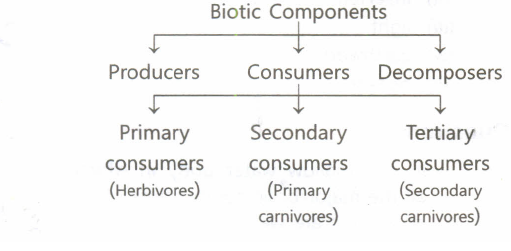
Producers:
These are the green plants or other autotrophs, which prepare their own organic food and feed energy into the ecosystem.
Decomposers:
Decomposers are the organisms which degrade the dead and decaying organic matter and satisfy their energy requirement, e.g. bacteria and fungi.
Abiotic Components:
They include the factors like:
(i) Air
(ii) Water
(iii) Solar radiation
(iv) Temperature
(v) Soil with organic and inorganic compounds as nutrients to plants.
9.
(ii) Out of the total solar energy PAR is only 50%.
10.
Zooplankton: They are primary consumers in an aquatic food chain who feeds upon phytoplanktons.
11.
None of these - Plants are autotrophic and are called primary producers because they are self-sufficient to synthesise their own food. Also, there is nothing like secondary producers.
12.
1. Trophic level is a step or division of food chain. It is characterized by the method of obtaining food.
2. The number of trophic level is equal to number of steps in the food chain.
3. The two fundamental trophic levels are producers and consumers.
4. Producers are autotrophic organisms found in ecosystem which synthesise food from raw materials.
5.Consumers are heterotrophic organisms. Herbivores are primary consumers. In a pond ecosystem many crustaceaus, larvae of insects constitute this trophic level.
13.
(a) Productivity is the rate of production of biomass (amount of living matter).
(b) Gross Prim y Productivity (GPP) is total amount of organic food synthesized by the producers per unit area and per unit time.
(c) Net Primary Productivity (NPP) is the total amount of biomass produced by the producers per unit area and per unit. It is GPP minus losses by way of respiration and decomposition. So NPP is represented as GPP-R.
(d) Secondary Productivity is the rate of biomass production by the consumers of per unit area per unit time. 'On average it is 10% for all the consumers.
14.
(a) autotrophs
(b) upright
(c) light
(d) earthworms and soil microbes.
(e) ocean

12th Standard CBSE Syllabus & Materials
12th Standard CBSE
CBSE 12th Computer Science Python Revision Tour I - New Previous year Question Papers Study Material - QB365 Set A
NEW12th Standard CBSE
CBSE 12th Business Studies Planning Important Questions And Answers Study Material - QB365 Set A
NEW12th Standard CBSE
CBSE 12th Business Studies Business Environment Important Questions And Answers Study Material - QB365 Set A
NEW12th Standard CBSE
CBSE 12th Business Studies Principles of Management Important Questions And Answers Study Material - QB365 Set A



NCERT Books

Syllabus

Exam Pattern

Sample Question Papers

Previous year Question Papers

Important Notes

MCQ Practice test

NCERT Exemplers

Case study Questions

Image Based Questions

Passage based Questions

HOT Questions

Value Based Questions

Model Questions Papers
NCERT ( Book Back ) Questions

Assertion and Reason
Important Questions And Answers

CBSE 12th Standard CBSE Subjects
CBSE Standards