 100% FREE ACCESS
12th Standard CBSE Syllabus & Materials
12th Standard CBSE
CBSE 12th Economics Government Budget and the Economy Previous year Question Papers Study Material - QB365 Set A
NEW12th Standard CBSE
CBSE 12th Computer Science Interface Python with MySQL - New Previous year Question Papers Study Material - QB365 Set A
NEW12th Standard CBSE
CBSE 12th Computer Science Database Concept - New Previous year Question Papers Study Material - QB365 Set A
NEW12th Standard CBSE
CBSE 12th Computer Science Data Communication - New Previous year Question Papers Study Material - QB365 Set A
NEW12th Standard CBSE
CBSE 12th Computer Science Data Structures - New Previous year Question Papers Study Material - QB365 Set A
NEW12th Standard CBSE
CBSE 12th Computer Science Functions - New Previous year Question Papers Study Material - QB365 Set A

Published on: 05/03/2026
Download CBSE Class 12th Standard CBSE Biology question papers, sample papers, important questions, and previous year solved papers in PDF format. Get free study materials, NCERT solutions, and exam preparation resources for Class 12th Standard CBSE Biology
Questions + Answers key
Take MCQ Biology Test
1.
Medically it is advised to all young mothers that breast-feeding is the best for their newborn babies. Do you agree? Give reasons in support of your answer.
2.
What is 'withdrawal syndrome'? List any two symptoms it is characterised by.
3.
Match the items listed in column I with suitable items from column II.
| Column I | Column II |
| (i) Prevent sleep | (i) Ergot gungus |
| (ii) Induce sleep | (ii) Papaver somniferum |
| (iii) Lung cancer | (iii) Cannabis indica |
| (iv) Ganja | (iv) Smoking |
| (v) Codeine | (v) Barbiturates |
| (vi) LSD | (vi) Amphetamines |
| (vii) Quinine | (vii) Health hazard |
| (viii) Tobacco | (viii) Natural Drug |
4.
(a) Explain the property that prevents normal cells from becoming cancerous.
(b) All normal cells have inherent characteristic of becoming cancerous.Explain.
5.
(a) Name the group of viruses responsible for causing AIDS in humans,Why are these viruses so named?
(b) List any two ways of transmission of HIV infection in humans other than sexual contact.
6.
A student on a school trip started sneezing and wheezing soon after reaching the hill station for no explained reasons,But on return to the plains,the symtoms disappeared.What is such a response called?How does the body produce it?
7.
Do you Consider passive smoking is more dangerous than active smoking?why?
8.
Explain the role of the following in providing defence against infection in human body:
(i) Histamine
(ii) Interferons
(iii) B-cells
9.
(i) How and at what stage does Plasmodium enter into a human body?
(ii) With the help of a flow chart only,show the stages of asexual reproduction in the life cycle of the parasite in the infected human.
(iii) Why does the victim show symptoms of high fever?
10.
A person is suffering from amoebiasis,Mention the pathogen that causes it and mention the pathogen that causes it and one organ of the body that gets affected.Give three symptoms and one mode of its transmission.
11.
(i) How do normal cell become cancerous ?
(ii) Cancer can be treated successfully only if detected at an early stage. How do the following help in detecting cancer ?
(a) Biopsy
(b) Histopathology
(c) MRI
(iii) Name any two methods that can possibly cure cancer.
12.
Draw the structure of human antibody and mention its types and functions.
13.
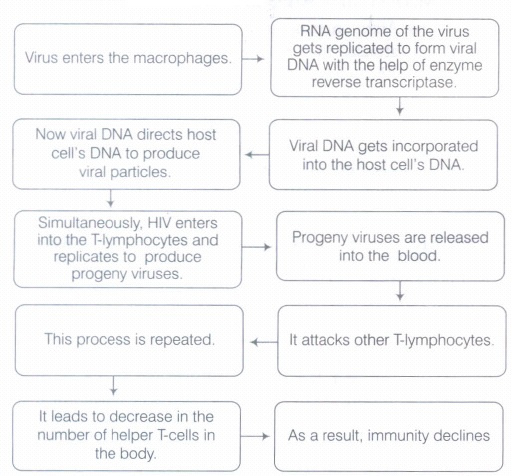
Explain the process of replication of a retrovirus after it gains entry into human body.
14.
Tetanus antitoxin (Tetanus toxoid) when injected into the human body it immediately provides:
innate immunity
passive immunity
auto immunity
active immunity
15.
Match the items in Column I with those in Column II.
| Column I | Column II |
| A. Physiological barrier | 1. Interferons |
| B. Cytokine barrier | 2. Skin of the body |
| C. Cellular barrier | 3. Tear in the eyes |
| D. Physical barrier | 4. Antibodies in colostrum |
| 5. Polymorphonuclear- leucocyte |
A - 1, B-3, C - 5,D - 2
A - 5, B-1, C - 3,D - 2
A - 2, B-1, C - 5,D - 3
A - 3, B-1, C - 5,D - 2
16.
Diacetyl morphine is commonly known as
cocaine
hashish
ganja
heroin
17.
Assertion: Allergy is an immunity disorder.
Reason: Allergy is confined to a person only.
Codes:
(a) Both assertion and reason are true and reason is the correct explanation of assertion.
(b) Both assertion and reason are true but reason is not the correct explanation of assertion.
(c) Assertion is true but reason is false.
(d) Both assertion and reason are false
18.
Assertion: SCID is the first genetic disorder to be combated with gene therapy.
Reason: SCID is a type of allergy.
Codes:
(a) Both assertion and reason are true and reason is the correct explanation of assertion.
(b) Both assertion and reason are true but reason is not the correct explanation of assertion.
(c) Assertion is true but reason is false.
(d) Both assertion and reason are false.
19.
Once Gita asked Sarita about her adrenaline and steroid medication. Sarita told Gita that she is allergic to pollens and mites. Sarita also mentioned that she became allergic due to the protected environment provided to her in early life. Upon further conversation, Gita discussed that she is suffering from an autoimmune disease.
(i) Name the antibody which is produced in response to allergens.
(ii) Mention few symptoms of allergic reactions.
(iii) How adrenaline and steroids would help Gita to relieve allergy?
(iv) What is an autoimmune disease? Give two examples of autoimmune diseases.
(v) Is there a permanent cure for autoimmune diseases?
20.
Refer to the graph given below and answer the questions that follows
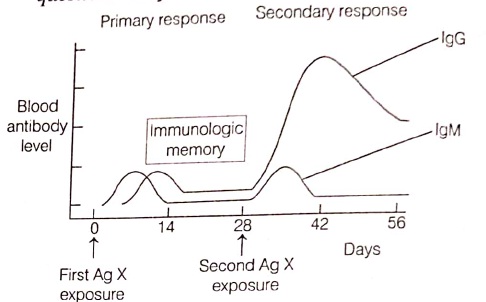
(i) With the reference of the above graph, give two differences between primary and secondary immune response.
(ii) Where does the primary and secondary responses occur in the body?
(iii) Trace the trajectory of the above graph.
(iv) IgG antibody level is higher in secondary response comment.
1.
Mother's milk is considered most appropriate or a boon for a newborn infant as it provides immunity in the initial period of baby's life. The yellowish fluid colostrum secreted by mother during the intial days of lactation has abundant antibodies (IgA) to protect the infant.
2.
He exhibits withdrawal syndrome.
(i) Withdrawal syndrome refers to the characteristic and unpleasant manifestations of the body of an addict, when regular dose of drugs/alcohol is abruptly discontinued.
Characterstics :
(i) Anxiety
(ii) Excess sweating
(iii) Shakiness
(iv) Nausea
In some cases, withdrawal symptoms can be severe and even life-threatening.
3.
(i) (vi);
(ii) (v);
(iii) (iv);
(iv) (iii);
(v) (ii);
(vi) (i);
(vii) (viii);
(viii) (vii)
4.
(a) Contact inhibition is the property shown by normal cells,by the virtue of which contact with other cells inhibits their uncontrolled proliferation and growth.
(b) All normal cells have cellular oncogenes (c-onc) or proto-oncogenes;when activated under certain conditions,such genes could lead to oncogenic transformation of cells,i.e.they become cancerous.
5.
(a) Retroviruses
They have RNA as the genetic material and can make DNA on RNA template with the help of enzyme reverse transcriptase;hence they are called retroviruses.
(d) Transmission of HIV infection
(i) by transfusion of blood and blood products contaminated with HIV.
(ii) by sharing infected needles as in the case of intravenous drug abusers.
(iii) from the infected mother to the foetus,through placenta.
6.
It is called allergy.
It is due to the release of histamine and serotonin by mast cells.
7.
Passive smoking can be equally dangerous because it exposes the person to the same harmful effects of smoke. Passive smoking means being in the same room or place, where some one is smoking and getting exposed to smoke in the surrounding area.
Once inhaled, the smoke can trigger mucus release in the bronchioles that blocks the airways. This induces coughing. But prolonged exposure can lead to bronchitis, emphysema, respiratory tract infections and eventually lung cancer.
8.
(i) Histamines cause reactions of the immune system against allergens.
(ii) Interferons protect the non-infected cells of our body from viral infections.
(iii) B-cells produce antibodies against antigens/pathogens.
9.
1. Life cycle of Plasmodium in human body.
2. When an infected female Anopheles mosquito bites a person,the sporozoites are injected into the body.
3. They reach the liver cells through blood.
4. The parasite reproduces asexually in the liver cells and by the bursting of liver cells,new cells are released into the blood.
5. They enter the red blood cells (RBCs) and reproduce asexually;by bursting the red blood cells,the cells of the parasite release haemozoin,which causes the cycles of fever,chill and shivering.
6. The released parasite cells infect new red blood cells;some continue the asexual reproduction and cause the cycles of fever.
7. Others enter the sexual stage and form gametocytes in the RBCs,which are picked by the Anopheles mosquito, along with the blood meal.
10.
(a) Amoebiasis is caused by Entamoeba histolytica.
(b) Symptoms:
(i) Constipation
(ii) Abdominal cramps and pain.
(iii) Stool with excess mucus and blood clots.
Transmission
Drinking water and food contaminated with the faeces of infected persons.
Houseflies act as mechanical carriers and transmit the parasite from faeces to food and water.
11.
(i) Normal cells have genes called cellular oncogenes (c-onc) or proto-oncogenes, which are present in inactive state. Also 'contact inhibition' is the property exhibited by normal cells.
It prevents their uncontrolled proliferation when they are in contact with other neighbouring cells.
Thus,when due to certain conditions like mutation oncogenes are turned on, this makes the cells to lose the property of contact inhibition and they continue to divide despite being in contact with other cell, which Jeads to masses of cells called tumours and lead to cancer.
(ii) Cancer can be detected by the following methods
(a) Biopsy In this method a suspected tissue is studied by cutling it into thin sections and staining it for cell examination.
(b) Histopathology lt is the study of diseased cells and tissues taken from the body during biopsy by using amicroscope.
(c) MRI (Magnelic Resonance Imaging) It uses strong magnelic fields and non-ionising radiations to accurately detect pathological and physiological changes in the living tissue.
(iii) Treatment of Cancer
Most cancers are treated by the combination of procedures, surgery, radiotherapy and chemotherapy and immunotherapy. These are explained below
(i) Surgery Tumours are removed by surgery to check further sprcad of cancer cells.
(ii) Radiotherapy Tumour cells are irradiated by lethal doses of radiation while protecting the surrounding normal cells.
12.
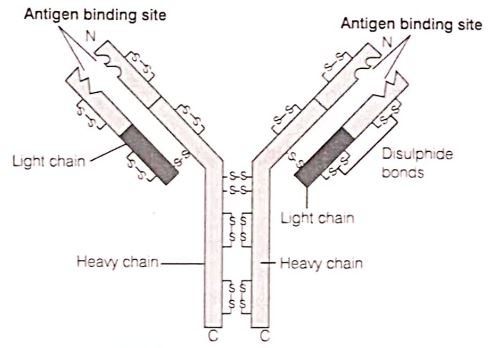
Types and functions.
| Types | Functions |
| IgG | Most prevalent class of antibody, constitutes 75-80% of total antibodies. Protects against fungi, bacteria, toxins, etc. It can cross placenta from mother to child and provides immune protection to newborns. Responsible for Rh-factor in blood. |
| IgA | Second most prevalent antibody. It is about 15% of the total antibodies. Secreted through parts lined by mucous system. Found in secretions from nose, eyes, lungs and digestive tract, saliva, tears, etc. Also found in colostrum, i.e. breast milk for newborn's immune protection. |
| IgM | Third most common antibody. It constitutes 5-10% of total antibodies. They are first to be produced in response to encounter with a pathogen. Responsible for blood transfusion reactions in ABO blood system. |
| IgE | The least common antibody. It makes upto only 0.1% of total antibodies and is involved in allergic reactions. |
| IgD | Their function is nor well understood yet. |
13.
The process by which retrovirus gains entry into human host body or the mechanism by which AIDS virus causes immunodeficiency is as follows:
14.
(b)
passive immunity
15.
(d)
A - 3, B-1, C - 5,D - 2
16.
(d)
heroin
17.
(b): Allergy is non-infectiousunusual reaction or hypersensitivity of an individual to a foreign substance or agent that may be harmless to other individuals (thus it is considered as immunity disorder). It is non-communicable as it is confined to a person only and does not spread from one person to another. The foreign substance or allergen on first contact functions as mild antigen. It produces antibodies which remain attached with the mast cell. Lysis of mast -cells occur which releases histamine as allergy mediator
18.
(c): Severe combined immunodeficiency (SCID) represents a group of rare, sometimes fatal, congenital disorders characterized by little or no immune response. The defining feature of SCID, commonly known as "bubble boy" disease, is a defect in the specialized white blood cells (B-and T-Iymphocytes) that defend us from infection by viruses, bacteria and fungi. SCID is caused by a defect in the gene that codes for the enzyme adenosine deaminase on chromosome number 20. Lack of the enzyme adenosine deaminase (ADA), means that the substrates for this enzyme accumulate in the cells. Immature lymphoid cells of the immune system are particularly sensitive to the toxic effects of these unused substrates, so fail to reach maturity. As a result, the immune system of the afflicted individual is severely compromised or completely lacking. Lack of this enzyme makes the body defenseless against infections. SCID is the first genetic disorder to be combated with gene therapy.
19.
(i) IgE antibody is released in allergic reactions.
(ii) Watery eyes, running nose, wheezing, sneezing, etc.
(iii) Adrenaline and steroids help to suppress and serotonin from the mast cells upon the entry of allergens in body. Thus, the allergic symptoms are either suppressed or reduced.
(iv) Autoimmune diseases are those in which the body begins to attack self-cells, e.g. rheumatoid arthritis, Addison's disease, etc.
(v) There are no permanent cures for autoimmune histamine diseases, but standard treatments available to reduce the signs and symptoms to a certain level.
20.
(i)
| Primary immune response |
Secondary immune response |
| This occurs as a result of primary contact with antigen. | This occurs as a result of second and subsequent exposure of same antigen. |
| First antibody produced is IgM. | Mainly lgG is produced. |
(ii) Primary response appears mainly in the lymph nodes and spleen. Whereas the secondary response appears mainly in the bone marrow, followed by spleen and lymph nodes.
(iii) Trajectory of the above graph is explained as follows In prinary immune response the lag phase is often longer. Level of antibody reaches peak in 7 to 10 days. The first antibody produced is mainly IgM. Although small amount of IgG are also produced. In secondary immune response, lag phase is shorter (1-4 days) due to the presence of memory cell. Level of antibody reaches peak in 3-5 days. Mainly IgG is produced. Usually 1000 times more antibodies are produced here.
(iv) IgG level is higher in secondary response as it can divide faster and produce high-affinity antibodies such as IgG, in response to antigen.

12th Standard CBSE Syllabus & Materials
12th Standard CBSE
CBSE 12th Computer Science Python Revision Tour I - New Previous year Question Papers Study Material - QB365 Set A
NEW12th Standard CBSE
CBSE 12th Business Studies Planning Important Questions And Answers Study Material - QB365 Set A
NEW12th Standard CBSE
CBSE 12th Business Studies Business Environment Important Questions And Answers Study Material - QB365 Set A
NEW12th Standard CBSE
CBSE 12th Business Studies Principles of Management Important Questions And Answers Study Material - QB365 Set A



NCERT Books

Syllabus

Exam Pattern

Sample Question Papers

Previous year Question Papers

Important Notes

MCQ Practice test

NCERT Exemplers

Case study Questions

Image Based Questions

Passage based Questions

HOT Questions

Value Based Questions

Model Questions Papers
NCERT ( Book Back ) Questions

Assertion and Reason
Important Questions And Answers

CBSE 12th Standard CBSE Subjects
CBSE Standards