 100% FREE ACCESS
12th Standard CBSE Syllabus & Materials
12th Standard CBSE
CBSE 12th Economics Government Budget and the Economy Previous year Question Papers Study Material - QB365 Set A
NEW12th Standard CBSE
CBSE 12th Computer Science Interface Python with MySQL - New Previous year Question Papers Study Material - QB365 Set A
NEW12th Standard CBSE
CBSE 12th Computer Science Database Concept - New Previous year Question Papers Study Material - QB365 Set A
NEW12th Standard CBSE
CBSE 12th Computer Science Data Communication - New Previous year Question Papers Study Material - QB365 Set A
NEW12th Standard CBSE
CBSE 12th Computer Science Data Structures - New Previous year Question Papers Study Material - QB365 Set A
NEW12th Standard CBSE
CBSE 12th Computer Science Functions - New Previous year Question Papers Study Material - QB365 Set A

Published on: 05/03/2026
Download CBSE Class 12th Standard CBSE Biology question papers, sample papers, important questions, and previous year solved papers in PDF format. Get free study materials, NCERT solutions, and exam preparation resources for Class 12th Standard CBSE Biology
Questions + Answers key
Take MCQ Biology Test
1.
Define autoimmunity.
2.
List three fungal genera which cause ringworm?
3.
Give the scientific name of the pathogen causing malignant malaria in humans.
4.
What is it that prevents a child to suffer from a disease he/she is vaccinated against?Give one reason.
5.
Why do sports person often fall a victim to cocaine addiction?
6.
Name the plant source of ganja.How does it affect the body of the abuser?
7.
Name the two special types of lymphocytes in humans.How do they differ in their roles in immune response?
8.
Name and explain the type of immunity that is provided by injecting microbes deliberately during immunisation into the human body.
9.
Think what two measures should be taken for prevention and control of alcohol and drug abuse among adolescents
10.
A person is suffering from Ascariasis Mention the pathogen causing the disease and an organ of the body affected,three symptoms and one mode of transmission of the disease.
11.
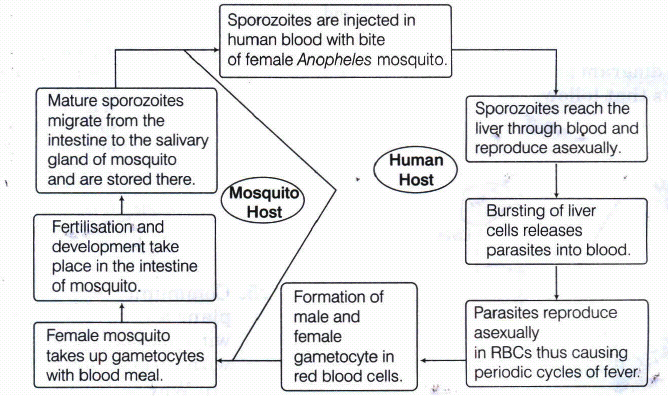
Trace the life cycle of malarial parasite in the human body,when bitten by an infected female Anopheles.
12.
Name the pathogen that causes amoebiasis in humans.Give the symptoms and the mode of transmission of the disease.
13.
Represent schematically the life cycle of a malarial parasite.
14.
Describe stem cells, write their sources and uses.
15.
Why do some adolescent start taking drugs?How can this be avoided.
16.
Marijuana and charas are
Stimulant
Hallucinogens
Depressant
Sedative
17.
T-lymphocytes first mature in
Thymus
Pancreas
Liver
Spleen
18.
Which of the following is involved in defence mechanism of the body?
Lymphocytes
Neutrophils
Macrophages
All of these
19.
The stimulant present in tea, cocoa and cola drinks is
Cocaine
Tannin
Astringent
Caffeine
20.
L.S.D, morphine and bhang are respectively obtained from
Claviceps, Papaver and Cannabis
Claviceps, Cannabis and Rauwolfia
Cannabis, Claviceps and Fuscarium
Claviceps, Rauwolfia and Papaver
1.
()
It is an abnormally which sometimes occur in the immune system and instead of destroying foreign molecules,it attacks body's own cells.
2.
()
(i) Microsporum
(ii) Trichophyton
(iii) Epidermophyton.
3.
()
Plasmodium falciparum
4.
()
1. His body develops antibodies,that circulate in the body fluids and neutralise the pathogenic agent during subsequent encounters.
2. Memory B cells and memory T cells are retained inthe system.
5.
Cocaine has a potent stimulating action on the central nervous system.
It produces a sense of euphoria and increased energy and hence,sportspersons become addicted to it.
6.
Ganja is obtained from the leaves,flower tops and the resin of the plant Cannabis sativa.
They interact with the cannabinoid receptors present in the brain and affect the cardiovascular system of the body.
7.
Two special types of lymphocytes in humans are B-lymphocytes and T-lymphocytes. B-lymphocytes execute antibody-mediated response while T-lymphocytes show cell-mediated response.
8.
1. Active immunity is produced by injecting the microbes deliberately during immunisation.
2. Antibodies are produced by the B-cells of our body in response to the antigens;they neutralise the pathogenic agents during actual infection.
3. The vaccines also generate memory B-cells and T-cells,which recognise the same pathogen on subsequent exposure and destroy them by a massive production of antibodies.
9.
(i) Avoiding undue pressure on adolescents.
(ii) Seeking professional and medical help.
10.
Ascariasis is caused by Ascaris lumbricoides.The intestine becomes blocked and damaged.
Symptoms
Intestinal bleeding - Muscular pain
Anaemia - Fever
Blockage of intestinal passage.
Transmission
The eggs of the parasite from the faeces of infected person contaminate soil,water and plants. Infection is mainly through contaminated water,fruits and vegetables.
11.
1. Life cycle of Plasmodium in human body.
2. When an infected female Anopheles mosquito bites a person,the sporozoites are injected into the body.
3. They reach the liver cells through blood.
4. The parasite reproduces asexually in the liver cells and by the bursting of liver cells,new cells are released into the blood.
5. They enter the red blood cells (RBCs) and reproduce asexually;by bursting the red blood cells,the cells of the parasite release haemozoin,which causes the cycles of fever,chill and shivering.
6. The released parasite cells infect new red blood cells;some continue the asexual reproduction and cause the cycles of fever.
7. Others enter the sexual stage and form gametocytes in the RBCs,which are picked by the Anopheles mosquito, along with the blood meal.
12.
(a) Amoebiasis is caused by Entamoeba histolytica.
(b) Symptoms:
(i) Constipation
(ii) Abdominal cramps and pain.
(iii) Stool with excess mucus and blood clots.
Transmission
Drinking water and food contaminated with the faeces of infected persons.
Houseflies act as mechanical carriers and transmit the parasite from faeces to food and water.
13.
The life cycle of a malarial parasite is shown below:
14.
Stem cells are undifferentiated biological cells that can differentiate into specialized cells and can divide (through mitosis) to produce more stem cells. They are found in multicellular organisms.
Types: In mammals, there are two broad types of stem cells, Embryonic stem cells, which are isolated from the inner cell mass ofblastocysts, and Adult stem cells, which are found in various tissues.
Role: In adult organisms, stem cells and progenitor cells act as a repair system for the body, replenishing adult tissues. In a developing embryo, stem cells can differentiate into all the specialized cells-ectoderm, endoderm and mesoderm (see induced pluripotent stem cells)-but also maintain the normal turnover of regenerative organs, such as blood, skin, or intestinal tissues.
Sources of stem cells: There are three known accessible sources of autologous adult stem cells in humans:
1. Bone marrow, which requires extraction by harvesting, that is, drilling into bone (typically the femur or iliac crest),
2. Adipose tissue (lipid cells), which requires extraction by liposuction, and
3. Blood, which requires extraction through apheresis, wherein blood is drawn from the donor (similar to a blood donation), and passed through a machine that extracts the stem cells and returns other portions of the blood to the donor.
Stem cells can also be taken from umbilical cord blood just after birth. Of all stem cell types, autologous harvesting involves the least. risk. By definition, autologous cells are obtained from one's own body,just as one may bank his or her own blood for elective surgical procedures.
Uses of stem cells:
1. Adult stem cells are frequently used in medical therapies, for example in bone marrow transplantation.
2. Stem cells can now be artificially grown and transformed (differentiated) into specialized cell types with characteristics consistent with cells of various tissues such as muscles or nerves.
3. Embryonic cell lines and autologous embryonic stem cells generated through somatic cell nuclear transfer of dedifferentiation have also been proposed as promising candidates for future therapies.
15.
It is true that once a person gets entangled in the deadly whirlpool of alcohol or drugs, it is very difficult to get rid of this habit because, in the absence of a continuous supply of alcohol/drugs, the person starts showing certain symptoms called withdrawal signs which are listed below:
(1) Anxiety
(2) Shakiness
(3) Nausea
(4)Sweating.
16.
(b)
Hallucinogens
17.
(a)
Thymus
18.
(b)
Neutrophils
19.
(d)
Caffeine
20.
(a)
Claviceps, Papaver and Cannabis

12th Standard CBSE Syllabus & Materials
12th Standard CBSE
CBSE 12th Computer Science Python Revision Tour I - New Previous year Question Papers Study Material - QB365 Set A
NEW12th Standard CBSE
CBSE 12th Business Studies Planning Important Questions And Answers Study Material - QB365 Set A
NEW12th Standard CBSE
CBSE 12th Business Studies Business Environment Important Questions And Answers Study Material - QB365 Set A
NEW12th Standard CBSE
CBSE 12th Business Studies Principles of Management Important Questions And Answers Study Material - QB365 Set A

NCERT Books

Syllabus

Exam Pattern

Sample Question Papers

Previous year Question Papers

Important Notes

MCQ Practice test

NCERT Exemplers

Case study Questions

Image Based Questions

Passage based Questions

HOT Questions

Value Based Questions

Model Questions Papers
NCERT ( Book Back ) Questions

Assertion and Reason
Important Questions And Answers

CBSE 12th Standard CBSE Subjects
CBSE Standards