
 100% FREE ACCESS
12th Standard CBSE Syllabus & Materials
12th Standard CBSE
CBSE 12th Economics Government Budget and the Economy Previous year Question Papers Study Material - QB365 Set A
NEW12th Standard CBSE
CBSE 12th Computer Science Interface Python with MySQL - New Previous year Question Papers Study Material - QB365 Set A
NEW12th Standard CBSE
CBSE 12th Computer Science Database Concept - New Previous year Question Papers Study Material - QB365 Set A
NEW12th Standard CBSE
CBSE 12th Computer Science Data Communication - New Previous year Question Papers Study Material - QB365 Set A
NEW12th Standard CBSE
CBSE 12th Computer Science Data Structures - New Previous year Question Papers Study Material - QB365 Set A
NEW12th Standard CBSE
CBSE 12th Computer Science Functions - New Previous year Question Papers Study Material - QB365 Set A

Published on: 05/03/2026
Download CBSE Class 12th Standard CBSE Biology question papers, sample papers, important questions, and previous year solved papers in PDF format. Get free study materials, NCERT solutions, and exam preparation resources for Class 12th Standard CBSE Biology
Questions + Answers key
Take MCQ Biology Test
1.
Differentiate between a cistron and an exon.
2.
Draw a neat labelled sketch of a replicating fork of DNA.
3.
State the difference between the structural genes in a transcription unit of prokaryotes and eukaryotes.
4.
Name a few enzymes involved in DNA replication other than DNA polymerase and ligase. Name the key function for each of them.
5.
In the medium where E.coli was growing, lactose was added, which induced the lac operon. Then, why does lac operon shut down some time after addition of lactose in the medium?
6.
Name the scientists who started the DNA finger printing technique in India.
7.
What do you understand by genome.
8.
Study the figure below and answer the questions:
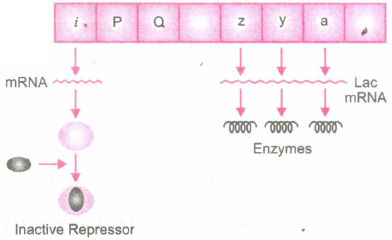
(a)What does the figure express?
(b)When does the transcription of lac mRNA stop?
(c)Name the enzyme transcribed by the gene 'Z'
9.
What changes happen during processing of RNA?
10.
how is the first ribonucleotide different from others in the RNA chain?
11.
What is a promoter in a transcription unit? Where is it located in DNA with reference to the structural gene(s)?
12.
How did Hershey and Chase differentiate between DNA and protein in their experiment while proving that DNA is the genetic material?
13.
Mention the role of ribosomes in peptide bond formation. How does ATP facilitate it?
14.
Write the full form of VNTR.How is VNTR different from 'probe'?
15.
Depending upon the chemical nature of template (DNA or RNA) and the nature of nucleic acids synthesised from it ?(DNA or RNA) list the types of nucleic acid polymerases.
1.
Difference between cistron and an exon:
1. Cistron : A segment of DNA coding for a polypeptide ,chain; the structural gene in a transcription unit could be said as monocistronic (mostly in eukaryotes) or polycistronic (mostly in bacteria or prokaryotes).
2. Exon : The coding sequences or expressed sequences are defined as exons. Exons are said to be those sequences that appear in mature or processed mRNA.
2.
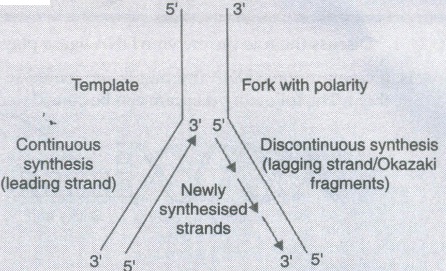
Polarity of the two strands of the fork to be shown and polarity as well as arrow mark of the lagging and leading strands to be shown with correct labellings.
3.
Prokaryotic structural genes are found in continuity without any non-coding region. In contrast, eukaryotic structural genes are divided into exons (coding DNA) and introns (non-coding DNA).
4.
The enzymes involved in DNA replication other than DNA polymerase and ligase are listed below with their functions:
| Helicase | -opens the helix |
| Topoisomerases | -Removes the tension caused due to unwinding |
| DNA ligase | -Joins the cut DNA strands |
5.
1. Lac is switched only adding lactose in the medium, as lactose acts as inducer and makes repressor inactive.
2. Due to this, \(\beta \) -galactosidase is formed which converts lactose into glucose and galactose. As soon as lactose is consumed, repressor again becomes active cause switching off of the system.
6.
Dr.S.P.Rai Chaudhary and Dr.Lalji Singh
7.
A complete set of gene contained in the haloid does of chromosomes and inherited as a unit from one parent is called geome
8.
(a) In presence of an inducer(such as lactose or allolactose), the repressor is inactivated by intersection with the inducer.
(b) Transcription of lac mRNA stops when the repress of the operon is synthesised from the i gene.The repress protein binds to the operator region of the operon and stops transcription.
(c) The gene 'Z' codes for beta-galactosidase.
9.
During RNA processing
(i)unwanted nucleotides are removed
(ii)useful regions are rejoined
(iii)certain nucleotides are added
(iv)some nucleotides are modified, and
(v)folding of molecule
10.
First ribonucleotide in RNA chain is triphosphate, monophosphates
11.
1.It is a DNA sequence that provides the binding site for RNA polymerase for transcription.
2.It is located towards the 5' end (upstream) of the structural gene (of the coding strand).
12.
1.Hershey and Chase Experiment
2.They made two different preparations of bactoriophage.
3. In one, the DNA was made radioactive with \(^{ 32 }{ P }\)
4. In the second, the protein coat was made radioactive with \(^{ 35 }{ S }.\)
5. The DNA being heavier sediments and hence radioactivity was found in the pellet.
6.Protein coat being lighter the radioactivity was found in the supernatant.
13.
Role of Ribosomes
(i) Ribosomes are the main cellular factory of protein synthesis the large subunit has two sites (P and A) for binding of amino acids,so that they are close to each other for formation of peptide bond.
(ii)They also act as catalyst (23s rRNA)in prokaryotes for formation of peptide bonds.ATP provides energy for the activation of amino acids.
14.
| VNTR | Probe |
| It is a class of satellite DNA where a small sequence is arranged tandemly in many copy numbers. | Probe is a labelled (with radioactivity) VNTR used for hybridisation with DNA segments in question. |
15.
(i) DNA-dependent DNA polymerase
It catalyses the polymerisation of approximately 2000 bps in a second into DNA, with high degree of accuracy.
(ii) DNA-dependent RNA polymerase
It catalyses the formation of RNA from DNA.
(iii) In eukaryotes, there are three types of DNA
dependent RNA polymerase as follows
(a) RNA Polymerase-l Transcribes rRNAs.
(b) RNA Polymerase-II Transcribes precursor of mRNA, i.e. hnRNA.
(c) RNA Polymernse-lII Transcribes tRNA, srRNA and snRNAs.
(iv) Reverse transcriptase is used for the synthesis of complementary DNA over RNA template.

12th Standard CBSE Syllabus & Materials
12th Standard CBSE
CBSE 12th Computer Science Python Revision Tour I - New Previous year Question Papers Study Material - QB365 Set A
NEW12th Standard CBSE
CBSE 12th Business Studies Planning Important Questions And Answers Study Material - QB365 Set A
NEW12th Standard CBSE
CBSE 12th Business Studies Business Environment Important Questions And Answers Study Material - QB365 Set A
NEW12th Standard CBSE
CBSE 12th Business Studies Principles of Management Important Questions And Answers Study Material - QB365 Set A



NCERT Books

Syllabus

Exam Pattern

Sample Question Papers

Previous year Question Papers

Important Notes

MCQ Practice test

NCERT Exemplers

Case study Questions

Image Based Questions

Passage based Questions

HOT Questions

Value Based Questions

Model Questions Papers
NCERT ( Book Back ) Questions

Assertion and Reason
Important Questions And Answers

CBSE 12th Standard CBSE Subjects
CBSE Standards