 100% FREE ACCESS
12th Standard CBSE Syllabus & Materials
12th Standard CBSE
CBSE 12th Economics Government Budget and the Economy Previous year Question Papers Study Material - QB365 Set A
NEW12th Standard CBSE
CBSE 12th Computer Science Interface Python with MySQL - New Previous year Question Papers Study Material - QB365 Set A
NEW12th Standard CBSE
CBSE 12th Computer Science Database Concept - New Previous year Question Papers Study Material - QB365 Set A
NEW12th Standard CBSE
CBSE 12th Computer Science Data Communication - New Previous year Question Papers Study Material - QB365 Set A
NEW12th Standard CBSE
CBSE 12th Computer Science Data Structures - New Previous year Question Papers Study Material - QB365 Set A
NEW12th Standard CBSE
CBSE 12th Computer Science Functions - New Previous year Question Papers Study Material - QB365 Set A

Published on: 05/03/2026
Download CBSE Class 12th Standard CBSE Biology question papers, sample papers, important questions, and previous year solved papers in PDF format. Get free study materials, NCERT solutions, and exam preparation resources for Class 12th Standard CBSE Biology
Questions + Answers key
Take MCQ Biology Test
1.
Why is the strand of DNA with 3'-5' polarity transcribed and not the other strand with 5'--> 3' polarity?
2.
Name the phenotypic/genotypic disorder of following genotype
(i) HbA/HbA
(ii) HbA/HbS
(iii) HbS/HbS
(iv) XhX
(v) XhY
3.
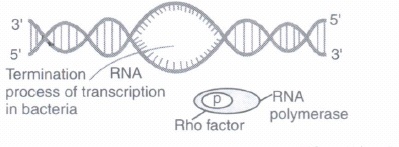
Describe the termination process of transcription in bacterium.
4.
Following the collision of two trains a large number of passenger are killed. A majority of them are beyond recognition. Authorities want to hand over the dead to their relatives. Name a modern scientific method and write the procedure that would help in the identification of kinship.
5.
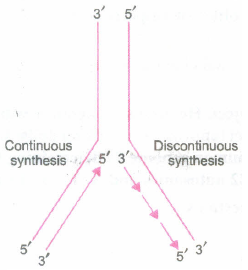
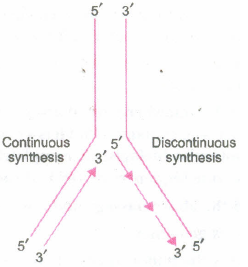
Correct the following figure of replication fork.
6.
Given below is a part of the template strand of a structural gene
\(\overline { TAC\quad CAT\quad TAG\quad GAT } \)
(a)Write its transcribed mRNA strand with its polarity
(b)Explain the mechanism involved in initiation of the transcription of this strand.
7.
What are the following of mRNA and tRNA ?What anticodons will be required to recognize the following codons?
(i)AAU
(ii)CGA
(iii)UAC
(iv)GCA
8.
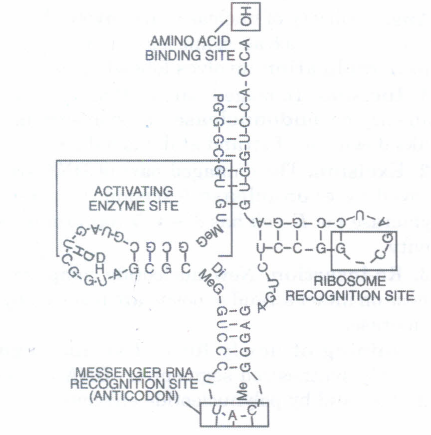
One of the codon on mRNA is AUG. Draw the structure of tRNA adapter molecule for this codon. explain the uniqueness of this tRNA?
9.
What is the inducer in the lac operon? How does it ensure the "switching on" or of genes?
(a) Draw a schematic representation of lac operon.
(b) Explain how does this operon get switched 'on' or 'off'
10.
Write briefly on each the following:
(i) oncogenes
(ii) reverse transcription
11.
(a) What is the contribution of Avery, MacCleod and McCarty?
(b) How did the transformation experiments of Griffith differ from those of Avery and MacCleod?
(c) What was the significance of each?
12.
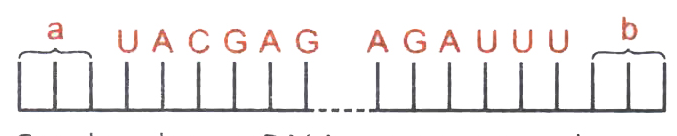
Study the mRNA segment given above which is complete to be translated into a polypeptide chain.
(i) Write the codons 'a' and 'b'.
(ii) What do they code for?
(iii) How is peptide bond formed between two amino acids in the ribosome?
13.
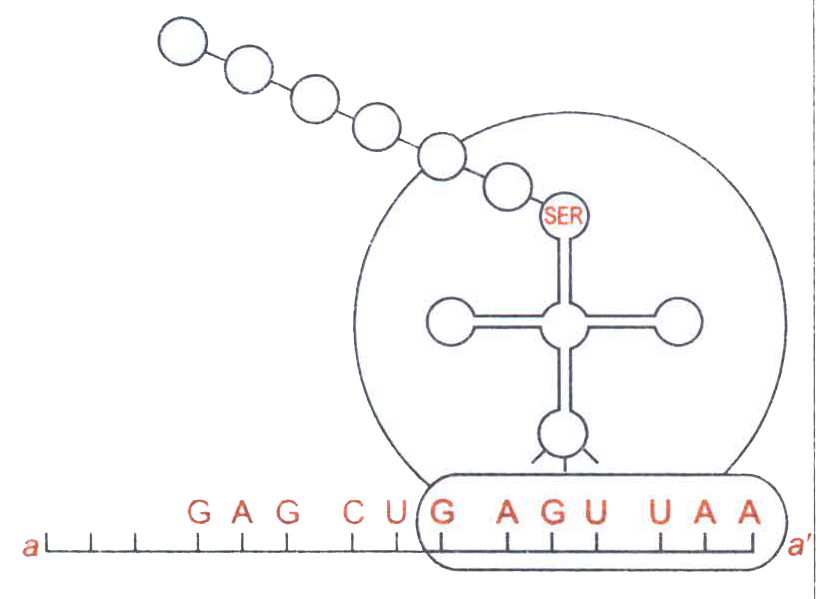
(a) Identify the polarity from a to a', in the above diagram and mention how many more amino acids are expected to be added to this polypeptide chain.
(b) Mention the DNA sequence coding for serine and the anticodon of tRNA for the same amino acid.
(c) Why are some untranslated sequence of bases seen in mRNA coding for a polypeptide? Where exactly are they present on mRNA?
14.
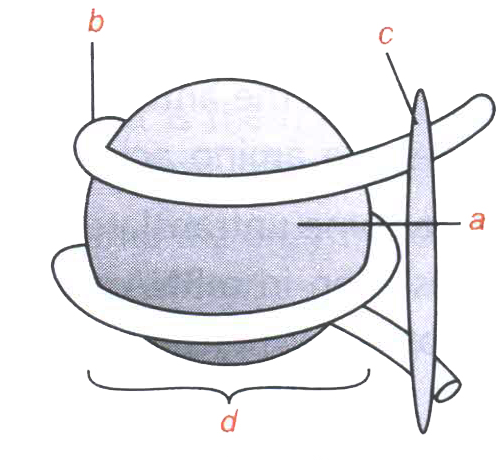
(a) What is this diagram representing?
(b) Name the parts a,b and c.
(c) In eukaryotes, the DNA molecules are organised within the nucleus. How is the DNA molecule organised in a bacterial cell in absence of a nucleus?
15.
(a) Identify the polarity at A and B respectively in the figure given below:
(b) Explain the mechanism the figure represents
.png)
16.
Differentiate between the following
(i)Promoter and Terminator in a transcription unit.
(ii)Exon and intron in an unprocessed eukaryotic mRNA.
(ii)Inducer and Repressor in operons.
17.
(a)Name the scientist who called tRNA an adptor molecule.
(b)Draw a clover leaf structure of tRNA showing the following:
(i)tyrosine attached to its amino acid site
(ii)anticodon for this amino acid in its correct site.
(c)What does the actual structure of tRNA look like?
18.
The base sequence in one of the strands of DNA is TAGCATGAT
(i)Give the base sequence of its complementry strand.
(ii)How are these base pairs held together in a DNA molecule?
(iii)Explain the base complementarity rule.Name the scientist who framed this rule.
19.
What is hnRNA?Explain the changes hnRNA undergoes during the processing to from mRNA
1.
The DNAstrand with 3'-5' polarity only is trancribed and not the other because the RNA-polymerase can polymerize RNA only in 5'-3' direction.
2.
(i) Normal haemoglobin
(ii) Sickle cell anemia carrier haemoglobin (Heterozygous)
(iii) Sickle cell anaemia (Homozygous condition)
(iv) Carrier woman for Haemophilia
(v) Haemophilic man
3.
(1) RNA polymerase binds to the promotor and initiates transcription. It uses nucleotide triphosphates as substrates and polymerises in a template dependent fusion following the rule of complementary. It somehow also facilitates opening
of the helix structure and continues elongation. Only a short stretch of RNA remains bound to the enzyme. Once the polymerase reaches the terminator region, the nascent RNA falls off, so also the RNA polymerase. This results into termination
of the transcription.
(2) RNA polymerase associates transiently with termination factor (rho) to terminate the transcription. Association of this factor alters the specificity of the RNA polymerase to terminate.
4.
DNA fingerprinting is used for identification of kinship.
Procedure:
1. Variable number of tanden repeats (VNTR's) are satellite DNA's that show high degree of polymorphism. They are used as probes in DNA fingerprinting.
2. Fragments of DNA from an individual are isolated and cut with restriction endonucleases.
3. Fragments are separated according to their size and molecular weight through gel electrophoresis.
4. Fragments separated through electrophoresis gel are blotted (immobilised) on a synthetic membrane such as nylon or nitrocellulose.
5. Immobilised fragments are hybridised with a VNTR probe.
6. Hybridised DNA fragments can be detected by autoradiography.
7. VNTRs are different in size, ranging from .1 to 20 kb. Hence, in the autoradiogram, a band of different sizes will be obtained.
8. These bands are the characteristic feature of an individual. They are different in each and ever} individual except identical twins.
5.
6.
(a)
\(\\ \overline { ^{ 3' }TAC\quad CAT\quad TAG\quad GAT\\ _{ 5' }\underline { AUG\quad GUA\quad AUC\quad CUA } _{ mRNA } } ^{ 5' }\)
7.
mRna caries a message from DNA to ribosome sin the form of sequence of triplet codes.It acts as a plateform where protein synthesis takes place.tRNA transfer aminoacids to protein synthesizing apparatus.mRNA possess codons and tRNA possess anticodons.The anticodons are---(i)UUA,(ii)GUC,(iii)AUA,(iv)CGU
8.
It constitutes 15% of total RNA and is smallest out of three with only 70-85 nucleotides having sedimentation coefficient 45. It is of 100 types. Nitrogen bases of some nucleotides are modified to provide coiling to the otherwise single stranded RNA. The tRNA has two models clover leaf and L-form model. It has different specific loops as shown:
9.
(b) Inducer, It is a chemical which may be a substrate hormone or some other metabolic which after coming in contact with the repressor, changes the latter into non-DNA binding state so as to free the operator gene. Thus the "switch on" occurs
The expression of the genes is usually controlled to achieve maximum cellular economy. This mean that gene will be turned on or off as per requirement. A set of gene will be switched on when there is necessity to handle and metabolise a new subtrate. when these genes are turned on enzymes are produced, which metabolise the new subtrate. The phenomenon is known as induction
10.
(i) Oncogenes are cancer causing genes. They are formed from proto-oncogenes which are present in a normal cell. oncogenes responsible for inducing uncontrolled cell divisions in a cell as a result of which cancer is caused
(ii) Reverse transcription The synthesis of a DNA molecule from the single-stranded RNA in the presence of an enzyme reverse transcriptase is called reverse transcription
A group of viruses referred to as Retroviruses has RNA as the genetic material
The single-stranded RNA of the virus gives rise to double-stranded DNA through the reverse transcription mechanism involving the enzyme reverse transcriptase. The original viral RNA is degraded and the double-stranded DNA is integrated into the host chromosome giving rise to the provirus. Transcription of the provirus may lead to the expression of viral oncogenes causing cancer. It is also possible that the provirus gives rise to the RNA and proteins leading to the information and release of more retroviral particles.
Thus, these viruses carry the genes for reverse transcription and the enzyme reverse transcriptase catalyses the conversion of RNA to DNA. Retroviruses are connected with one or the other type of cancer
11.
(a) Avery, MacCleod and McCarty gave the proof that "Transforming agent" is DNA
Avery, MacCleod and McCarty experiment:
1) Oswald Avery, colin MacCleod and McCarty in 1933-34 revealed the chemical nature of the transforming substance to be DNA
2) They purified DNA, RNA, Protein from heat-killed S-strain to see which of them could transform R-cells \(\rightarrow \)S-cells.
3) They also observed that protein digesting enzyme (protease) and RNA digesting enzyme (RNAase) have no effect on transformation whereas digestion of DNA with DNAase would not cause transformation
4) This finding established that transforming genetic material is DNA
Result of experiment
| Mixture | Result |
| 1) R-type bacteria + carbohydrates of S-type bacteria 2) R-type + protein of S-type 3) R-type + DNA of S-type 4) R-type + DNA of S-type + Deoxyribonuclease |
R-type R-type S-type R-type |
(b) Griffith's in vitro experiments demonstrated the occurrence of transformation in Pneumococcus. They provide no indication as to the molecular basis of the transformation phenomenon. Avery and MacCleod carried their experiments in vitro employing biochemical analysis to demonstrate that transformation was mediated by DNA
(c) Griffith showed that a transforming substance existed. Avery et.al. defined it as DNA
12.
(i) a - AUG
b - UAA/UAG/UGA.
(ii) AUG codes for methionine.
UAA/UAG/UGA does not code for any amino acid, but brings about termination of polypeptide synthesis.
(iii)There are two sites in the large subunit of ribosome, where the subsequent amino acids bind to and come close enough for formation of peptide bond; it is catalysed by peptidyl transferase.
The ribosome also acts as a catalyst (in bacteria) for the formation of peptide bond.
13.
(a) a to a' is \({ 5 }^{ ' }\longrightarrow { 3 }^{ ' }\)
No more amino acid will be added.
(b) TCA; anticodon is UCA.
(c) The untranslated regions are required for efficient translation process.
They are present before the initiation codon at the 5'-end and after the stop/termination codon, at the 3'-end.
14.
(a) It is a nucleosome.
(b) a - Histone octamer;
b - DNA;
c - \({ H }_{ 1 }\) Histone.
(c) In prokaryotes, the DNA is held with some positively-charged proteins to form a nucleoid.
15.
(a) A-5', B-3'
(b) The figure represents the continuous and discontinuous synthesis of DNA strands at the replication fork, during replication of DNA.
(c) Replication fork is the y-shaped structure formed with small opening of DNA double helix.
(d) DNA polymerase catalyses polymerisation of nucleotides only in \({ 5 }^{ ' }\longrightarrow { 3 }^{ ' }\) direction.
(e) Both the strands of (parental)DNA act as templates for the synthesis of new strands.
(f) On the template strand with \({ 3 }^{ ' }\longrightarrow { 5 }^{ ' }\) polarity, the new strand is synthesised as a continuous stretch; it is called continuous synthesis.
(g) On the other strand with \({ 5 }^{ ' }\longrightarrow { 3 }^{ ' }\) polarity, DNA is synthesised as short stretches; it is called discontinuous synthesis.
Later the short stretches of DNA are joined by DNA-ligases into a continuous strand.
16.
(i) Differences
| Promoter | Terminator |
| It is the sequence of DNA that provides binding site for RNA polymerase for transcription. It is located towards 5' end (upstream) of the structural gene. |
It is the sequence of DNA that defines the end of the process of transcription. It is located towards the 3' end (down-stream) of the structural gene. |
(ii) Differences
| Exon | Intron |
| Exons are the coding sequences of DNA that form part of mRNA and code for different regions of the poly-peptide. |
Introns are the non-coding sequences of DNA that are removed during splicing of hnRNA and they do not form a part of mRNA. |
(iii) Differences
| Inducer | Repressor |
| Inducer is the substance that binds to the repressor and 'switches on' or induce the operon. Regulation of the operon is positive. |
Repressor is the protein coded by regulatory (i) gene, that binds to the operator and 'switches' off' the operon. Regulation of the operon is negative. |
17.
(a) Francis Crick.
(b)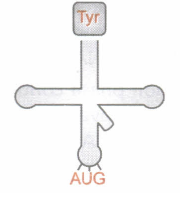
(c) It looks like inverted L.
18.
(i) ATCGTACTA.
(ii) Base pairs are held together by weak hydroyen bodsin a DNA molecule. Adenine pairs with thymine by two H-bonds and guanine pairs with cytosine by three H-bonds.
(iii) According to basc complementarity rule proposed by Erwin Chargalf for a double-stranded DNA, the ratios between adenine-thymine and guanine-cytosine are constant and equal to one.
19.
In Eukaryotes:
1. The structural genes are split. They have coding sequences (exons) interspersed with non-coding sequences (introns).
2. The primary transcript of RNA undergoes a process called splicing, by which the introns are removed and the exons are joined together.
3. The hnRNA (precursor of mRNA) undergoes capping and tailing to become mRNA.
4. In capping, methyl guanosine triphosphate is added to the 5' end of hnRNA.
5. In tailing, adenylate residues (about 200-300) are added at the 3' end.
6. The fully processed mRNA is released from the nucleus into the cytoplasm.

12th Standard CBSE Syllabus & Materials
12th Standard CBSE
CBSE 12th Computer Science Python Revision Tour I - New Previous year Question Papers Study Material - QB365 Set A
NEW12th Standard CBSE
CBSE 12th Business Studies Planning Important Questions And Answers Study Material - QB365 Set A
NEW12th Standard CBSE
CBSE 12th Business Studies Business Environment Important Questions And Answers Study Material - QB365 Set A
NEW12th Standard CBSE
CBSE 12th Business Studies Principles of Management Important Questions And Answers Study Material - QB365 Set A



NCERT Books

Syllabus

Exam Pattern

Sample Question Papers

Previous year Question Papers

Important Notes

MCQ Practice test

NCERT Exemplers

Case study Questions

Image Based Questions

Passage based Questions

HOT Questions

Value Based Questions

Model Questions Papers
NCERT ( Book Back ) Questions

Assertion and Reason
Important Questions And Answers

CBSE 12th Standard CBSE Subjects
CBSE Standards