
 100% FREE ACCESS
12th Standard CBSE Syllabus & Materials
12th Standard CBSE
CBSE 12th Economics Government Budget and the Economy Previous year Question Papers Study Material - QB365 Set A
NEW12th Standard CBSE
CBSE 12th Computer Science Interface Python with MySQL - New Previous year Question Papers Study Material - QB365 Set A
NEW12th Standard CBSE
CBSE 12th Computer Science Database Concept - New Previous year Question Papers Study Material - QB365 Set A
NEW12th Standard CBSE
CBSE 12th Computer Science Data Communication - New Previous year Question Papers Study Material - QB365 Set A
NEW12th Standard CBSE
CBSE 12th Computer Science Data Structures - New Previous year Question Papers Study Material - QB365 Set A
NEW12th Standard CBSE
CBSE 12th Computer Science Functions - New Previous year Question Papers Study Material - QB365 Set A

Published on: 05/03/2026
Download CBSE Class 12th Standard CBSE Biology question papers, sample papers, important questions, and previous year solved papers in PDF format. Get free study materials, NCERT solutions, and exam preparation resources for Class 12th Standard CBSE Biology
Questions + Answers key
Take MCQ Biology Test
1.
List causative agents of the following STDs.
(i) AIDS
(ii) Gonorrhoea.
2.
What is point mutation? Give one example.
3.
Using a punnett square, workout the distribution of phenotypic features in the first filial generation after a cross between a homozygous female and a heterozygous male for a single locus.
4.
Write the recessive forms of the following traits in garden pea.
(i) Flower position
(ii) Pod shape
(iii) Seed shape
(iv) Pod colour.
5.
What is pedigree analysis? Suggest how such an analysis can be useful.?
6.
A woman with blood group O married a man with AB group. Show the possible blood group of the progeny. List the alleles involved in this inheritance.
7.
Differentiate between multiple allelism and pleiotropy, with the help of an example each.
8.
How would you find the genotype of an organism exhibiting a dominant phenotype trait?
9.
A diploid organism is heterozygous for 4 loci, how many types of gametes can be produced?
10.
Expand the follwing
(a)MMR
(b)PID
(c)IMR
(d)MTP
11.
Correct the following statements
(a) Surgical methods of contraception prevent gamete formation.
(b) All sexually transmitted disease are completely curable.
(c) Oral pills are very popular contraceptives among the rural women.
(d) In E.T techniques, embryos are always transferred into the uterus.
12.
Is the use of contraceptives justified? Give reasons.
13.
Describe the lactational Amenorrhoea method of birth control.
14.
Why is 'Saheli' cosidered an effective contraceptive for womem to space children?
15.
Why is Cu-T considered a good contraceptive device to space children?
1.
(i) HIV (Human Immuno deficieny virus), and
(ii) Neisseria gonorrhoeae.
2.
Gene mutations that involves the substitution, deletion or insertion of a single nitrogeneous base is called point mutation. For example a change of a single nitrogenous base causes sickel-cell anaemia that may prove fatal by age 20.
3.
Honozygous female-Ww
Heterozygous male-Ww
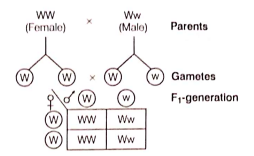
In this case, all individuals of Fi,-generation would possess dominant trait. 50% are homozygous dominant and 50% are heterozygous dominant.
4.
(i) Terminal flowers
(ii) Constricted pods
(iii) Wrinkled seeds
(iv) Yellow pod.
5.
Pedigree analysis is the study of transmission of particular traits over the generations for finding out the possibility of their occurrence in the future generations.
Importance of pedigree analysis is as follows
(i) It is used to know the possibility of expressive or recessive allele, which may cause genetic disorders.
(ii) It shows the origin of a trait and inheritance pattern of that trait in a family.
6.
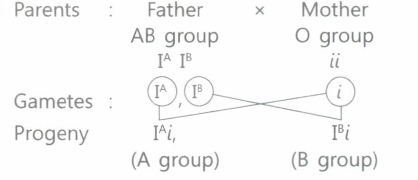
The gene for blood group exists in three allelic forms \(I^{ \wedge }I^{ B }and\quad i\)
7.
| Multiple allelism | Pleiotropy |
| It is the phenomenon in which a gone for a trait exists in more than two allelic forms |
It is the phenomenon of the ability of a single gene to have more than one phenotypic effect. |
|
The alleles can show codominance. |
Codominance is not exhibited. |
8.
In the test cross, an individual showing dominant phenotype would be crossed to an individual with recessive phenotype for the same trait.
(i) If the individual is homozygous dominant, all the individuals in the progeny would show the dominant phenotype.
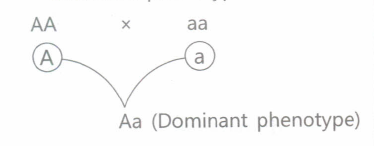
(it) If the individual is heterozygous, the progeny will show dominant phenotype and recessive phenotype in the ratio of 1 : 1.
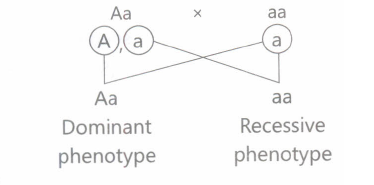
Thus, the genotype of the individual with dominant phenotype can be ascertained.
9.
The formula 2n is applied here
where, n = Number of loci
The organism is heterozygous for 4 loci, n =4
So, 2n = 24 =2 x 2 x 2 x 2 = 16
The organism will produce 16 types of gametes.
10.
(a)Maternal Morality Rate
(b)Pelvic Inflammatory Disease
(c)Infant Morality Rate
(d)Medical Termination of Pregnancy
11.
(a) The surgical methods of contraception prevent gamete transfer from the organs of production to the site of fertilisation.
(b) Not all sexually transmitted disease are completely curable.
(c) Oral pills are very popular contraceptives among the rural women.
(d) In E.T techniques, embryos are always transferred into the uterus
12.
Use of contraceptives is justified due to the following reasons
(i) In the absence of contraceptives, the population growth rate will rise at an explosive rate and there will be scarcity of even the basic necessities.
Earth's resources are limited. We have already started facing the problems of overcrowding, food price inflation, power and water shortage, etc. Further increase in population will only aggrevate situation.
(ii) Contraceptives provide an option for planning the family by spacing the pregnancies and avoiding unwanted pregnancies.
(iii) Contraceptives also guard against STDs to some extent.
13.
1. Lactational Amenorrhoea refers to the absence of menstriation during the period of intense lactation following parturition.
2. It is because ovulation and other events in menstrual cycle do not occur during this period.
3. Hence as long as the mother breast feeds her child chances of conception are almost nil.
14.
(i) It is a non-steroidal preparation.
(ii) It is a 'once' a week' pill.
(iii) It has high contraceptive value.
(iv) It has fewer side effects than other oral contraceptives.
15.
Cut is an intra-uterine device (IUD) and functions as follows:
1. It suppresses sperm motility and the fertilising capacity of sperms.
2. It increases phagocytosis of sperms within the uterus.

12th Standard CBSE Syllabus & Materials
12th Standard CBSE
CBSE 12th Computer Science Python Revision Tour I - New Previous year Question Papers Study Material - QB365 Set A
NEW12th Standard CBSE
CBSE 12th Business Studies Planning Important Questions And Answers Study Material - QB365 Set A
NEW12th Standard CBSE
CBSE 12th Business Studies Business Environment Important Questions And Answers Study Material - QB365 Set A
NEW12th Standard CBSE
CBSE 12th Business Studies Principles of Management Important Questions And Answers Study Material - QB365 Set A



NCERT Books

Syllabus

Exam Pattern

Sample Question Papers

Previous year Question Papers

Important Notes

MCQ Practice test

NCERT Exemplers

Case study Questions

Image Based Questions

Passage based Questions

HOT Questions

Value Based Questions

Model Questions Papers
NCERT ( Book Back ) Questions

Assertion and Reason
Important Questions And Answers

CBSE 12th Standard CBSE Subjects
CBSE Standards