 100% FREE ACCESS
12th Standard CBSE Syllabus & Materials
12th Standard CBSE
CBSE 12th Economics Government Budget and the Economy Previous year Question Papers Study Material - QB365 Set A
NEW12th Standard CBSE
CBSE 12th Computer Science Interface Python with MySQL - New Previous year Question Papers Study Material - QB365 Set A
NEW12th Standard CBSE
CBSE 12th Computer Science Database Concept - New Previous year Question Papers Study Material - QB365 Set A
NEW12th Standard CBSE
CBSE 12th Computer Science Data Communication - New Previous year Question Papers Study Material - QB365 Set A
NEW12th Standard CBSE
CBSE 12th Computer Science Data Structures - New Previous year Question Papers Study Material - QB365 Set A
NEW12th Standard CBSE
CBSE 12th Computer Science Functions - New Previous year Question Papers Study Material - QB365 Set A

Published on: 05/03/2026
Download CBSE Class 12th Standard CBSE Biology question papers, sample papers, important questions, and previous year solved papers in PDF format. Get free study materials, NCERT solutions, and exam preparation resources for Class 12th Standard CBSE Biology
Questions + Answers key
Take MCQ Biology Test
1.
A man with blood group A and his wife blood group B have a son with blood group O, father claim that was not his son. How can the problem be solved?
2.
What are the kinds of mutation according to phenotypic effect?
3.
How many genes are responsible for?
(i) ABO system of blood group
(ii) Skin colour in human.
4.
What will be the consequence, if cytokinesis does not follow the telophase stage of cell division? What term is given to this phenomenon?
5.
Thalassemia \(\alpha\) is different from thalassemia \(\beta\). Justify.
6.
In dogs, black coat colour is dominant over white. What coloured dog will you choose to breed with a given back dog, in order to find its genotype. What is this type of cross known as?
7.
Give the Mendelian monohybrid ratio. How is it mathematically condensable to the binomial expression?
8.
How are alleles of a particular gene different from each other? Explain its significance.
9.
Differentiate between Dominance and Recessive.
10.
In a dihybrid cross, while-eyed, yellow-bodied female Drosophila crossed with red-eyed, brown-bodied male Drosphila produced in F2 generation, 1.3 per cent recombinats and 98.7 per cent progeny with parental type combinations. This observation of Morgan deviated from Mendelian F2 phenotypic dihybrid ratio. Explain giving reasons Morgan's observations.
11.
With the help of a Punnett square, find the percentage of homozygous tall plants in a F2 population involving a true-breeding tall and a true-breeding dwarf pea plant.
12.
A Corss between a red flower-bearing plant and a white flower-bearing plant of antirrhinum produced all plants having pin flowers. Work out a cross to explain how this is possible.
13.
when a tall pea-plant was selfed, it produced one-fourth of its progeny as dwarf. Explain with the help of a cross.
1.
Real father can be identified by blood group analysis and with DNA fingerprinting. Value:- critical thinking ,trust making
2.
According to their phenotypic effects following kinds of mutations may occur:
(a) Dominant mutations, i.e., expressed phenotypically all the times;
(b) Recessive mutations, usually not expressed except homozygous recessive state;
(c) Lethal mutations, result in the death of the organisms.
3.
Three genes are responsible for expression of ABO blood groups.For skin colour in man three pairs of genes are responsible.
4.
1.It leads to an increase in a whole set of chromosomes of the organism.
2. It is called polyploidy.
5.
| Thalassemia \(\alpha\) | Thalassemia \(\beta\) |
| It is under the control of two genes HBA1 and HbA2 on chromosome 16. |
It is controlled by a single gene HBB on chromosome 11. |
| The synthesis of \(\alpha\) chain is impaired | The synthesis of \(\beta\) chain is impaired. |
6.
(i) A white colour dog will be chosen.
(ii) White colour is recessive; a homozygous white do, that breeds true will be chosen.
(iii) Such a cross is called test cross.
7.
- Mendelian phenotupic ratio of a monohybrid cross is 3 : 1 and the genotypic ration is 1 : 2 : 1.
- It can be mathematically condensed as (ax + by)2.
8.
Alleles are polymorphs that differ in their nucleotide sequence resulting in contrasting phenotypic expression. These are the alternative forms of a same gene, e.g. genes for height have two alleles, one for dwarfness (t) and one for tallness (T). Significance of alleles are
(i) A characler may have two or more contrasting phenotypic expression, thus resulting in variation in a population.
(i) These are used in the studies of inheritance.
9.
| Dominance | Recessive |
| - Dominance refers to the phenomenon exhibited by the form of a trait, which appears in the heterozygous (hybrid) condition. | - Recessive refers to the phenomenon exhibited by the form of a trait, which remains suppressed or hidden in the heterozygous (hydrid) condition. |
10.
It is due to the phenomenon of linkage. fruit fly produces all ova with one
Linkage is defined as the phenomenon X-chromosome and the male fowl in which two or more linked genes are produces all the sperms with one inherited together and their frequency Z-chrornosorne, along with autosomes.
of recombination in a test cross 2.13 Parents Father x Mother progeny is less than the expected 50 AB group 0 group percent.
In this case, the genes for eye colour Gametes and body colour show linkage and do not always allow for crossing over Progeny during gamete formation; hence the parental combination is in greater - The gene for blood group exists in proportion than that of recombinants.
\({ F }_{ 1 }\) generation Aali-(Axial flowers, inflated flowers)
The phenotype of the \({ F }_{ 1 }\)progeny-Axial flowers and inflated pods
The genotype of the \({ F }_{ 1 }\)progeny-Aali
11.
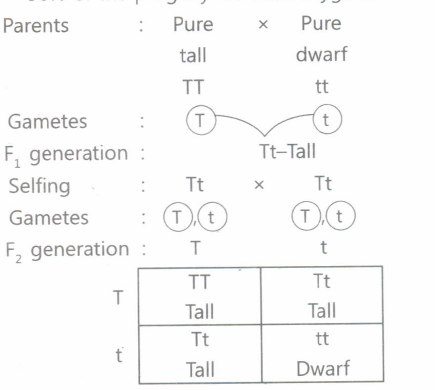
Phenotypic ratio : 3 Tall : 1 Dwarf Genotypic ratio : 1 TT : 2 Tt : 1 tt
Two-thirds of the tall progeny is heterozygous.
It is because the gene for tallness (T) is dominant and expresses itself in the heterozygous condition, Tt.
12.
Inheritance of flower colour in Antirrhinum majus:
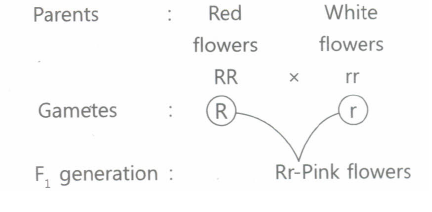
This character shows incomplete dominance , where neither of the two alleles of the gene is completely dominant and the Fl hybrid is intermediate between the two.
13.
Since dwarfness (recessive trait) has appeared in the progeny, the tall pea plant must be heterozygous for tallness, i.e. its genotype is Tt
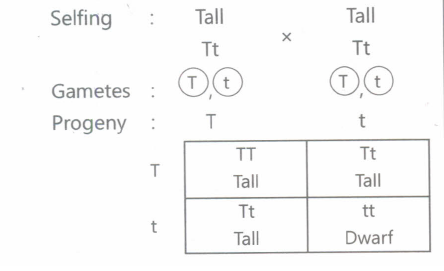
The phenotypic ratio is 3 Tall : 1 dwarf.
Since tallness is dominant over dwarfness, the homozygotes (TT) as well as the heterozygotes (Tt) are tall.
The recessive trait is expressed only under homozygous condition (tt) and hence appears only in one-fourth of the progeny.

12th Standard CBSE Syllabus & Materials
12th Standard CBSE
CBSE 12th Computer Science Python Revision Tour I - New Previous year Question Papers Study Material - QB365 Set A
NEW12th Standard CBSE
CBSE 12th Business Studies Planning Important Questions And Answers Study Material - QB365 Set A
NEW12th Standard CBSE
CBSE 12th Business Studies Business Environment Important Questions And Answers Study Material - QB365 Set A
NEW12th Standard CBSE
CBSE 12th Business Studies Principles of Management Important Questions And Answers Study Material - QB365 Set A



NCERT Books

Syllabus

Exam Pattern

Sample Question Papers

Previous year Question Papers

Important Notes

MCQ Practice test

NCERT Exemplers

Case study Questions

Image Based Questions

Passage based Questions

HOT Questions

Value Based Questions

Model Questions Papers
NCERT ( Book Back ) Questions

Assertion and Reason
Important Questions And Answers

CBSE 12th Standard CBSE Subjects
CBSE Standards