12th Standard CBSE Syllabus & Materials
12th Standard CBSE
CBSE 12th Economics Government Budget and the Economy Previous year Question Papers Study Material - QB365 Set A
NEW12th Standard CBSE
CBSE 12th Computer Science Interface Python with MySQL - New Previous year Question Papers Study Material - QB365 Set A
NEW12th Standard CBSE
CBSE 12th Computer Science Database Concept - New Previous year Question Papers Study Material - QB365 Set A
NEW12th Standard CBSE
CBSE 12th Computer Science Data Communication - New Previous year Question Papers Study Material - QB365 Set A
NEW12th Standard CBSE
CBSE 12th Computer Science Data Structures - New Previous year Question Papers Study Material - QB365 Set A
NEW12th Standard CBSE
CBSE 12th Computer Science Functions - New Previous year Question Papers Study Material - QB365 Set A

Published on: 03/08/2026
Download CBSE Class 12th Standard CBSE Biology question papers, sample papers, important questions, and previous year solved papers in PDF format. Get free study materials, NCERT solutions, and exam preparation resources for Class 12th Standard CBSE Biology
Questions + Answers key
Take MCQ Biology Test
1.
Mention two strategies evolved to prevent self-pollination in flowers.
2.
If one can induce parthenocarpy through the application of growth substances, which fruits would you select to induce parthenocarpy and why?
3.
Why is apple called a false fruit? Which part(s) of the flower forms the fruit?
4.
What is meant by emasculation? When and why does a plant breeder employ this technique?
5.
What is fruit production without fertilisation called?
6.
How many embryo sacs are formed in an ovule?
7.
How does a plant breeder ensure cross-pollination in economically important bisexual flower?
8.
Enumerate any six adaptive floral characteristics of a wind-pollinated plant.
9.
Explain the process of artificial hybridisation to get improved crop variety in
(i) plants bearing bisexual flowers and
(ii) female parent producing unisexual flowers.
10.
Explain the characteristic features of flowers that facilitate wind pollination.
11.
(a) In plant breeding experiments, pistillate flowers are not emasculated, but are still bagged. Explain.
(b) Why are outbreeding devices developed by some flowering plants?
12.
Explain how false, true and parthenocarpic fruits are different from each other. Give one example of each.
13.
(a) Describe the process of syngamy and triple fusion in angiosperms.
(b) Explain the development of a fertilised egg upto a mature embryo in a dicot plant. draw a labelled diagram of a mature dicot embryo,
14.
(a) Differentiate between: Autogamy, geitonogamy and xenogamy.
(b) Explain the events that occur during pollen-pistil interaction.
15.
How does a pollen mother cell develop into a mature pollen grain? Illustrate the stages with labelled diagrams.
16.
Describe in sequence the events that lead to the development of a 3-celled pollen grain from a microspore mother cell in angiosperms.
17.
Anthesis is a phenomenon which refers to
Formation of pollen
Development of anther
the opening of a flower bud
Reception of pollen by stigma
18.
Devices for self-pollination are
Dicliny or unisexuality
Dichogamy
heterostyly
None of these
19.
Pollen grains are able to withstand extremes of temperature and desiccation because their exine is composed of
Cutin
Suberin
Sporopollenin
Callose
20.
The plant part which consists of two generations one within the other is
Germinated pollen grain
seed
Unfertilized ovule
Embryo
21.
Pick the odd one out
Chalazogamy
Porogamy
Mesogamy
Allogamy
22.
In a flowering plant, archesporium gives rise to
only the wall of the sporangium
both wall and the sporogenous cells
wall and the tapetum
Only tapetum and sporogenous cells
23.
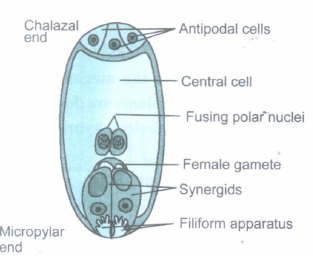
A fully developed embryo sac
A fully-developed and mature embryo sac is shown above.
(a) Name the cell from which it has developed.
(b) What is the ploidy level of its nuclei?
(c) What is filiform apparatus? Mention its significance.
24.
Assertion: Mostly in a tetrad, all microspores are free.
Reason: Compound pollen grain and pollinium are formed by grouping of microspores
Codes:
(a) Both assertion and reason are true and reason is the correct explanation of assertion.
(b) Both assertion and reason are true but reason is not the correct explanation of assertion.
(c) Assertion is true but reason is false.
(d) Both assertion and reason are false
25.
Assertion: One pollen mother cell forms four microspores.
Reason: Microspores are formed due to reduction division
Codes :
(a) Both assertion and reason are true and reason is the correct explanation of assertion.
(b) Both assertion and reason are true but reason is not the correct explanation of assertion.
(c) Assertion is true but reason is false.
(d) Both assertion and reason are false
1.
1. Self-incompatibility: A condition wherein the pollen is ineffective in fertilizing the same flower or other flowers on the same plant usually due to inhibition of the growth of the pollen tube in the stigma and style, thereby preventing delivery of male gametes to the ovules.
2. Maturation of pistil before that of stamen (protogyny) or maturation of stamen before that of the pistil (protandry) inhibit self-pollination.
2.
The fruits selected to induce parthenocarpy can be watermelon, papaya, etc. It is because these fleshy fruits have a large number of seeds, which interfere with the preparation of jams, jellies, etc.
3.
Apple is called a false fruit because it develops from the thalamus (enlarged structure at the base of the flower) instead of ovary.
4.
1. Emasculation is the process of removal of stamens from a bisexual flower before they shed pollen in order to prevent self-pollination and permit cross-pollination of stigma with desired pollen. During breeding, the breeder wants to make sure that the desired pollen grains are used for pollination and the stigma is protected from contamination (from unwanted pollen).
2. A plant breeder employs this technique to select and incorporate specific traits in the progeny.
5.
Parthenocarpy.
6.
One
7.
(i) Emasculation refers to the practice of removal of anthers/stamens from a bisexual flower before the pollen grains mature.
(ii) It is necessary to prevent the self-pollen from contaminating the stigma.
(iii) Bagging refers to the covering of the emasculated flowers with a suitable bag made of butter paper; it is essential to prevent contamination of the stigma of the emasculated flower with unwanted pollen grains.
(iv) When the stigma becomes receptive, the pollen grains from the selected flowers are dusted on it and the flower is rebagged for the development of fruits and seeds.
(v) If female parent bears unisexual flowers, there is no need for emasculation.
(vi) The female flower buds are bagged before they open.
(vi) When the stigma becomes receptive, pollination is carried out with the desired pollen the flowers are rebagged.
8.
In wind pollinated flowers,
(i) The stamens are well-exposed, so that pollen grains are easily dispersed in wind currents.
(ii) The stigma is large and often feathery, to easily trap the air-borne pollen grains.
(iii) The pollen grains are light and non-sticky, to be transported in wind currents.
(iv) Pollen grains are produced in enormous quantity.
(v) Numerous small flowers are packed into an inflorescence.
(vi) There is a single ovule in the ovary of these flowers.
9.
(i) Emasculation refers to the practice of removal of anthers/stamens from a bisexual flower before the pollen grains mature.
(ii) It is necessary to prevent the self-pollen from contaminating the stigma.
(iii) Bagging refers to the covering of the emasculated flowers with a suitable bag made of butter paper; it is essential to prevent contamination of the stigma of the emasculated flower with unwanted pollen grains.
(iv) When the stigma becomes receptive, the pollen grains from the selected flowers are dusted on it and the flower is rebagged for the development of fruits and seeds.
(v) If female parent bears unisexual flowers, there is no need for emasculation.
(vi) The female flower buds are bagged before they open.
(vi) When the stigma becomes receptive, pollination is carried out with the desired pollen the flowers are rebagged.
10.
In wind pollinated flowers,
(i) The stamens are well-exposed, so that pollen grains are easily dispersed in wind currents.
(ii) The stigma is large and often feathery, to easily trap the air-borne pollen grains.
(iii) The pollen grains are light and non-sticky, to be transported in wind currents.
(iv) Pollen grains are produced in enormous quantity.
(v) Numerous small flowers are packed into an inflorescence.
(vi) There is a single ovule in the ovary of these flowers.
11.
(a) In plant breeding experiments, pollen from the selected male parent only, are used for pollination.
To prevent contamination of the stigma by any other pollen grain, the pistillate flowers are bagged.
(b) Continued self-pollination leads to inbreeding depression; hence to discourage self-pollination, outbreeding devices have been developed by flowers.
12.
| False fruit | True fruit | Parthenocarpic fruit |
|
- When any part other than the ovary, contributes to the formation of fruit, it is called a false fruit, e.g. Apple, strawberry. |
- When a fruit is formed only by the ovary, it is called a true fruit, e.g. Tomato, brinjal | - When the ovary transforms into a fruit, without fertilisation, it is called a parthenocarpic fruit, e.g. banana. |
13.
(a) Syngamy
Syngamy refers to the fusion of a male gamete with the female gamete in the embryo sac to form a diploid zygote.
Triple fusion
Triple fusion refers to the fusion of a male gamete with the secondary nucleus (formed by fusion of two haploid polar nuclei) to form the triploid primary endosperm nucleus.
(b) Embryo development
Th'e zygote undergoes mitotic divisions during embryogeny.
The first division is transverse and results in a basal cell and a terminal cell; the basal cell forms the suspensor while the terminal cell forms the embryo proper.
It first, forms a filamentous proembryo, which later forms in sequence a globular embryo, heart-shaped embryo and then a mature embryo.
14.
(a) Differences:
| Autogamy | Getonogamy | Xenogamy |
| It refers to the transfer of pollen grains from the anther of a flower to the stigma of the same flower | It refers to the transfer of pollen grains from the anther of a flower to the stigma of same plant. | It refers to the transfer of pollen grains from the anther of a flower to the stigma of another flower on a different plant of the same species. |
| It does not lead to genetic variation in the progency | It does not lead to genetic variation in the progeny. | It leads to genetic variation in the progeny |
| No pollinating agent is needed. | A pollinating agent is needed. | A pollinating agent is needed. |
(b) Pollen-Pistil Interaction.
The stigma/pistil has the ability to recognise the right type of pollen, i.e. the compatible pollen of the same species and rejects the wrong type of pollen grains.
It is the result of interaction between the chemical components of the pollen and those of stigma. - A compatible pollen grain starts its germination on the stigma.
The intine grows out through one of the germ pores as a protuberance.
The contents of the pollen move into this tube, i.e. the tube nucleus (nucleus of the vegetative cell) and the generative cell (or the two male gametes in those species where pollen is liberated in the three-celled stage).
The pollen tube grows through the tissues of stigma and style and enters the ovule through micropyle.
It enters the embryo sac through the filiform apparatus of one of the synergids to liberate the male gametes.
The events from the deposition of pollen on the stigma till the pollen tube enters the ovule, are collectively referred to as pollen-pistil interaction.
15.
(a) Development of Pollen grain:
- Microsporocytes undergo mitotic divisions to increase the number of functional microspore mother cells.
- Each microspore mother cell undergoes meiosis to form a microspore tetrad.
- All the four microspores remain enclosed in a common wall.
- They start separating from each other.
- The nucleus undergoes a mitotic division resulting in the formation of a large vegetative cell and a small generative cell.
- The spore develops a wall of two layers the outer- exine and inner intine.
- At this stage, the pollen grains are liberated; but in some cereals the generative cell undergoes mitosis and the pollen grain is 3-celled, at the time of liberation.
(b) Mature Pollen Grain:
- A mature pollen grain has a protective covering of two layers.
- The outer is thick, sculptured variously and is made of sporopollenin; this layer is called exine.
- The inner layer, called intine is thin and is made of cellulose.
- A mature pollen grain is two celled with a large vegetative cell and a small generative cell floating in the cytoplasm of the vegetative cell.
- The pollen grains of dicot plants have three germ pores while those of monocots have one.
16.
(a) Development of Pollen grain:
- Microsporocytes undergo mitotic divisions to increase the number of functional microspore mother cells.
- Each microspore mother cell undergoes meiosis to form a microspore tetrad.
- All the four microspores remain enclosed in a common wall.
- They start separating from each other.
- The nucleus undergoes a mitotic division resulting in the formation of a large vegetative cell and a small generative cell.
- The spore develops a wall of two layers the outer- exine and inner intine.
- At this stage, the pollen grains are liberated; but in some cereals the generative cell undergoes mitosis and the pollen grain is 3-celled, at the time of liberation.
(b) Mature Pollen Grain:
- A mature pollen grain has a protective covering of two layers.
- The outer is thick, sculptured variously and is made of sporopollenin; this layer is called exine.
- The inner layer, called intine is thin and is made of cellulose.
- A mature pollen grain is two celled with a large vegetative cell and a small generative cell floating in the cytoplasm of the vegetative cell.
- The pollen grains of dicot plants have three germ pores while those of monocots have one.
17.
(c)
the opening of a flower bud
18.
(d)
None of these
19.
(c)
Sporopollenin
20.
(b)
seed
21.
(d)
Allogamy
22.
(b)
both wall and the sporogenous cells
23.
(a) Megaspore
(b) Haploid
(c) (i) Filiform apparatus refers to the special cellular thickenings in the synergids, towards micropylar tip.
(ii) They play an important role in guiding the pollen tube to enter one of the synergids.
24.
(b) Mostly all the four spores within a tetrad are completely isolated from one another and from the spores in other tetrads of the locule. Usually the microspores separate from one another shortly after meiosis. However, in some plants the spores tend to remain together in tetrads for longer period and develop into compound pollen grains. In many members of Orchidaceae and Asclepiadaceae all the microspores in a sporangium remains together to form what is called a pollinium.
25.
(a) The sporogenous cells of anther may directly function as microspore mother cells (also called pollen mother cells or PMCs) or they may undergo a few mitosis to add up to their number before entering meiosis. Each PMC, by a meiotic division, gives rise to a group of four haploid microspores. The aggregates of four microspores are referred to as microspore tetrads.

12th Standard CBSE Syllabus & Materials
12th Standard CBSE
CBSE 12th Computer Science Python Revision Tour I - New Previous year Question Papers Study Material - QB365 Set A
NEW12th Standard CBSE
CBSE 12th Business Studies Planning Important Questions And Answers Study Material - QB365 Set A
NEW12th Standard CBSE
CBSE 12th Business Studies Business Environment Important Questions And Answers Study Material - QB365 Set A
NEW12th Standard CBSE
CBSE 12th Business Studies Principles of Management Important Questions And Answers Study Material - QB365 Set A



NCERT Books

Syllabus

Exam Pattern

Sample Question Papers

Previous year Question Papers

Important Notes

MCQ Practice test

NCERT Exemplers

Case study Questions

Image Based Questions

Passage based Questions

HOT Questions

Value Based Questions

Model Questions Papers
NCERT ( Book Back ) Questions

Assertion and Reason
Important Questions And Answers

CBSE 12th Standard CBSE Subjects
CBSE Standards