
 100% FREE ACCESS
12th Standard CBSE Syllabus & Materials
12th Standard CBSE
CBSE 12th Economics Government Budget and the Economy Previous year Question Papers Study Material - QB365 Set A
NEW12th Standard CBSE
CBSE 12th Computer Science Interface Python with MySQL - New Previous year Question Papers Study Material - QB365 Set A
NEW12th Standard CBSE
CBSE 12th Computer Science Database Concept - New Previous year Question Papers Study Material - QB365 Set A
NEW12th Standard CBSE
CBSE 12th Computer Science Data Communication - New Previous year Question Papers Study Material - QB365 Set A
NEW12th Standard CBSE
CBSE 12th Computer Science Data Structures - New Previous year Question Papers Study Material - QB365 Set A
NEW12th Standard CBSE
CBSE 12th Computer Science Functions - New Previous year Question Papers Study Material - QB365 Set A
Published on: 20/08/2026
Download CBSE Class 12th Standard CBSE Chemistry question papers, sample papers, important questions, and previous year solved papers in PDF format. Get free study materials, NCERT solutions, and exam preparation resources for Class 12th Standard CBSE Chemistry
Questions + Answers key
Take MCQ Chemistry Test
1.
Identify A, B and C in the following reaction
\(HC\equiv CH\xrightarrow [ dil.{ H }_{ 2 }{ SO }_{ 4 } ]{ Hg{ SO }_{ 4 } } \quad A\quad \underrightarrow { dil.NaOH } \quad B\quad \underrightarrow { heat } \quad C\)
2.
Calculate molality of 2.5 g of ethanoic acid (CH3COOH) in 75 g of benzene.
3.
Can Gatterman-Koch reaction be considered similar to friedel Craft's acylation? Discuss.
4.
Arrange the following in increasing order of acidic character:
HCOOH, CICH2COOH, CF3COOH, CCl3COOH
5.
State Henry’s law and mention some important applications.
6.
The elevation in boiling point of 0.1 molal solution of X in water is 0.1536 oC. What conclusion do you draw about the molecular state of X?
[Given : Kb = 0.512 k kg mol-1]
7.
(i) How will you convert the following:
(a) Propanone to propan-z-ol
(b) Ethanal to -2-hydroxy propanoic acid
(c) Toluene to benzoic acid
ii) Distinguish the following pairs of compounds:
(a) Pentan-2-one and pentan-3-one
(b) Ethanal and propanal
8.
(a) How will you prepare the following compounds starting with benzene:
(i) Benzaldehyde
(ii) Acetophenone
(b) Give chemical tests to distinguish between the following pairs of compounds
(i) Ethanal and Propanal
(ii) Benzaldehyde and Acetophenone
(iii) Phenol and Benzoic acid
9.
(a) A compound A (C2H6O) on oxidation by PCC given B, which on treatment with aqueous alkali and subsequent heating furnished C, B on oxidation by KMnO4 forms a monobasic carboxylic acid with molar mass of 60 g mol-1. Deduce the structures of A, B, and C.
(b) Predict the products of the following reactions:
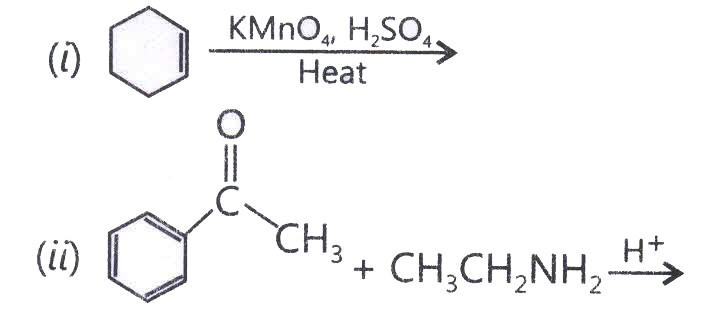
10.
(a) Define the terms osmosis and osmotic pressure. What is the advantage of using osmotic pressure as compared to other colligative properties for the solutes in solutions?
(b) A solution prepared from 1.25 g of oil of wintergreen ?(methyl salicylate) in 90.0 g of benzene has a boiling point of 80.31 oC. Determine the molar mass of this compound. (Boiling point of pure benzene = 80.10 oC and K b for benzene = 2.53 oC kg mol-1)
11.
(a) Define the terms osmosis and osmotic pressure. Is the osmotic pressure of a solution a colligative property? Explain.
(b) Calculate the boiling point of a solution prepared by adding 15.00 g of NaCl to 250.0 g of water.
(K b for water = 0.512 K kg mol-1, molar mass of NaCl = 58.44 g)
12.
Calculate the depression in the freezing point of water when 10 g of CH3CH2ChClCOOH is added to 250 g of water. Ka = 1.4\(\times\)10-3 Kf = 1.86 K kg mol-1.
13.
Calculate the mole fraction of ethylene glycol (C2H6O2) in a solution containing 20% of C2H6O2 by mass.
14.
What happens when:
(i) An aqueous solution of sodium acetate is electrolysed?
(ii) Calcium acetate is dry distilled?
(iii) Sodium benzoate is heated with soda lime?
15.
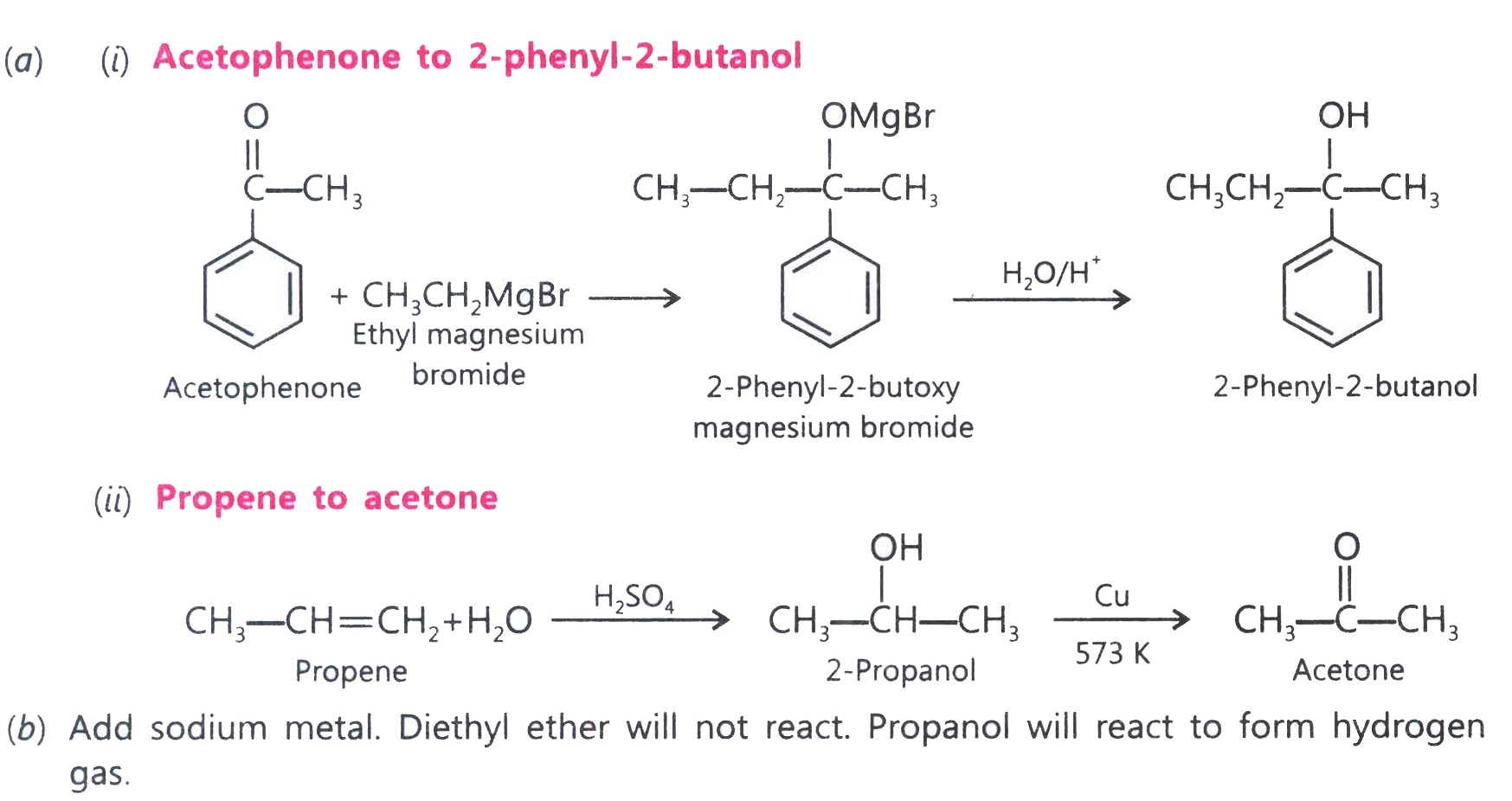
(a) Write the step and conditions involved in the following conversions:
(i) Acetophenone to 2-phenyl-2-butanol
(ii) Propene to acetone
(b) Describe simple chemical tests to distinguish between the following pairs of compounds:
Diethyl ether and Propanol
16.
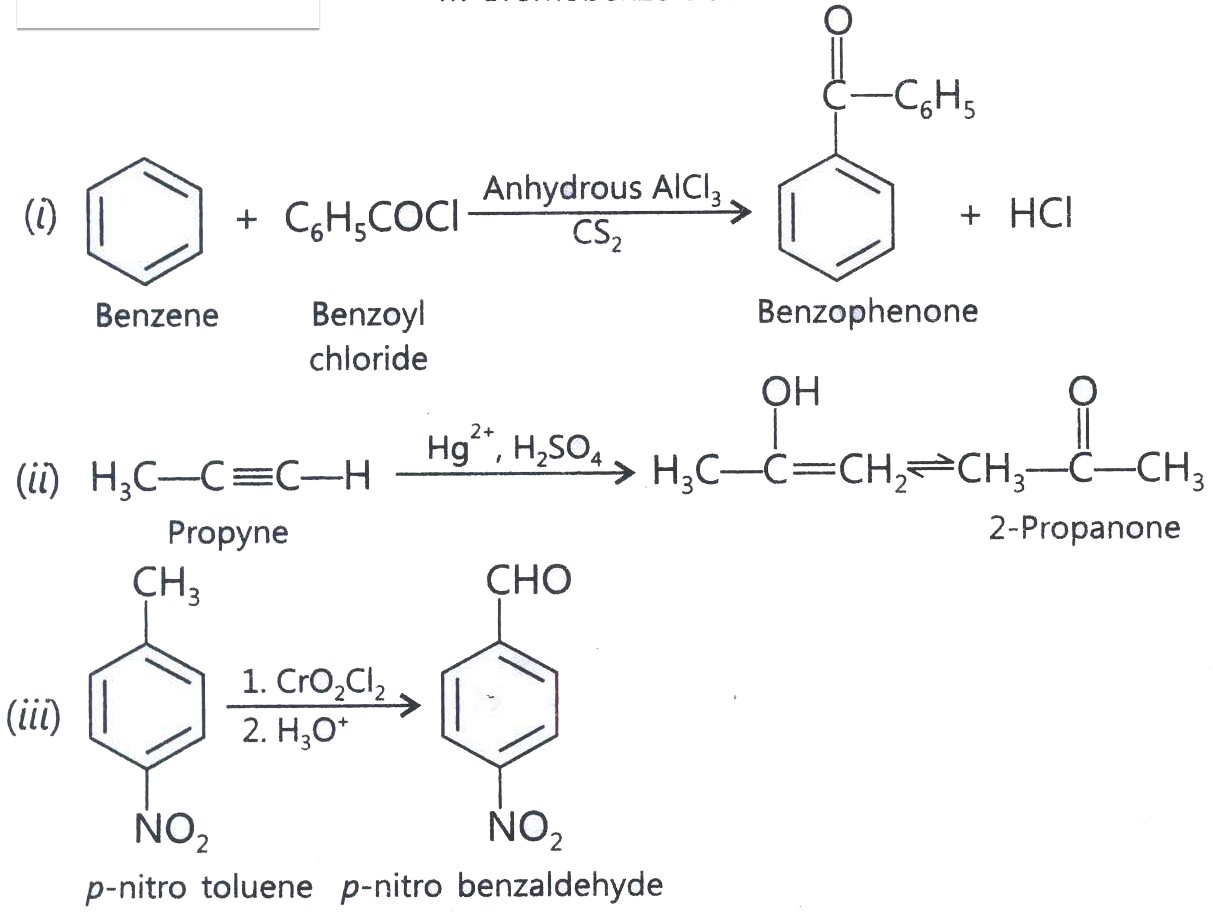
Write the structures of the main products of following reactions:
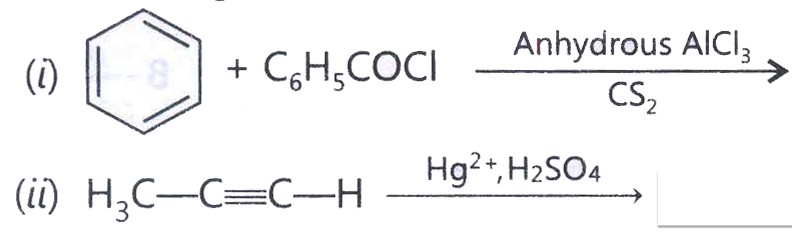
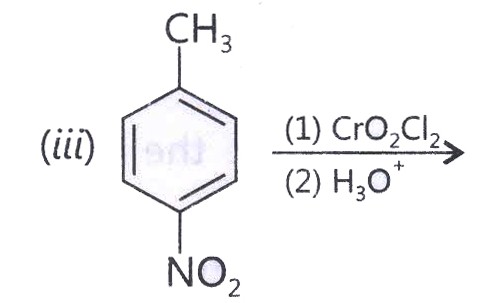
17.
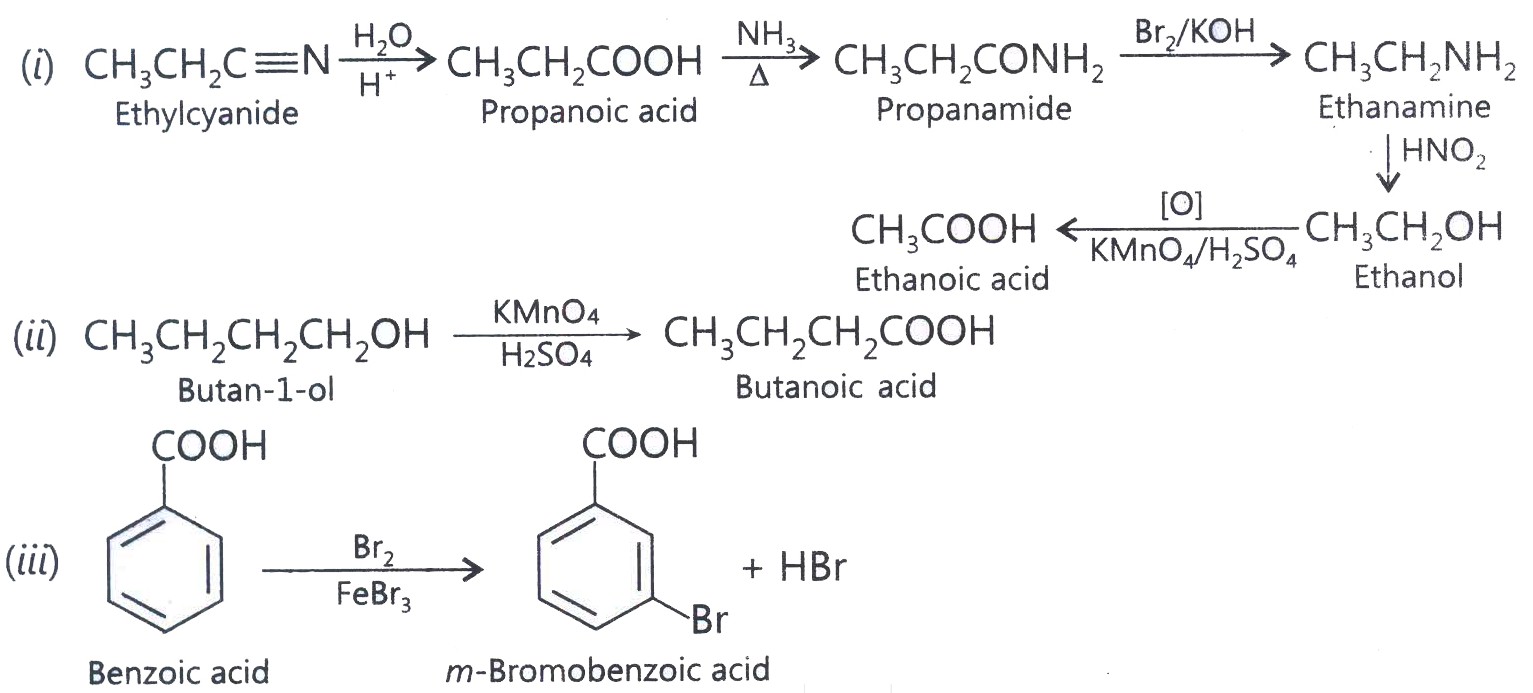
How are the following conversions carried out?
(i) Ethylcyanide to ethanoic acid
(ii) Butan-1-ol to butanoic acid
(iii) Benzoic acid to m-bromobenzoic acid.
18.
A solution of sucrose (Mol. Wt. 342) is prepared by dissolving 68.4 g of it per litre of solution. What is osmotic pressure at 300 K? (R = 0.0821 L atm K-1 mol-1)
19.
What mass of ethylene glycol (molar mass = 62.0 g mol-1) must be added to 5.50 kg of water to lower the freezing point of water from 0oC to -10oC? (Kf for water = 1.86 K kg mol-1)
20.
Determine the amount of CaCl2 (i = 2.47) dissolved in 2.5 litre of water such that its osmotic pressure is 0.75 atm at 27oC.
21.
Calculate the amount of benzoic acid (C6H5COOH) required for preparing 250 ml of 0.15 M solution in methanol.
22.
A compound (A) with molecular formula C5H10O,forms a phenyl hydrazone and gives negative Tollen's and iodoform tests. The compound on reduction gives n-pentane. The compound (A) is
pentan-3-one
pentanal
pentanol
pentan-2-one
23.
Which of the following is most reactive in nucleophilic addition reactions?
HCHO
CH3CHO
CH3COCH3
CH3COC2H5
24.
The product formed by the reaction of an aldehyde with a primary amine is
Carboxylic acid
Aromatic acid
Schiff's base
Ketone
25.
Reduction of aldehydes and ketones into hydrocarbons using zinc amalgam and conc. HCI is called:
Cope reduction
Dow reduction
Wolff Kishner reduction
Clemensen reduction
26.
What is the by-product formed in this reaction

NaHCO3
CO2
Na2HCO3
Na2CO3
27.
Which of the following is the strongest acid?
CH3COOH
CICH2COOH
Cl2HCOOH
CI3C-COOH
28.
0.6 mL of acetic acid is dissolved in 1 litre of water. The value of van't Hoff factor is 1.04. What will be the degree of dissociation of the acetic acid ?
0.01
0.02
0.03
0.04
29.
An aqueous solution of urea is found to boil at 100.52oC. Give Kb for water is 0.52 K kg mol-1 , the mole fraction of urea in the solution is
1
0.5
0.018
0.25
30.
Which of them is not equal to zero for an ideal solution ?
\({ \Delta V }_{ mix }\)
\(\Delta P={ P }_{ observed }-{ P }_{ Raoult }\)
\({ \Delta H }_{ mix }\)
\({ \Delta S }_{ mix }\)
31.
The molarity of 900 g of water is
50 M
55.5 M
5 M
cannot be calculated
32.
Which of the following units is useful in relating concentration of solution with its vapour pressure ?
mole fraction
parts per million
mass percentage
molality
33.
Increasing the temperature of an aqueous solution will cause
Decrease in molality
decrease in molarity
decrease in mole fraction
decrease in % w/w
34.
In the following questions. an Assertion (A) is followed by a corresponding Reason (R) Use the following keys to choose the appropriate answer.
Assertion (A) Carboxylic acids have higher boiling liquids than aldehydes, ketones and even alcohols of comparable molecular masses.
Reason (R) More extensive association of carboxylic acid molecules through intermolecular hydrogen bonding is responsible for the high boiling point of carboxylic acid.
Codes:
(a) Both (A) and (R) are correct, (R) is the correct explanation of (A).
(b) Both (A) and (R) are correct, (R) is not the correct explanation of (A). .
(c) (A) is correct; (R) is incorrect.
(d) (A) is incorrect; (R) is correct.
35.
In the following questions. an Assertion (A) is followed by a corresponding Reason (R) Use the following keys to choose the appropriate answer.
Assertion (A) IUPAC name of  is butane-dioic acid.
Reason (R) In compounds containing more than one carboxyl group, '-e' of the alkane is retained, and prefix 'di' is added to the term-'oic'.
Codes:
(a) Both (A) and (R) are correct, (R) is the correct explanation of (A).
(b) Both (A) and (R) are correct, (R) is not the correct explanation of (A). .
(c) (A) is correct; (R) is incorrect.
(d) (A) is incorrect; (R) is correct.
36.
In the following questions. an Assertion (A) is followed by a corresponding Reason (R) Use the following keys to choose the appropriate answer.
Assertion (A) Ethanol and acetone show positive deviation from Raoult's law.
Reason (R) Pure ethanol molecule show hydrogen bond and on adding acetone hydrogen bond between ethanol molecules breaks
(a) Both (A) and (R) are correct, (R) is the correct explanation of (A).
(b) Both (A) and (R) are correct, (R) is not the correct explanation of (A).
(c) (A) is correct; (R) is incorrect.
(d) (A) is incorrect; (R) is correct.
37.
In the following questions. an Assertion (A) is followed by a corresponding Reason (R) Use the following keys to choose the appropriate answer.
Assertion (A) Polar solute dissolves in polar solvents and non-polar solute dissolves in non-polar solvents.
Reason (R) Like dissolves like.
(a) Both (A) and (R) are correct, (R) is the correct explanation of (A).
(b) Both (A) and (R) are correct, (R) is not the correct explanation of (A).
(c) (A) is correct; (R) is incorrect.
(d) (A) is incorrect; (R) is correct.
38.
39.
Read the passage given below and answer the following questions :
Carboxylic acids dissociate in water to give carboxylate ion and hydronium ion.
RCOOH + H2O \(\longrightarrow\) RCOO- + H3O+
The acidity of carboxyl group is due to the presence of positive charge on oxygen which liberates proton. The carboxylate ion formed is resonance stabilised.

Carboxylic acids are stronger acids than phenols. Electron withdrawing groups (EWG) increase the acidity of carboxylic acids by stabilising the conjugate base through delocalisation of negative charge by inductive and/ or resonance effects. Electron donating group (EDG) decrease the acidity by destabilising the conjugate base.
The following questions are multiple choice questions. Choose the most appropriate answer :
(i) Which of the following reactions is showing the acidic property of carboxylic acid?

(ii) Which one of the following is the correct order of acidic strength?
| (a) CF3COOH > CHCl2COOH > HCOOH > C6H5CH2COOH > CH3COOH |
| (b) CH3COOH > HCOOH > CF3COOH > CHCl2COOH > C6H5CH2COOH |
| (c) HCOOH > C6H5CH2COOH > CF3COOH > CHCl2COOH > CH3COOH |
| (d) CF3COOH > CH3COOH > HCOOH > CHCl2COOH > C6H5CH2COOH |
(iii) Which of the following acids has the smallest dissociation constant?
| (a) CH3CHFCOOH | (b) FCH2CH2COOH |
| (c) BrCH2CH2COOH | (d) CH3CHBrCOOH |
(iv) The correct order of acidity for the following compounds is
| (a) I > II > III > IV | (b) III > I > II > IV |
| (c) III> IV > II> I | (d) I > III > IV > II |
1.
\(\underset { Acetylene }{ { HC }{ = }{ CH } } \overset { dill.{ H }_{ 2 }{ SO }_{ 4 },Hg{ SO }_{ 4 } }{ \underset { (Addtion\ of{ H }_{ 2 }O }{ \longrightarrow } } \underset { Vinyl alcocol\\ (unstable) }{ [{ H }_{ 2 }C=CHOH } \overset { tautomerises }{ \longrightarrow } \underset { Acetaldehyde(A) }{ { CH }_{ 3 }{ - }{ CHO } }\overset { dill.NaOH }{ \underset { (Aldol\quad condensation) }{ \longrightarrow } }\)
\( \underset { \beta -Hydroxybutyradehyde(B)\ (An\ aldol) }{ { CH }_{ 3 }{ - }{ CHO }H-{ CH }_{ 2 }-CHO } \overset { Heat }{ \underset { Dehydration\quad (-{ H }_{ 2 }{ O }) }{ \longrightarrow } } \underset { But-2-en-1-al }{ { CH }_{ 3 }{ - }{ CH }=H-CHO } \)
2.
Molar mass of C2H4O2: 12 × 2 + 1 × 4 + 16 × 2 = 60 g mol-1
\(\text {Moles of } \mathrm{C}_{2} \mathrm{H}_{4} \mathrm{O}_{2}=\frac{2.5 \mathrm{~g}}{60 \mathrm{~g} \mathrm{~mol}^{-1}}=0.0417 \mathrm{~mol}\)
\(\text {Mass of benzene in } \mathrm{kg}=75 \mathrm{~g} / 1000 \mathrm{~g} \mathrm{~kg}^{-1}=75 \times 10^{-3} \mathrm{~kg}\)
\(\text {Molality of } \mathrm{C}_{2} \mathrm{H}_{4} \mathrm{O}_{2}=\frac{\text { Moles of } \mathrm{C}_{2} \mathrm{H}_{4} \mathrm{O}_{2}}{\text { kg of benzene }}=\frac{0.0417 \mathrm{~mol} \times 1000 \mathrm{~g} \mathrm{~kg}^{-1}}{75 \mathrm{~g}}\)
= 0.556 mol kg-1
3.
Yes, it is similar to Friedal Crafts reaction.
4.
HCOOH < CICH2COOH < CCl3COOH < CF3COOH.
5.
Henry's Law: It states that the partial vapour pressure of gas in vapour phase(g) is directly proportional to the mole fraction of the gas in the solution.
Applications of Henry's Law:
(i) To minimise the painful effects accompanying the decompression of deep sea divers, oxygen diluted with less soluble helium gas is used as breathing gas.
(ii) To increase the solubility of CO2 in soft, drinks and soda water, the bottle is sealed under high pressure.
6.
\(\Delta T_{b}\) = Kb x m = 0.512 x 0.1 = 0.0512,
i = \(\frac{\text { observed } \Delta \mathrm{T}_{b}}{\text { normal } \Delta \mathrm{T}_{b}}=\frac{0.1536}{0.0512}=3\)
Solute undergoes dissociation in water. It is a strong electrolyte.
7.
(i) \({ CH }_{ 3 }-\overset { \begin{matrix} O \\ \parallel \end{matrix} }{ C } -{ CH }_{ 3 }\overset { LIAIH_{ 4 } }{ \underset { Reduction }{ \longrightarrow } } { CH }_{ 3 }-\overset { \begin{matrix} OH \\ | \end{matrix} }{ CH } -{ CH }_{ 3 }\\ Propanone\quad \quad \quad \quad \quad \quad \quad \quad \quad Propan-2-ol\)
(b)
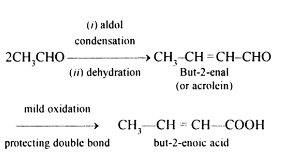
(c)
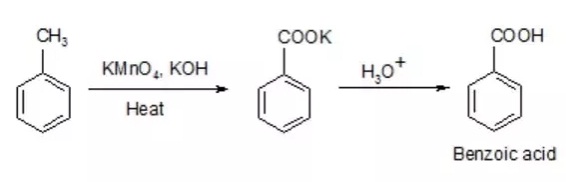
(ii) (a) Pentane -2-one gives yellow ppt of iodoform in Idoform test, while pentane-3 one does not give it.
\({ CH }_{ 3 }{ CH }_{ 2 }{ CH }_{ 2 }-\overset { \begin{matrix} O \\ \parallel \end{matrix} }{ C } -{ CH }_{ 3 }+3NaOI\longrightarrow { CH }_{ 3 }{ CH }_{ 2 }{ CH }_{ 2 }COONa+CHI_{ 3 }\downarrow +2NaOH\)
(yellow ppt)
(b) Ethanal will give iodoform test, while propanal will not give it.
\({ CH }_{ 3 }CHO+3NaOI\longrightarrow CH{ I }_{ 3 }\downarrow +HCOONa+2NaOH\)
(Yellow ppt)
8.
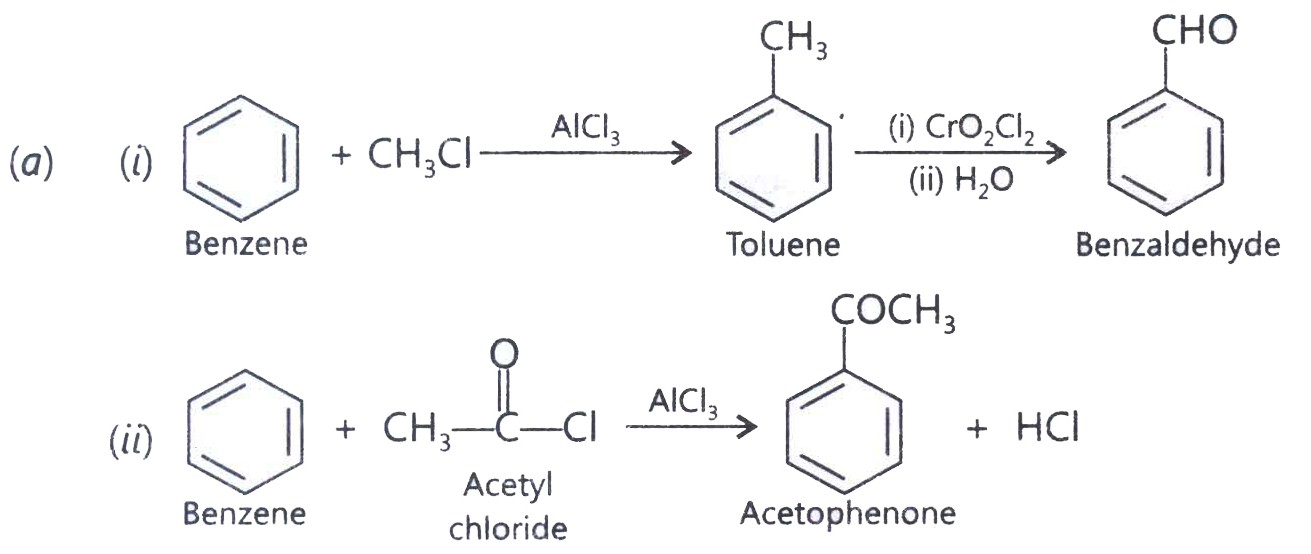
(b) (i) Ethanal and Propanal
Iodoform test – Methyl ketones give a positive iodoform test.
Ethanal has one methyl group linked to the carbonyl carbon atom and therefore, responds to this test.
Propanal does not respond to this test.
(ii) Benzaldehyde and Acetophenone
Tollen’s test – aldehydes give a positive Tollen’s test.
Benzaldehyde is an aldehyde. Therefore, it reduces Tollen’s reagent to give a reddish-brown precipitate.
Acetophenone is a ketone and therefore gives a negative test.
(iii) Phenol and Benzoic acid
Ferric chloride test – phenols give a violet coloration with this test.
Phenol reacts with neutral ferric chloride to form an iron-phenol complex, which gives a violet coloration.
Whereas, benzoic acid reacts with neutral ferric chloride to give a buff coloured precipitate of ferric benzoate.
9.
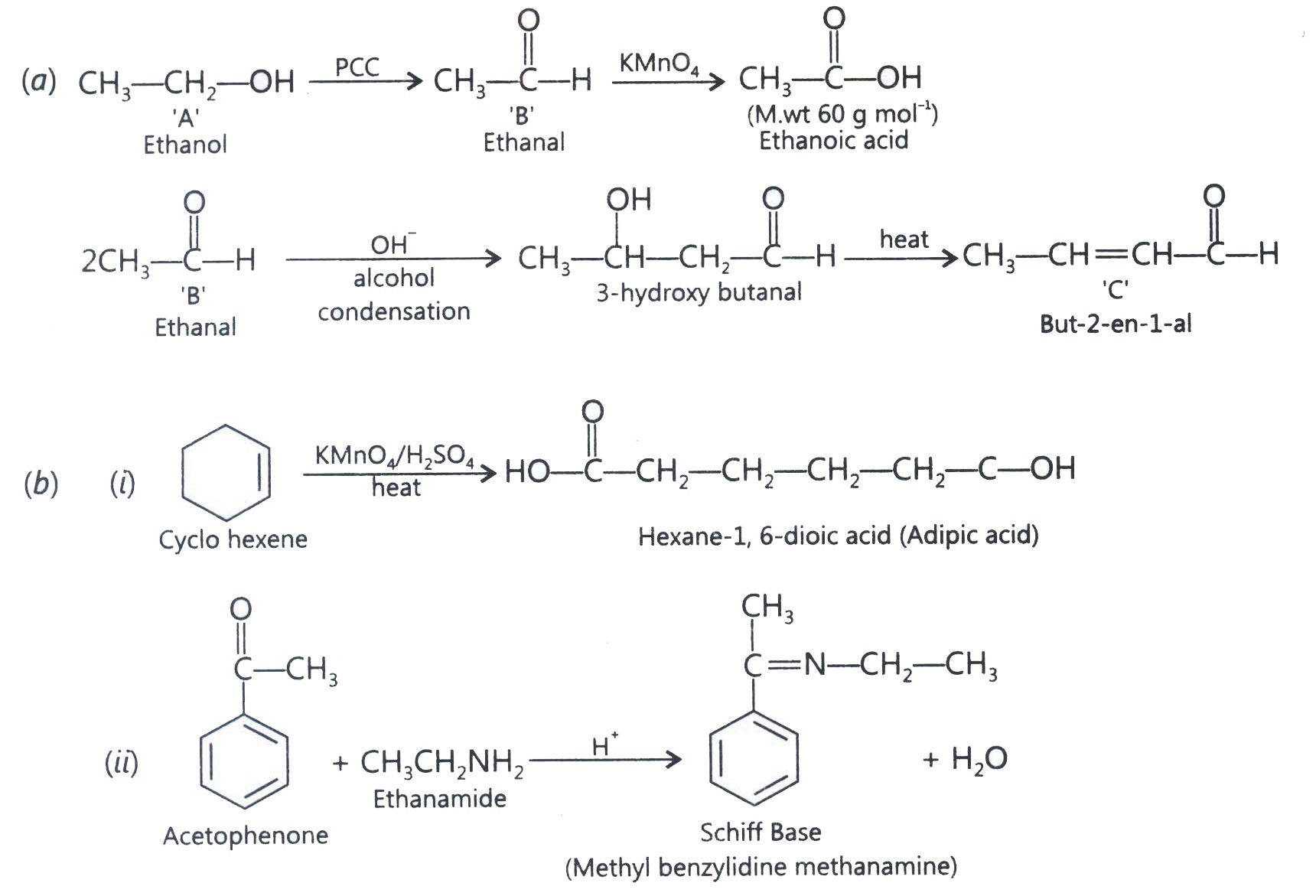
10.
(a) Osmosis: When a solution is separated from the solvent by a semi-permeable membrane which allows the passage of solvent molecules but does not allow solute particles to pass through it, there is net flow of solvent molecules from the solvent to the solution which is called osmosis.
Osmotic Pressure: Osmotic pressure may be defined as extra pressure that must be applied to the solution side to prevent the flow of solvent into solution through a semi-permeable membrane. Osmotic pressure is determined at room temperature and has appreciable value which can be easily measured
(b) WB = 1.25 g, WA = 90 g,
ΔTb = 80.31- 80.10 = 0.210C,
MB = ?, Kb = 2.530C kg rnol-1
\(\Rightarrow\ M_B={W_B\times 1000\over Δ T_b\times W_A}\times K_b\)
\(\Rightarrow\ M_B={1.25\times1000\over 0.21\times 90}\times2.53\)
\(M_B={3162.5\over 18.9}=167.328g\ mol^{-1}\)
11.
(a) Osmosis is the flow of solvent from solution of lower concentration to higher concentration through a semi-permeable membrane.
Osmotic pressure is the excess pressure which must be applied to a solution to prevent the passage of solvent through a semi-permeable memberane.
It has been found experimentally that for n moles of the solute dissolved in V litres of the solution, the osmotic pressure (π) at temperature T is
πV=nRT
Where R is a gas constant.
or \(\pi={n\over V}RT\)
= C RT
Where Cis the molar concentration ofthe solution.For a solution at given tempeature, both R and T are constant, so that
π ∝ C
Thus, osmotic pressure depends upon the molar concentration ofsolution and therefore, is a colligative property.
(b) \(ΔT_b={iK_b\times1000\times W_2\over W_1\times M_2}\)
NaCI dissociates as:
NaCI ⇾ Na+ + Cl-
i = 2
W2 = 1.5.0g, W1 = 250.0 g, M2 = 58.44 g mol-1 Kb = 0.512 K kg mol-1
\(\Delta T_b={2\times 0.512\times1000\times15.0\over 250.0\times58.44}\)
= 1.05 °C
Boiling point of solution = 100 + 1.05
= 101.5° C
12.
Molar mass of CH3CH2CHCICOOH
= 122.5 g mo-1
No. of moles of CH3CH2CHCICOOH present
\(=\frac{10}{122 \cdot 5}=8.16 \times 10^{-2} \mathrm{~mole}\)
\(\text { Molality }=\frac{8 \cdot 16 \times 10^{-2}}{250} \times 1000=0.3264 \mathrm{~m}\)
Let a be the degree of dissociation of CH3CH2CHCICOOH, then and C be the initial concentration of CH3CH2CHCICOOH
\(\mathrm{CH}_{3} \mathrm{CH}_{2} \mathrm{CHClCOOH} \rightleftharpoons \mathrm{CH}_{3} \mathrm{CH}_{2} \mathrm{CHClCOO}^{-}+\mathrm{H}^{+}\)
Initially 0 0
At Equilibrium C(1-\(\alpha\)) \(c\alpha\) \(c\alpha\)
\(\therefore K_{a}=\frac{C^{2} \alpha^{2}}{C(1-\alpha)}=\frac{C \alpha^{2}}{1-\alpha} \simeq C \alpha^{2}\)
\( \{\alpha \text { being very very small) }\\ \therefore K_{a}=C \alpha^{2} \)
\(\alpha=\sqrt{\frac{K_{a}}{C}}=\sqrt{\frac{1 \cdot 4 \times 10^{-3}}{0 \cdot 3264}}=0.065\)
13.
Assume that we have 100 g of solution (one can start with any amount of solution because the results obtained will be the same). Solution will contain 20 g of ethylene glycol and 80 g of water.
Molar mass of C2H6O2 = 12 x 2 + 1 × 6 + 16 × 2 = 62 g mol-1
\(\text {Moles of } \mathrm{C}_{2} \mathrm{H}_{6} \mathrm{O}_{2}=\frac{20 \mathrm{~g}}{62 \mathrm{~g} \mathrm{~mol}^{-1}}=0.322 \mathrm{~mol}\)
\(\text {Moles of water }=\frac{80 \mathrm{~g}}{18 \mathrm{~g} \mathrm{~mol}^{-1}}=4.444 \mathrm{~mol}\)
\(\mathrm{x}_{\text {glycol }}=\frac{\text { moles of } \mathrm{C}_{2} \mathrm{H}_{6} \mathrm{O}_{2}}{\text { moles of } \mathrm{C}_{2} \mathrm{H}_{6} \mathrm{O}_{2}+\text { moles of } \mathrm{H}_{2} \mathrm{O}}\)
\(=\frac{0.322 \mathrm{~mol}}{0.322 \mathrm{~mol}+4.444 \mathrm{~mol}}=0.068\)
\(\text {Similarly, } x_{\text {water }}=\frac{4.444 \mathrm{~mol}}{0.322 \mathrm{~mol}+4.444 \mathrm{~mol}}=0.932\)
Mole fraction of water can also be calculated as: 1- 0.068 = 0.932
14.
(i) \(2CH_{ 3 }COONa\overset { Electrolysis }{ \longrightarrow } 2CH_{ 3 }COO^{ - }+2Na^{ + }\)
At anode : \(2CH_{ 3 }COO^{ - }\longrightarrow \overset { CH_{ 3 } }{ \underset { CH_{ 3 } }{ | } } +2CO_{ 2 }+2e^{ - }\)
At Cathode : \(2H^++2e^-\rightarrow H_2(g)\)
(ii) \(_{ CH_{ 3 }COO }^{ CH_{ 3 }COO }{ _{ \diagup }^{ \diagdown }{ Ca } }\quad \overset { Dry }{ \underset { distillation }{ \longrightarrow } } \underset { Acetone }{ CH_{ 3 }COCH_{ 3 } } +CaCO_{ 3 }\)
(iii) \(\underset { Sodium\quad benzoate }{ C_{ 6 }H_{ 5 }COONa } +\underset { Soda\quad lime }{ NaOH(CaO) } \overset { \triangle }{ \longrightarrow } \underset { Benzene }{ C_{ 6 }H_{ 6 } } +\underset { sodium\\ carbonate }{ Na_{ 2 }CO_{ 3 } } \)
15.
16.
17.
18.
\(\pi V\)= nRT = \(\frac{{W}^{B}}{{M}^{B}}\times R \times T\)
\(\Rightarrow \) \(\pi \times1 = \frac{68.4}{342}\times0.0821 \times 300 K \)
\(\Rightarrow \) \(\pi =\frac{24.63}{5} = 4.92 \ atm\)
19.
Given, M2 (ethylene glycol) = 62 g mol-1
W1 = 5.50 kg = 5500 g. \(\Delta T_f\)= 10K
[00C - (- 10° C)= 10° C = 10 K]
and Kf = 1.86 K kg mol-1
\(\Delta T_f=\frac{K_f W_2 1000}{M_2W_1}\)
\(W_2=\frac{\Delta T_f M_2 W_1}{K_f 1000}\)
\(=\frac{10 K \times 62 g mol{-1}\times 5500 g}{1.86 K kg mol^{-1}\times 1000}\)
W3 = 1833.33 g = 1.833 kg
20.
\(\text { Using relation, } \pi=i C R T=i \frac{n}{V} R T\)
\(n=\frac{\pi V}{i R T}=\frac{0.75 \times 2 \cdot 5}{2 \cdot 47 \times 0 \cdot 0821 \times 300}=0.0308 \text { mole }\)
\( \text { Molar mass of } \mathrm{CaCl}_{2}=40+2 \times 35 \cdot 5=111 \mathrm{~g} \mathrm{~mol}^{-1} \)
\(\therefore \text { Amount of } \mathrm{CaCl}_{2} \text { dissolved }\)
\(=0.0308 \times 111=3.42 \mathrm{~g}\)
21.
\(Molarity \ (M)=\frac{\text { Mass of solute } / \text { molar mass }}{\text { Volume of solution in litres }} \\\)
M = 0.15 M = 0.15 mol L-1 ;
Molar mass of solute = 7 x 12 + 6 x 1 x 2 x 16 = 122 g mol-1;
Volume of solution = 250 mL = 0.25 L.
\(\left(0 \cdot 15 \mathrm{~mol} \mathrm{~L}^{-1}\right)=\frac{\text { Mass of solute }}{\left(122 \mathrm{~g} \mathrm{~mol}^{-1}\right) \times(0 \cdot 25 \mathrm{~L})}\)
Mass of solute = (0.15 mol L-1) x (122 g mol-1) x (0.25 L) = 4.575 g
22.
(a)
pentan-3-one
23.
(a)
HCHO
24.
(c)
Schiff's base
25.
(d)
Clemensen reduction
26.
(d)
Na2CO3
27.
(d)
CI3C-COOH
28.
(d)
0.04
29.
(c)
0.018
30.
(d)
\({ \Delta S }_{ mix }\)
31.
(b)
55.5 M
32.
\(\frac { { p }^{ o }-{ p }_{ s } }{ { p }^{ o } } ={ x }_{ 2 }\) (mole fraction of solute in solution) - Raoult's law.
33.
On increasing the temperature, volume of the solution increases. Hence Molarity decreases.
34.
(a) Carboxylic acids are higher boiling liquids than aldehydes, ketones and even alcohols of comparable molecular masses. This is due to more extensive association of carboxylic acid molecules through intermolecular hydrogen bonding. Hence, both (A) and (R) are correct and (R) is the correct explanation of (A).
35.
IUPAC name of is butane-dioic acid. For compounds containing more than one carboxyl group, the ending '-e' of the alkane is retained. The number of carboxyl groups are indicated by adding the multiplicative prefix, di, tri etc., to the term 'oic'. Thus both A and R is correct and R is the correct explanation of A.
36.
(a) Ethanol molecules show hydrogen bonding. On adding acetone, its molecules get in between the host molecule and break some of hydrogen bonds between them. Due to weakening of interaction, the mixture of ethanol and acetone shows the positive deviation from Raoult's law. Hence, both (A) and (R) are correct and (R) is the correct explanation of (A).
37.
(a) Polar solute formed interaction with polar solvent and non-polar solute gives interaction with non-polar solvent. Hence, both (A) and (R) are correct and (R) is the correct explanation of (A).
38.
39.
(i) (d): All the reactions are showing the acidic properties of carboxylic acid. Carboxylic acid forms the sodium salts with all i.e., alkali metals, NaOH and Na2CO3 etc. and removes the acidic proton from the carboxylic acid.
(ii) (a): In general, greater the +I effect of the group attached to the carboxyl group, lesser will be the acidic strength and greater the -I effect ofthe group, greater will be acidic strength. As number of halogen atoms and electronegativity of halogen atom increases, acidic strength increases. Thus, correct order of acidic strength is
CF3COOH> CHCl2COOH > HCOOH > C6H5CH2COOH > CH3COOH
(iii) (c) : Stronger -I group attached closer to - COOH makes the acid stronger, i.e., acid has the larger dissociation constant. - Br shows poor (-I) effect and also far away from -COOH group i.e., option (c) has smallest dissociation constant.
(iv) (a): Due to ortho-effect, (I) and (II) are stronger acids than (III) and (IV). Due to two ortho-hydroxyl groups in (I), it is stronger acid than (II). (III) is a stronger acid than (IV) because at m-position, -OH group cannot exert its +R effect but can only exert its -I effect while at p-position, -OH group exerts its strong +R effect. Thus, the correct order of acidity is : I > II > III > IV.

12th Standard CBSE Syllabus & Materials
12th Standard CBSE
CBSE 12th Computer Science Python Revision Tour I - New Previous year Question Papers Study Material - QB365 Set A
NEW12th Standard CBSE
CBSE 12th Business Studies Planning Important Questions And Answers Study Material - QB365 Set A
NEW12th Standard CBSE
CBSE 12th Business Studies Business Environment Important Questions And Answers Study Material - QB365 Set A
NEW12th Standard CBSE
CBSE 12th Business Studies Principles of Management Important Questions And Answers Study Material - QB365 Set A



NCERT Books

Syllabus

Exam Pattern

Sample Question Papers

Previous year Question Papers

Important Notes

MCQ Practice test

NCERT Exemplers

Case study Questions

Image Based Questions

Passage based Questions

HOT Questions

Value Based Questions

Model Questions Papers
NCERT ( Book Back ) Questions

Assertion and Reason
Important Questions And Answers

CBSE 12th Standard CBSE Subjects
CBSE Standards